
How to Optimize a Local Service Page for Search Intent and Conversions

Freelancer Tawhid
SEO Expert and Consultant
- October 14, 2026
- No Comments
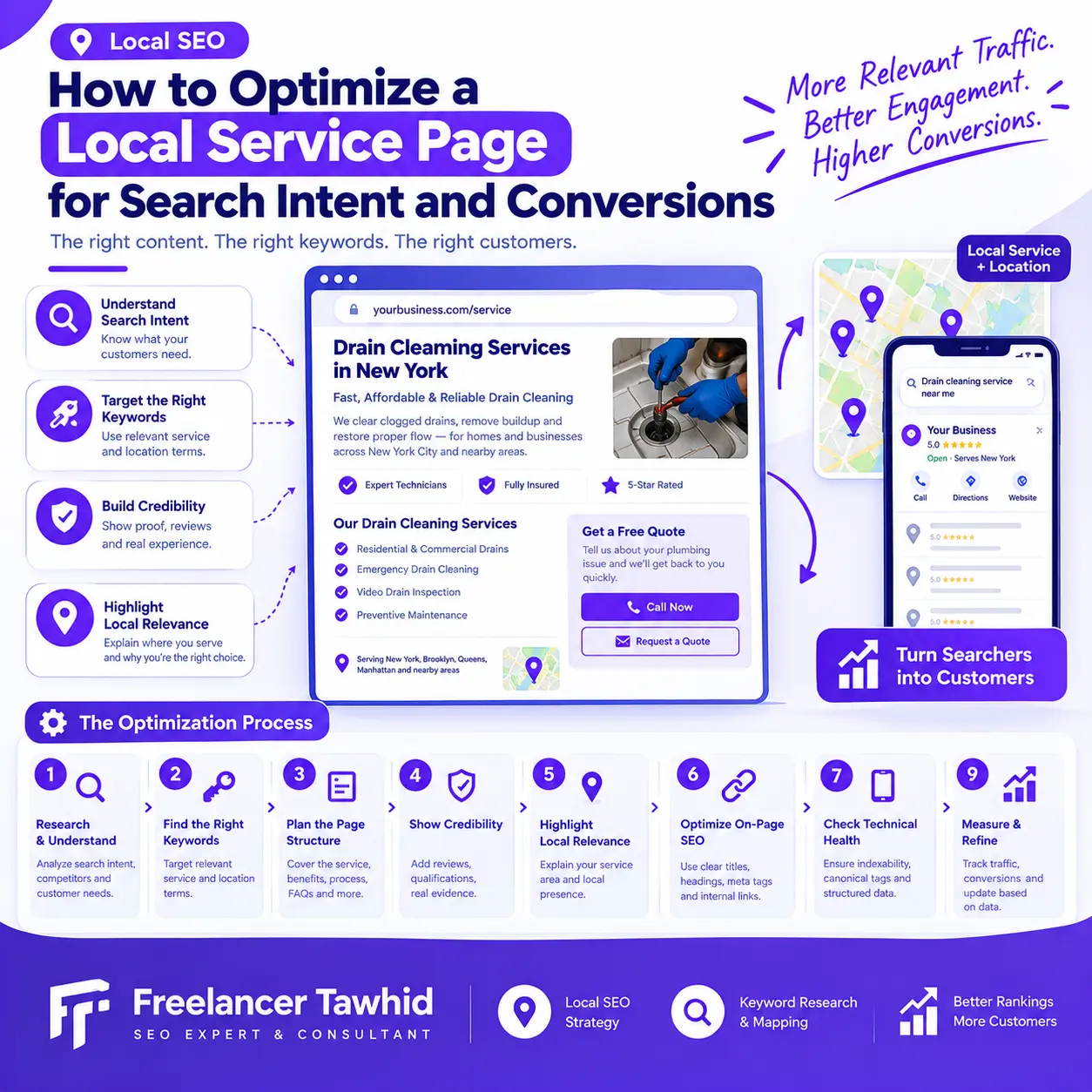
A well-optimized local service page helps potential customers understand what a business offers, whether the service meets their needs, and how to take the next step. To optimize a local service page, align its content with search intent, target relevant service keywords, demonstrate genuine credibility, explain geographic relevance, simplify the conversion process, and measure qualified enquiries alongside organic search performance.
However, adding keywords and a contact button is not enough. A page can attract visitors but fail to generate enquiries because it does not answer important questions, communicate the service clearly, or give potential customers a compelling reason to take action.
The goal is to create a page that serves both searchers and the business: relevant to the queries it targets, useful to people evaluating the service, and structured around a clear next step.
This guide explains how to research, improve, and measure a local service page without relying on keyword stuffing, repetitive location pages, or unsupported promises about rankings and conversions.
1. Understand What a Local Service Page Should Achieve
A local service page is a website page dedicated to explaining a particular service offered within a relevant geographic market. It helps potential customers understand the service, its suitability, the business providing it, and how to enquire or arrange the next step.
For example, a plumbing company might have separate pages explaining drain cleaning, emergency plumbing, and pipe installation if these services represent sufficiently distinct customer needs.
The purpose is not simply to mention every service the business offers. It is to give each important service query an appropriate destination.
How a local service page differs from other website pages
Different pages serve different purposes.
Page type | Primary purpose |
Homepage | Introduce the business and its main offerings. |
Service page | Explain a specific service, its scope, benefits, process, and suitability. |
Location page | Provide genuinely useful information about a particular business location or market when a dedicated page is justified. |
Blog post | Explain a topic, answer a question, or help readers research a problem. |
Google Business Profile | Represent an eligible business in Google’s local search ecosystem and communicate essential business information. |
These page types should support one another rather than compete for the same search intent.
A service page should generally target relevant commercial searches, while a supporting article may explain how a service works or help customers compare possible solutions.
A useful page architecture makes these relationships clear to visitors and search engines.
The three essential objectives
An effective local service page needs to accomplish three things.
Relevance: The content must reflect the service and the visitor’s underlying need.
Confidence: The page should provide enough detail, evidence, and transparency for visitors to evaluate the business.
Action: The page should make it easy to request a quote, call, book an appointment, or take another appropriate next step.
These objectives work together. Relevant traffic has limited business value when the page does not answer the visitor’s questions, and persuasive copy cannot compensate for attracting people who need a different service.
2. Understand Search Intent Before Optimizing the Page
Search intent is the likely purpose behind a search query. Understanding that purpose helps determine what information a page needs, which keywords it should target, and what action it should encourage.
Before changing headings or rewriting content, establish what the searcher expects to find.
Identify the primary service and the customer’s needs
Start by answering a few practical questions:
- What specific service does the business provide?
- Which customers are most likely to need it?
- What problem or desired outcome prompts someone to search?
- What concerns might prevent a potential customer from enquiring?
- Is the visitor exploring solutions, comparing providers, or ready to contact a business?
Consider someone searching for emergency plumbing services. That person may need availability information, the problems covered, a way to contact the business, and clarity about what happens next.
Someone searching for the causes of a blocked drain may instead want troubleshooting information.
Although the two searches concern the same general subject, they do not necessarily require the same page.
Analyze the search results for the target query
Review the current organic search results for the main service query and relevant variations.
Look at the types of pages Google displays and identify recurring patterns:
- Which service details appear prominently?
- What information helps customers compare providers?
- Are prices, estimates, availability, or service limitations addressed?
- What forms of proof do businesses provide?
- Which customer questions appear unanswered or poorly explained?
- What calls to action are commonly used?
The purpose is to understand the expectations associated with the query, not to copy competitors.
A competitor may rank with a short page because its brand, reputation, website, and search relevance differ from yours. Another business may need more explanation because its service is complex or unfamiliar.
Use competitor analysis to identify meaningful information gaps and opportunities to make your page more useful.
Match the page to the dominant search intent
Once the intent is clear, determine whether an existing page is the right destination.
A service page is generally appropriate for a distinct commercial service query. A supporting article may be more appropriate for an educational question. A dedicated location page may be justified when a genuine location-specific need exists and the page can provide meaningful value.
Avoid creating several pages that differ only slightly while targeting essentially the same need.
Google’s helpful, reliable, people-first content guidance emphasizes creating content that serves an intended audience rather than producing pages primarily to attract search traffic.
3. Research Keywords and Map Them to the Right Page
Once you understand the search intent, identify the search terms that best represent the service and the questions potential customers need answered.
The objective is not to collect the largest possible keyword list. It is to select relevant terms and assign them to appropriate pages.
Identify primary and supporting keywords
Start with the main service query, then explore closely related search themes.
For a hypothetical drain-cleaning business, relevant themes might include:
- Drain cleaning services
- Blocked drain removal
- Drain cleaning methods
- Signs that a drain needs professional attention
- Drain-cleaning service costs
- Emergency drain-cleaning availability
Not every phrase needs its own page. Several related queries may share the same search intent and be adequately addressed by one comprehensive service page.
Choose supporting keywords according to relevance, intent, business value, and the information customers need.
Use geographic keywords naturally
Geographic modifiers can help align a page with relevant local searches when the business actually serves the area.
Depending on the business model, these may include service-plus-location phrases, accurate service-area information, or references to a genuine business location.
However, geographic terms should support useful content rather than replace it.
Repeating a place name in every heading does not make a page more valuable. Likewise, claiming to operate in an area where the business does not genuinely provide the service creates misleading expectations.
Google explains that local search results are influenced primarily by relevance, distance, and prominence. Website optimization can contribute to a broader local strategy, but optimizing a service page does not guarantee a particular Google Maps or Local Pack position. See Google’s guidance on local ranking.
Map keyword groups to URLs
A simple keyword-to-page map helps reduce overlap and gives your website a clearer structure.
Query or topic | Appropriate destination |
Core commercial service query | Main service page |
A distinct supporting service | Separate service page when justified |
Genuine location-specific search need | Relevant location or service-area page, if useful |
Educational question about the service | Supporting blog post or resource |
Broad local search optimization needs | Main Local SEO service page |
For example, a page about drain cleaning should explain the service and help visitors enquire. An article about common reasons drains become blocked could link to that service page when professional help is relevant.
This approach helps each page serve a distinct purpose.
For deeper guidance on discovering search terms, classifying intent, and connecting keywords to the right URLs, see Local Keyword Research.
4. Structure the Page Around the Customer’s Decision
After determining the page’s intent and target keywords, organize the content around the information a potential customer needs before making contact.
There is no universal page template that suits every service. The structure should reflect the complexity of the offering, the customer’s concerns, and the information required to make a decision.
Write a clear, descriptive headline
Your main heading should immediately identify the service.
Where appropriate, include the relevant geographic context and explain the main benefit or purpose of the service.
For example, a hypothetical roofing business might use a heading such as:
Roof Repair Services for Residential Properties
A supporting introduction could explain the types of roofing problems the business handles, the properties it serves, and how customers can request an inspection.
The wording should accurately represent the service. Avoid vague headlines such as “Welcome to Our Website” or exaggerated claims that cannot be substantiated.
Explain exactly what the service includes
Visitors need to understand what they are considering before submitting an enquiry.
Describe the service’s scope and answer relevant questions about:
- The problems or needs the service addresses.
- The tasks included in the work.
- The typical process from initial contact to completion.
- What information the customer should provide.
- Any relevant limitations or exclusions.
- What determines the final price or project scope.
Specific explanations are more useful than general statements about quality, professionalism, or customer satisfaction.
For instance, rather than saying only that a business offers comprehensive drain services, explain which types of drain problems it handles and how the initial assessment works.
Do not imply that a business performs tasks, uses equipment, or provides guarantees unless those claims are accurate.
Explain who the service is suitable for
Help visitors determine whether the offering matches their situation.
Discuss relevant customer needs, typical use cases, service requirements, or factors that may make another solution more appropriate.
Where useful, explain the difference between a basic service and a more involved option.
This information can qualify enquiries by helping potential customers understand what the business does before contacting it.
Address pricing and buying concerns
Pricing is often an important part of the customer’s decision.
When appropriate, provide published prices, realistic starting prices, or an explanation of what affects the quote. If pricing depends on several variables, explain those variables clearly.
For example, a service estimate may depend on the amount of work required, property conditions, materials, project complexity, or travel requirements.
There is no requirement for every business to publish a fixed price. The important point is to be transparent about what can be disclosed and how customers can obtain an accurate estimate.
Use FAQs to resolve remaining uncertainty
Include questions that matter to prospective customers but are not fully answered in the main content.
Depending on the service, these might cover eligibility, preparation, timing, limitations, required information, or the steps that follow an enquiry.
FAQs should add meaningful information rather than repeat the page’s headings or introduce keyword variations solely for SEO.
5. Optimize the Page’s On-Page SEO Elements
The page’s content and structure should make its main subject clear to visitors and search engines.
Optimize the title tag and H1
Write a unique title tag that describes the service and accurately represents the page.
The H1 should communicate the page’s main subject. Supporting H2 and H3 headings should organize the service details, customer concerns, process, evidence, and next steps.
For example:
- Title tag: Roof Repair Services | Business Name
- H1: Roof Repair Services for Residential Properties
- H2: Roof Repair Services We Provide
- H2: How Our Roof Repair Process Works
- H2: Request a Roof Repair Estimate
These are illustrative examples, not mandatory title or heading formulas.
Google may generate title links using several page elements, so the submitted title tag is not guaranteed to appear exactly as written. Follow Google’s title-link best practices by keeping titles descriptive, distinct, and concise.
Write useful body content and a relevant meta description
The main content should explain the service in natural, specific language. Use related terminology where it helps communicate meaning and answer customer questions.
Avoid repeating the primary keyword in every paragraph or trying to satisfy an arbitrary keyword-density target.
The meta description should summarize the page’s main value and help searchers understand what they can expect if they click. Google may use the description or generate a different search snippet based on the query and page content.
Neither the meta description nor a particular keyword placement guarantees higher rankings.
Use images that genuinely improve understanding
Relevant visuals can help customers assess a service and understand the work involved.
Depending on the business, useful images may include completed projects, equipment, staff, examples of the work process, or visual explanations of common problems.
Use descriptive alternative text for meaningful images. For example, an image of a completed roof repair could use text that describes the visible work accurately.
Avoid keyword-stuffed alt text and do not label stock imagery as a real customer project.
Check indexability and canonical URLs
A useful page cannot attract organic search traffic if search engines cannot access or index it appropriately.
Check that the intended URL:
- Returns the expected response.
- Is not unintentionally blocked from crawling.
- Does not have an inappropriate noindex directive.
- Has the correct canonical URL.
- Is reachable through relevant internal links.
- Does not duplicate another page without a clear reason.
For technical checks, use Google Search Console’s URL Inspection tool and review any relevant indexing reports.
These checks are particularly important when redesigning a site, changing URLs, consolidating pages, or publishing a large number of service pages.
6. Demonstrate Genuine Local Relevance and Credibility
A local service page should explain why the business is relevant to the people and geographic market it serves. Geographic wording alone is not a substitute for genuine relevance.
Explain where the business operates
Provide accurate information about the service area, physical location, or geographic availability as appropriate to the business.
A storefront with customers visiting its premises has different requirements from a service-area business that travels to customers.
The page should reflect the actual operating model. Do not invent addresses, claim nonexistent offices, or suggest that the business serves locations it cannot reasonably cover.
Demonstrate trust with verifiable evidence
Potential customers may need reassurance before they enquire, especially when the service involves significant expense, risk, or disruption.
Relevant evidence can include:
- Genuine customer testimonials or reviews.
- Real project photographs.
- Verifiable qualifications or licences where applicable.
- Accurate information about the business and its team.
- Documented service standards.
- Genuine case studies explaining the work performed.
- Clear policies, limitations, and expectations.
Only include evidence that the business can substantiate. Do not manufacture testimonials, certifications, customer results, or claims of being the leading provider.
A specific, verifiable explanation of the service is generally more useful than an unsupported statement that the business is the best.
Keep business information accurate
Where applicable, ensure the service page aligns with the wider business presence, including relevant contact details, service information, and Google Business Profile details.
Google Business Profile is useful for eligible businesses, but it does not replace the need for a helpful website.
Also, do not confuse website relevance with local map rankings. Google describes relevance, distance, and prominence as the primary factors involved in local results. A well-optimized service page can contribute to the wider strategy, but no single website change controls all those factors.
Learn from practical implementation without overstating results
A useful example comes from my published Local SEO case study for a Canada-based drain and plumbing business.
The project involved location targeting, website structure, on-page SEO, content optimization, internal linking, Google Business Profile optimization, off-page work, and performance monitoring.
The case study illustrates why local search improvements often require several connected parts of a website and its wider search presence to work together. Because multiple activities were implemented, the overall reported outcomes should not be attributed to a single service-page change.
That distinction matters when evaluating SEO performance: document what was changed, identify what the data shows, and avoid claiming causation that the evidence cannot establish.
7. Improve the Conversion Experience
A service page should do more than attract relevant visitors. It should help those visitors take the next appropriate step.
Conversion optimization means identifying and reducing the obstacles between a visitor’s need and a useful action.
Choose a clear primary call to action
Select the action that best fits the service and the visitor’s likely readiness.
Examples include:
- Request a quote.
- Call the business.
- Book an appointment.
- Arrange an inspection.
- Submit a project enquiry.
Use clear wording that tells visitors what will happen next. A specific invitation such as “Request a Roof Repair Estimate” communicates more than a vague button labeled “Click Here.”
The primary CTA should be easy to find, but it should not overwhelm the page or interrupt every section.
Make contact forms easy to complete
Review the information requested and remove fields that are not needed at the initial enquiry stage.
A form might ask for a name, contact method, brief description of the problem, and relevant project information. The appropriate fields depend on how the business qualifies and handles enquiries.
Also check that forms work on mobile devices, validation messages are understandable, and visitors receive a clear confirmation after successful submission.
Shorter forms can reduce effort, but a longer form may be appropriate when the service requires detailed qualification. The objective is to strike a sensible balance between usability and lead quality.
Address the concerns that prevent enquiries
Before submitting a form or making a call, visitors may wonder about price, availability, the process, service suitability, or what information they need to provide.
Answer these questions where they are most useful.
For example, explain whether an initial assessment is required, what determines an estimate, or what happens after an enquiry. Include relevant proof near the claims it supports rather than placing all trust information at the bottom of the page.
This reduces uncertainty without relying on artificial urgency, false scarcity, or unsupported guarantees.
Make the mobile experience practical
Check how the page works on a smaller screen.
The service, main message, and CTA should be easy to identify. Text should be readable, buttons should be usable, and forms should not require unnecessary effort.
For businesses that rely on phone enquiries, make the telephone contact option easy to use. For appointment-led services, ensure the booking process is straightforward.
A page that looks polished on a desktop but makes contacting the business difficult on mobile may be failing an important part of the customer journey.
8. Use Internal Links to Support the Service Page
Internal links connect related pages and help visitors move through a website naturally.
They can also help search engines discover pages and understand relationships between topics. Google’s link best practices recommend crawlable links and descriptive anchor text.
Link to relevant service and supporting pages
A service page may link to its parent service category, complementary services, relevant educational content, or genuine case studies.
For example, a page explaining a specific local service could link to a supporting article that answers a common customer question. A visitor who needs broader assistance with local visibility could then explore the relevant Local SEO offering.
On my website, the Local SEO service page explains how website optimization fits into a wider local search strategy. It is a relevant resource for understanding how service pages, keyword research, location-based content, and other local search activities work together.
Use each link where it helps the reader. Do not add links to every service simply because those pages exist.
Use descriptive, natural anchor text
The visible text of an internal link should make its destination understandable.
For example, “learn more about local keyword research” is clearer than repeatedly using “click here.” However, descriptive anchor text should still sound natural and fit the sentence.
Avoid forcing the exact same keyword into every internal link. The surrounding context matters, and links should help people navigate rather than make the content feel over-optimized.
Avoid competing pages and unnecessary duplication
Before creating a new URL, check whether an existing page already addresses the same service and search intent.
If two pages overlap substantially, assess whether their roles can be clarified, their content differentiated, or the pages consolidated.
Google’s spam policies identify doorway abuse as a concern, including substantially similar pages created to rank for closely related searches while offering little distinct value.
For location-specific content, a dedicated page should provide useful information relevant to that location rather than merely swapping one place name for another.
9. Check Technical Accessibility and Structured Data
Even a relevant, well-written page needs a sound technical foundation.
Review the basics
Check that the page loads correctly, functions across common devices, contains crawlable links, and can be indexed when intended.
Review broken links, redirect behavior, duplicate URLs, mobile usability, and loading performance where relevant.
Tools such as Google Search Console, PageSpeed Insights, and browser testing can help identify issues. Treat individual tool scores as diagnostic information, not as a complete measure of content quality or business performance.
Use structured data when it accurately describes the page
Structured data can help search engines interpret eligible content and may support particular search appearances.
For a blog article, appropriate Article structured data may be worth considering. For a genuine local business, relevant business structured data may be appropriate on suitable pages.
Choose markup based on the page’s actual content and the applicable requirements. Do not add unrelated schema types or assume that structured data alone will improve rankings.
Google’s structured-data documentation explains the supported features and their requirements. Correct implementation does not guarantee a rich result.
The same principle applies to AI-assisted search. Google’s guide to optimizing for generative AI features says foundational SEO practices remain relevant and emphasizes valuable, useful content. It does not require a special writing formula, artificial content chunking, or a particular word count for AI visibility.
10. Measure Search Performance and Qualified Conversions
Optimization should be evaluated against the page’s actual objectives.
Search visibility, clicks, enquiries, and qualified leads measure different stages of the customer journey. Improvements in one area do not automatically establish improvements in every other area.
Establish a baseline before making changes
Record the data available for the page, including:
- Search impressions and clicks.
- Relevant search queries.
- Organic click-through rate.
- Landing-page visits.
- Completed form submissions, calls, or bookings.
- Qualified enquiries, where tracking permits.
- Existing technical or content problems.
Use a consistent measurement period and document major changes made to the page.
Calculate conversion rate using a consistent definition
A basic conversion-rate formula is:
Conversion rate = (Completed conversions ÷ Eligible visits or sessions) × 100
Suppose a page receives 400 eligible sessions and generates 12 completed enquiries during the same period.
Its session-based enquiry conversion rate would be:
(12 ÷ 400) × 100 = 3%
This is an illustrative calculation, not an industry benchmark or an expected result.
The definition matters. A form submission, a qualified lead, a booked appointment, and a completed sale are different outcomes. Decide which one the business needs to measure and keep the denominator consistent with the chosen rate.
Google Search Console can help evaluate search impressions, clicks, queries, and other search-performance data. Analytics tools, call tracking, and a CRM may help measure what happens after visitors arrive, depending on the available setup.
Diagnose the problem before changing the page
Use observed performance to determine which part of the journey needs attention.
Observed issue | What to investigate |
Few impressions for relevant queries | Indexability, keyword targeting, page relevance, competition, and content gaps. |
Impressions but few clicks | Search snippet, title relevance, and alignment with the query. |
Relevant traffic but few enquiries | Service clarity, trust, CTA placement, contact options, and user experience. |
Visitors start but do not complete a form | Form friction, mobile usability, errors, and unnecessary requirements. |
Many enquiries but poor lead quality | Query intent, service scope, positioning, and qualification. |
Enquiries improve but search traffic remains low | Search visibility, demand, indexability, competition, and the separate SEO opportunities. |
These are starting points for investigation, not guaranteed diagnoses. Several issues can exist at the same time.
Prioritize and test improvements
Not every possible change deserves immediate attention.
Prioritize based on four considerations: likely business value, evidence supporting the diagnosis, implementation effort, and feasibility.
For example, a broken enquiry form deserves attention before rewriting a section that already answers its purpose well. Likewise, a page targeting the wrong search intent may need a strategic revision before small wording changes are worthwhile.
After implementation, monitor the relevant metrics and compare them with the baseline. Consider seasonality, changes in traffic, other SEO activities, and the time required to collect useful data.
Do not promise a fixed ranking timeline or assume that one edit caused every observed performance change.
11. Common Local Service Page Optimization Mistakes
Several mistakes can weaken an otherwise sensible optimization strategy.
Targeting keywords without understanding intent. A phrase may appear relevant but lead to the wrong kind of page if the searcher has a different goal.
Publishing generic service descriptions. Broad claims about quality and professionalism do not adequately explain what the service includes or why it suits the visitor.
Repeating geographic keywords unnaturally. Location terms should provide relevant context, not replace meaningful information.
Creating near-identical location pages. Pages that offer little distinct value may create duplication and can fall within Google’s doorway-abuse policy.
Combining distinct services into one confusing page. When services satisfy genuinely different needs, separate pages may be appropriate.
Adding unsupported trust claims. Fake testimonials, unverified credentials, and exaggerated promises can mislead potential customers.
Using vague or aggressive CTAs. Visitors need a clear, appropriate next step—not repeated sales prompts throughout the page.
Ignoring the mobile experience. Forms, buttons, and important service details must remain usable across devices.
Measuring traffic without business outcomes. More visits do not necessarily mean more qualified enquiries or customers.
Treating structured data or AI-search tactics as shortcuts. Neither markup nor special formatting can substitute for useful content, accessibility, and a clear purpose.
The solution is to return to the fundamentals: relevance, accurate information, a good user experience, and evidence-based improvement.
12. Local Service Page Optimization Checklist
Use this checklist when reviewing an existing page or preparing a new one.
Research and planning
- Identify the main service, intended customer, and primary search query.
- Review the search results to understand the dominant intent.
- Identify relevant supporting keyword themes.
- Map keyword groups to appropriate pages.
- Check for overlapping URLs and unnecessary duplication.
Content and on-page SEO
- Make the service and its purpose clear near the top.
- Explain scope, process, suitability, and limitations accurately.
- Address relevant pricing and purchasing questions.
- Use descriptive titles and a logical heading structure.
- Include genuine evidence of experience and credibility.
- Explain geographic relevance where appropriate.
- Add contextual internal links to useful related pages.
Conversion and usability
- Choose a clear primary CTA.
- Make forms and contact options easy to use.
- Remove unnecessary friction from the enquiry process.
- Check the mobile experience.
- Ensure important information is easy to find.
Technical checks and measurement
- Confirm the intended page can be crawled and indexed.
- Check canonical URLs and broken links.
- Validate appropriate structured data where applicable.
- Establish a performance baseline.
- Track enquiries and qualified leads where possible.
- Record changes and prioritize future improvements using evidence.
You do not need to change every element at once. Begin with the most important gap between what the searcher needs and what the page currently provides.
Frequently Asked Questions
1. How many words should a local service page have?
There is no fixed word count that makes a local service page effective. The page should contain enough useful information to explain the service, answer important customer questions, demonstrate credibility, and support the next step. Avoid adding unnecessary text simply to reach an arbitrary length or satisfy a keyword target.
2. Should every service area have its own service page?
No. A separate page makes sense when it addresses a distinct need and provides genuinely useful information about the service or location. Creating numerous near-identical pages by changing only place names offers little additional value and may constitute doorway abuse under Google’s spam policies.
3. Which keywords should appear on a local service page?
Start with the primary service query and add related terms that naturally reflect the service, customer needs, and relevant geographic context. Use suitable terminology in the title, headings, introduction, and main content where it helps communicate meaning. Avoid keyword-density formulas and unnecessary repetition.
4. What is a good conversion rate for a local service page?
There is no universal conversion rate that applies to every local service page. Performance depends on the service, visitor intent, traffic source, customer journey, and what counts as a conversion. Establish a consistent baseline and, where possible, measure qualified enquiries rather than relying only on total traffic or form submissions.
5. How long does it take to see results after optimizing a local service page?
There is no guaranteed timeframe. Search visibility depends on factors such as crawling, indexing, relevance, competition, and the website’s existing condition. Conversion changes may follow a different timeline depending on visitor volume and tracking quality. Record changes, monitor the appropriate metrics, and assess performance without assuming a fixed SEO schedule.
Conclusion: Build a Service Page That Serves Searchers and Customers
Optimizing a local service page requires more than choosing keywords, adding a location name, and placing a contact button on the page.
The strongest approach begins with search intent and connects it to useful service information, accurate geographic context, credible evidence, a clear conversion path, and measurable business outcomes.
Start by reviewing the page’s main purpose. Confirm that it targets the right query, answers the customer’s important questions, explains the service accurately, and makes the next step straightforward. Then address technical issues, internal links, and performance measurement where needed.
Finally, continue refining the page based on evidence. Search impressions and clicks can help reveal visibility problems, while enquiry and lead data can show whether the page is attracting the right people and helping them move forward.
Need Help Optimizing Your Local Service Pages?
If your website attracts visitors but generates few relevant enquiries, your service pages may need closer attention to search intent, content structure, keyword targeting, internal linking, or the conversion experience.
Explore Freelancer Tawhid’s Local On-Page SEO service for help improving service-page relevance and structure. For wider issues involving local search visibility, website targeting, and the overall strategy, visit the Local SEO service page.
The priority is to identify what is limiting your particular website, determine which improvements are justified, and build a practical plan around your business objectives—not rely on generic checklists or promises of guaranteed rankings.