
Online Reputation Management Pricing: What Affects Cost and What to Compare

Freelancer Tawhid
SEO Expert and Consultant
- October 16, 2026
- 0 comments
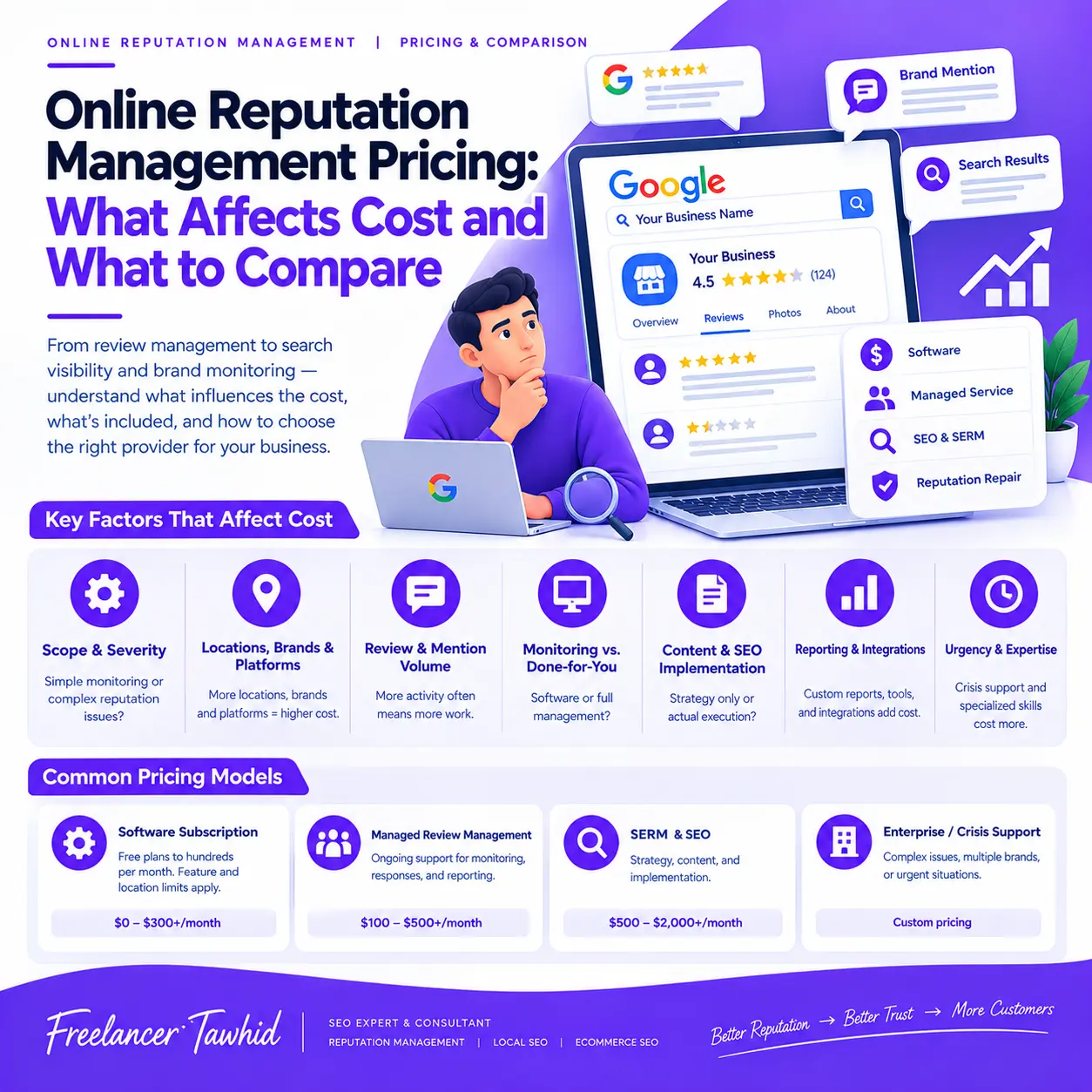
Online reputation management pricing depends on the type of service you need, the complexity of your reputation issues, the number of platforms or business locations involved, and how much work a provider performs. Basic software may cost little or nothing, while managed reputation services and complex reputation-repair projects can require substantially larger budgets. Understanding what each quote includes is essential before choosing a provider.
If you’re comparing reputation management companies, looking for review management software, or considering professional help with negative reviews and branded search results, the advertised monthly fee is only part of the decision.
This guide explains the main pricing models, the factors that influence costs, the differences between software and managed services, and how to compare proposals fairly. It also covers contract terms, realistic expectations, and warning signs to look for before committing to an engagement.
How Much Does Online Reputation Management Cost?
There is no single standard price for online reputation management (ORM) because providers sell different services under the same general label.
As a broad starting point, review-management software may be available through free plans or subscriptions costing tens to hundreds of dollars per month. More advanced platforms can cost considerably more, while professional reputation management, search engine reputation management, and crisis-related work are often priced according to the scope of the engagement.
For example, HiFiveStar’s published pricing page lists a free plan and paid software plans, including a Core plan advertised at $28 per month when billed annually. Its higher tiers offer additional features and location allowances. These figures describe one software vendor’s plans, not the cost of a complete managed reputation management service.
Other platforms use customized pricing based on business size, locations, and selected features. Birdeye’s pricing page asks prospective customers to provide business and location information to request pricing.
These examples demonstrate why pricing should be interpreted in context. A software subscription, a monthly service agreement, and a complex reputation-repair project are not directly comparable.
Indicative online reputation management pricing
Service type | Typical pricing approach | What to understand before buying |
DIY review-management software | Free plans or recurring subscriptions | You may need to manage responses, investigate complaints, and implement recommendations internally. |
Advanced reputation software | Higher-tier or custom subscription pricing | Additional locations, integrations, monitoring sources, analytics, and usage limits can affect the fee. |
Managed review management | Usually a recurring service fee, sometimes combined with software costs | Confirm who monitors reviews, writes responses, implements workflows, and prepares reports. |
Reputation management combined with SEO | Monthly retainer or customized scope | The fee may include content, optimization, technical work, or other SEO deliverables beyond reputation management. |
Search engine reputation management (SERM) | Project fee, retainer, or custom proposal | The work depends on the search results, existing content, competition, and required implementation. |
Enterprise or crisis reputation support | Customized project or retainer pricing | Specialist resources, urgency, stakeholder approvals, and communication requirements can increase the cost. |
These categories are a practical buying framework, not a verified industry-wide price survey. Actual prices vary by provider, market, service scope, billing terms, and complexity.
Why is there no single average ORM price?
The phrase online reputation management can describe anything from receiving alerts about new customer reviews to coordinating a complex response to widespread reputational damage.
A small business that needs help keeping up with incoming reviews has different requirements from a company that needs monitoring across dozens of locations, multilingual responses, executive reporting, or a strategy for improving branded search results.
Combining the costs of these different services into a single average would be misleading.
Rather than asking only whether a quote is expensive, ask whether it reflects the work necessary to solve your particular problem.
What does an advertised price actually include?
An advertised starting price might include access to a dashboard, review alerts, automated requests, and basic reporting. A managed package might also include professional oversight, response preparation, implementation, and recurring performance reviews.
Before comparing prices, separate four components:
- Software: The platform, features, user access, and integrations.
- Professional labor: Monitoring, analysis, writing, strategy, and execution.
- Additional expenses: External tools, integrations, content production, translation, or specialist support.
- Accountability: Reporting, agreed service levels, escalation procedures, and responsibility for completing the work.
A low subscription price can be appropriate when you have the internal resources to manage reputation activities. It may not be sufficient when you need a specialist to perform the work for you.
What Type of Reputation Management Are You Paying For?
Before evaluating cost, identify the service you actually need. Different types of reputation management solve different problems and require different resources.
Review monitoring and reputation management software
Review-management software helps businesses monitor feedback, receive notifications, organize reviews, analyze recurring themes, and sometimes automate or assist with review responses.
Pricing may depend on the number of locations, supported review platforms, user accounts, message allowances, integrations, and analytics features.
Some tools also include review-request workflows and response-drafting assistance. However, access to these features does not necessarily mean someone will investigate complaints, make operational improvements, or manage the reputation process on your behalf.
Software may be a sensible starting point when your team can consistently handle the work internally.
Managed review management
A managed review service involves professional support for some or all of the review-management process.
Depending on the agreement, the provider might monitor reviews, prepare responses, help establish compliant review-request workflows, escalate sensitive complaints, analyze customer feedback, and deliver regular reports.
The most important distinction is who performs each task.
For example, one provider might send an alert whenever a new review appears. Another might draft an appropriate response and send it to your team for approval. A more comprehensive arrangement might also include publishing approved responses and analyzing recurring customer concerns.
Those are different levels of service, even if both providers describe their offering as review management.
If you need help establishing a structured reputation-management process, explore Reputation Management Services by Freelancer Tawhid.
Search engine reputation management and online reputation repair
Search engine reputation management (SERM) focuses on what people encounter when searching for a brand, company, or individual.
The work may involve analyzing branded search results, understanding which pages are visible, improving relevant website content, strengthening appropriate search visibility, and addressing the underlying issues that influence how a brand appears online.
This is different from responding to customer reviews.
For example, a company may receive few negative reviews but discover that a misleading third-party page appears prominently for its brand name. That issue may require research, content strategy, and SEO implementation rather than a review-response subscription.
The cost depends on the actual problem, the work required, and the level of implementation included in the engagement.
No provider can legitimately guarantee that every negative result will be removed or that a particular search position will be achieved.
Enterprise and crisis reputation support
Some businesses face complex reputation issues involving multiple brands, high volumes of feedback, widespread public attention, or urgent communication requirements.
These situations may require specialized monitoring, senior-level oversight, coordination with public relations teams, multilingual support, or carefully defined escalation procedures.
Legal advice and crisis communications may also be necessary, depending on the situation. These services may fall outside an ordinary ORM contract and could require separate specialists.
The important point is that crisis support should not be used as the pricing benchmark for routine review management. The work and responsibilities are substantially different.
What Factors Affect Online Reputation Management Pricing?
The price of an ORM engagement generally reflects its scope, complexity, execution requirements, and duration. Understanding these factors will help you determine whether a quotation is appropriate for your business.
1. Scope and severity of the reputation problem
The amount and type of work required are among the most important cost considerations.
A business that needs a consistent process for monitoring incoming reviews may require a relatively straightforward setup. A business facing recurring complaints, suspicious reviews, or damaging branded search results may need deeper investigation and a more involved response.
The number of negative reviews alone does not determine the cost. Ten complicated complaints may require more attention than a much larger volume of routine feedback.
Start with a diagnosis of the problem before purchasing an extensive package.
2. Number of locations, brands, and platforms
Businesses operating multiple locations or brands often need more coordination than businesses managing a single profile.
Each additional location or brand may involve separate review sources, access permissions, response requirements, reporting, and internal approval workflows.
The number of platforms also matters. Monitoring Google reviews alone differs from monitoring feedback across several third-party platforms, industry-specific directories, and social channels.
Multilingual operations may introduce additional writing, moderation, and coordination requirements.
Ask whether the quotation covers every relevant location, brand, platform, and language, or whether those items incur extra fees.
3. Review and mention volume
Review volume affects the amount of monitoring, response preparation, escalation, and analysis required.
A business receiving a handful of reviews each month may be able to manage responses internally. A business receiving frequent feedback across several channels may need more automation, additional staff time, or a managed service.
Volume should not be assessed in isolation. Sensitive complaints, allegations requiring investigation, and complex customer issues can demand more attention than routine comments.
When comparing providers, ask whether the price has limits on the number of reviews, responses, locations, or monthly activities included.
4. Monitoring versus done-for-you execution
Monitoring and execution are not the same service.
A monitoring-only tool might notify you about a negative review. A managed provider could assess the issue, prepare an appropriate response, follow your approval process, and report the outcome.
Consider a hypothetical example involving two businesses.
Business A needs notifications and a shared dashboard because its staff can respond to reviews themselves.
Business B receives frequent reviews but lacks the time and internal processes to monitor and respond consistently.
Business A may need software access and a clear internal workflow. Business B may benefit from managed support that includes response preparation, escalation, and reporting.
Neither option is inherently better. The appropriate choice depends on internal capacity and the work that needs to be completed.
5. Content creation and SEO implementation
Broader reputation work may require more than review monitoring.
Depending on the diagnosis, the provider may need to improve existing website content, create useful brand-related pages, evaluate third-party search results, or implement relevant SEO improvements.
These activities involve different levels of research, writing, optimization, and technical execution.
Make sure the proposal distinguishes between recommendations and implementation. An engagement that supplies a strategy document is not equivalent to one that includes publishing content, making approved website changes, and monitoring the results.
If reputation issues overlap with local search visibility, Google Business Profile optimization or Google Maps SEO may also be relevant, depending on the problem.
6. Reporting, integrations, and service-level requirements
Reporting requirements can influence cost, particularly when a business needs customized dashboards, multiple data sources, recurring stakeholder meetings, or detailed analysis across brands.
Integrations with customer relationship management systems, booking platforms, or other business tools may also require setup and maintenance.
Response-time commitments matter too. An agreement requiring monitoring and escalation within defined time windows demands different resources from one that provides periodic reports.
Pay for reporting and integrations that support actual decisions. Additional features are not valuable merely because they appear on a longer feature list.
7. Urgency, specialist expertise, and external expenses
Urgent projects may require faster work, additional staffing, specialist analysis, or coordination among several parties.
Depending on the issue, expenses could include external monitoring tools, translation, content production, public relations assistance, or legal advice.
Not every ORM provider supplies these services directly. Ask which activities are included in the fee, which are subcontracted, and which require separate approval.
A transparent proposal should make these boundaries clear before work begins.
Which Reputation Management Pricing Models Should You Compare?
Once you understand the service scope, compare how the provider charges for it.
Monthly retainer
A monthly retainer is commonly used for ongoing activities such as review monitoring, response support, recurring analysis, and reporting.
It can be appropriate when the business needs continuing management rather than a one-time recommendation.
Before agreeing to a retainer, confirm the monthly deliverables, workload limits, reporting frequency, response arrangements, contract duration, renewal terms, and cancellation conditions.
A recurring fee should correspond to clearly defined responsibilities.
One-time audit or project fee
A project fee may be appropriate for a defined piece of work, such as an initial reputation assessment, a scoped investigation, or a strategy and implementation project.
The proposal should identify the deliverables, completion criteria, assumptions, exclusions, and whether any follow-up work is included.
A one-time fee is not automatically more economical than a retainer. If the underlying problem requires ongoing monitoring or repeated execution, a separate continuing arrangement may still be necessary.
Software subscription and per-location pricing
Software providers may charge according to feature tier, number of locations, users, integrations, usage allowances, or reporting functionality.
Compare the features you genuinely need with those you would pay for but rarely use.
For multi-location businesses, check whether each additional location increases the fee. For businesses with large review volumes, investigate any limits on messages, review requests, or automated actions.
Also check whether the displayed price requires annual billing. The monthly equivalent of an annual plan is not the same as a flexible month-to-month commitment.
Hourly consultation and custom enterprise pricing
Hourly consultation can be useful when you need expert guidance to identify the problem, prioritize work, or prepare a more precise brief before committing to a larger project.
Custom enterprise pricing may be appropriate for businesses requiring specialized monitoring, complex integrations, multiple brands, or defined service levels.
In either case, ask for a written scope, deliverables, responsibilities, payment terms, and reporting arrangements.
No pricing model is automatically superior. Select the one that fits your requirements and makes the provider accountable for the agreed work.
How Do You Compare Reputation Management Quotes Fairly?
The best way to compare quotations is to make sure each provider is responding to the same requirements.
A proposal with a lower monthly fee may cover only software and alerts, while a more expensive proposal includes monitoring, response preparation, implementation, and reporting. Comparing the totals without comparing the scope can lead to the wrong decision.
Compare the scope, deliverables, and responsibilities
Use the following table when reviewing proposals.
Comparison item | Questions to ask |
Coverage | Which brands, locations, platforms, and languages are included? |
Monitoring | Which sources are monitored, how frequently, and how are issues escalated? |
Review responses | Who drafts, approves, and publishes responses? |
Review requests | Is workflow setup included, and are the processes compliant with platform policies? |
SEO and content | Does the provider offer advice only, or is implementation included? |
Reporting | How often are reports provided, and which metrics are covered? |
Workload limits | Are there caps on reviews, responses, hours, or locations? |
Additional fees | Are onboarding, integrations, third-party tools, or extra work charged separately? |
Contract | What are the minimum term, renewal, cancellation, and exit conditions? |
Ownership | Who controls accounts, data, access permissions, and deliverables after the engagement ends? |
Do not choose the provider with the longest list of features simply because the offer looks comprehensive. Focus on whether the included work addresses your actual needs.
Calculate the real cost beyond the advertised price
The advertised monthly amount is only one part of the financial commitment.
Use this formula to estimate the first-year cost:
First-year cost = Setup fees + 12 months of recurring fees + Expected add-ons and usage charges + External expenses
For example, consider two entirely hypothetical proposals.
Cost component | Provider A | Provider B |
Setup fee | $300 | $0 |
Monthly fee | $150 | $220 |
Annual recurring fee | $1,800 | $2,640 |
First-year provider cost before extras | $2,100 | $2,640 |
Provider A has the lower first-year invoice cost in this example. However, suppose Provider A only supplies monitoring software, while Provider B includes agreed review-response work and recurring reporting.
The lower price does not necessarily represent better value. You must consider which responsibilities remain with your own team and whether the additional work included by Provider B is necessary.
These figures are illustrative, not actual provider quotations.
For a fair comparison, calculate both the expected first-year cost and the ongoing cost after onboarding. Where one proposal leaves significant work to your team, account for internal labor separately so the operational trade-off is clear.
Evaluate contract terms and account ownership
Before signing, review the minimum commitment, cancellation notice, automatic renewal, price-change provisions, account ownership, data access, and responsibilities at termination.
Confirm that you will retain appropriate access to your own business profiles and that the agreement explains what happens to reports, data, content, and other deliverables if the relationship ends.
Also establish how extra work is approved. Requests that fall outside the original scope should not lead to unexpected charges without clear agreement.
Questions to ask before signing an ORM agreement
Use these questions to make provider proposals more comparable:
- What work will you perform each month, and what remains our responsibility?
- What limits apply to locations, review platforms, responses, reporting, and working hours?
- Which setup fees, subscriptions, external costs, and overages are excluded?
- How will you report progress and decide whether the strategy needs to change?
- What happens if the agreed scope needs to change or we decide to end the engagement?
Request clear written answers rather than relying on general promises during a sales call.
How Should You Measure Value From Reputation Management?
Price should be evaluated against the work performed and the outcomes the engagement is intended to support.
Reputation management does not produce identical results for every business. Monitoring quality, response processes, review activity, customer feedback, and search visibility are different aspects of performance and should be measured appropriately.
Review-management and customer feedback metrics
Depending on the scope, useful measures may include:
- The proportion of eligible reviews receiving a response.
- Average or median response time.
- Review volume and changes in review activity.
- Recurring customer complaints and feedback themes.
- Completion of agreed review-monitoring and escalation workflows.
These measures can show whether the agreed work is being performed consistently.
However, an increase in review volume or average rating alone does not prove that a reputation management engagement has improved business performance.
Search visibility and business outcomes
For broader reputation and SEO projects, relevant measures may include branded-search visibility, engagement with important website pages, customer inquiries, and qualified conversions when suitable analytics are available.
The measures should match the goal. A project focused on improving the information visible for branded searches should not be evaluated exclusively through review-response time.
Similarly, changes in traffic or inquiries during an engagement should not automatically be attributed to the provider without considering other factors.
Establish a baseline and realistic evaluation period
Before work begins, document the current situation, the agreed scope, the available performance data, and the reporting schedule.
Some aspects of service delivery, such as monitoring coverage and completion of an audit, can be evaluated relatively early. Wider reputation improvements and changes in search visibility may require a longer observation period.
Evaluate delivery against agreed milestones and assess longer-term outcomes over a suitable period. Be cautious of providers promising fixed rankings, guaranteed removal of legitimate negative reviews, or guaranteed business results.
What Are the Red Flags in Reputation Management Pricing?
A credible reputation management proposal should explain what the provider can do, what the client must supply, which policies apply, and how progress will be evaluated.
Be cautious when an offer relies on unrealistic promises or avoids defining the actual work.
Guaranteed negative-review removal or ratings
Google does not remove reviews simply because a business disagrees with them or dislikes their impact.
According to Google’s review-removal guidance, reviews must violate applicable policies to be eligible for removal. Reporting a review does not guarantee that the platform will remove it.
A specialist can help identify suspected policy violations, organize relevant evidence, and guide a reporting process. The platform determines the outcome.
Treat promises of guaranteed removal, fixed star ratings, or guaranteed search positions as warning signs.
Fake reviews, review gating, and manipulative tactics
Purchased reviews, fabricated customer experiences, and selective practices designed to present only positive feedback can create policy and legal risks.
Google’s Maps user-contributed content policy prohibits fake engagement, including reviews that do not reflect genuine experiences and incentives offered in exchange for reviews or changes to reviews. Its guidance also explains that businesses should not selectively solicit positive reviews.
For businesses subject to United States law, the Federal Trade Commission’s Consumer Reviews and Testimonials Rule guidance explains restrictions on certain deceptive review and testimonial practices. The rule took effect on October 21, 2024. Other jurisdictions may have different legal requirements.
A legitimate service should help you build reliable processes for genuine feedback, respond appropriately to customers, and address review-policy violations when there is a valid basis to report them.
Unclear scope, hidden fees, and indefinite retainers
Be careful when proposals avoid specific deliverables or do not explain how ongoing work will be evaluated.
Warning signs include undefined monthly responsibilities, unexplained additional fees, unclear ownership arrangements, and reluctance to provide written cancellation terms.
A lower initial quote may be less attractive when substantial work is excluded or additional costs are difficult to predict.
Compare the provider’s transparency, relevance, execution responsibilities, and contract terms alongside the price.
How Do You Choose the Right Reputation Management Budget?
The right budget depends on the problem you need to solve and the resources available internally. Start by selecting the appropriate service category before deciding how much to spend.
Your situation | Appropriate starting point | Main consideration |
You receive occasional reviews and have time to respond | Internal review process or suitable software | Consistency, alerts, and staff time |
Review volume is growing and responses are becoming difficult to manage | Managed review-management support | Execution, escalation, and reporting |
Negative information is prominent in branded search results | A scoped SERM and SEO assessment | Diagnosis, implementation, and realistic expectations |
You manage many locations or brands | Multi-location software or structured managed support | Scalability, consistency, permissions, and reporting |
You face an urgent and complex reputational incident | Specialist support with a clearly defined scope | Relevant expertise, response arrangements, and escalation |
When is software enough?
Software may be sufficient when your team can monitor incoming reviews, respond consistently, analyze recurring problems, and maintain review-request processes.
It can also be a useful starting point when you want to establish a more organized process without outsourcing all execution.
Professional support becomes more relevant when your team lacks the time or expertise to manage the workload, several platforms need attention, or the underlying issue extends beyond routine review management.
When is a managed service worth considering?
Managed support may be appropriate when you need help establishing a strategy, carrying out recurring activities, coordinating responses, or analyzing broader reputation issues.
The decision should be based on the value of the work being performed and the internal resources it replaces or complements.
You can review Freelancer Tawhid’s reputation management services to understand the available service option and determine whether professional support aligns with your requirements.
When should you start with an audit or consultation?
If you are unsure what is causing a reputation problem, committing to a large ongoing package may be premature.
An initial assessment can help establish the scope, identify the immediate priorities, and separate routine review-management needs from broader search-result or SEO concerns.
This makes it easier to obtain a suitable proposal and decide which work should be completed first.
How to Prepare a Reputation Management Brief Before Requesting Quotes
A clear brief helps providers quote against the same requirements and makes their proposals easier to evaluate.
1. Document the current situation
List the brands, locations, review platforms, and search results relevant to the issue.
Describe the main problems, current monitoring and response processes, available performance data, and any existing tools or contracts. For a branded search concern, identify the queries and visible results that require assessment.
Avoid assuming the solution before the problem has been evaluated.
2. Define the work you need
Separate your requirements into categories such as monitoring, review responses, review-request workflow development, strategic advice, content creation, SEO implementation, and incident-specific support.
Identify who will provide information, approve responses, make website changes, and carry out recommendations.
This helps prevent misunderstandings about what the provider is expected to deliver.
3. Establish your budget and priorities
Set a realistic budget based on the problem, available internal resources, urgency, and expected workload.
Identify essential deliverables separately from optional features. Determine which performance indicators will help you evaluate service delivery and whether the engagement should be a one-time project or ongoing arrangement.
The goal is to obtain proposals that fit your needs, not simply to find the lowest headline price.
4. Use a consistent proposal scorecard
Evaluate every quotation against the same criteria:
- Scope clarity: Are the work and exclusions specific?
- Execution ownership: Who actually performs the tasks?
- Total cost: Are recurring, setup, usage, and external expenses clear?
- Reporting: Will the provider demonstrate what has been completed?
- Compliance: Are the methods consistent with relevant platform policies and applicable law?
- Contract flexibility: Are renewal, cancellation, data access, and ownership terms acceptable?
- Business fit: Does the proposal address your actual problem without unnecessary features?
You can keep this checklist in a spreadsheet or document and use it whenever you compare proposals. There is no need to assign arbitrary numerical weights unless your organization has a defined evaluation method.
Frequently Asked Questions About Reputation Management Pricing
Is reputation management software enough, or do I need a managed service?
Reputation management software may be sufficient when your team can consistently monitor reviews, respond to feedback, analyze recurring issues, and maintain review-request processes. A managed service is more suitable when you need professional oversight or execution. Compare the work you can perform internally with the responsibilities explicitly included in each provider’s agreement.
Are setup fees and extra charges common in reputation management contracts?
Additional charges may apply for onboarding, integrations, extra locations, user seats, usage, customized reporting, content creation, or third-party services. Not every provider charges these fees, so ask for a written breakdown of one-time, recurring, and usage-based costs. Compare expected first-year expenditure as well as the ongoing monthly fee.
Can a reputation management company guarantee the removal of negative reviews?
No provider can reliably guarantee the removal of legitimate negative reviews. Google states that only reviews violating its policies are eligible for removal. A specialist can assess suspected violations, help document them, and guide the reporting process, but the platform determines the outcome. Treat guaranteed removal claims as a warning sign.
How long should I commit to a reputation management service before evaluating performance?
The appropriate evaluation period depends on the problem and the work agreed. You can assess initial audits, monitoring coverage, response processes, and reporting early, while broader reputation or search-visibility changes may require longer observation. Establish a baseline, review progress against agreed milestones, and understand the cancellation terms before entering a long-term contract.
Is paid reputation management necessary if my business has only a few negative reviews?
Not necessarily. A business with occasional negative reviews may be able to respond professionally, address legitimate customer concerns, and monitor feedback internally. Paid support becomes more relevant when issues recur, review volume grows, suspicious reviews need investigation, or search results create wider concerns. Start with the problem rather than assuming a monthly service is necessary.
Conclusion: Compare the Work, Not Just the Price
Online reputation management pricing varies because the services themselves vary. A software subscription, managed review service, broader SEO engagement, and specialist reputation-repair project involve different responsibilities and costs.
Before choosing a provider, identify the problem you need to solve, compare deliverables and workload limits, calculate the total cost, and review the contract carefully. Evaluate whether the proposed work fits your requirements rather than assuming that the cheapest or most comprehensive package is automatically the best choice.
A clear scope and realistic expectations make it easier to invest in the right support without paying for unnecessary services.
If you need help determining whether your situation calls for review management, Google Business Profile support, or broader search-engine reputation work, explore Reputation Management Services by Freelancer Tawhid. You can also contact Tawhid to discuss your website, SEO goals, and the work that may be appropriate for your business.