
How to Measure Local Link Building Results Beyond Backlink Counts

Freelancer Tawhid
SEO Expert and Consultant
- October 14, 2026
- No Comments
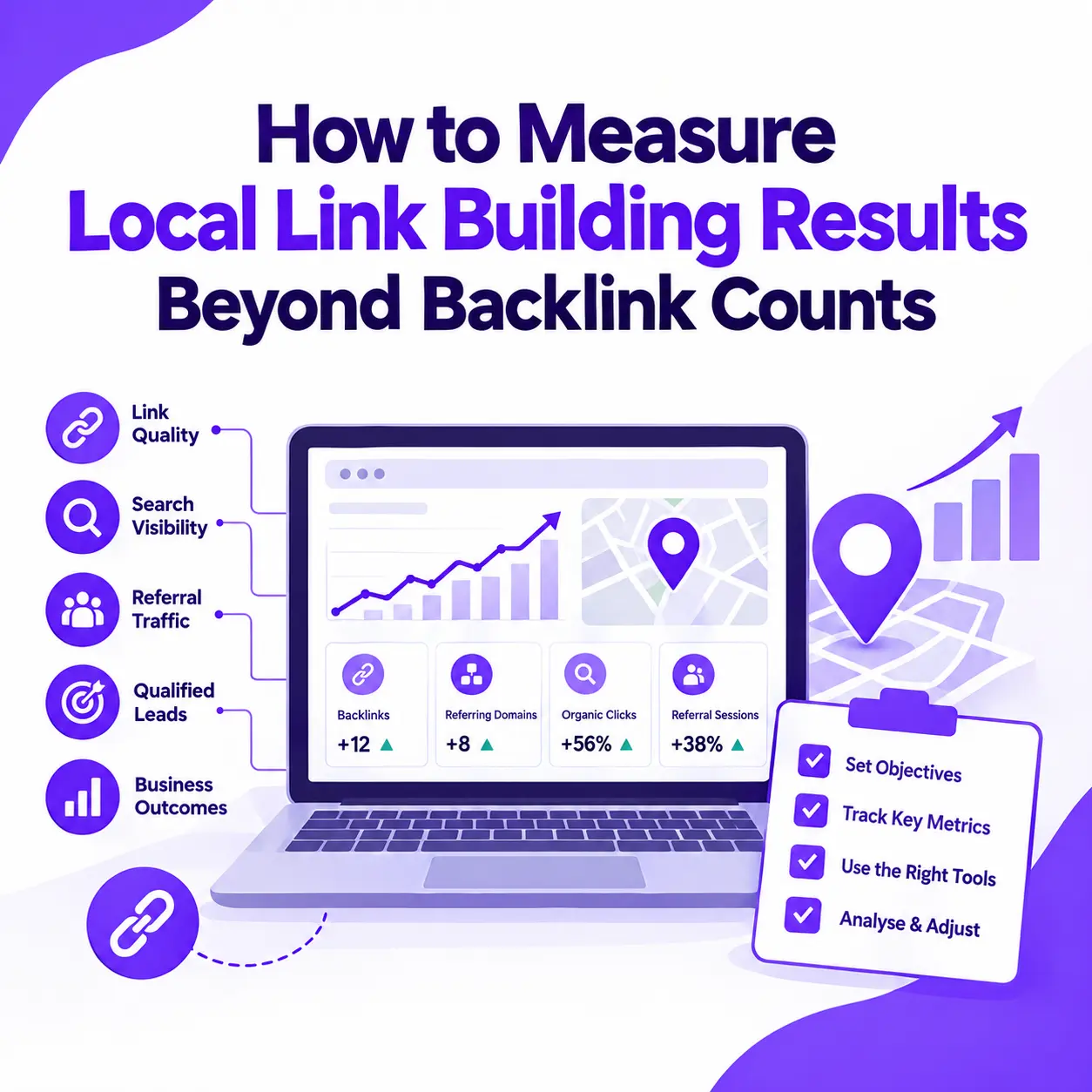
Local link building results should be measured by more than the number of backlinks acquired. To evaluate a campaign properly, assess link relevance and quality, changes in organic search visibility, referral traffic, qualified leads, and business outcomes. Comparing these indicators against a baseline helps you understand what has changed and whether the campaign is contributing to your objectives.
A growing backlink count can look impressive in a report, but it does not necessarily mean a business is becoming more visible in search results or attracting more customers. What matters is whether the links are relevant, whether the campaign supports your SEO objectives, and whether the available evidence shows meaningful progress.
In this guide, you will learn which local link building metrics to track, how to measure them using practical tools, how to evaluate campaign performance, and how to interpret results without making unsupported assumptions about rankings or revenue.
1. What Does Local Link Building Success Actually Mean?
Local link building success means acquiring relevant, legitimate links that support your broader SEO and business objectives. Depending on the campaign, success may involve stronger search visibility, useful referral traffic, qualified enquiries, valuable industry relationships, or a combination of these outcomes.
The right measurements depend on what you want the campaign to accomplish.
Backlink Acquisition Is an Activity, Not the Final Outcome
Acquiring backlinks is an important part of a link building campaign, but acquisition is only one stage of the process.
Consider the difference between these four categories:
- Campaign activities: Researching potential websites, conducting outreach, building relationships, and earning placements.
- Acquisition outcomes: New backlinks, new referring domains, and relevant editorial placements.
- SEO performance indicators: Changes in organic impressions, clicks, relevant query visibility, and target-page performance.
- Business outcomes: Qualified enquiries, booked appointments, new customers, and attributable revenue where reliable data is available.
These categories are related, but they are not interchangeable.
For example, acquiring a backlink from a relevant industry website is a verifiable campaign outcome. An increase in organic clicks during the following months is an observed performance change. Claiming that the backlink caused the increase requires additional evidence.
A useful report distinguishes what happened from what may have contributed to it.
Define Success Before Starting a Campaign
Before investing time or money in local link building, establish what the campaign is intended to achieve.
Your objective might be to:
- Support the visibility of an important service page.
- Earn links from relevant industry publications or associations.
- Attract visitors from websites that reach your intended audience.
- Strengthen your wider Local SEO strategy.
- Generate qualified leads from referral traffic.
- Improve the efficiency of your overall marketing investment.
Choose one primary objective and a small group of supporting metrics. Record the starting position, target pages, reporting period, available analytics, and any other SEO activities taking place.
This gives you a consistent basis for evaluating performance rather than choosing whichever metric looks best after the campaign has started.
2. Which Local Link Building Metrics Should You Track?
A balanced measurement framework should include backlink acquisition, link quality, organic search performance, referral traffic, business outcomes, and campaign efficiency. No single metric can establish the overall success of a local link building campaign.
The following table explains what each category contributes.
Metric category | What to measure | What it tells you | Main limitation |
Link acquisition | New backlinks and referring domains | What the campaign has acquired | Volume does not establish value |
Link quality | Relevance, context, legitimacy, and placement | Whether the links make strategic sense | Assessment requires context and judgment |
Search visibility | Impressions, clicks, and relevant query performance | How organic visibility is changing | Other SEO and market factors influence results |
Referral performance | Referral sessions, engagement, and conversions | Whether links attract useful visitors | Tracking may be incomplete |
Business outcomes | Qualified leads, appointments, and attributable revenue | Whether the campaign supports business goals | Attribution can be difficult |
Campaign efficiency | Campaign costs and cost per meaningful outcome | How efficiently resources are being used | Lower cost does not automatically mean greater value |
Backlink Count and New Referring Domains
A backlink is an individual link pointing to your website. A referring domain is a distinct domain that contains one or more links to your website.
Both measurements can be useful, but they answer different questions.
Suppose a campaign acquires several links from one website. The backlink count may increase substantially, while the number of new referring domains increases by only one.
Tracking both metrics helps you understand whether the campaign is expanding its range of referring websites or mainly acquiring additional links from sources already represented in your link profile.
Monitor:
- New backlinks acquired during the reporting period.
- New unique referring domains.
- Lost backlinks and referring domains.
- The pages receiving the links.
- The status of each important placement.
- Whether a link is newly acquired or was simply discovered by a monitoring tool.
Do not assume that every link carries equal value. Multiple sitewide links, duplicated URLs, or links with little editorial relevance should not automatically be treated as equivalent to distinct, useful placements.
Link Relevance and Placement Quality
Link quality cannot be evaluated reliably through a backlink count alone.
Review the context surrounding each important link. Ask:
- Is the referring website relevant to the business, its industry, or its intended audience?
- Does the website appear legitimate and serve a genuine purpose?
- Does the link make sense within the surrounding content?
- Does the destination page provide something useful to the reader?
- Could the placement introduce relevant visitors?
- Does the acquisition method comply with applicable search spam policies?
Geographic relevance may also matter when the link is intended to connect a business with a particular service area or audience.
Third-party metrics such as Domain Authority or Domain Rating can help compare websites within a tool’s own measurement system. However, these are proprietary estimates, not Google’s own link-quality scores. They should not override relevance, legitimacy, context, and the purpose of the placement.
A relevant link from a legitimate industry resource may be more strategically useful than a link from a much less relevant website with a higher third-party authority score.
Search Visibility and Organic Performance
Search performance helps you understand whether important pages are becoming more visible in Google Search.
Google Search Console provides data on clicks, impressions, click-through rate, average position, queries, and pages. These metrics can be filtered and compared over time.
Useful measurements include:
- Organic impressions for relevant search queries.
- Organic clicks to the pages receiving links.
- Changes in the visibility of relevant query groups.
- Click-through rate for important queries and pages.
- Average position trends, interpreted in context.
- Performance changes across relevant reporting periods.
For example, if you acquire a relevant link pointing to a service page, you can monitor that page’s search performance before and after acquisition.
However, an improvement after the link was acquired does not prove that the link caused it. Content updates, internal linking, technical improvements, search demand, competitors, and search algorithm changes may also influence performance.
Use Search Console as a source of observed search data, not as a tool for proving the impact of an individual backlink.
Official resource: Google Search Console Performance report.
Referral Traffic and Visitor Engagement
A backlink can also be useful because it introduces your business to people visiting another website.
Referral traffic helps you evaluate this direct audience benefit.
In Google Analytics 4 (GA4), review relevant traffic acquisition data and, where available, identify referring sources and landing pages.
Consider the following metrics:
- Referral sessions.
- Referral source and medium.
- Landing pages visited.
- Engaged sessions.
- Relevant engagement events.
- Completed contact forms or other configured conversion events.
For instance, a link from a relevant professional association may introduce visitors who want to learn more about a service. Even if the campaign produces no immediately observable ranking change, the referral activity may still provide useful evidence of audience reach.
Interpret these metrics carefully. Some backlinks may never generate a measurable visit. Others may introduce visitors whose subsequent activity cannot be attributed reliably because of privacy settings, redirects, tracking limitations, or incomplete referral information.
Official resource: Google Analytics traffic acquisition reporting.
Qualified Leads and Business Outcomes
For many businesses, the ultimate objective is not simply to attract visitors. It is to generate relevant enquiries and acquire customers.
Where reliable tracking is available, measure outcomes such as:
- Qualified enquiries.
- Contact-form submissions.
- Calls that can be attributed to a traffic source.
- Booked appointments.
- Sales opportunities.
- New customers.
- Revenue associated with identifiable conversions.
Lead quality matters because a large number of irrelevant enquiries may be less useful than a smaller number of enquiries from people who genuinely need the service.
You should also distinguish direct referral conversions from conversions that occur through organic search after a person may previously have encountered the business elsewhere.
A backlink might generate a referral visit today, while a later conversion occurs through another channel. That possibility is worth investigating, but it should not be used to claim that every later conversion was caused by the link.
Campaign Efficiency and Cost
A campaign can acquire relevant links and show promising performance while still using resources inefficiently.
Track costs consistently so you can evaluate whether the campaign is worth continuing or adjusting.
Potential measures include:
- Cost per acquired placement.
- Cost per new relevant referring domain.
- Research and outreach hours per successful placement.
- Cost per qualified referral lead.
- Total campaign cost relative to attributable business value.
For example, a low cost per backlink is not necessarily a positive result if the placements have little relevance or do not serve the campaign’s objectives.
Efficiency should be evaluated alongside quality and outcomes, not as a replacement for them.
3. How to Measure Local Link Building Results Step by Step
A repeatable measurement process makes campaign reports more useful and helps you avoid drawing conclusions from isolated metrics.
Step 1: Establish a Baseline Before Link Acquisition
Record the website’s starting position before the campaign begins.
Your baseline should include:
- Existing backlinks and referring domains.
- The relevance and general quality of the existing link profile.
- Search Console performance for the intended target pages.
- Relevant search queries and their performance.
- Existing referral traffic and conversion data.
- Local organic or Maps performance, if relevant to the campaign.
- Other SEO activities already in progress.
Record the date and reporting period, and note any limitations in the available data.
Without a baseline, it is difficult to determine whether a later change represents improvement, decline, or ordinary variation.
Step 2: Set Campaign Objectives and Choose KPIs
Choose metrics that correspond to the objective.
For a campaign intended to support an important service page, you might track new relevant referring domains, the quality of acquired placements, organic clicks and impressions for relevant queries, and qualified enquiries.
For a campaign intended to reach a new audience, referral sessions, engaged visits, and qualified referral leads may be more useful.
You do not need dozens of KPIs. A small, clearly defined group is easier to monitor and interpret.
Document what success would look like, what evidence you expect to collect, and what conclusions the available data can reasonably support.
Step 3: Maintain a Link Acquisition Tracking Sheet
A link tracking sheet creates a consistent record of campaign activity and placement status.
Use fields such as:
Field | What to record |
Referring domain | The website containing the link |
Source URL | The specific page containing the link |
Destination URL | The page on your website being linked to |
Date acquired | When the placement was first verified |
Placement type | Editorial mention, association listing, sponsorship, or another relevant category |
Relevance notes | Why the source and placement fit the campaign |
Link status | Active, lost, redirected, or uncertain |
Last checked | When the placement was most recently reviewed |
Referral performance | Observable referral activity, if available |
Campaign notes | Context, follow-up actions, and relevant changes |
Distinguish between prospects, successfully acquired links, lost placements, and links whose current status is uncertain.
Do not mark a link as successfully acquired merely because an outreach email was sent or a website owner agreed to consider the request.
Step 4: Monitor Search Performance Using Google Search Console
After acquisition, review the search performance of the pages you are trying to support.
In Search Console:
- Open the Performance report for Search results.
- Select a suitable reporting period.
- Filter by the relevant page or page group.
- Review clicks, impressions, click-through rate, and average position.
- Examine the queries associated with those pages.
- Compare the data with the baseline and an appropriate comparison period.
Focus on meaningful patterns rather than isolated ranking movements.
If the target page receives more impressions but clicks remain unchanged, investigate whether its search visibility is changing across relevant queries and whether its search result presentation matches user intent.
If organic performance declines, review other possible causes before concluding that link building has failed.
Search Console data has limitations, including aggregated reporting and omitted anonymized queries. Read the official explanation of Search Console performance data when interpreting the results.
Step 5: Track Referral Traffic Using Google Analytics 4
Use GA4 to understand whether acquired links introduce visitors and whether those visitors take useful actions.
Review the Traffic acquisition report and relevant source or medium information. Where appropriate, examine landing pages, engagement and configured conversion events.
Check that your analytics implementation is working correctly before relying on the data.
A simple review might ask:
- Are identifiable referring websites sending visitors?
- Do those visitors reach relevant pages?
- Are they engaging with the content?
- Are they completing useful actions?
- Are any resulting leads relevant to the business?
A lack of recorded referral traffic does not automatically mean a backlink has no value. The link may still serve as a relevant citation or resource, and analytics data may not capture every visit accurately.
Step 6: Measure Local Search Performance Separately
Local search performance deserves its own measurement process because organic website rankings and Google Maps results are not the same thing.
Depending on the campaign objective, review:
- Organic website performance for relevant searches.
- Local rank tracking across a defined set of queries and geographic points.
- Google Business Profile performance metrics available to the business.
- Website clicks, calls, and other available customer actions.
Local results can vary with the searcher’s location, query, and competitive environment. A single rank check is therefore not a reliable representation of overall local visibility.
If a business sees changes in Maps performance while its backlink profile is growing, treat those changes as observations to investigate rather than automatic proof that the new links caused the improvement.
For wider strategy support, see my Local SEO services.
Step 7: Review Business Outcomes and Attribution
Bring together the campaign tracker, search performance data, referral data, and business records where available.
If the business uses a CRM, enquiry log, booking system, or sales pipeline, review whether identifiable visits and leads are progressing toward meaningful outcomes.
Separate four types of evidence:
- Direct referral conversions: Conversions that can be linked to identifiable referral traffic.
- Organic performance changes: Search clicks, impressions, or other indicators that changed during the campaign.
- Assisted or multi-touch conversions: Outcomes for which the available attribution system identifies multiple relevant interactions.
- Uncertain outcomes: Results where the source or contribution cannot be established reliably.
Avoid double-counting conversions across channels.
This distinction is essential because campaign timing alone does not establish causation. A business may improve its content, resolve technical problems, earn links, and update its Google Business Profile during the same period.
Step 8: Review Results and Decide What to Change
Once the data is collected, use it to decide whether the campaign should continue unchanged, be refined, or be investigated further.
Observed situation | What to investigate | Possible next action |
Relevant links are acquired and meaningful indicators improve | Whether the pattern continues and what other changes occurred | Continue monitoring and document the evidence |
Relevant links are acquired but search performance is unchanged | Observation period, target-page relevance, competition, and other SEO constraints | Investigate the page and wider SEO context |
Referral traffic exists but conversions are weak | Audience relevance, landing-page intent, conversion tracking, and lead quality | Improve the visitor journey or refine targeting |
Backlink volume grows but relevance remains weak | Prospect qualification, source legitimacy, and acquisition methods | Revise campaign priorities |
Important links are lost | Whether the placement was valuable and why it disappeared | Investigate recovery when justified |
Data is too limited to support a conclusion | Tracking setup, sample size, and reporting period | Improve measurement before making a strong claim |
Do not assume that a disappointing campaign requires immediate disavowal or removal of every low-value link. Investigate the actual issue and respond proportionately.
4. How Do You Know Whether a Local Backlink Is Valuable?
A valuable local backlink is one that makes sense in its context, comes from a legitimate source, and serves a meaningful purpose for the website or its audience. Its value cannot be established by a single numerical score.
Evaluate Relevance, Context, and Genuine Usefulness
Consider two hypothetical placements.
Example A: An industry association publishes a member resource page and links to a relevant business website so readers can find additional information.
Example B: An unrelated website offers hundreds of links to businesses without a meaningful editorial purpose or relevant audience.
The first placement has a clearer connection to a real audience and a useful resource. The second raises questions about relevance and legitimacy.
These examples are illustrative, not evidence of actual campaign outcomes. The purpose is to show why link evaluation requires context rather than a simple numerical comparison.
Understand Third-Party Authority Metrics
SEO tools may provide domain-level scores or estimates to help users compare websites.
These metrics can be useful for prioritization, but they should not be interpreted as direct measurements of Google’s ranking systems.
A sensible assessment considers the whole placement: the source website, its relevance, the surrounding content, the destination page, the link’s purpose, and the acquisition method.
Avoid rejecting a relevant source simply because its third-party score is modest. Equally, do not assume a high score makes an irrelevant or manipulative placement worthwhile.
Account for Link Attributes and Placement Status
Links may include attributes such as rel=”nofollow”, rel=”sponsored”, or rel=”ugc”.
These attributes help describe the relationship between the linking website and the destination. Sponsored links, for example, should be appropriately qualified under Google’s guidance.
Also distinguish between a link being present on a page, being accessible to users, being discoverable by crawlers, and producing referral visits. These are different properties.
Record what you can verify instead of assuming every acquired link has the same search impact.
Follow Google’s link spam policies and its guidance on qualifying outbound links when evaluating link acquisition methods and link attributes.
5. How Long Does It Take to Measure Local Link Building Results?
There is no universal timeline for measuring local link building results. A placement can be checked as soon as it is acquired, but referral visits, search visibility changes, and business outcomes may become observable at different times.
Separate Immediate Outputs From Longer-Term Outcomes
Different metrics require different observation periods.
- Immediate checks: Verify the source URL, destination URL, placement context, and current link status.
- Ongoing checks: Monitor whether important links remain available and whether referral traffic is recorded.
- Periodic performance reviews: Compare search visibility, traffic, enquiries, and other relevant outcomes over suitable reporting periods.
Do not promise that a link will improve rankings within a fixed number of days or weeks.
Compare Equivalent Reporting Periods
Choose comparison periods that make sense for the business and the available data.
For example, a seasonal business may need to compare equivalent periods rather than a quiet month with a naturally busy one.
Document major changes such as:
- Website redesigns or migrations.
- New or substantially revised content.
- Technical SEO fixes.
- Internal linking changes.
- Google Business Profile updates.
- Search demand changes.
- Significant competitive developments.
These events help explain why performance may have changed during the campaign.
Avoid Premature Conclusions
Short-term changes can be misleading, especially when the website receives little traffic or the target queries have limited search demand.
Look for consistent patterns across relevant indicators and acknowledge when the data is insufficient to support a conclusion.
A lack of immediate improvement does not necessarily mean a campaign has failed. Similarly, a temporary increase does not prove success.
The objective is to make decisions based on the strongest available evidence, not to force a positive or negative verdict before the data supports one.
6. How to Calculate Local Link Building ROI
Local link building ROI measures the financial return associated with a campaign relative to its cost. A reliable calculation requires a consistent definition of campaign costs and a defensible estimate of attributable revenue.
Calculate the Total Campaign Cost
Depending on how the campaign is managed, relevant costs may include:
- Prospect research and qualification.
- Outreach and relationship management.
- Content creation or digital PR.
- Legitimate placement or sponsorship expenses.
- Relevant software and monitoring tools.
- Staff or contractor time spent on implementation and reporting.
Use a consistent accounting method. If you compare multiple campaigns, make sure their cost calculations include comparable categories.
Calculate ROI When Attributable Revenue Is Available
The standard formula is:
ROI (%) = ((Attributable revenue − Campaign cost) ÷ Campaign cost) × 100
For a hypothetical example, suppose a campaign costs $1,000 and produces $1,500 in revenue that can reasonably be attributed to it.
The calculation would be:
ROI = (($1,500 − $1,000) ÷ $1,000) × 100 = 50%
These figures are illustrative only. They are not a real project result or a prediction of what a campaign will achieve.
The calculation also assumes that the $1,500 is revenue attributable to the campaign, not simply total revenue earned during the same period. If revenue attribution is uncertain, the ROI figure should not be presented as definitive.
Measure Cost Per Qualified Lead When Revenue Is Unavailable
Not every business can reliably attribute sales revenue to an individual backlink or link building campaign.
In that situation, cost per qualified lead may be more practical.
Cost per qualified lead = Campaign cost ÷ Number of qualified leads attributed to the campaign
For example, if a hypothetical campaign costs $1,000 and generates five qualified leads that can be attributed to it, the cost per qualified lead is $200.
This does not establish profitability. You would still need to understand lead-to-customer conversion rates, customer value, and other relevant costs to estimate the campaign’s wider commercial contribution.
If no qualified leads can be attributed reliably, report the available indicators and acknowledge that a meaningful cost-per-lead calculation is not yet possible.
Understand Attribution Limits
SEO performance often results from multiple activities working together. Link acquisition may take place alongside content improvements, technical fixes, internal linking, and changes in search demand.
A revenue increase during the campaign does not automatically prove that link building generated that increase.
Separate directly observed referral conversions from broader organic performance changes. Where multi-touch attribution is available, explain what the model measures and what it cannot establish.
The most credible report is one that communicates both the positive evidence and the remaining uncertainty.
7. How to Build a Useful Local Link Building Performance Report
A useful report should help someone understand what the campaign accomplished, what changed, how confidently the changes can be interpreted, and what should happen next.
It should not simply list backlinks or present a collection of SEO tool screenshots.
Include the Essential Reporting Fields
A practical report should contain:
- Campaign objective and reporting period.
- Baseline and comparison period.
- New and lost backlinks.
- New referring domains.
- Relevant placement and quality notes.
- Target-page search performance.
- Referral traffic and configured conversions.
- Qualified leads or business outcomes, where available.
- Campaign costs and efficiency metrics.
- Tracking limitations and other relevant SEO changes.
- Key findings and recommended next actions.
Keep the report focused on the metrics that support the campaign’s objective.
Separate Deliverables, Performance Changes, and Business Outcomes
Use clear language when explaining results.
For example:
Deliverable: The campaign acquired 12 new referring domains.
Observed change: Organic clicks to a target page increased during the comparison period.
Causal conclusion: The new links caused the increase in clicks.
The first two statements describe observable information, assuming the underlying data is accurate. The third requires evidence that distinguishes the campaign’s contribution from other possible explanations.
Avoid presenting all three statements as equally established facts.
Use a Decision-Oriented Reporting Table
A simple reporting format is often enough:
Metric | Baseline | Current period | Change | Interpretation | Next action |
Relevant referring domains | Record starting count | Record current count | Calculate difference | Assess relevance and acquisition quality | Continue or refine prospecting |
Organic clicks | Record starting performance | Record current performance | Compare periods | Investigate changes across relevant queries | Review the target page and wider SEO factors |
Referral sessions | Record starting performance | Record current performance | Compare periods | Assess whether links attract useful visitors | Review sources and landing pages |
Qualified leads | Record starting count | Record current count | Compare periods | Assess commercial relevance | Check attribution and conversion quality |
Campaign cost | Record planned or initial cost | Record actual cost | Calculate difference | Assess resource use | Adjust campaign priorities if needed |
Use the interpretation column to explain what the data means and what remains uncertain. The next-action column should turn the findings into a practical decision.
A concise narrative summarizing the strongest evidence, the main limitations, and the next steps will make the report more useful to decision-makers.
8. Which Tools Help Measure Local Link Building Results?
You can build a useful measurement process without relying on a large collection of paid tools. Start with the available data, then add specialist tools where they answer a specific question.
Google Search Console for Organic Search Performance
Search Console helps you review how often your pages appear in Google Search, how many clicks they receive, which queries bring visitors, and how their performance changes over time.
Use it to monitor target pages and relevant query groups before and after link acquisition.
Remember that Search Console does not identify which backlink caused a change in organic performance.
Google Analytics 4 for Referral Traffic and Conversions
GA4 helps you understand how visitors arrive at your website and what they do after arriving.
Use traffic acquisition reports to review referral sources, sessions, engagement, and configured conversion events.
The quality of this analysis depends on correct tracking implementation and the data available. Missing source information, consent settings, redirects, and other limitations can affect attribution.
Backlink Analysis Tools for Link Discovery and Monitoring
Third-party backlink tools can help you:
- Discover known backlinks and referring domains.
- Review source URLs and destination pages.
- Monitor newly discovered or lost links.
- Compare link profiles.
- Identify potential link opportunities.
- Organize campaign monitoring.
Different providers may report different backlink totals because they maintain different crawlers, indexes, and update schedules. Their reports are estimates of the links they have discovered, not a complete record of how Google processes every link.
Use these tools to support investigation and tracking rather than treating their metrics as definitive ranking signals.
Local Rank Tracking and Business Reporting Systems
When local search visibility is part of the objective, a rank tracker configured for relevant queries and geographic points can help identify patterns.
Google Business Profile reporting may also help evaluate customer interactions and performance indicators available to the business.
Keep Maps visibility, organic website rankings, referral traffic, and business conversions separate in the reporting framework. They answer different questions and should not be combined into a single unexplained score.
9. Common Mistakes When Measuring Local Link Building
Even a well-organized report can be misleading if its metrics are interpreted incorrectly.
Treating Every Backlink as Equally Valuable
A large backlink count can conceal weak relevance, poor context, duplicate links, or questionable acquisition practices.
Evaluate important placements individually and assess whether they support the campaign’s purpose.
Assuming Improved Rankings Prove Link Building Worked
A ranking improvement that occurs after link acquisition does not establish causation.
Review other SEO changes, query demand, competition, technical conditions, and the target page’s content before deciding what most likely contributed to the outcome.
Ignoring Lost Links and Destination Pages
Important links can disappear, redirect, or stop pointing to the intended page.
Monitor their status and investigate meaningful losses. Recovery may be worthwhile when a placement is relevant and useful, but not every lost link needs to be replaced.
Confusing Maps Performance With Organic Website Rankings
Organic website rankings and Google Maps results are different search experiences.
Evaluate each using appropriate measurements and avoid attributing every change in local visibility to backlink acquisition.
Reporting Activity Without Interpretation
Outreach totals, acquired links, and third-party scores can describe campaign activity, but they do not automatically explain its value.
A good report connects activity to the objective, observed performance, relevant limitations, and a reasoned next step.
Using Manipulative Link Acquisition Tactics
Automated link creation, link schemes, and other manipulative methods can violate Google’s spam policies.
Avoid pursuing backlink volume through tactics designed primarily to manipulate search rankings. Focus on legitimate, relevant placements that make sense for users and the business.
See Google’s official Search spam policies for current guidance.
10. A Practical Checklist for Measuring Local Link Building Results
Use this checklist before preparing your next campaign report.
- Define the campaign’s primary objective.
- Record the baseline backlink and referring-domain data.
- Identify the target pages and relevant search queries.
- Evaluate the relevance and legitimacy of acquired placements.
- Record acquired and lost links.
- Review Search Console performance for relevant queries and pages.
- Check referral traffic and conversion tracking in GA4.
- Evaluate qualified enquiries and business outcomes where data is available.
- Compare appropriate reporting periods.
- Document other SEO changes that may influence performance.
- Calculate campaign costs consistently.
- Separate observed changes from claims about causation.
- Record data limitations.
- Choose the next action based on the evidence.
The purpose of this checklist is not to prove that every backlink produced a measurable result. It is to understand whether the campaign is progressing toward a meaningful objective and whether the available evidence justifies continuing or changing the strategy.
Conclusion: Measure the Value of Local Link Building, Not Just the Volume
Backlink counts are useful for tracking acquisition activity, but they cannot tell you whether a local link building campaign is genuinely valuable.
A more complete evaluation considers the relevance and quality of acquired links, changes in organic search visibility, referral traffic, qualified leads, and business outcomes. Establishing a baseline, monitoring the right metrics, and accounting for other SEO activities helps you interpret the results more responsibly.
Most importantly, distinguish between what the campaign has delivered, what changed during the reporting period, and what you can reasonably attribute to link building. That distinction makes campaign reporting more credible and helps you make better decisions about future investment.
If you want to evaluate an existing link profile or build a measurement framework around your wider SEO objectives, explore my Local Link Building service. You can also contact Tawhid to discuss your SEO requirements and determine which measurements are most relevant to your website.
Frequently Asked Questions
1. How do you measure the quality of a local backlink?
Evaluate the referring website’s relevance to the business, industry, audience, or geographic market, along with its legitimacy, editorial context, placement, and potential usefulness to readers. Third-party authority scores can provide additional context, but they should not replace qualitative assessment or be treated as Google’s own link-quality metrics.
2. How long does it take to see results from local link building?
There is no guaranteed timeline. Link acquisition can be verified as it happens, but referral visits, search visibility changes, and business outcomes may emerge on different schedules. Establish a baseline, monitor relevant indicators over meaningful comparison periods, and account for other SEO changes before drawing conclusions about performance.
3. Can local link building improve Google Maps rankings?
Relevant backlinks may contribute to the wider prominence and authority signals surrounding a local business, but they do not guarantee improved Google Maps rankings. Local results also depend on factors such as relevance, distance, and prominence. Evaluate Maps performance separately and avoid attributing ranking changes to link building alone.
4. How do you calculate the ROI of a local link building campaign?
When attributable revenue and campaign costs are available, calculate ROI as (attributable revenue minus campaign cost) divided by campaign cost, multiplied by 100. If reliable revenue attribution is unavailable, report cost per qualified lead or other clearly defined outcomes, and explain the limitations of the available evidence.
5. Why are backlinks increasing but organic traffic staying the same?
More backlinks do not guarantee more organic traffic. The links may have limited relevance, target pages may not satisfy search intent, competitors may be stronger, or technical and content issues may constrain performance. Review link quality, target-page performance, query demand, and other SEO changes before deciding what to improve.