
Local SEO Audit Report Template: How to Prioritize Findings and Build an Action Plan

Freelancer Tawhid
SEO Expert and Consultant
- October 13, 2026
- No Comments
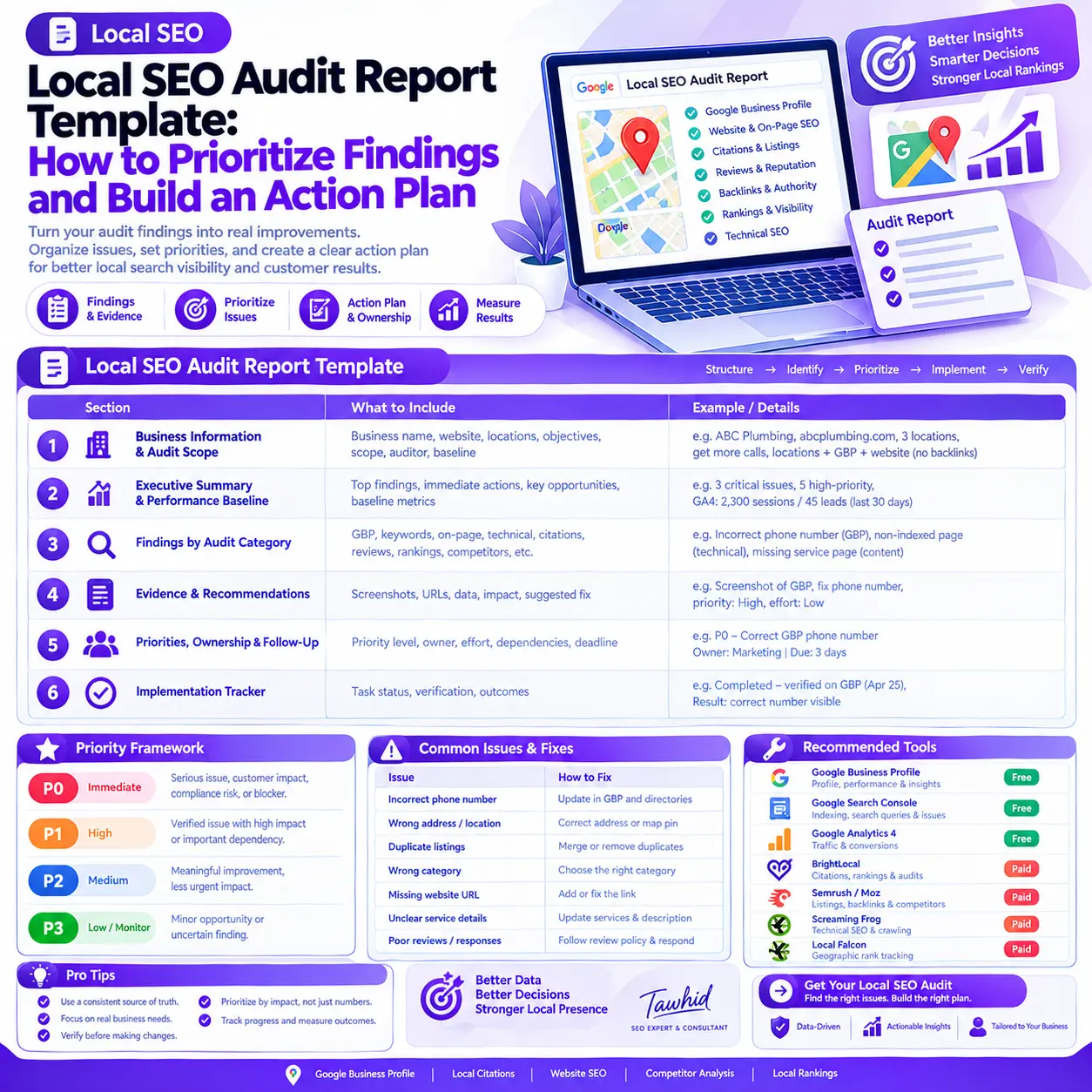
A Local SEO audit report template helps you organize audit findings, document supporting evidence, evaluate potential business impact, and decide which issues to address first. By connecting each finding to a specific recommendation, priority, responsible owner, and verification method, you can turn a long list of SEO problems into a practical action plan.
Finding problems is only one part of a Local SEO audit. The real value comes from understanding which problems matter, why they matter, and what should happen next.
An audit might uncover technical SEO errors, inaccurate Google Business Profile information, inconsistent business listings, weak service pages, keyword-targeting gaps, or opportunities to improve local search visibility. However, not every finding deserves the same level of attention.
This guide provides a reusable Local SEO audit report template, a practical framework for prioritizing findings, a worked example, and a step-by-step process for building an implementation roadmap.
Whether you are a business owner, SEO freelancer, agency professional, or consultant, you can adapt the framework to your objectives and resources.
What Is a Local SEO Audit Report Template?
A Local SEO audit report template is a reusable document or spreadsheet structure for recording the results of a local search audit and converting those findings into actionable recommendations.
A useful template documents what was found, where the problem exists, what evidence supports the finding, why it may matter, and what action should follow.
It also helps the person responsible for implementation understand the priority, expected effort, dependencies, deadline, and method for verifying the work.
Local SEO Audit Checklist vs. Audit Report vs. Action Plan
These three resources support different stages of the audit and implementation process.
Resource | Primary purpose | Typical contents |
Local SEO audit checklist | Guides the examination | Questions, tests, audit categories, and inspection items |
Local SEO audit report | Communicates findings and recommendations | Evidence, affected assets, potential impact, priorities, and suggested fixes |
Local SEO action plan | Manages implementation | Tasks, owners, dependencies, deadlines, status, and verification |
For example, an audit checklist might ask whether an important service page can be indexed. The audit report would document that the page has an unintended noindex directive, show the supporting evidence, and explain why the issue requires investigation.
The action plan would assign someone to confirm the page’s intended indexing status, correct the directive if appropriate, and verify the result.
This separation prevents audit findings from becoming a long list of problems that nobody knows how to resolve.
Who Should Use a Local SEO Audit Report Template?
The template can support several types of users.
- Business owners who need to understand their website’s local search weaknesses and the work required to address them.
- SEO freelancers and consultants who need to explain findings clearly and recommend practical next steps.
- SEO agencies that need consistent reporting across client projects.
- In-house marketing teams coordinating SEO work with content, development, operations, and management.
- Multi-location businesses that need to track issues across multiple websites, location pages, or Google Business Profiles.
The reporting structure can remain consistent while the depth changes according to the project.
An executive may need a summary of the most important risks and recommended actions. An SEO specialist may need affected URLs, diagnostic evidence, implementation notes, and validation criteria.
What Should a Local SEO Audit Report Include?
A good report should help its reader answer three questions:
- What did the audit find?
- Why does each important finding matter?
- What should happen next?
The following components make those answers easier to understand.
1. Business Information and Audit Scope
Begin by recording the context of the audit.
Include the business name, website, relevant business locations, services, audit date, auditor, business objectives, and scope of work.
For multi-location businesses, identify the affected location, profile, or page whenever a finding is location-specific.
It is also important to document exclusions. For example, the audit might cover website and Google Business Profile issues but exclude a detailed backlink investigation because the necessary data was unavailable.
Clear scope documentation prevents readers from assuming that every possible Local SEO issue has been investigated.
2. Executive Summary and Performance Baseline
The executive summary should communicate the most important findings without requiring the reader to review every technical detail.
Include the most consequential issues, the recommended immediate actions, significant opportunities, and any decisions or resources required.
Record a performance baseline before implementing changes wherever suitable data is available. Depending on the project, this may include:
- Relevant Google Search Console impressions and clicks.
- Google Business Profile interactions.
- Website sessions and qualified conversions.
- Search visibility for selected queries.
- The condition of important service and location pages.
- Known technical or business-information problems.
Do not invent a baseline when data is unavailable. Instead, explain which measurements could not be obtained and whether tracking needs to be configured.
Avoid presenting an unexplained overall SEO score as though it accurately measures a business’s likelihood of ranking. A scorecard is useful only when its criteria, calculation, and limitations are clear.
3. Findings Organized by Audit Category
Group related findings so that readers can understand where problems occur.
Common reporting categories include:
- Google Business Profile information and optimization.
- Local keyword research and search intent.
- Service pages and location-page optimization.
- Technical SEO, crawlability, and indexability.
- Business information and local citations.
- Reviews and reputation management.
- Google Maps and local organic search visibility.
- Competitor analysis and relevant backlinks.
- Analytics, tracking, and conversion measurement.
These categories are a reporting framework, not a checklist of problems every business must have.
For example, a business with accurate listings and strong review-management practices may have little corrective work in those areas. Another business may need to address inaccurate contact details or duplicate listings before investing in broader optimization.
The report should reflect the evidence rather than manufacture work to fill every category.
4. Evidence and Recommended Actions
Every important finding needs enough supporting evidence for another person to understand and verify it.
Useful evidence can include an affected URL, a screenshot, a crawl result, a page directive, a Search Console observation, a verified business record, or a relevant Business Profile metric.
The recommendation should explain the specific corrective action rather than simply telling the reader to improve SEO.
For instance, “improve website optimization” is too vague. A more actionable recommendation might be to review a particular service page’s indexing status, confirm its intended canonical URL, and correct an unintended indexing directive if the evidence supports that diagnosis.
Clearly distinguish observed facts from interpretations. A verified technical configuration is an observation; the size of its potential business impact may require further analysis.
5. Priorities, Ownership, and Follow-Up
A report should specify how each actionable finding will be handled.
Record the priority, responsible owner, estimated effort, dependencies, target date, completion status, and success criterion.
If a task depends on developer access or client approval, document that dependency rather than assigning an unrealistic deadline.
The aim is to make the report useful after the initial audit meeting is over.
Copy-and-Adapt Local SEO Audit Report Template
You can copy the following structures into a spreadsheet, document, or project-management tool.
Local SEO Audit Report Header
Field | What to enter |
Business name | The business being reviewed |
Website | The website included in the audit |
Locations covered | Relevant locations or location groups |
Audit date | When the review was conducted |
Auditor | The person or team performing the audit |
Business objective | The intended outcome, such as qualified calls or bookings |
Audit scope | Areas examined and any significant exclusions |
Baseline | Available measurements before implementation |
Executive summary | The most important verified findings |
Immediate priorities | Urgent corrections or significant blockers |
Recommended next steps | The actions and decisions needed to proceed |
Individual Audit-Finding Template
Use one row per finding when the report is maintained in a spreadsheet.
Field | Information to record |
Finding ID | A unique reference, such as LSA-001 |
Category | Technical SEO, GBP, citations, content, or another relevant area |
Affected asset | URL, profile, listing, or business location |
Observed finding | The specific issue identified |
Supporting evidence | Screenshot, test result, data source, or verified observation |
Potential impact | Why it may matter to search visibility, customers, or business goals |
Confidence | Whether the diagnosis is confirmed or requires further investigation |
Recommendation | The proposed corrective action |
Priority | P0, P1, P2, or P3, with a rationale |
Effort and dependencies | Estimated work and prerequisites |
Owner and deadline | Who is responsible and the agreed target date |
Success criterion | How the action will be verified |
Status | Not started, in progress, blocked, or complete |
Validation date | When the completed work was checked |
For clarity, keep sensitive credentials and private access information out of ordinary audit reports.
Local SEO Action-Plan Template
The action plan should track implementation rather than repeat the entire audit report.
Task | Priority | Owner | Dependency | Target date | Status | Verification |
Correct a verified business-information error | P0/P1, as justified | Assigned owner | Access to the relevant account | Agreed date | Not started | Confirm the displayed information is correct |
Investigate an indexing issue on an important page | P0/P1, as justified | SEO specialist or developer | Confirm the page’s intended indexing status | Agreed date | In progress | Inspect the corrected configuration |
Improve a priority service page | P2, as justified | Content or SEO team | Approved page purpose and target intent | Agreed date | Not started | Review the completed page against the requirements |
Review relevant listing inconsistencies | P1/P2, as justified | Local SEO owner | Verified master business information | Agreed date | Not started | Check the corrected listings |
Establish a performance review | P2/P3, as justified | Analytics or marketing owner | Appropriate tracking and baseline | Agreed date | Not started | Confirm that the required metrics are available |
The priorities above are illustrative, not universal. Assign them only after examining the actual finding and its implications.
One finding may also generate several tasks. For example, resolving a website issue might require diagnosis, development, deployment, and post-deployment validation.
How to Adapt the Template for Multiple Locations
A single-location business may only need one record for each affected page or profile. A multi-location business may need separate records when an issue affects different profiles, location pages, or listings.
Use consistent categories and status labels so that reports can be compared. However, do not automatically duplicate every task across every location.
Separate the records when the affected asset, evidence, severity, owner, or appropriate corrective action differs.
How to Prioritize Local SEO Audit Findings
The best way to prioritize Local SEO audit findings is to evaluate verified problems against business impact, urgency, confidence, implementation effort, and dependencies. A long list of warnings from an SEO tool does not automatically identify the most important work.
Prioritization should be tied to the business’s actual goals and the evidence available.
Step 1: Establish the Business Objective
Start with the result the business wants to improve.
A company focused on qualified calls may need to investigate its contact details, Business Profile interactions, and relevant service pages. A business focused on online bookings may need to examine its booking path, website experience, and conversion tracking.
Identify the pages, profiles, services, and locations connected to that objective.
This does not mean ignoring technical issues. It means assessing their significance in the context of the business rather than treating every warning equally.
Step 2: Identify Urgent Risks and Major Blockers
Some problems deserve immediate investigation because they can harm customers, undermine an important business process, or prevent essential pages from appearing in search.
Examples include:
- A confirmed error in the main business phone number.
- A broken booking or contact route.
- An unintended noindex directive on an important search landing page.
- A serious Business Profile compliance concern requiring review.
- A technical problem affecting an important group of URLs.
Verify the condition before recommending a fix. A page should not be indexed merely because a tool reports it as excluded; it may have been intentionally excluded for a valid reason.
Likewise, do not mark every technical error as urgent simply because a crawler describes it as critical.
Step 3: Evaluate Impact, Confidence, Effort, and Dependencies
Use five questions to evaluate each finding.
- Potential impact: Could the issue materially affect important search visibility, customer experience, leads, or conversions?
- Breadth: Does it affect one low-value page, a critical landing page, or a large group of important URLs or locations?
- Confidence: Is the finding verified, or is additional investigation required to establish the cause?
- Effort: How much time, expertise, money, and coordination will the proposed action require?
- Dependencies: Does the task need to be completed before another important task can proceed?
These questions help explain why one finding should be handled before another. They are a decision framework, not a validated formula for predicting ranking increases.
Step 4: Assign Clear Priority Levels
A simple P0–P3 system can make the report easier to understand.
Priority | Meaning | Illustrative example |
P0 — Immediate | A serious verified customer-impacting issue, urgent compliance concern, or fundamental blocker | The main contact route is broken, or an important page is unintentionally unavailable to search engines |
P1 — High | A well-supported problem with substantial potential impact or a significant dependency | A critical service page has a confirmed indexing problem |
P2 — Medium | A meaningful optimization opportunity that is less urgent than higher-priority work | An important service page requires substantial improvements to its content or internal links |
P3 — Low or planned | A lower-impact opportunity or improvement that can reasonably wait | A non-urgent listing opportunity with limited evidence of business value |
These are proposed operational labels, not official Google categories. Their definitions should be documented and applied consistently within each project.
A tool warning does not automatically deserve P0 or P1. The priority depends on whether the issue is genuine, what it affects, and what could happen if it remains unresolved.
Quick Wins Are a Separate Consideration
A quick win is an action that is relatively easy to implement compared with its potential value. It is not a severity level.
For example, correcting a verified business-hours error may be straightforward and immediately useful. A complex technical problem could deserve higher priority even if it requires substantially more effort.
Use effort to help plan work, not to disguise a low-impact task as the most important recommendation.
Step 5: Identify Dependencies and Sequence the Work
Some tasks need to happen in a particular order.
For example, confirm a page’s intended indexing and canonical setup before spending substantial time rewriting it. Establish suitable analytics and conversion tracking before using those measurements to judge an optimization campaign. Confirm a page’s purpose before creating a replacement or rewriting its content.
Other tasks can proceed in parallel. A team can often correct verified business-information errors while a developer investigates an unrelated website issue.
Document dependencies explicitly so the action plan reflects how the work will actually be completed.
Step 6: Document the Reason for Each Priority
Every important finding should include a brief explanation of its position in the plan.
A useful rationale identifies the evidence, affected asset, likely significance, confidence in the diagnosis, and reason for acting now rather than later.
This also makes the report easier to review with a business owner or developer who may have additional context.
Local SEO Audit Report Example: Prioritizing Findings
The following example is hypothetical. It demonstrates how to apply the framework without representing a real client project or claiming actual ranking improvements.
Finding | Evidence to verify | Example priority | Recommended action |
A Google Business Profile displays an incorrect phone number | Compare the displayed number with the business’s verified contact information | P0 if confirmed and causing customer harm | Correct the information through the appropriate account and recheck it |
An important service page has an unintended noindex directive | Inspect the page’s indexing directives and relevant Search Console evidence | P0 or P1, depending on importance and circumstances | Confirm the intended indexing status, correct the issue if appropriate, and verify the result |
Important business listings contain conflicting contact details | Compare relevant listings with the verified business record | P1 or P2, depending on scope and impact | Correct the most consequential inconsistencies and track the changes |
A priority service page does not adequately address its intended search intent | Review the page, relevant queries, business offering, and competing search results | P2 if a material gap is confirmed | Improve the existing page to better meet the intended user need |
A relevant industry directory does not list the business | Evaluate directory relevance, customer usefulness, and the opportunity’s likely value | P3 or defer | Pursue the listing only if the opportunity is worthwhile |
The priorities are scenario-dependent. An indexing issue on an essential service page is different from an indexing issue on an intentionally excluded page. A directory inconsistency affecting core contact information may warrant greater attention than an unclaimed, low-value listing.
Why Tool Severity and Business Priority Are Different
Automated audits can identify patterns and potential problems efficiently. However, tools do not always know the business context or the intended role of a particular page.
A report that assigns urgent status to every technical warning creates unnecessary pressure and makes genuine risks harder to identify.
A better report validates significant findings, explains their impact, and recommends actions based on the evidence. Where the cause is uncertain, the next action may be further diagnosis rather than an immediate change.
How to Turn Prioritized Findings Into a Local SEO Action Plan
Once the priorities are established, convert them into work that people can actually complete.
Organize Tasks Into Workstreams
Group related actions into practical workstreams, such as:
- Urgent customer-facing and compliance corrections.
- Technical SEO and indexing improvements.
- Google Business Profile and business-information updates.
- Website content and on-page SEO.
- Citation cleanup and duplicate-listing investigation.
- Review and reputation-management improvements.
- Measurement, verification, and ongoing monitoring.
A workstream helps organize implementation but does not dictate the order of all tasks. Use the assigned priority and dependencies to determine the sequence.
For more substantial profile-related work, see my Google Business Profile Optimization service. For inconsistent business listings, my Local Citation Building service provides a more specific destination for that topic.
Assign an Owner, Effort Estimate, and Deadline
Every task should have a clear deliverable and a responsible owner.
For example, “fix indexing issues” is not sufficiently specific for implementation management. A better task would identify the affected URL, the confirmed issue, the change required, who will make it, and what evidence will verify completion.
Effort estimates should account for the actual work, approvals, access requirements, and dependencies. A deadline should be agreed upon with the people responsible for delivery rather than guessed from the priority label.
Build a Sample 30-Day Implementation Roadmap
The following roadmap illustrates one possible way to organize an initial month of work. It is not a guarantee that all Local SEO issues can be resolved in 30 days.
Period | Main focus | Example deliverables |
Week 1 | Confirm findings and address urgent risks | Validate major issues, correct urgent errors, and assign owners |
Week 2 | Address high-priority technical and website issues | Investigate confirmed blockers, implement approved corrections, and verify affected pages |
Week 3 | Complete suitable Local SEO improvements | Implement approved content, profile, or business-information changes |
Week 4 | Review completion and prepare the next cycle | Retest completed work, review available performance data, and reassess unresolved findings |
The appropriate timeline depends on the website’s size, the number of locations, technical complexity, developer availability, approval processes, and external platform behavior.
Some corrections can be completed quickly. Others may require further investigation, significant development, or time before the effects can be measured.
Separate Completed Work From Measurable Results
A task’s implementation status and its business outcome are different measurements.
If a verified contact-detail error has been corrected and rechecked, the task can be marked complete. It should not automatically be recorded as a successful SEO outcome unless the relevant outcome has been measured.
Similarly, publishing a revised service page is a completed deliverable. Changes in relevant search visibility, qualified calls, or conversions should be evaluated separately.
Establish a Review and Approval Process
For client or team projects, clarify who approves recommendations, who implements them, how blockers are reported, and when unfinished tasks are reassessed.
Keep a record of important changes. This makes it easier to investigate results later and prevents multiple people from unknowingly repeating the same work.
How to Measure the Results of a Local SEO Action Plan
An effective report tracks both the work performed and the outcomes that matter to the business.
Use Appropriate Measurement Sources
Choose metrics that correspond to the business objective and can be measured reliably.
Source | Useful information | Important limitation |
Google Search Console | Search impressions, clicks, queries, and page-level search performance | Does not establish every cause of a performance change or measure all business outcomes |
Google Business Profile performance | Available profile discovery and interaction metrics | Metric availability and definitions vary; clicks and requests are not automatically completed customer conversions |
Website analytics | Sessions and configured events or conversions | Data quality depends on suitable tracking and implementation |
Local rank tracking | Observed positions or visibility for selected queries and geographic contexts | Rankings may vary by search context and do not directly measure leads or revenue |
Implementation tracker | Completed corrections, validated URLs, and remaining tasks | Measures delivery rather than ranking or business impact |
Google’s Business Profile performance documentation explains the available metrics for verified profiles. These can include calls, website clicks, direction requests and other customer interactions, depending on the metric and profile.
For example, the calls metric records clicks on the call button; it does not prove that every click resulted in a connected call or qualified lead. Direction requests likewise should not automatically be interpreted as completed visits.
Use consistent metric definitions when comparing reporting periods.
Record a Baseline and Compare Fairly
Before implementation, record the starting measurement period and the relevant conditions.
After changes are implemented, compare an appropriate later period with the baseline. Consider seasonality, search demand, changes in competition, website releases, tracking changes, and other factors that may influence results.
Where possible, avoid attributing all observed changes to a single SEO action when multiple changes occurred during the same period.
Google explains that local search results are primarily influenced by relevance, distance, and prominence. This means a report should not treat one search position as a universal measure of local visibility. See Google’s official guidance on improving local ranking.
If the purpose is to evaluate Maps visibility, consider the relevant queries and geographic context. My Google Maps SEO service explains how profile information, website relevance, and the broader local search environment can be considered together.
What If Performance Does Not Improve?
Do not automatically repeat the same change because a ranking report has not improved.
First, determine whether the recommendation was implemented correctly. Check whether the original issue still exists, whether the relevant page or profile reflects the change, and whether enough appropriate data is available to evaluate the outcome.
Then reconsider the diagnosis. The underlying problem may have been misunderstood, the recommendation may have addressed only one contributing factor, or other competitive and business conditions may be influencing the result.
The correct next step may be further investigation, a revised recommendation, or continued monitoring—not a promise of a particular ranking.
Which Tools Can Help Create a Local SEO Audit Report?
You do not need an expensive platform to produce a useful report. A spreadsheet or document is often sufficient for organizing findings and managing implementation.
Choose tools according to the questions the audit needs to answer.
Tools for Collecting Evidence
Google Search Console is useful for examining organic search performance and investigating relevant page or indexing issues.
Google Business Profile provides business owners and authorized managers with profile-management and performance information for eligible profiles.
Website crawlers can identify technical patterns across URLs, such as status codes, canonical tags, metadata, internal links, and indexing directives. Important findings still require context and verification.
Analytics tools can help measure website behavior and configured conversions when tracking is correctly implemented.
Rank-tracking tools can help observe search visibility for selected queries in a defined geographic context. They should be treated as measurement tools, not definitive explanations for ranking changes.
Citation and backlink tools can help investigate business-listing consistency and link-related opportunities, where those areas are relevant to the audit.
How to Choose the Right Tools
Consider the reliability of the available evidence, the website’s size, the number of locations, export functionality, reporting requirements, access permissions, and cost.
Different tools may use different datasets or definitions. If their results disagree, investigate the discrepancy rather than automatically accepting the most alarming score.
Why Manual Verification Remains Important
A crawler warning, profile score, citation scan, or ranking grid is a starting point for investigation.
Before recommending a consequential fix, confirm the underlying issue with the relevant page, account, business record, or source data. Determine whether the condition is actually incorrect and whether the proposed action fits the business’s goals.
The value of a report comes from the quality of the interpretation and recommendation, not the number of tools used to create it.
Common Mistakes to Avoid in Local SEO Audit Reporting
Treating Every Finding as Equally Important
An unprioritized list makes it difficult to see which tasks deserve immediate attention.
Assign priorities according to verified conditions, business objectives, impact, effort, and dependencies. Explain the rationale for the most important findings.
Reporting Scores Without Evidence
A score or automated warning should not replace an explanation of what is wrong.
Include enough evidence for the reader to understand the finding and verify the recommended action. Where evidence is incomplete, label the issue as provisional and identify what additional investigation is needed.
Writing Recommendations That Are Too Vague
“Improve local SEO” does not tell an implementation team what to do.
Identify the affected asset, the required change, the responsible owner, and how the result will be checked. A clear recommendation reduces unnecessary back-and-forth and makes implementation easier to track.
Ignoring Business Goals
A technically complete website does not automatically produce more qualified leads.
Priorities should reflect the business’s actual services, customers, conversion paths, and relevant search opportunities. The objective is to resolve important issues and support business outcomes, not to maximize the number of completed checklist items.
Promising Rankings or Recommending Manipulative Tactics
An audit report should not guarantee specific rankings, traffic increases, or revenue outcomes. SEO results depend on conditions that a service provider cannot completely control.
Avoid recommendations such as adding keywords to a Business Profile name when those words are not part of the real-world business name, creating fake reviews, or producing unnecessary duplicate location pages.
Google’s Business Profile guidelines explain how business information should be represented, while its Search spam policies describe practices that can violate Search requirements.
Recommendations should be accurate, justified, and appropriate for the business—not designed to manipulate search systems.
Frequently Asked Questions About Local SEO Audit Reports
1. What is the difference between a Local SEO audit checklist and a report template?
A Local SEO audit checklist helps you examine important areas of a business’s local search presence. A report template organizes the results into findings, evidence, recommendations, and priorities. An action plan then assigns the approved tasks, owners, and deadlines needed to address those findings.
2. How do you prioritize findings in a Local SEO audit?
Start with verified problems that create significant customer harm, compliance risks, or fundamental technical barriers. Then compare remaining findings by business impact, affected pages or locations, confidence, implementation effort, and dependencies. Record why each issue receives its priority, and reassess the order when evidence or business objectives change.
3. What should each finding in a Local SEO audit report include?
Each finding should describe the observed problem, identify the affected page or business profile, provide supporting evidence, explain its potential impact, and recommend a specific action. Include a priority, confidence level, responsible owner, effort estimate, and verification method where relevant. Distinguish confirmed facts from assumptions.
4. How often should you update a Local SEO audit report?
Update the action tracker as implementation work progresses, and review the underlying audit when meaningful business, website, or search-performance changes occur. Examples include a website redesign, a new location, a major visibility decline, or a change to important business information. The appropriate recurring review schedule depends on the business and its competitive environment.
5. Should a Local SEO audit report include keyword rankings and Google Business Profile metrics?
Yes, when those metrics relate to the business’s goals and the relevant data is available. Include search visibility alongside appropriate measurements such as Search Console clicks and impressions, Business Profile calls or website clicks, and configured conversions. Rankings alone do not explain customer outcomes or establish why performance changed.
Conclusion: Turn Local SEO Audit Findings Into Action
A useful Local SEO audit report does more than identify errors. It explains the evidence behind each finding, evaluates why the issue matters, and provides a clear recommendation for what should happen next.
Use a consistent report template, prioritize findings according to their significance, document dependencies, and assign every approved task to a responsible owner. Then verify the completed work and measure the outcomes that matter to the business.
Remember that an audit score or a large list of warnings is not a strategy. The goal is to make sound decisions about which issues deserve attention, which actions are practical, and how the work will be evaluated.
If you are preparing your own report, use the template in this guide as a starting point and adapt it to your website, business objectives, and available data.
Need Help Prioritizing Your Local SEO Issues?
If your business has multiple technical, website, Google Business Profile, or local search problems and you are unsure where to begin, a structured assessment can help clarify the findings and identify appropriate next steps.
Explore my Local SEO Audit service to learn how a professional audit can evaluate your current local search presence and organize recommendations around your business needs.
If you already have an audit report but need help understanding its findings or deciding how to sequence the work, you can contact Freelancer Tawhid to discuss your requirements and SEO consultation needs.
The objective is not to fix everything at once. It is to identify the right priorities, take justified action, and evaluate progress using reliable evidence.