
Local SEO Audit Checklist: A Step-by-Step Process to Find and Prioritize Issues

Freelancer Tawhid
SEO Expert and Consultant
- October 13, 2026
- No Comments
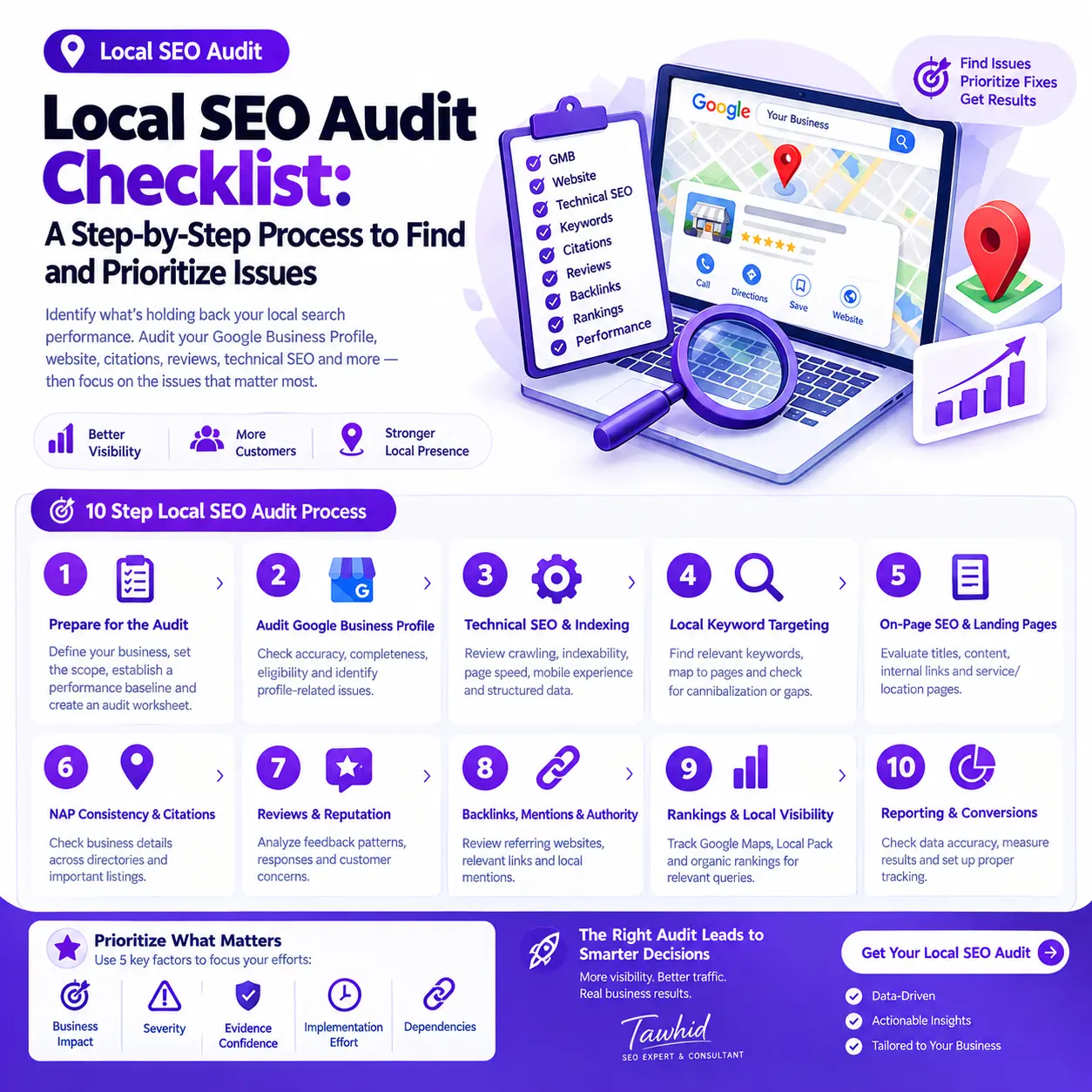
A local SEO audit helps you identify why a business may be struggling to appear in relevant local search results and determine which improvements deserve attention first. By reviewing Google Business Profile, website optimization, technical SEO, local keywords, business listings, reviews, backlinks, and performance data, you can uncover issues, validate their impact, and build a practical action plan.
However, finding problems is only part of the process. The real value of an audit comes from understanding what each issue means for the business, which evidence supports the diagnosis, and what should be fixed first.
Whether you manage a single-location business, a service-area business, or a company operating across multiple locations, this local SEO audit checklist will help you evaluate your current performance and make more informed optimization decisions.
What Is a Local SEO Audit?
A local SEO audit is a systematic evaluation of a business’s website, Google Business Profile, business information, online reputation, external references, and search visibility to identify problems and opportunities affecting local search performance.
Unlike a general SEO audit, a local SEO audit gives particular attention to geographic relevance, local search intent, business-location information, Google Maps visibility, and the relationship between a business’s online presence and its actual operations.
Google identifies relevance, distance, and prominence as the main factors behind local results. Relevance describes how well a business matches the search, distance concerns its proximity to the searcher’s location, and prominence relates to how well-known the business is. These factors help explain local search behavior, although Google’s complete ranking systems are not publicly disclosed.
You can review Google’s official explanation in its guide to improving local rankings.
A well-conducted audit should help answer five questions:
- Can search engines discover and index the important pages?
- Does the business information accurately represent the business?
- Do the website and its pages match relevant customer searches?
- Are there meaningful problems with local visibility, reputation, or authority?
- Which issues should be addressed first, and how will the results be checked?
The objective is not to collect the longest possible list of warnings. It is to identify meaningful issues and turn them into actionable improvements.
Quick Local SEO Audit Checklist
Use this overview to organize your audit before examining each area in detail.
Audit area | What to check | Evidence to collect |
Google Business Profile | Eligibility, categories, business details, verification, restrictions | Current profile information and relevant policy or account notices |
Technical SEO | Crawling, indexability, status codes, canonicals, redirects | Search Console reports, URL inspections, and crawl results |
Local keywords | Search intent, service coverage, keyword-to-page mapping | Search queries, page data, and keyword research |
On-page SEO | Titles, headings, content relevance, internal links | Important landing pages and their current content |
Business listings | NAP accuracy, duplicates, important citations | Verified business details and directory records |
Reviews and reputation | Feedback patterns, responses, customer concerns | Public reviews and documented response practices |
Backlinks and mentions | Relevant referring websites, earned links, brand mentions | Backlink reports and manually verified opportunities |
Local rankings | Google Maps, Local Pack, and organic visibility | Consistent tracking across relevant queries and locations |
Performance measurement | Search traffic, profile interactions, leads | Search Console, analytics, and available profile performance data |
This is a diagnostic checklist, not a universal ranking formula. A business does not automatically need to change something simply because it appears in the table. Every finding should be evaluated against actual evidence and business priorities.
Step 1: Prepare for the Local SEO Audit
Before examining individual SEO elements, establish what you are auditing, which outcomes matter, and what the current performance looks like.
Without this preparation, it is easy to confuse normal variations with problems or spend time optimizing pages that have little relevance to business goals.
Define the Business and Audit Scope
Begin by documenting the business model and the search presence you need to evaluate.
Identify:
- The core products or services offered.
- The business’s legitimate operating locations or service areas.
- The primary website and its important service or location pages.
- The relevant Google Business Profile or profiles.
- The main competitors appearing for important searches.
- The business’s primary objectives, such as calls, bookings, inquiries, or visits.
A physical storefront, a service-area business, and a multi-location company may need different audit procedures. For example, a service-area business must represent its operating model correctly, while a multi-location business may require individual checks of eligible profiles and relevant location pages.
Do not create artificial locations or profiles to expand search coverage. The audit should reflect the business as it genuinely operates.
Establish a Performance Baseline
Before making changes, record the website’s current search and business performance wherever suitable data is available.
Use Google Search Console to review relevant search queries, impressions, clicks, and landing pages. Use Google Analytics 4 if it is configured to measure website activity and conversions. Review Google Business Profile performance data where available.
Look for:
- Queries that already attract relevant impressions.
- Important pages receiving organic traffic.
- Pages with meaningful impressions but relatively few clicks.
- Changes in traffic, leads, or search visibility.
- Unusual drops or changes that correspond with website updates.
- Missing or unreliable conversion tracking.
A decline is a reason to investigate, not proof of a penalty or a specific technical fault. Search demand, competition, geographic context, seasonality, and changes in measurement can all influence observed performance.
Record the dates and metrics you use so that later comparisons are consistent.
Create an Audit Worksheet
Maintain one central spreadsheet rather than keeping findings in scattered notes.
Recommended columns:
Audit Area | Page or Profile | Finding | Evidence | Business Impact | Confidence | Effort | Priority | Recommended Action | Status | Validation Result
For example, if Search Console indicates that an important service page is not indexed, record the URL, the indexing information, the likely business consequence, and the next diagnostic step.
Do not immediately label the page as having an indexing error that requires correction. First determine why it is not indexed and whether that outcome is appropriate.
This distinction between an observation and a confirmed issue makes the entire audit more reliable.
Step 2: Audit Google Business Profile
Google Business Profile is a fundamental part of local SEO for eligible businesses. Incorrect information, inappropriate categories, duplicate profiles, or policy violations can create problems for search visibility and customer trust.
Start by confirming that the profile accurately represents the real business.
Check Business Profile Eligibility and Accuracy
Review the following items:
- Business name: It should reflect the name used consistently in the real world, rather than extra keywords added for rankings.
- Primary category: It should accurately represent the business’s core activity.
- Additional categories: Include only relevant categories that genuinely describe the business.
- Address and service area: Confirm that the information matches the business’s actual operating model.
- Phone number: Check that customers can reach the business through the provided number.
- Website URL: Ensure the link leads to an appropriate page representing the business.
- Opening hours: Verify regular and applicable special hours.
- Services and attributes: Review applicable details for accuracy and relevance.
- Verification and restrictions: Investigate unresolved verification issues, suspensions, or other notices.
- Duplicate profiles: Check whether unnecessary duplicate listings may be confusing customers or creating policy problems.
Google’s Business Profile guidelines explain how businesses should represent themselves, including requirements for names, addresses, categories, service areas, and profiles.
Review Profile Completeness and Customer Experience
After checking accuracy and eligibility, review whether the profile provides useful information for customers.
Examine available photos, business descriptions, services, hours, and other relevant profile details. Make sure customers can understand what the business offers and how to contact it.
Completeness should serve a real purpose. Adding unnecessary information, using irrelevant categories, or repeatedly editing profile details without a clear reason does not constitute an effective optimization strategy.
Investigate Significant Profile Problems
Examples of findings that deserve further investigation include:
- Incorrect contact details that prevent customers from reaching the business.
- An inappropriate category that misrepresents its main activity.
- An unresolved suspension or verification problem.
- A duplicate profile that needs careful review.
- An address or service-area configuration that does not reflect the actual business.
Do not assume that every incomplete field is a ranking problem. Separate factual errors, policy issues, and meaningful customer-experience gaps from optional enhancements.
Next step: When the audit reveals substantial profile-optimization needs, explore my Google Business Profile Optimization service.
Step 3: Audit Technical SEO, Crawling, and Indexing
A website can contain relevant content and useful services yet still have search visibility problems if important pages are difficult to access, incorrectly configured, or not indexed.
Technical SEO checks help determine whether the website’s underlying structure supports the pages you want search engines to discover.
Check Important Pages in Google Search Console
Open Google Search Console and inspect the status of important URLs, such as:
- The homepage.
- Core service pages.
- Important location pages, where applicable.
- High-value informational content.
- Pages that have recently lost visibility.
Use the URL Inspection tool to investigate individual URLs, and review the Page Indexing report when it is useful for understanding broader patterns.
Google’s Page Indexing report documentation explains how to investigate indexing status and interpret reasons that pages may not be indexed.
Remember that not every excluded URL is a problem. Duplicate URLs, deliberately excluded pages, redirects, and other cases may be entirely appropriate. Concentrate on important pages whose intended indexation does not match their actual status.
Review Crawlability and Indexability
Check whether important pages can be crawled and whether search engines are receiving the intended indexing instructions.
Investigate:
- Accidental noindex directives.
- Robots.txt rules that block important resources or URLs.
- Unexpected HTTP errors.
- Incorrect canonical tags.
- Redirect chains and redirect loops.
- Broken internal links.
- Important pages missing from the internal-link structure.
- Sitemap entries that include inappropriate or redirected URLs.
An XML sitemap can help communicate which URLs you consider important, but submitting a URL does not guarantee that Google will index it.
Check Page Performance and Mobile Experience
Review representative pages with tools such as PageSpeed Insights.
Consider:
- Whether the page loads and works properly on mobile devices.
- Whether the main content is accessible.
- Whether large images or scripts cause avoidable delays.
- Whether intrusive elements make important information difficult to use.
- Whether performance issues materially affect the user experience.
Do not treat every poor laboratory performance score as a confirmed ranking problem. Interpret the diagnostic evidence alongside the real page experience and the impact on customers.
Validate Structured Data Where Relevant
If the website uses LocalBusiness or other applicable structured data, inspect whether the markup accurately represents the visible content.
Check for:
- Incorrect business details.
- Invalid properties or formatting.
- Markup that does not match the page.
- Structured data added to inappropriate pages.
- Unnecessary or misleading markup.
Google’s LocalBusiness structured data documentation provides guidance on supported properties and implementation requirements.
Structured data can help search engines interpret certain information and can make pages eligible for applicable search features. It does not guarantee enhanced search appearances or higher rankings.
Prioritization tip: An unintended indexing restriction affecting an important service page usually deserves attention before an optional technical refinement. Confirm the issue and its consequences before changing the page.
Step 4: Audit Local Keyword Targeting
Local keyword research helps connect what potential customers search for with the pages that can satisfy their needs.
The purpose of this audit is not to insert more keywords into the website. It is to establish whether the business targets relevant searches and provides appropriate destinations for them.
Identify the Business’s Important Search Topics
Start with the main services and customer needs the business genuinely serves.
Research relevant variations such as:
- Core service searches.
- Service-plus-location queries, where geographic intent is relevant.
- Branded searches.
- Commercial searches comparing providers or evaluating options.
- Informational questions that support customers’ decisions.
Use Google Search Console query data where available, supported by keyword research and competitor analysis.
Consider the meaning behind a search, not only its wording. Two phrases that look different may represent essentially the same need, while similar-looking queries can require different pages.
Map Keywords to Appropriate Pages
Create a keyword-to-page map for the most important search topics.
Search intent | Appropriate destination | Problem to investigate |
Main service | Relevant service page | No clear page matches the service intent |
A legitimate location-specific service | Useful, relevant location page | The page does not adequately address the location-related need |
Brand search | Homepage or appropriate brand page | Important brand information is unclear or inconsistent |
Informational question | Relevant educational article | The site lacks a useful resource addressing the question |
This mapping can reveal content gaps, overlapping pages, and cases where a page is targeting an unsuitable search intent.
Identify Keyword Cannibalization and Content Gaps
If multiple pages appear to target the same intent, examine their actual content and performance before deciding whether they should be consolidated, differentiated, or left unchanged.
Overlapping keywords alone do not prove cannibalization. The important question is whether the pages serve distinct purposes or whether their duplication creates confusion for readers and a weak content structure.
Similarly, do not create a separate page for every keyword variation. Build pages around meaningful services, locations, and customer needs.
For a deeper process, see my Local Keyword Research service.
Step 5: Review On-Page SEO and Local Landing Pages
Once you understand the relevant search topics, examine whether the website’s pages communicate the right information and satisfy the intended search needs.
Check Titles, Headings, and Page Content
Review important pages for:
- Descriptive page titles.
- Accurate meta descriptions.
- One clear primary heading.
- Logical supporting headings.
- Useful and relevant content.
- Clear descriptions of services and offerings.
- Accessible contact information.
- Appropriate internal links.
- Images and supporting media that genuinely help visitors.
Avoid optimizing pages around keyword-density targets. A page can mention a phrase repeatedly and still fail to answer the reader’s question.
The goal is to make the page’s purpose clear and provide enough information for customers to evaluate the business’s offering.
Evaluate Service and Location Pages
A service page should explain what the business provides, who the service is for, and any important details customers need before making a decision.
A location page should exist because it serves a real location-related need. Depending on the business, useful information might include the services available at that location, genuine operating details, relevant contact information, or meaningful differences in the offering.
Be cautious of pages created by swapping city names while leaving the rest of the content substantially identical.
Google’s spam policies describe doorway abuse, including substantially similar pages created to capture similar regional queries and funnel visitors to the same destination.
Adding a geographic phrase does not automatically create a useful location page.
Review Internal Links and Website Structure
Check whether users and search engines can discover important service pages through logical navigation and contextual links.
For example, an informational article about a particular service should link naturally to the relevant service page when doing so helps the reader understand the next step.
Look for:
- Important pages with few or no internal links.
- Relevant content that fails to link to its associated service page.
- Descriptive anchor text that explains the destination.
- Broken links and unnecessary redirect chains.
- Pages that are difficult to reach through the site’s structure.
Avoid linking every page to every other page. Internal links should help readers navigate naturally and clarify the relationship between related content.
My Local On-Page SEO service covers the page-level optimization work that may be needed after this part of the audit.
Step 6: Audit NAP Consistency and Local Citations
NAP stands for name, address, and phone number. Accurate business information across important online references helps customers identify and contact the correct business.
An audit should focus on finding meaningful discrepancies, rather than trying to make every mention of the business identical in every minor detail.
Check Core Business Information
Use a verified source of business information to compare key details across:
- The business website.
- Google Business Profile.
- Important industry directories.
- Relevant local or professional associations.
- Other significant listings that customers may use.
Investigate incorrect phone numbers, outdated addresses, old business names, duplicate listings, and links that point to unrelated or outdated destinations.
For businesses with multiple locations, ensure that each listing corresponds to the correct legitimate location.
Prioritize Important Listing Errors
Not every citation deserves the same attention.
A wrong phone number on a major customer-facing listing may be more consequential than a minor formatting difference on an obscure directory.
Prioritize corrections based on accuracy, visibility, customer impact, and the credibility of the listing.
Do not submit the business indiscriminately to hundreds of directories. Focus on relevant, trustworthy sources rather than citation volume alone.
Document the listing URL, the discrepancy, the correct information, and whether the correction has been completed.
If you need help correcting or building relevant listings, see my Local Citation Building service.
Step 7: Review Customer Reviews and Online Reputation
Reviews provide useful evidence about how customers perceive the business and where the customer experience may need attention.
A reputation audit should investigate feedback patterns and response practices rather than focusing exclusively on the average star rating.
What to Check
Review:
- The volume and recency of feedback on relevant platforms.
- Repeated themes in positive and negative reviews.
- Whether customer concerns receive appropriate responses.
- Whether reviews reveal recurring service or communication problems.
- Whether review-management practices comply with relevant platform policies.
- Whether the business’s public responses are professional and useful.
Where relevant, compare public feedback patterns with competing businesses, but avoid assuming that every difference in review count causes a particular ranking difference.
Turn Review Findings Into Action
If customers repeatedly mention unclear communication, missed appointments, or inconsistent service, the audit should identify the underlying operational problem where possible.
Encourage genuine customer feedback without manipulating the process.
Avoid buying reviews, offering prohibited incentives, suppressing legitimate criticism, or selectively soliciting reviews only from satisfied customers. Such practices undermine trust and can violate platform policies.
A review audit is most useful when it leads to better customer experiences, more appropriate responses, and a sustainable approach to gathering honest feedback.
For further support, explore my Reputation Management service.
Step 8: Review Local Backlinks, Mentions, and Authority
A backlink audit helps evaluate how other websites refer to the business and whether there are legitimate opportunities to improve its online visibility.
The goal is to understand the quality and relevance of the website’s external references, not simply to increase the number of backlinks.
Examine the Existing Link Profile
Use an appropriate backlink-analysis tool to inspect:
- Referring websites and the pages linking to the business.
- Links pointing to important service and location pages.
- Links from relevant publications, organizations, or industry sources.
- Obvious patterns of manipulative link acquisition.
- Links that appear to have been earned naturally through useful work or resources.
Third-party metrics can help organize investigation, but they are not Google’s private ranking scores.
Do not assume that a low third-party authority metric makes a link harmful or that every warning labeled “toxic” requires removal.
Identify Legitimate Opportunities
Investigate opportunities such as relevant industry associations, professional relationships, useful contributions to publications, community involvement, or original resources that others may reasonably want to reference.
The appropriate opportunities will depend on the business and its industry.
Avoid mass link acquisition, automated link schemes, and tactics intended primarily to manipulate rankings.
Document what exists, what deserves further investigation, and which opportunities have a clear business rationale.
My Local Link Building service provides a relevant next step for businesses that need support with a legitimate local link-building strategy.
Step 9: Audit Google Maps, Local Pack, and Organic Rankings
A local search audit should examine different search surfaces separately. Google Maps visibility, Local Pack appearances, and traditional organic rankings are related, but they are not interchangeable.
Track Relevant Queries Consistently
Choose searches that represent actual services, customer needs, and relevant business locations.
Record:
- The exact search query.
- The date of observation.
- The search surface being evaluated.
- The location or geographic point used for the measurement.
- The observed competitors and relevant landing pages.
- Any notable change compared with previous observations.
For multi-location or geographically dispersed businesses, a suitable local rank-tracking tool may help compare visibility across representative geographic points.
A single ranking check cannot establish how visible a business is throughout an entire service area.
Compare the Business With Relevant Competitors
Look for meaningful differences in areas such as:
- Relevance of service pages to the queries being targeted.
- Quality and usefulness of landing-page content.
- Accurate business information and appropriate profile categories.
- Customer feedback patterns.
- Relevant links, mentions, and other observable sources of authority.
- Website structure and the discoverability of important pages.
Use these comparisons to develop hypotheses worth testing. Do not assume that every difference between two businesses is a ranking factor or that copying a competitor’s strategy will produce the same results.
Interpret Geographic Variation Carefully
Local results may differ depending on the searcher’s location, the relevance of the business to the query, and other contextual factors.
For example, a business may appear prominently near its operating location but less prominently farther away. This does not automatically indicate a technical SEO problem.
For more detailed guidance, see my Google Maps SEO service.
Step 10: Check Local SEO Reporting and Conversion Tracking
The final audit area examines whether you can measure the outcomes that matter to the business.
Visibility is useful, but it does not tell the entire story. A business also needs to understand whether relevant search activity contributes to meaningful customer actions.
Review the Available Data
Depending on the tools and tracking in place, evaluate:
- Search impressions and clicks for relevant queries.
- Organic landing-page performance.
- Website actions and conversions.
- Leads, bookings, or form submissions.
- Available Google Business Profile performance metrics.
- Trends over time using consistent reporting periods.
Google explains the available information in its guide to Business Profile performance.
Check whether conversion tracking works before drawing conclusions from it. Missing events, duplicate tracking, inconsistent attribution, and incomplete reporting can create a misleading view of performance.
Choose Measures That Match the Business Goal
Different metrics answer different questions.
Business question | Useful evidence |
Are relevant searches finding the website? | Search Console queries, impressions, and clicks |
Can Google discover important pages? | URL Inspection and relevant indexing information |
Is local visibility changing? | Consistent local search and map-visibility observations |
Are customers interacting with the profile? | Available Business Profile performance data |
Is organic traffic contributing to leads? | Properly configured analytics and conversion tracking |
Are changes producing the intended outcome? | Repeated measurements using comparable periods and definitions |
Do not claim that a particular fix caused a performance improvement merely because the two occurred close together. Consider other possible explanations and retain the evidence needed to evaluate the result.
At the end of this step, your audit should provide a clear record of issues, supporting evidence, recommended actions, and suitable ways to validate each correction.
How to Prioritize Local SEO Audit Issues
Completing the checklist may reveal numerous problems, but they will not all have the same business impact.
An effective audit distinguishes significant issues from minor improvements and uncertain observations. Otherwise, a business may spend time polishing small details while more consequential problems remain unresolved.
I recommend using five considerations to prioritize the findings.
1. Business Impact
Ask how closely the issue relates to an important service, customer journey, or business objective.
A problem affecting a major service page may matter more than an issue on a page that contributes little to the business’s goals.
2. Severity
Consider the extent of the problem.
An important page that is unintentionally blocked from indexing can deserve more urgent attention than a minor content improvement. An incorrect phone number may also deserve immediate attention because customers cannot reach the business through it.
3. Evidence Confidence
Determine how certain you are that the issue exists and that the proposed action is appropriate.
A reproducible error or verified discrepancy is stronger evidence than a third-party warning whose significance is unclear.
Investigate uncertain findings before investing substantial time or resources in them.
4. Implementation Effort
Estimate the resources required to resolve the issue. Some corrections may be straightforward, while others require development, content restructuring, platform support, or coordination among multiple people.
Effort matters when planning work, but it should not override a high-impact problem simply because the problem is difficult to fix.
5. Dependencies
Determine whether another task needs to be completed first.
For example, resolving a canonicalization problem or an indexing restriction may need to precede detailed content refinement on the affected page.
A Practical Priority Matrix for Local SEO Findings
Use these categories to organize the audit. They are a project-management framework, not an official Google ranking formula.
Priority | Meaning | Example |
P0 — Critical | Requires immediate investigation because a serious problem affects customers, eligibility, or access to important business assets | An unresolved profile restriction or incorrect contact details preventing customers from reaching the business |
P1 — High | A verified issue materially affects an important page, service, or business objective | An important page unintentionally excluded from indexing |
P2 — Medium | A meaningful improvement with a credible rationale but less immediate impact | A relevant service page needs additional content to satisfy customer intent |
P3 — Low / Monitor | A minor opportunity, low-impact issue, or finding that needs more evidence | An isolated tool warning without an established consequence |
Priorities should reflect the actual circumstances of the business. Not every technical warning deserves P0 status, and a task that is minor for one business may be important for another.
Turn the Priorities Into an Action Plan
For each finding, record:
- The problem and affected URL, profile, or listing.
- The evidence that confirms the problem.
- Its likely business consequence.
- The recommended corrective action.
- The person responsible and any dependencies.
- The validation method.
- The metric or outcome to monitor, where relevant.
For example, imagine a business discovers that an important service page has an unintended indexing restriction and that another page has a slightly weak meta description.
After verifying both observations, the indexing problem would normally receive attention first because it may prevent the intended page from being indexed. The title and description improvement can follow if it is still appropriate.
This approach keeps the plan focused on the problems most likely to matter rather than the order in which a software tool presents its warnings.
Which Tools Do You Need for a Local SEO Audit?
You can complete many meaningful audit checks without purchasing an expensive SEO platform. The right tool depends on the question you are trying to answer.
Free or Foundational Tools
Google Search Console: Use it to examine search queries, page performance, indexing information, and URL-level diagnostics.
Google Business Profile performance: Review the performance information available for eligible profiles.
Google Analytics 4: Measure website engagement and conversions when tracking is properly configured.
PageSpeed Insights: Investigate page-performance issues and relevant user-experience diagnostics.
Structured-data testing tools: Validate applicable structured data and investigate supported rich-result requirements.
Manual checks: Verify important business listings, review customer feedback, inspect landing pages, and compare how relevant competitors communicate their services.
The availability and usefulness of particular metrics depend on the website, profile, configuration, and tool.
When Paid SEO Tools Are Useful
Paid platforms may make audits more efficient when a website has many pages, a business operates multiple locations, or extensive competitor and backlink analysis is required.
Useful tool capabilities include:
- Website crawling and technical issue reporting.
- Local keyword research and competitive analysis.
- Geographic rank tracking.
- Citation discovery and listing management.
- Backlink analysis and reporting.
Choose tools based on data coverage, accuracy for your use case, usability, export capabilities, and cost.
Do not treat a proprietary health score, authority score, or automated opportunity rating as an official measure of Google’s assessment.
Can You Perform a Local SEO Audit for Free?
Yes. First-party Google tools, manual verification, and a well-organized spreadsheet can uncover many meaningful problems.
Paid tools can save time and help scale the process, but they do not replace sound diagnosis. A carefully verified issue is more useful than a long list of unexplained warnings.
Common Local SEO Audit Mistakes to Avoid
Even a detailed checklist can lead to poor decisions if the findings are interpreted incorrectly.
Treating Every Tool Warning as a Ranking Problem
Automated tools identify possible issues, not necessarily the cause of weak search performance.
Verify the finding, determine whether the affected page or asset matters, and establish whether the recommended correction is appropriate.
Focusing Only on Google Business Profile
A profile review can miss website indexing problems, weak landing pages, poor search-intent alignment, incorrect citations, or measurement gaps.
Evaluate the wider search presence while keeping the business profile’s requirements and goals in view.
Attempting to Make Every Citation Identical
Accurate business information matters, but harmless formatting differences do not automatically indicate a serious problem.
Prioritize important, customer-facing listings and verified discrepancies rather than chasing every minor variation.
Adding Keywords to Business Names or Creating Duplicate Profiles
Google requires business profiles to reflect the actual business. Adding unnecessary keywords to a name or creating duplicate profiles can violate its guidelines.
Follow the official Business Profile representation requirements instead of using shortcuts intended to manipulate visibility.
Publishing Thin Location Pages
Creating large numbers of substantially similar pages simply to target different geographic terms can result in doorway abuse.
Publish location-specific pages when they serve legitimate user needs and provide useful, accurate information. Do not treat the number of pages as a substitute for quality.
Trusting One Ranking Check
A single observation may not represent visibility across the relevant market.
Use a consistent tracking process and account for the search surface, query, and observation location when comparing results.
Expecting Guaranteed Results
An audit can identify problems and support better decisions, but it cannot guarantee rankings, traffic, leads, or revenue. Results depend on multiple factors, including competition, geographic context, implementation quality, and changes in search systems.
The purpose of a responsible audit is to improve the quality of diagnosis and decision-making, not to promise a particular outcome.
When Should You Repeat a Local SEO Audit?
A local SEO audit should be repeated when the circumstances justify a new investigation. There is no single schedule that suits every business.
A quarterly review can be a practical starting point for some businesses, but important changes may require an earlier audit.
Consider a targeted review after:
- A website migration or major redesign.
- A business move or a change to legitimate operating locations.
- A significant change in services.
- An important profile restriction or business-information discrepancy.
- A sustained decline in relevant search performance.
- Major changes to page structure or indexing instructions.
- Expansion into new services or markets.
You do not need to repeat every check every time. The scope should reflect what has changed and what the previous audit identified.
Verify Completed Fixes
A task is not complete simply because someone marks it as finished.
Confirm the intended correction using suitable evidence. For example:
- Reinspect a URL after resolving an indexing issue.
- Check a listing after correcting its business details.
- Verify the relevant profile information after an approved change.
- Test a form or booking journey after modifying conversion tracking.
- Compare search performance over an appropriate period after implementation.
Technical fixes may be verifiable immediately, while the impact on search visibility or business outcomes may require more time and careful comparison.
Keep the original finding, the action performed, and the validation result together. This creates a useful record for future audits.
Frequently Asked Questions About Local SEO Audits
How often should you conduct a local SEO audit?
A local SEO audit can be reviewed on a recurring schedule suited to the business, with additional checks after significant changes. A quarterly review is one possible starting point, not a universal Google requirement. Reaudit sooner after a migration, business move, profile restriction, or sustained decline in relevant visibility or leads.
How long does a local SEO audit take?
The time required depends on the website’s size, number of locations, technical complexity, quality of available data, and scope of the investigation. A focused review of a small single-location business may be straightforward, while a large website or multi-location organization requires more extensive analysis. Audit quality depends on evidence and coverage, not time alone.
Can you conduct a local SEO audit for free?
Yes. Google Search Console, available Business Profile performance data, configured analytics, manual website checks, and a spreadsheet can help uncover many meaningful problems. Paid tools may improve efficiency for crawling, citation analysis, rank tracking, and competitor research, but they do not replace evidence-based diagnosis.
Why do local search rankings differ by location?
Local search results can vary because Google considers factors such as relevance, distance, and prominence. A business may appear more prominently near its operating location than farther away. For a useful comparison, track representative queries across a consistent set of relevant locations rather than relying on one search observation. See Google’s local ranking guidance.
Does fixing every issue guarantee higher local rankings?
No. Correcting verified issues can improve the underlying condition of a website or business profile, but rankings are also influenced by competition, geographic context, relevance, prominence, and other factors. A responsible audit prioritizes evidence-based improvements without guaranteeing specific positions, traffic increases, or business results.
Need Help Prioritizing Your Local SEO Issues?
A local SEO audit is most useful when it leads to clear decisions and an actionable plan. You should know which issues are confirmed, which need further investigation, which matter most to your business, and how to validate the corrections.
If you have completed the checklist but are unsure what to fix first, my Local SEO Audit service can help you investigate your website and local search presence, evaluate the evidence, and identify practical next steps.
As an SEO Expert & Consultant, I focus on understanding the underlying problems before recommending an approach. The appropriate strategy depends on your website, business model, legitimate operating locations, competitive environment, and goals.
Ready to understand what’s holding back your local search performance? Explore my Local SEO Audit service to find a suitable next step for your business.