
Local Link Building Strategies That Earn Relevant Backlinks

Freelancer Tawhid
SEO Expert and Consultant
- October 14, 2026
- No Comments
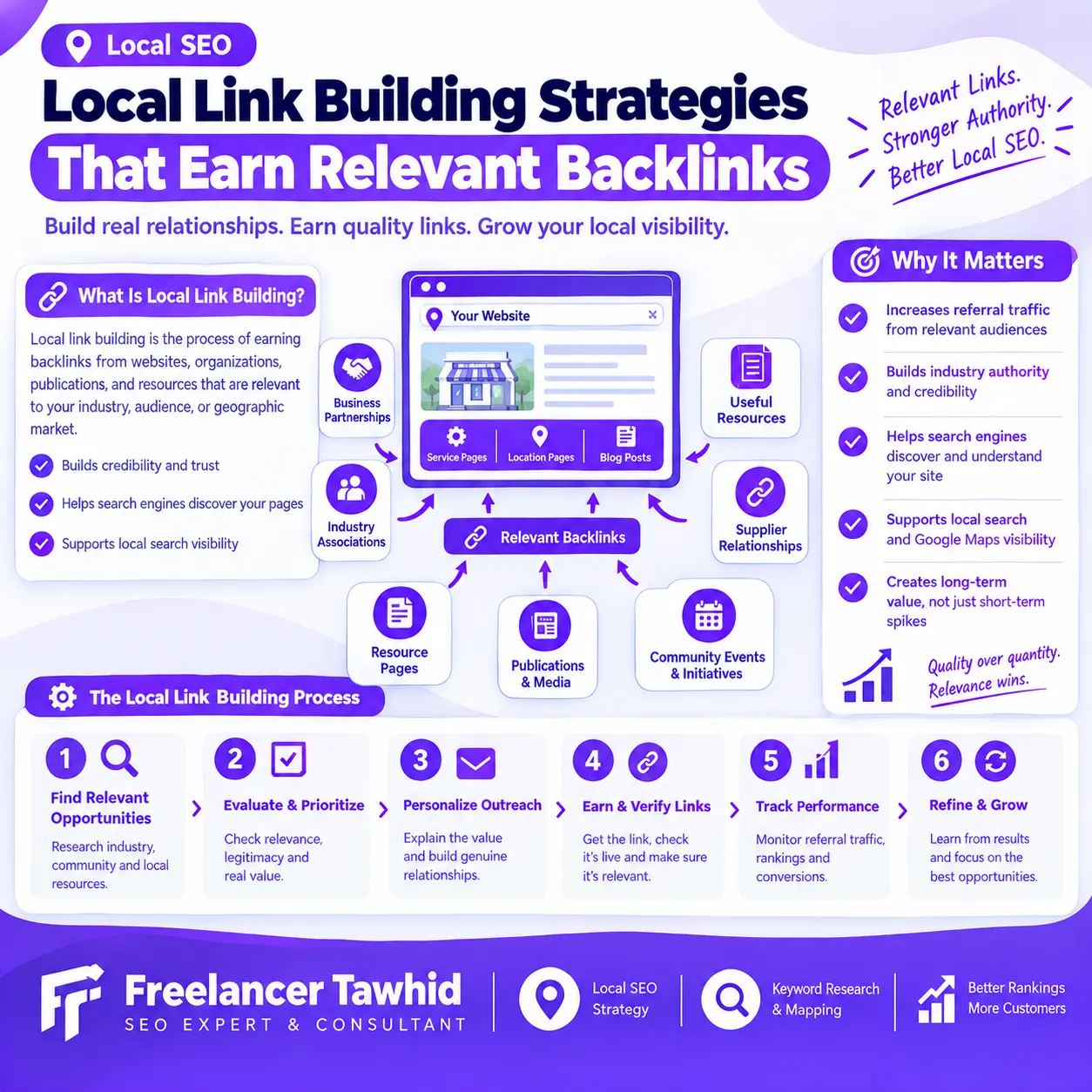
Local link building is the process of earning backlinks from websites, organizations, publications, and resources that are relevant to a business’s industry, audience, or geographic market. The most useful opportunities come from genuine relationships, valuable resources, editorial coverage, and meaningful participation in a community—not simply collecting as many links as possible.
For local businesses, earning relevant backlinks can be challenging. Some opportunities require relationship building, others require useful content, and many outreach attempts never result in a link. The solution is to prioritize opportunities that make sense for the business and provide a legitimate reason for another website to reference it.
In this guide, you’ll learn how to identify relevant backlink opportunities, evaluate potential referring websites, implement practical local link-building strategies, conduct outreach, avoid risky tactics, and measure your results.
What Is Local Link Building, and Why Does Relevance Matter?
Local link building is the process of earning backlinks from websites connected to a business’s industry, community, audience, or service market. These links can come from relevant publications, professional associations, suppliers, community organizations, resource pages, and other legitimate websites.
A backlink is a hyperlink from one website to another. When another website links to a page on your website, it creates a pathway for readers to discover your content and can help search engines discover and understand pages.
Google explains that links help it discover pages and understand their relevance. However, not every backlink provides the same practical value, and no individual link guarantees improved rankings.
What Makes a Backlink Relevant to a Local Business?
Backlink relevance is best evaluated through several connected factors.
- Geographic relevance
The referring website has a genuine connection to the business’s market. It might serve a relevant community, publish regional information, or represent an organization operating within the business’s service area.
- Topical relevance
The website or specific page relates to the business’s industry, expertise, services, or subject matter.
For example, a home-improvement resource referencing a qualified contractor may have a clearer topical connection than an unrelated entertainment website.
- Audience relevance
The website reaches people who could reasonably benefit from discovering the business or its resources.
- Editorial relevance
The link belongs naturally within the content. It provides a useful reference, supports a statement, or helps readers take an appropriate next step.
These factors are practical evaluation criteria, not an official Google scoring formula. A relevant link does not automatically produce a ranking improvement, and a website does not need to be physically nearby to be a useful referring source.
Local Backlinks vs. Local Citations
Local backlinks and citations are related but different.
A backlink is a clickable hyperlink pointing to a website. A local citation is a mention of business information, commonly its name, address, and phone number, on another website. A citation may include a link, but it does not have to.
Consider two hypothetical examples:
- A professional association publishes a member profile containing a link to a business’s website.
- A business directory displays the company’s name and contact details without a clickable website link.
The first example includes a backlink and may also serve as a citation. The second is a citation without a backlink.
Both may have legitimate uses, but they should not be evaluated as interchangeable SEO activities. If your business needs help maintaining relevant business listings, explore the appropriate citation-building service within your Local SEO strategy.
How Local Link Building Fits Into a Wider Local SEO Strategy
Backlinks are one part of a broader Local SEO strategy. They should complement relevant website content, technical accessibility, useful service pages, accurate business information, and a good experience for potential customers.
A business may earn relevant backlinks but still struggle to attract qualified visitors if its website has confusing navigation, weak service pages, or content that does not address customer needs.
Similarly, strong on-page optimization does not eliminate the need to build a credible online presence.
For a broader view of how these activities work together, explore Local SEO services and strategy.
How to Identify a High-Quality Local Backlink Opportunity
Before contacting a website, evaluate whether the opportunity is relevant, legitimate, and worth pursuing.
A backlink prospect is not automatically valuable because a third-party tool reports a high authority score. The actual website, the proposed linking page, the audience, and the method of acquisition all matter.
Evaluate the Website, Not Just Its Authority Score
SEO tools provide metrics such as Domain Rating, Domain Authority, and other estimates of backlink strength. These metrics can help compare prospects within a tool, but they are not Google ranking scores.
Review the following questions before deciding whether to pursue a link:
- Does the website have a clear purpose and identifiable audience?
- Does it publish useful, relevant content?
- Is the specific page related to your business or its audience?
- Do its outbound links make sense in context?
- Does the website appear to exist primarily to sell backlinks?
- Could the link help readers discover a useful business, resource, or service?
- Can the link be earned without manipulative practices?
A website with modest third-party metrics may be a strong prospect if it serves the right audience and provides a legitimate editorial opportunity.
Conversely, a high-metric website may be a poor choice if its subject matter is unrelated or its pages contain large numbers of artificial commercial links.
Assess Geographic, Industry, and Audience Fit
The best prospects depend on the business and its customers.
For example:
- A contractor might be relevant to a home-improvement resource or a complementary building-services provider.
- A restaurant might be relevant to a legitimate dining guide or a regional food publication.
- A professional practice might qualify for a reputable industry association directory.
- A service provider might contribute useful information to a publication serving the same professional audience.
These are illustrative examples, not claims that such placements are available or guaranteed.
The important question is not simply, “Is this website local?” Ask instead, “Does this website have a genuine reason to reference this business or resource?”
Use a Backlink Prospect Qualification Checklist
Before adding a prospect to your outreach list, evaluate it against the following criteria.
Factor | What to evaluate |
Relevance | Does the website or page relate to the business, industry, audience, or market? |
Legitimacy | Is it a genuine organization, publication, business, or useful resource? |
Editorial fit | Would the link make sense within the content? |
Audience value | Could readers benefit from visiting the linked page? |
Acquisition method | Can the link be earned without manipulating ranking signals? |
Effort and cost | Is the opportunity worth pursuing with the available resources? |
You can rate each factor as strong, moderate, or weak. Use the results to prioritize your work rather than treating the assessment as a scientific prediction of ranking impact.
How to Find Local Link-Building Opportunities Step by Step
A repeatable research process makes link building more manageable and helps prevent wasted outreach.
Step 1: Define Your Business, Audience, and Objectives
Start by identifying your core services, target customers, relevant market, and existing website resources.
Then decide what you want your link-building campaign to accomplish.
Possible objectives include:
- Earning editorial references from relevant websites.
- Improving the range of relevant referring domains.
- Helping potential customers discover useful resources.
- Attracting qualified referral traffic.
- Identifying and addressing gaps in your existing backlink profile.
Avoid starting with a fixed backlink quota. The right number of opportunities depends on your competitive environment, existing profile, resources, and business goals.
Step 2: Review Your Existing Backlinks
Before searching for new opportunities, understand what your website has already earned.
Google Search Console’s Links report can help you review links that Google has identified. Third-party backlink tools can provide additional prospecting and historical data.
Look for:
- Relevant referring websites and pages.
- Pages on your website that already attract backlinks.
- Lost links that may be recoverable.
- Unlinked mentions of your business.
- Repeated or low-value link patterns.
- Gaps between your current profile and relevant competitors.
Remember that no single backlink database contains every link on the web. Different tools may report different results, so interpret the data as a useful sample rather than a complete record.
If you need a broader assessment of your website before prioritizing off-page SEO work, consider a Local SEO audit.
Step 3: Analyze Relevant Competitors’ Backlinks
Competitor backlink analysis can reveal opportunities that are difficult to find through ordinary searches.
Start with a small set of genuine competitors. These should be businesses competing for similar customers or search visibility, not simply websites operating in the same broad industry.
Look for referring pages associated with:
- Professional associations.
- Industry resources and directories.
- Relevant publications and interviews.
- Supplier and partner relationships.
- Useful educational content.
- Community initiatives and event coverage.
For every potential opportunity, ask why the competitor received the link.
Perhaps it contributed an expert quote, created a useful resource, participated in an event, or had an established relationship with the publisher.
Understanding the reason for the link is more useful than copying a competitor’s backlink list without considering relevance.
Step 4: Build a Prioritized Prospect List
Create a spreadsheet or use a lightweight customer relationship management tool to organize opportunities.
Useful fields include:
Field | Purpose |
Website and target page | Identifies the prospect and proposed placement |
Contact information | Helps locate the appropriate person or submission route |
Relevance notes | Explains why the opportunity makes sense |
Link opportunity | Records the proposed reference or contribution |
Outreach status | Tracks contacted, replied, accepted, declined, or pending |
Follow-up date | Helps manage communication |
Cost and effort | Supports prioritization |
Outcome | Records the final placement and relevant observations |
Illustrative example: Suppose you identify a relevant trade association, a complementary supplier, and an unrelated website advertising paid links. The first two might merit further research if you meet the eligibility requirements or have a genuine relationship. The third should not be prioritized simply because it promises a quick backlink.
Step 5: Choose the Most Realistic Opportunities First
Prioritize prospects where three conditions overlap:
- The website is relevant and legitimate.
- You have something useful to offer or a genuine reason to be referenced.
- The effort required is reasonable for the likely benefit.
Existing relationships, relevant resource pages, and genuine editorial opportunities are often practical starting points.
More ambitious digital PR campaigns may be worthwhile when you have original research, useful expertise, or a compelling story. However, they generally require more preparation and depend on editorial decisions outside your control.
Local Link-Building Strategies That Can Earn Relevant Backlinks
The following strategies provide different ways to earn legitimate backlinks. Not every method will suit every business, and none guarantees a link.
1. Earn Links Through Genuine Business Partnerships
Businesses often work with suppliers, complementary service providers, contractors, and professional partners.
These relationships may create natural opportunities for relevant references.
For example, a supplier might publish a useful directory of authorized partners, or a business might contribute expertise to a partner’s educational resource.
Start by identifying existing relationships where a reference would help customers. Explain what information or resource would be useful and allow the other organization to decide whether to link.
Do not make reciprocal links a mandatory condition of a partnership. Systematic link exchanges designed primarily to manipulate rankings can violate Google’s link spam policies.
2. Join Relevant Industry Associations and Directories
Professional associations, trade organizations, and legitimate business directories can provide useful discovery opportunities.
Research potential organizations before submitting your website.
Consider:
- Whether the organization is genuine and active.
- Whether your business qualifies for membership or inclusion.
- Whether its audience relates to your services.
- Whether the listing provides value beyond a backlink.
- Whether the fee is reasonable for the membership or exposure provided.
- Whether the directory appears to exist primarily to sell links.
A reputable association may be worthwhile even if its profile link is marked nofollow. Referral opportunities, professional credibility, and industry participation can have value independent of ranking credit.
Avoid submitting your website indiscriminately to hundreds of generic directories. Google identifies low-quality directory links among examples of link spam.
3. Create Resources That Organizations Genuinely Need
Useful resources can give other websites a legitimate reason to reference your business.
Potential assets include:
- Practical industry guides.
- Checklists that help people complete a task.
- Original research with transparent methodology.
- Educational resources that answer recurring questions.
- Helpful community or industry reference pages.
- Expert explanations of complicated topics.
Start with a real audience need rather than a list of keywords.
For example, a business serving property owners might develop a practical maintenance checklist. Relevant publishers could reference it if it provides useful information that their readers need.
The resource should be accurate, accessible, and sufficiently helpful to stand on its own. Creating thin pages solely to attract links is unlikely to provide lasting value.
4. Earn Editorial Mentions From Relevant Publications
Publications may link to a business when it contributes useful information, expert commentary, original research, or a genuinely newsworthy development.
Potential approaches include:
- Offering relevant expert commentary.
- Responding to legitimate journalist requests.
- Sharing original findings with a clear methodology.
- Providing an interview or useful explanation.
- Pitching a meaningful business or industry development.
- Contributing information that helps a publisher complete a story.
Research the publication’s audience and editorial standards before reaching out.
A generic press release sent to a large contact list is not a substitute for a compelling story. Neither is an exaggerated announcement created mainly to acquire backlinks.
Editorial decisions belong to the publisher. Your goal is to provide useful, verifiable information—not to demand a link.
5. Participate in Community Initiatives and Events
Genuine participation in professional events, educational initiatives, community projects, or nonprofit activities can create opportunities for legitimate coverage.
An organizer might publish a contributor profile, event recap, speaker biography, or resource page that references participating organizations.
Choose activities that align with your business values, expertise, and genuine interests.
Sponsorship can also provide legitimate advertising or visibility, but do not require a followed backlink in exchange for a donation or payment. Commercial links should be qualified appropriately.
Participation should have real value even if no backlink results.
6. Pitch Relevant Resource Pages and Curated Guides
Resource pages collect information that helps a specific audience find useful services, references, or educational materials.
To identify suitable opportunities:
- Search for resource pages related to your industry or audience.
- Review the actual page rather than relying on its title.
- Identify a gap your business or content could fill.
- Confirm that your resource is relevant and genuinely useful.
- Contact the editor with a concise, personalized suggestion.
For instance, a publisher maintaining a guide to industry resources might consider an original checklist if it fills a genuine gap.
Do not submit your website to unrelated pages simply because they accept suggestions. A relevant editorial fit matters more than the number of submission forms you can find.
7. Use Guest Contributions Selectively
Guest contributions can help demonstrate expertise and introduce useful information to a relevant audience.
The strongest opportunities involve publications that maintain genuine editorial standards and serve readers who can benefit from your knowledge.
A good contribution should:
- Address a specific audience need.
- Contain original insights or useful explanations.
- Meet the publisher’s editorial requirements.
- Disclose commercial relationships where appropriate.
- Include links only where they are relevant and permitted.
Avoid mass-produced guest posts published primarily to acquire keyword-rich backlinks. Google’s spam policies specifically address link schemes involving paid articles and guest posts intended to manipulate ranking signals.
The purpose should be useful publishing and legitimate audience development, not manufacturing links.
8. Recover Unlinked Mentions and Broken References
Sometimes a website mentions your business without linking to it. In other cases, a relevant page contains a broken link that could potentially be replaced with a suitable resource.
These are different opportunities, but both begin with research.
Unlinked mentions
Find existing references to your business and check whether a link would help readers access the correct website or resource.
Contact the publisher politely, explain the context, and ask whether adding a link would be useful. Do not assume that every mention should become a backlink.
Broken references
Review relevant resource pages for links that no longer work. If you have a genuinely suitable replacement, explain the issue and provide the correct resource.
Your page should serve the same purpose as the broken destination. A broken link to an industry guide, for example, is not an invitation to substitute an unrelated commercial landing page.
Neither method guarantees a placement, but both can identify opportunities where your request has a clear justification.
9. Develop Newsworthy Expertise Through Digital PR
Digital PR involves earning attention and references through useful stories, research, expert commentary, and other information that publishers may want to share.
For a business, possible starting points include original research, a useful industry analysis, a meaningful community initiative, or a clear expert explanation of an important issue.
A successful campaign needs a credible reason for publication. The data should be accurate, the methodology transparent, and the claims proportionate to the evidence.
Avoid fabricated statistics, exaggerated claims, and low-value press-release distribution designed mainly to create backlinks.
Digital PR can generate relevant editorial coverage, but results depend on the quality of the story, the intended audience, timing, and publisher interest.
Which Local Link-Building Strategy Should You Prioritize?
Use this comparison to choose a realistic starting point.
Strategy | Best suited to | Main limitation |
Business partnerships | Businesses with genuine professional relationships | Opportunities depend on existing relationships |
Associations and directories | Eligible businesses with relevant organizations available | Membership or listing costs may apply |
Useful resources | Businesses able to create genuinely helpful content | Requires research and content development |
Editorial outreach | Businesses with credible expertise or a compelling story | Publishers decide whether to cover it |
Resource-page outreach | Businesses with a relevant resource that fills a gap | Many prospects may decline |
Digital PR | Businesses with original insights or newsworthy information | More preparation and uncertain outcomes |
Unlinked mentions | Businesses already referenced by publishers | A link may not be appropriate or accepted |
Broken-link outreach | Businesses with a suitable replacement resource | Relevant broken-link opportunities may be limited |
You do not need to implement every strategy at once. Select the approaches that best match your resources, relationships, and business objectives.
How to Conduct Local Link-Building Outreach
Finding a good prospect is only part of the process. Your outreach needs to give the recipient a clear reason to consider the suggestion.
Research the Recipient Before Contacting Them
Read the specific page you want to reference and identify the person responsible for it, such as an editor, resource-page manager, organization representative, or webmaster.
Before sending an email, determine:
- What the page is intended to help readers accomplish.
- Why your resource or business is relevant.
- What information or reference you can contribute.
- Whether the recipient accepts suggestions or contributions.
- Whether you can explain the benefit without exaggeration.
This research makes your request more useful and helps prevent irrelevant outreach.
Write Personalized Outreach That Explains the Value
A practical outreach email can follow this structure:
- Address the recipient appropriately.
- Mention the specific resource or page you reviewed.
- Explain the relevant connection.
- Describe how your resource might help the audience.
- Make a simple, low-pressure request.
Illustrative outreach template
Subject: A resource suggestion for your [topic] guide
Hi [Name],
I was reading your [specific guide or resource page] and found the section about [relevant topic] useful.
I wanted to share [resource name], which covers [brief, accurate explanation of the resource]. It may be a helpful addition for readers looking for more information about [specific need].
Here’s the resource: [URL]
If you think it fits your page, please feel free to consider it.
Thank you for your time.
Best regards,
[Your Name]
Personalize the message for each recipient. Do not send the same generic request to hundreds of unrelated websites or imply that the recipient owes you a link.
Follow Up Professionally
A reasonable follow-up may be appropriate if the recipient has not replied. Keep it brief, relevant, and respectful.
Record the date, response, and next action in your outreach tracker. If the recipient declines or asks not to be contacted again, respect that decision.
If someone offers a paid placement, assess whether the advertising opportunity is worthwhile independently of SEO. Links included in paid placements should be qualified appropriately rather than purchased to pass ranking credit.
Which Local Link-Building Tactics Should You Avoid?
A sustainable campaign should focus on legitimate references, not artificial link volume.
Paid Links Intended to Manipulate Rankings
Paying for advertising, sponsorship, or promotional coverage is not inherently the same as manipulating search rankings. The problem arises when a link is purchased or arranged primarily to pass ranking credit in violation of Google’s policies.
Google recommends using rel=”sponsored” for paid placements. rel=”nofollow” remains an acceptable alternative for qualifying paid links.
See Google’s official guidance on qualifying outbound links.
Private Blog Networks and Automated Link Creation
Avoid artificial networks of websites created primarily to link to one another, automated link-generation services, and bulk submissions to low-quality directories.
These methods prioritize manufactured links over genuine editorial value and may violate Google’s spam policies.
Excessive Link Exchanges and Manipulative Anchor Text
There is a difference between a natural reciprocal reference and a systematic exchange designed primarily to manipulate rankings.
For example, two organizations may reasonably reference each other’s useful resources when those references benefit their respective audiences. That does not justify building a large network of pages whose principal purpose is exchanging ranking signals.
Anchor text should also describe the destination naturally. Repeating exact-match commercial keywords unnaturally across links is not a substitute for relevance or editorial justification.
Chasing Authority Scores and Backlink Counts
A high third-party authority score does not automatically make a link valuable. Nor does a large number of backlinks establish that a website has a strong or relevant backlink profile.
Evaluate the source, linking page, context, audience, and acquisition method. Focus on legitimate opportunities that make sense for the business.
For the current rules and examples, consult Google’s Search spam policies.
How to Measure Local Link-Building Results
Measuring results helps you understand which activities deserve more attention. It also prevents you from confusing the number of acquired links with the actual value of a campaign.
Track Acquired Backlinks and Referring Domains
Record each acquired backlink with its source URL, destination URL, acquisition date, placement context, and link attributes.
A backlink is an individual link. A referring domain is a domain that links to your website. One referring domain can provide multiple backlinks.
Monitor whether links remain live and whether the surrounding content continues to make sense. Do not assume that every lost link needs recovery or that every newly discovered link deserves action.
Google Search Console and third-party backlink tools can help you review different aspects of your backlink profile, but their reports may not match exactly.
Monitor Referral Traffic and Organic Search Performance
Where suitable analytics are available, review referral traffic from relevant websites and whether those visitors take meaningful actions.
You can also monitor organic search impressions, clicks, and performance for relevant pages and queries in Google Search Console.
Interpret these metrics carefully. Organic performance can change because of content updates, competition, technical issues, changes in search demand, and other factors. It is often difficult to isolate the effect of an individual backlink.
Evaluate Link Relevance and Campaign Efficiency
Useful campaign measures include:
- Relevant links acquired.
- Referring domains added.
- Outreach response and placement rates.
- Time and cost per successful placement.
- Referral visits and meaningful conversions.
- Changes in the quality and relevance of your backlink profile.
These metrics are tools for managing a campaign, not official Google ranking factors or guaranteed predictors of future performance.
A campaign that earns a small number of genuinely relevant links may be more useful to a business than one that produces many unrelated placements with little audience value.
How Long Does Local Link Building Take to Show Results?
There is no universal timeline for link-building results.
Prospecting and outreach take time, publishers make independent editorial decisions, and published links may be discovered and processed by search engines on different schedules. Any subsequent change in organic performance may also reflect other SEO activities or changes in the competitive landscape.
Set expectations around controllable activities first: research quality, outreach consistency, placement verification, and measurement. Review results over time and adjust your approach based on the evidence.
Avoid promises about a fixed number of links, a specific ranking improvement, or a guaranteed delivery date.
A Practical Local Link-Building Action Plan
If you are beginning a campaign, use the following workflow to turn the strategies into manageable tasks.
1. Review Your Existing Backlink Profile
Identify your current relevant referring domains, useful existing links, lost links, and any obvious gaps worth investigating.
2. Build a Qualified Prospect List
Research relevant associations, publications, resource pages, partners, and other legitimate opportunities. Record why each prospect is suitable before contacting anyone.
3. Prioritize Your Best Opportunities
Select prospects based on relevance, legitimacy, audience value, feasibility, and cost. Start with opportunities where you have a clear reason to make contact.
4. Offer Something Worth Referencing
This might be a useful resource, expert contribution, accurate business information, a legitimate partnership, or a relevant editorial suggestion. Make the value clear and avoid treating a backlink as an entitlement.
5. Conduct Outreach and Document Outcomes
Personalize your communications, follow up respectfully when appropriate, and record replies and placements. Learn from unsuccessful outreach rather than repeating the same message indiscriminately.
6. Verify Links and Evaluate Results
Check successful placements, record the source and destination pages, and monitor referral and organic performance. Use what you learn to refine the next round of prospecting.
The process is straightforward, but its success depends on the quality of the opportunities and the value you provide to the people and organizations you approach.
Frequently Asked Questions About Local Link Building
What makes a backlink relevant to a local business?
A relevant backlink comes from a website or page that has a meaningful connection to the business’s industry, audience, geographic market, or subject matter. Assess the referring page’s context, legitimacy, editorial purpose, and usefulness to readers rather than relying only on domain-level authority metrics.
How can I find local link-building opportunities?
Start by reviewing your existing backlinks and analyzing relevant competitors’ referring domains. Then research legitimate business associations, industry resources, relevant publications, community organizations, supplier relationships, and resource pages. Qualify each prospect before outreach by checking relevance, legitimacy, editorial fit, audience value, and the feasibility of earning a link.
How many local backlinks does a business need?
There is no universal backlink target for every local business. The appropriate strategy depends on the competitive landscape, existing backlink profile, business objectives, available opportunities, and overall SEO foundations. Evaluate the relevance and usefulness of acquired links instead of pursuing a fixed quantity.
Are paid local backlinks safe for SEO?
Paying for a legitimate advertisement or sponsorship is different from buying a backlink intended to manipulate rankings. Google’s spam policies identify paid links that pass ranking credit as a link-spam concern. Appropriate paid placements should use qualifying attributes such as rel=”sponsored” or rel=”nofollow” where applicable, rather than being purchased as artificial ranking signals.
How do I measure whether local link building is working?
Track relevant backlinks and referring domains, placement quality, referral traffic, outreach outcomes, and organic search performance. Use Google Search Console and suitable analytics tools where available. Compare performance over time, but avoid assuming that any ranking or traffic change was caused solely by a particular backlink.
Conclusion: Focus on Relevant Backlinks, Not Just Link Counts
Effective local link building starts with understanding your business, your audience, and the websites that have a genuine reason to reference you.
Instead of chasing backlink volume, identify legitimate opportunities, create or contribute something useful, personalize your outreach, and evaluate each placement in context. Review your existing backlink profile, prioritize the strongest prospects, and improve your process based on measurable outcomes.
Remember that backlinks are only one part of a wider SEO strategy. They should complement useful website content, strong service pages, sound technical foundations, and a clear experience for potential customers.
If you need help identifying relevant opportunities, evaluating your backlink profile, or planning a sustainable acquisition strategy, explore the Local Link Building Service from Freelancer Tawhid.
As an SEO Expert & Consultant, Tawhid can help you assess your website’s needs and determine which link-building activities are appropriate for your objectives. You can also explore the broader Local SEO services to understand how link building fits into your overall strategy.
The goal is not simply to earn more backlinks. It is to build a more relevant, credible, and useful online presence through links that have a legitimate reason to exist.