
Local Link Building Outreach: Pitch Emails, Follow-Ups, and Relationship Building

Freelancer Tawhid
SEO Expert and Consultant
- October 14, 2026
- No Comments
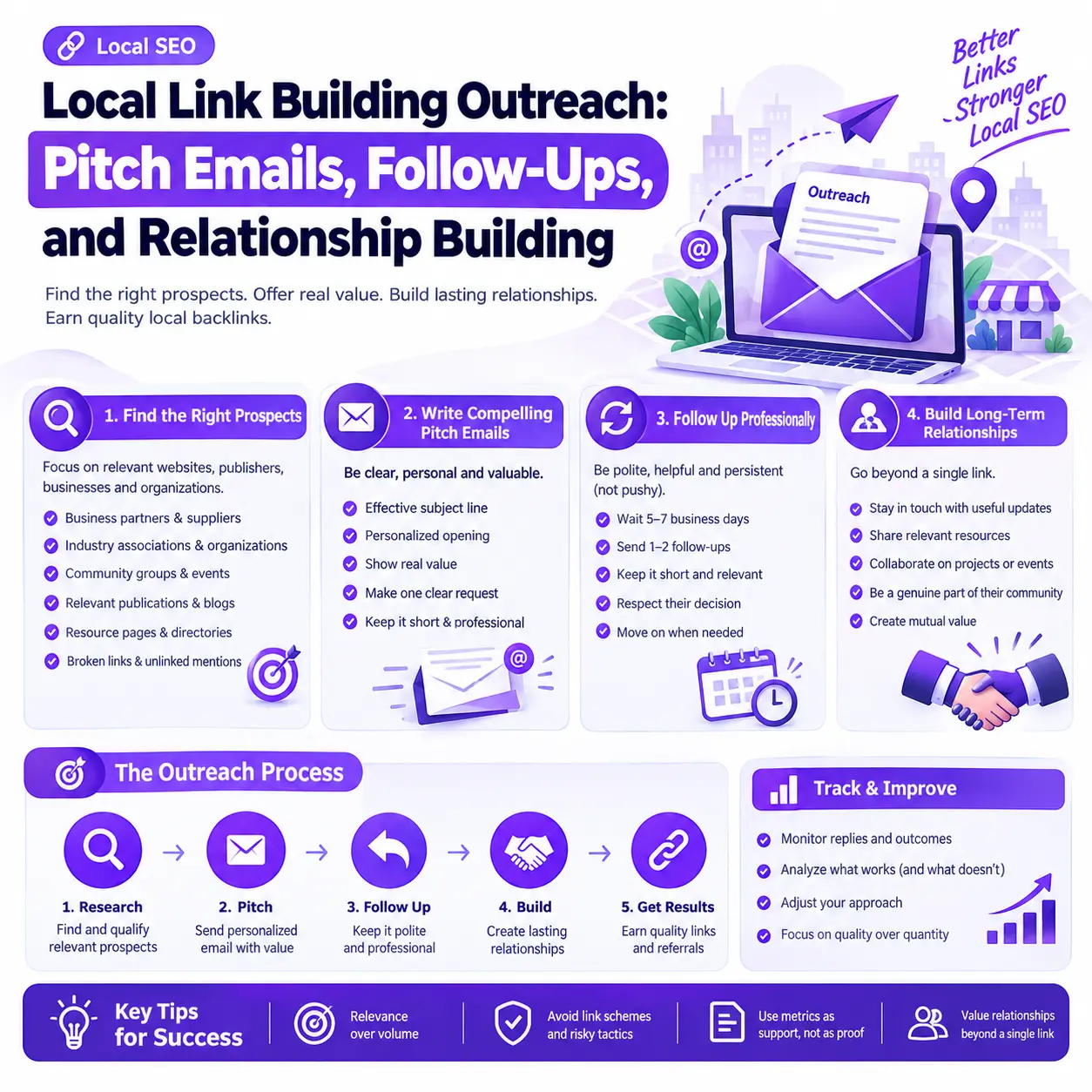
Local link building outreach is the process of contacting relevant websites, publishers, businesses, and organizations to earn legitimate opportunities for backlinks, editorial mentions, and meaningful collaborations. Effective outreach starts with choosing the right prospects, offering something useful, writing personalized emails, and following up professionally. Long-term relationships can create opportunities beyond a single backlink.
However, sending more emails does not automatically produce better results. The quality of your prospects, relevance of your offer, and reason for contacting each recipient matter far more than simply increasing outreach volume.
In this guide, you’ll learn how to find suitable prospects, prepare compelling pitch emails, follow up without being pushy, build lasting professional relationships, and measure your outreach efforts.
What Is Local Link Building Outreach?
Local link building outreach is an off-page SEO process in which you contact relevant websites and organizations to propose a legitimate opportunity for them to reference your business, content, expertise, or resources.
For example, a business might contact an industry association about an appropriate member listing, suggest a useful resource to a relevant publisher, or contribute original expert information to an industry article.
The objective is not to persuade every recipient to link to your website. It is to identify situations in which a link or collaboration genuinely benefits the recipient and their audience.
How Does Local Link Outreach Support SEO?
Relevant backlinks can help search engines discover content and understand its connections to other websites. They can also introduce your business to new audiences, generate referral traffic, and strengthen professional relationships.
For local businesses, relevant links may come from industry associations, suppliers, community organizations, regional publications, and other websites connected to the business’s activities.
However, link building is only one part of a broader SEO strategy. Acquiring a backlink does not guarantee higher rankings, increased traffic, or improved Google Maps visibility.
The quality and context of an opportunity matter more than simply counting the number of links acquired.
Local Link Building vs. Local Citation Building
Local link building and local citation building can overlap, but they serve different purposes.
Approach | Main purpose | Example |
Local link building | Earn relevant backlinks and editorial references | A trade association links to a member business |
Local citation building | Establish or correct business information across relevant listings | A legitimate business directory lists a company’s name, address, and phone number |
General link-building outreach | Develop relevant backlink opportunities across a wider range of websites | A specialist publication references an original research resource |
A directory listing may provide both a citation and a backlink. Nevertheless, not every citation is an editorial link, and not every valuable backlink is a local business citation.
If you need help distinguishing these activities, explore my Local Citation Building service.
Which Websites Should You Contact for Local Link Building?
The best prospects are websites with a legitimate connection to your business, industry, audience, or community. A website should not qualify simply because a backlink analysis tool reports a high authority score.
Start by identifying opportunities where your business, content, expertise, or participation could genuinely help the recipient.
1. Business Partners and Suppliers
Existing professional relationships can create natural opportunities for online recognition.
Consider suppliers, distributors, complementary service providers, and established business partners.
Possible opportunities include:
- An appropriate partner directory.
- A supplier or distributor resource page.
- A collaborative educational resource.
- A genuine business partnership announcement.
- A relevant case study or project contribution.
For example, a commercial equipment supplier might maintain a directory of businesses that use or distribute its products. If your business genuinely qualifies, you could ask whether an appropriate listing is available.
The key is to establish a legitimate reason for the mention. Do not assume that a partner must link to your website or that a reciprocal link should be required.
2. Industry Associations and Business Organizations
Professional associations, trade groups, and business organizations may maintain member directories, educational resources, or industry publications.
Before contacting them, check their membership requirements and editorial policies.
Determine whether membership is appropriate, whether your business qualifies, and whether the proposed listing or contribution would be useful.
Avoid joining organizations solely to obtain a backlink when the membership offers no meaningful business or professional value.
3. Community Organizations and Events
Community involvement can create legitimate opportunities for recognition.
Depending on the business, relevant opportunities might include educational events, professional workshops, community initiatives, or event participation.
A business that genuinely contributes to an event may be mentioned on an organizer’s website. A sponsor may also receive recognition under the sponsorship agreement.
These activities should be selected for their real-world value rather than treated as guaranteed backlink opportunities.
4. Relevant Publications and Industry Blogs
Publishers may be interested in original research, useful resources, informed commentary, or contributions that answer questions their audience cares about.
Before pitching, review the publication’s:
- Target audience.
- Existing articles and topics.
- Editorial standards.
- Contributor guidelines.
- Preferred contact method.
- Expectations for original contributions.
A pitch should propose something specific and useful rather than merely ask for a backlink.
5. Resource Pages and Curated Directories
Some websites maintain pages that recommend tools, educational resources, suppliers, or organizations.
Look for pages where your resource genuinely fills a gap or improves the existing collection.
A relevant resource-page pitch should explain what the page currently offers, why your resource fits, and how it may help visitors.
Do not assume that every directory or resource page is worth pursuing. Evaluate its relevance, editorial quality, legitimacy, and usefulness to the intended audience.
6. Broken Links and Unlinked Brand Mentions
Broken-link outreach involves identifying a nonworking link on a relevant website and suggesting a suitable replacement when you have a genuinely useful alternative.
Unlinked brand-mention outreach involves finding an existing reference to your business that does not link to your website.
In either case, contact the publisher only when you can identify a real improvement.
A broken link does not entitle you to a backlink, and a brand mention does not obligate its publisher to add a link.
How to Qualify Local Link-Building Prospects
Before sending an email, evaluate whether the opportunity deserves your time.
Use this checklist:
- Relevance: Is the website connected to your industry, audience, business activities, or geographic market where relevant?
- Audience value: Would the proposed link or contribution genuinely help its visitors?
- Editorial quality: Does the website publish useful, trustworthy material?
- Opportunity fit: Is there a legitimate reason for the recipient to consider your proposal?
- Contact accuracy: Have you identified the appropriate person or department?
- Link integrity: Does the opportunity avoid manipulative paid links, excessive link exchanges, or other link-scheme risks?
- Relationship potential: Could the interaction create value beyond a single link?
- Business relevance: Could the opportunity provide useful exposure, referrals, credibility, or another legitimate benefit?
You do not need a complicated scoring formula. A simple classification can help:
Priority | Characteristics | Recommended action |
High | Strong relevance, clear value, and a specific opportunity | Research the recipient and prepare a personalized pitch |
Medium | Relevant website but an unclear or indirect opportunity | Investigate further before contacting |
Low | Weak relevance, questionable quality, or no legitimate reason to reach out | Skip the prospect |
This process helps prevent wasted effort on websites that are unlikely to provide meaningful value.
How to Prepare Before Writing a Link-Building Pitch
A successful outreach email begins before you write the subject line.
You need to understand the recipient, identify a real opportunity, and prepare an offer that makes sense.
Research the Website and Contact Person
Visit the relevant page and review its content. Look for the website’s purpose, intended audience, editorial guidelines, existing resources, and the person responsible for the opportunity.
For example, an editorial contribution should generally be directed to an editor or the appropriate contributor contact. A partnership proposal may be better suited to a partnerships manager.
Use publicly provided business contact details or appropriate professional contact channels. Avoid indiscriminate scraping and sending identical messages to large lists of unrelated recipients.
Identify a Specific Reason to Reach Out
Your pitch should be connected to an actual opportunity.
Examples include:
- A relevant resource that could improve an existing page.
- A broken reference for which you have a suitable replacement.
- An original contribution that fits a publication’s audience.
- An appropriate business partnership or member listing.
- A legitimate event or community collaboration.
- An existing brand mention that could benefit from a contextual link.
A vague message such as “Please link to my website because it will help my SEO” gives the recipient little reason to act.
A stronger approach explains the specific connection and the potential value to the recipient’s audience.
Prepare the Resource or Offer
Before sending the pitch, make sure the destination page or proposed contribution is ready.
Check that your resource:
- Provides useful information.
- Matches the promise made in the email.
- Is relevant to the recipient’s audience.
- Contains accurate information.
- Works correctly and is accessible.
- Adds value beyond material already available on the recipient’s page.
If you are proposing an expert contribution, prepare a specific topic idea rather than a vague offer to write about anything.
The goal is to make the opportunity easy to evaluate.
How to Write a Local Link-Building Outreach Email
A good outreach email is relevant, specific, concise, and respectful.
It explains why you are contacting the recipient, what you are proposing, and why the opportunity may be useful. It makes one clear request without pressuring the recipient.
What Should a Good Outreach Email Include?
Use this structure:
- Subject line: Describe the actual reason for your email.
- Personalized opening: Refer to a relevant article, resource, project, or relationship.
- Context: Explain why you are contacting this particular recipient.
- Value proposition: Describe how the proposal could benefit their audience.
- Clear request: Ask one specific, reasonable question.
- Professional closing: Thank the recipient and provide your name and relevant contact information.
Keep the email focused. A long introduction about your business history is rarely necessary.
How to Write an Effective Subject Line
The subject line should help the recipient understand what the message concerns.
Examples include:
- Resource suggestion for your business guide
- Question about your partner directory
- Possible correction to your resource page
- Expert contribution for your industry article
- Question about your existing business mention
Choose a subject that accurately reflects the email. Avoid misleading urgency, exaggerated promises, or subject lines designed to disguise the message’s purpose.
How to Personalize a Pitch Naturally
Personalization is more than inserting a recipient’s first name.
A useful personalized opening refers to something specific and relevant, such as a resource they published, an editorial topic they cover, or an existing business relationship.
Generic approach:
“Hello, I found your website and would like you to link to mine.”
More relevant approach:
“Hello, I was reviewing your guide to choosing industry resources and noticed that it covers several useful tools for your readers. I have a resource on [specific topic] that may complement the section about [relevant subject].”
The second example explains why the sender is contacting that particular website.
Only include details you have actually verified. False compliments and fabricated familiarity can damage trust.
Local Link-Building Outreach Email Templates
The following templates are illustrative examples. Adapt each one to the actual recipient, opportunity, and resource. Replace every placeholder with accurate information before sending.
Template 1: Outreach to a Business Partner or Supplier
Subject: Question about your partner directory
Hello [Name],
I hope you’re doing well.
I’ve been reviewing the resources available on [Company Name]’s website and noticed your [partner or supplier directory].
As an existing [accurate description of your business relationship], I wanted to ask whether [Your Business Name] would be eligible for inclusion if the directory is open to relevant partners.
You can find more information about our business here: [Website URL].
If this is appropriate for your directory, I’d be happy to provide any details you need. If not, no problem at all.
Thank you for your time.
Best regards,
[Your Name]
[Business Name]
Why this works: The email identifies an existing relationship and asks a reasonable question. It does not imply that the recipient owes you a listing or must exchange links.
Use this template only when the relationship and eligibility are genuine.
Template 2: Pitching a Relevant Resource Page
Subject: Resource suggestion for your [topic] guide
Hello [Name],
I came across your [page or guide title] while researching resources about [topic].
Your page covers [specific subject], and I noticed that readers interested in [relevant need] may also benefit from a resource that explains [specific missing or complementary information].
I have a guide covering [accurate description of your resource]: [Resource URL].
Would you consider reviewing it as a possible addition to your page if you think it would be useful for your readers?
Thanks for considering it.
Best regards,
[Your Name]
Why this works: The pitch identifies a relevant page, explains the potential value, and leaves the editorial decision to the recipient.
Do not claim that a resource fills a gap unless you have reviewed the page and can explain the gap accurately.
Template 3: Broken-Link Outreach
Subject: Possible correction to your [topic] resource page
Hello [Name],
I was reading your [page title] and noticed that the link to [resource description] appears to be unavailable.
I thought I’d let you know in case you’d like to update it.
If you’re looking for an alternative, this resource may be relevant: [Replacement URL]. It covers [brief, accurate description of the material].
Please feel free to review it and decide whether it is suitable for your page.
Thank you for maintaining the resource.
Best regards,
[Your Name]
Why this works: It leads with a potentially useful correction rather than demanding a backlink.
Before sending, verify that the original link is actually broken and that your replacement is relevant. Do not suggest your page as a replacement simply because you want a link.
Template 4: Guest Contribution or Expert Insight
Subject: Contribution idea for [Publication Name]
Hello [Name],
I’ve been reading your articles about [topic] and noticed that your publication covers [specific audience need or subject].
I’d like to propose an original contribution on [specific proposed topic], focusing on [two or three useful points the article would address].
The aim would be to provide your readers with practical guidance on [reader outcome], supported by relevant examples and reliable sources.
If the topic fits your editorial plans, would you be open to reviewing a short proposal?
Thank you for your consideration.
Best regards,
[Your Name]
[Relevant professional description]
Why this works: It offers a specific editorial idea instead of asking for a guest-post link.
The contribution should be original, accurate, and written for the publication’s audience. Do not create low-value articles primarily to acquire backlinks.
Template 5: Community Organization or Event Collaboration
Subject: Possible collaboration for [Event or Initiative]
Hello [Name],
I came across [Event or Initiative] and was interested in its focus on [specific, verified objective].
I’m contacting you because [genuine connection between your business and the initiative].
Would you be open to discussing [specific proposed contribution, educational session, or relevant collaboration]?
I would be happy to share more information if this fits your plans.
Thank you for your time.
Best regards,
[Your Name]
Why this works: The proposal starts with a legitimate connection and a specific opportunity.
If sponsorship is involved, evaluate its business value independently. Do not treat a paid placement or sponsorship as a guaranteed way to acquire a ranking-credit-passing link.
Template 6: Requesting a Link for an Existing Brand Mention
Subject: Question about your mention of [Business Name]
Hello [Name],
I noticed that your [article or page title] mentions [Business Name] in the context of [specific subject].
Thank you for including the reference.
If you think it would help your readers, would you consider linking the mention to our relevant page here: [URL]?
That would make it easier for interested readers to find [brief explanation of the relevant information].
Of course, I’ll leave the decision to your editorial judgment.
Thanks again.
Best regards,
[Your Name]
Why this works: The email acknowledges an existing reference and explains how a link might help readers.
Only use it when the mention exists and the proposed destination is genuinely relevant.
How to Adapt These Templates to Real Prospects
Consider this hypothetical situation: a professional business publishes a useful guide, and a relevant industry association maintains a resource page.
A weak pitch might say:
“Please add my website to your page. It would help my SEO.”
A stronger pitch would identify the specific resource page, explain which audience need the business’s resource addresses, and provide a direct link for review.
The important difference is not the wording alone. It is the quality of the underlying opportunity.
A template cannot make an irrelevant pitch relevant. Research and a legitimate value proposition must come first.
How to Follow Up on Link-Building Outreach Without Being Pushy
A lack of response does not necessarily mean the recipient rejected your proposal. They may be busy, the email may have reached the wrong contact, or the opportunity may not fit their current priorities.
A follow-up should make it easier for the recipient to evaluate the proposal, not pressure them into accepting it.
When Should You Send the First Follow-Up?
For ordinary cold outreach, waiting approximately five to seven business days is a reasonable starting point.
This is a practical guideline, not a universal rule. The appropriate timing depends on the recipient, the type of opportunity, any stated response timeline, and the urgency of the situation.
For example, an editorial pitch may require a different approach from a question about a directory listing.
If the recipient has published submission guidelines or a specific response window, follow those instructions.
How Many Follow-Up Emails Should You Send?
A restrained sequence can include:
- The initial outreach email.
- One polite follow-up if there is no response.
- One final message when the opportunity justifies it.
You do not need to send every prospect the full sequence. If the recipient declines, asks you to stop, or makes it clear that the opportunity is unsuitable, end the outreach.
Repeated messages do not make an irrelevant offer more valuable.
Template: First Follow-Up Email
Subject: Re: [Original Subject]
Hello [Name],
I wanted to follow up on my earlier message about [specific opportunity].
I thought [resource or proposal] might be relevant because [brief, genuine reason].
If it fits your current plans, I’d be happy to provide any additional information you need.
Thanks for your time.
Best regards,
[Your Name]
Why this works: It provides context, briefly reminds the recipient of the opportunity, and makes responding straightforward.
Avoid resending a long pitch or introducing a new, unrelated request.
Template: Final Follow-Up Email
Subject: Re: [Original Subject]
Hello [Name],
I’m following up once more regarding [specific opportunity].
If this isn’t a fit for your current priorities, no worries at all. I’ll close the loop on my side.
Thank you for considering it, and I appreciate your time.
Best regards,
[Your Name]
Why this works: It closes the conversation professionally without creating pressure or implying that the recipient must respond.
What If There Is Still No Response?
After a reasonable follow-up sequence, mark the prospect as inactive and move on.
Before doing so, check whether:
- The contact details were accurate.
- The recipient was the appropriate person.
- The proposed opportunity was sufficiently relevant.
- The resource or offer was ready for review.
- Your email was clear and easy to understand.
If a contact was clearly incorrect, you may research the appropriate professional contact. Do not use multiple addresses or channels to bypass a recipient’s refusal or silence.
A well-managed outreach campaign should make it easy to stop pursuing unsuitable opportunities.
How to Build Long-Term Relationships Through Local Outreach
The strongest outreach processes treat backlinks as one possible outcome of a useful professional relationship, not the sole purpose of every interaction.
A publisher may decline a link request but later welcome a different contribution. A business partner may introduce you to a relevant organization. An event collaboration may lead to useful exposure without producing a backlink.
These outcomes are not guaranteed, but they illustrate why relationship quality can matter beyond a single campaign.
Build a Relationship Before You Need a Backlink
Where appropriate, engage with people and organizations because their work is genuinely relevant to your interests or professional activities.
You might:
- Share a useful resource with a relevant contact.
- Participate in an industry event.
- Introduce two people who could benefit from knowing each other.
- Contribute a thoughtful answer to a professional discussion.
- Collaborate on an educational resource.
- Provide accurate information when a publisher needs clarification.
These activities should have genuine value in their own right. Avoid manufacturing interactions simply to create an excuse to ask for a link later.
What to Do After Someone Accepts Your Pitch
Once the recipient agrees to consider or proceed with your proposal:
- Thank them and confirm any agreed details.
- Provide the requested information promptly.
- Follow their editorial or organizational requirements.
- Avoid changing the scope without discussing it.
- Verify the final page and any published link.
- Keep the relationship professional regardless of the outcome.
If a link is published, confirm that it points to the intended destination and appears in an appropriate context.
Do not pressure the publisher to use an unnatural anchor text or to make an editorial choice that conflicts with their standards.
Maintain Relationships Without Repeatedly Asking for Links
Keep in touch when you have a legitimate reason to do so.
Examples include a relevant new resource, a useful industry development, a genuine collaboration opportunity, or information that directly relates to a previous conversation.
There is no need to send regular messages just to remain visible. Unnecessary contact can damage an otherwise useful relationship.
How to Handle Rejection Professionally
If a recipient declines, thank them and accept the decision.
You can acknowledge the response without attempting to negotiate a different link arrangement. If the relationship is appropriate for future communication, leave the conversation on good terms.
A professional reputation is more valuable than repeatedly pursuing a prospect that has already said no.
Common Local Link-Building Outreach Mistakes to Avoid
Sending Mass Emails With Superficial Personalization
Inserting a person’s name into a generic template does not establish relevance.
Research the specific page, identify a real opportunity, and explain why your proposal fits. A smaller list of well-qualified prospects can be more useful than a large list of unrelated websites.
Asking for Links Without Offering Value
A request such as “Please link to my website” gives the recipient little reason to act.
Explain how the proposed resource, contribution, or reference could benefit their audience. If you cannot identify a legitimate benefit or connection, reconsider whether you should send the pitch.
Choosing Prospects Only by Domain Metrics
Third-party backlink metrics can help with initial research, but they do not establish whether a website is relevant, trustworthy, or appropriate for your business.
Evaluate the website’s actual content, audience, editorial quality, and relationship to the opportunity.
Following Up Too Frequently
Repeated emails can damage trust and waste time. Use a restrained follow-up process, record your communication, and stop when further contact is unwelcome.
Using Manipulative Link-Building Tactics
Google’s spam policies for web search identify practices such as buying or selling links for ranking purposes, excessive link exchanges, automated link creation, and certain manipulative guest-post or advertorial practices as link spam.
Legitimate advertising and sponsorships can still be appropriate business activities, but links in paid placements should be qualified appropriately. Google recommends using rel=”sponsored” for paid links; rel=”nofollow” is also accepted for qualifying links.
Do not require another website to pass ranking credit as a condition of a commercial agreement.
Promising Rankings or Treating Every Backlink as Equally Valuable
Outreach does not guarantee a backlink, and a backlink does not guarantee improved rankings.
Assess opportunities according to their relevance, editorial context, audience, legitimacy, and wider business value. Avoid promises that a particular number of acquired links will produce a specific ranking result.
How to Track and Improve a Local Link-Building Outreach Campaign
Outreach tracking helps you understand which opportunities deserve attention, where communication is breaking down, and whether the work is producing meaningful outcomes.
You do not need an expensive platform to begin. A spreadsheet can be sufficient for a small campaign.
Build a Simple Outreach Tracking Spreadsheet
Include the following columns:
Field | What to record |
Prospect website | Website and relevant page URL |
Contact | Name, role, and appropriate contact channel |
Opportunity type | Partnership, resource page, editorial contribution, or another legitimate opportunity |
Qualification notes | Why the website and opportunity are relevant |
Initial contact date | When the first email was sent |
Follow-up dates | Dates and status of any follow-ups |
Response status | No response, interested, declined, or awaiting information |
Outcome | Accepted opportunity, completed collaboration, or closed prospect |
Link status | Not acquired, published, or requiring verification |
Relationship notes | Agreed next steps and relevant context |
This makes it easier to avoid duplicate outreach, respect previous decisions, and identify the next appropriate action.
Which Outreach Metrics Should You Monitor?
Focus on a combination of activity, response, and outcome metrics.
Qualified prospects contacted: The number of prospects that passed your qualification process.
Reply rate: The proportion of delivered outreach emails that receive a reply. Define whether you include every reply or only positive responses.
Positive reply rate: The proportion of delivered outreach emails that receive a genuinely interested response.
Relevant opportunities earned: The number of legitimate opportunities accepted or completed.
Links acquired: The number of relevant links that have actually been published and verified.
Time per outcome: The time invested in research, communication, and coordination relative to the outcomes achieved.
You can calculate a reply rate as follows:
Reply rate = (Number of replies ÷ Number of delivered emails) × 100
For example, if 50 delivered emails generate 10 replies, the reply rate is 20%. This is an illustrative calculation, not an industry benchmark or a prediction of future campaign performance.
Keep positive replies separate from negative responses. A high reply rate is not necessarily evidence of success if the replies are mostly refusals or irrelevant inquiries.
How to Diagnose a Weak Outreach Campaign
Use the observed pattern to identify what needs investigation.
Problem | What to investigate |
Few replies | Contact accuracy, prospect relevance, subject lines, and value proposition |
Replies but few positive outcomes | Opportunity fit, clarity of the request, and usefulness of the resource |
Positive discussions but few published links | Editorial requirements, implementation barriers, and whether the proposed link is appropriate |
Links acquired but little measurable business impact | Audience relevance, referral traffic, landing-page quality, and the wider SEO strategy |
These patterns suggest possible causes rather than proving that one factor is responsible.
Review your messages and prospect selection before making major changes. Correct obvious mistakes immediately, and compare meaningful groups of opportunities rather than drawing strong conclusions from a handful of emails.
When Should You Change Your Outreach Approach?
Consider changing your process when you identify a consistent issue with prospect relevance, contact accuracy, message clarity, or the value of your offer.
For example, if your emails frequently receive replies asking for clarification, your request may be unclear. If recipients consistently indicate that the opportunity does not fit their website, revisit your qualification criteria.
Do not automatically respond to low results by increasing email volume. Improve the quality of the underlying process first.
What Tools Help With Local Link-Building Outreach?
Tools can make prospect research, communication, and tracking more efficient, but they cannot replace sound judgment.
Prospect Research and Backlink Analysis
Backlink analysis tools can help identify websites that link to competitors, discover referring domains, and uncover potential opportunities.
Treat their metrics as research signals rather than definitive measures of quality. Review each prospect manually before deciding whether to contact it.
Email and Outreach Management
Email tools and spreadsheets can help you maintain contact records, schedule reminders, and track communication.
For larger campaigns, an outreach management platform may provide additional workflow and reporting features. Evaluate whether those features justify the cost and whether the tool supports responsible personalization and communication practices.
How to Choose an Outreach Tool
Consider:
- Ease of use.
- Contact accuracy.
- Personalization capabilities.
- Follow-up tracking.
- Reporting and export options.
- Privacy and data-handling safeguards.
- Cost relative to the campaign’s needs.
Automation should assist organization and routine administration, not produce large volumes of irrelevant emails. Use a simple setup when it meets your requirements.
How Long Does Local Link-Building Outreach Take?
There is no universal timeline for local link-building outreach.
Researching prospects and preparing emails may take relatively little time for straightforward opportunities, while more complex collaborations can require substantial preparation and discussion.
The response and publication timelines also depend on the recipient’s workload, editorial process, the usefulness of your offer, and whether a relationship already exists.
Distinguish between three milestones:
- Outreach activity: Researching prospects and sending the initial messages.
- Opportunity development: Receiving responses, answering questions, and agreeing on the next steps.
- Completed outcome: A collaboration or contribution is completed, and any resulting link is verified.
Some prospects will never respond, while others may take considerable time to evaluate an opportunity.
Avoid guaranteeing a backlink within a fixed period or promising that a specific number of links will improve rankings. Measure progress through qualified opportunities, completed work, relevant links, and meaningful business outcomes.
Frequently Asked Questions About Local Link-Building Outreach
How do you write a local link-building outreach email?
A local link-building outreach email should explain why you are contacting the recipient, identify a specific opportunity, and show how your proposed resource, contribution, or collaboration could benefit their audience. Personalize the message, make one clear request, include relevant information, and keep the tone professional. Never assume the recipient owes you a link.
How long should you wait before following up on a link-building email?
For ordinary cold outreach, waiting around five to seven business days before a first follow-up is a reasonable starting point. Adjust the interval to the recipient’s stated response time, editorial deadlines, and the nature of the opportunity. If the recipient declines or asks you not to contact them again, stop.
How many follow-up emails should you send for link building?
There is no universally correct number of follow-ups. A restrained approach is to send the initial email, one polite follow-up, and, if appropriate, one final message. Stop sooner when the recipient declines, the opportunity becomes irrelevant, or further contact would be unwelcome. Track the outcome rather than pursuing every prospect indefinitely.
Should you offer payment or a reciprocal link in exchange for a backlink?
Do not offer money or reciprocal links as a way to obtain ranking credit through manipulative link schemes. Google’s policies identify buying links for ranking purposes and excessive link exchanges as link spam. Legitimate advertising and sponsorships can be appropriate, but paid links should be qualified with rel=”sponsored” or rel=”nofollow” as applicable.
What should you do if a website agrees to your pitch but does not publish the link?
Thank the recipient and confirm any agreed next steps without assuming publication is guaranteed. If a reasonable period passes, send one polite message asking whether they need additional information or whether the opportunity is still proceeding. Respect their decision, record the outcome, and do not report the link as acquired until you verify the published page.
Final Thoughts: Make Local Link Building About Relevance and Relationships
Effective local link-building outreach is not about sending the largest number of emails or persuading every website to link to your business.
It is about finding relevant opportunities, understanding the recipient’s needs, offering something genuinely useful, and communicating professionally.
A sustainable process includes:
- Qualifying prospects before contacting them.
- Preparing a relevant resource or collaboration proposal.
- Personalizing pitches with accurate information.
- Following up at reasonable intervals.
- Respecting editorial decisions and communication preferences.
- Maintaining useful professional relationships.
- Tracking outcomes and improving the process based on evidence.
Start with a manageable list of well-qualified prospects. Focus on the value of each opportunity, learn from the responses you receive, and refine your approach as you gain a clearer understanding of what works for your business.
Need Help With Your Local Link-Building Strategy?
If you need help identifying relevant backlink opportunities, evaluating your existing link profile, or developing a more structured outreach strategy, explore my Local Link Building service.
As an SEO Expert & Consultant, I can help you understand where link building fits into your broader SEO priorities and identify practical next steps suited to your website and business goals.
Explore the service: Local Link Building Service — Freelancer Tawhid