
Local Keyword Research for Multi-Location Businesses: Build a Separate Keyword Map for Every Market

Freelancer Tawhid
SEO Expert and Consultant
- October 14, 2026
- No Comments
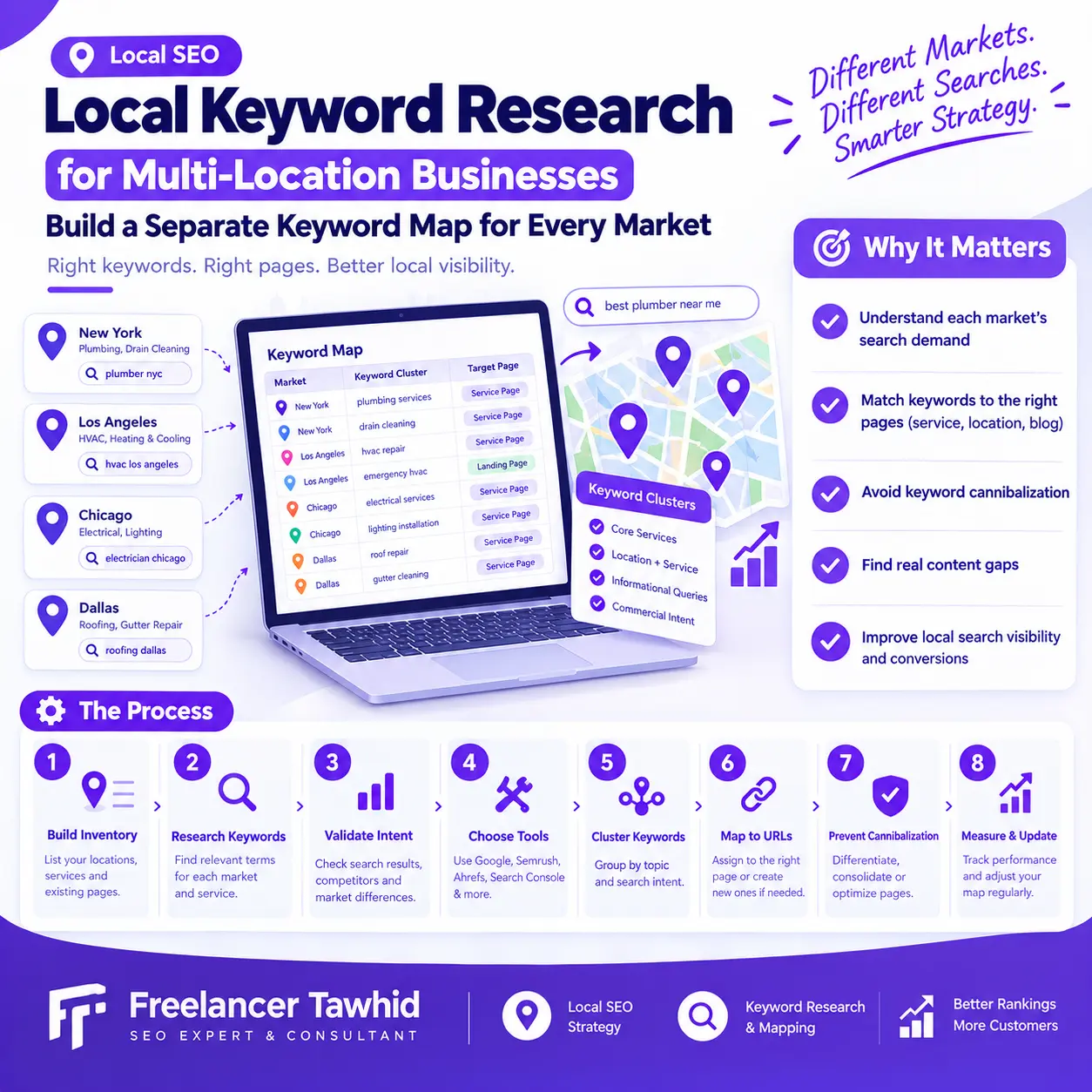
Local keyword research for multi-location businesses involves identifying how customers search for each location’s services, comparing local search opportunities, and mapping relevant keyword clusters to the most appropriate website pages. Instead of using one generic keyword list for every market, businesses should validate search intent, competition, and page requirements separately while maintaining a consistent overall SEO strategy.
When a business operates across several locations, its SEO strategy needs to account for more than the names of cities or service areas.
Customers may search for different services, use different terminology, compare different competitors, or expect different types of pages depending on the market. Even when the core service remains the same, its search landscape may not.
A single keyword spreadsheet can help identify general opportunities, but it does not necessarily explain which searches belong to which market, what each page should target, or where additional content would genuinely help customers.
The solution is to build a market-by-market keyword map that connects relevant searches with business priorities, search intent, and website architecture.
In this guide, you’ll learn how to research local keywords for multiple locations, compare market-specific opportunities, organize keyword clusters, assign them to appropriate URLs, and maintain the resulting strategy without creating unnecessary pages.
What Is a Market-by-Market Local Keyword Map?
A local keyword map is a structured record connecting search terms and related keyword groups to the website pages best suited to satisfy their intent.
For a multi-location business, this mapping process considers both the shared characteristics of the business and the differences between its markets.
Three concepts are worth distinguishing:
- Keyword list: A collection of relevant search terms discovered through research.
- Keyword cluster: A group of related queries that can reasonably be addressed by the same page.
- Market-specific keyword map: A structured plan showing which keyword clusters matter in each market and which existing or proposed URLs should address them.
For example, a plumbing company may offer the same core services across several locations. However, its keyword research might reveal different opportunities around emergency repairs, drain cleaning, pipe replacement, or other specialized services.
The business should investigate those differences rather than assume every service has equal demand in every location.
A market-specific keyword map records these findings and turns them into practical page-level decisions.
Why One Keyword List Is Not Enough
A general keyword list can reveal the main services customers search for, but it may overlook the differences that matter when implementing a multi-location SEO strategy.
Those differences can include:
- Service availability: Not every branch offers every service.
- Customer terminology: People may describe the same problem or service differently.
- Search intent: Similar phrases may produce different types of search results.
- Competition: Different businesses, directories, or national brands may dominate individual markets.
- Search demand: The relative importance of services may vary by market.
- Website requirements: Some searches may be satisfied by an existing page, while others may justify a distinct landing page.
These are possibilities to investigate, not assumptions to make about every location.
The objective is to identify which characteristics are shared and which differences deserve action.
Does Every Location Need a Completely Different Keyword Strategy?
No. Every location does not need an entirely different keyword list.
Most multi-location businesses can begin with shared service keywords and common customer needs. They can then investigate each market to identify meaningful variations, validate those opportunities, and determine whether the existing page structure can satisfy them.
The distinction is important: research each market separately, but create separate pages only when there is a legitimate reason to do so.
Step 1: Build a Location and Service Inventory
Before opening a keyword research tool, establish what the business actually offers and where it operates.
Keyword research should reflect the real business rather than a spreadsheet containing every possible combination of services and locations.
Create a Location-and-Service Matrix
Start with a master inventory containing the following information:
Field | What to record |
Location or market | The actual branch, location, or legitimate service area |
Services offered | The services genuinely available in that market |
Priority services | The services most important to the business |
Target customers | The customer groups the business serves |
Existing location URL | The current page representing the market, if one exists |
Existing service URLs | Pages already covering relevant products or services |
Competitors | Businesses and other websites appearing in relevant local results |
Current performance | Available impressions, clicks, rankings, traffic, and conversions |
Business priorities | Services or markets requiring attention first |
This information helps prevent a common mistake: assigning a keyword to a location merely because its wording includes that location.
For example, a business should not target a specialized repair service on a local landing page if that service is not actually available there.
Likewise, a company serving customers across several areas does not necessarily have a physical branch in every area. Its website and local business information should accurately reflect how the business operates.
Audit Existing Pages Before Planning New Ones
Review the homepage, primary service pages, location pages, service-and-location pages, and relevant blog articles.
For each URL, record its main purpose, the searches it appears to serve, and whether its existing content is useful and distinct.
Check for pages that already cover the intended service or location, pages targeting similar search intent, weak or outdated content, and relevant keywords that currently have no suitable destination.
A new page is not always the best solution. Sometimes, the right action is to improve an existing URL, clarify its purpose, or combine overlapping content.
A structured Local SEO audit can help identify these issues before additional pages are planned.
Step 2: Discover Keywords for Each Market
Once the business inventory is complete, begin with its confirmed services and expand the research using customer language, keyword tools, search results, and competitor analysis.
The process should balance consistency with market-specific investigation.
Start With Core Services and Customer Problems
Build a shared seed list covering the business’s primary services, meaningful subservices, common customer problems, urgent needs, commercial queries, and relevant informational questions.
For a plumbing company, the initial research might include:
- Plumbing services
- Emergency plumbing
- Drain cleaning
- Leak detection
- Pipe repair
- Water heater repair
- Plumbing installation
- Plumbing service costs
- How to identify a plumbing problem
These are illustrative starting points, not recommendations for every plumbing business. The final list should reflect its actual services and target customers.
The purpose of shared seed keywords is to establish a consistent foundation across markets. They make comparison easier without requiring every location to end up with identical keyword targets.
Identify Explicit and Implicit Local Keywords
Local searches can communicate geographic intent in different ways.
Explicit local keywords include a location directly in the query, such as a service plus a city, district, or other geographic term.
Implicit local keywords express a local need without naming a location. Someone searching for an emergency plumber, for example, may expect nearby service providers even without including a geographic modifier.
Research both patterns where relevant.
Consider:
Keyword pattern | Example | Research objective |
Core service | Emergency plumbing | Understand general service intent |
Service plus location | Emergency plumber in [Market A] | Investigate explicit local demand |
Location plus service | [Market A] plumbing company | Identify natural query variations |
Near-me search | Plumber near me | Understand implicit local intent |
Specific service | Drain cleaning | Identify service-specific opportunities |
Commercial query | Plumbing service cost | Understand evaluation and purchasing needs |
Problem-based query | Why is my drain blocked? | Identify useful informational content |
Do not automatically create a separate keyword target or webpage for every variation. Closely related searches may belong to the same cluster.
Research Each Market Beyond Replacing the Location Name
Replacing one city name with another can generate keyword ideas, but it does not complete the research.
For every market, investigate:
- Which core services are relevant to the actual location.
- Which additional services, problems, or customer questions are worth investigating.
- Whether the local search results show meaningful differences in page types or intent.
- Which competitors appear for important queries.
- Whether available tools indicate differences in search demand or competition.
- Which findings warrant a different page assignment, content update, or priority.
Record both the opportunities shared across locations and the meaningful differences between them.
Semrush’s local keyword research guide similarly recommends separate research for different locations and cautions that changing location names alone may miss additional opportunities.
The practical lesson is to use a common research process while allowing the evidence to determine each market’s final keyword map.
Step 3: Validate Local Search Intent and Competitors
Keyword data helps you discover opportunities, but it does not independently determine which page should target a query.
The next step is to examine the actual search results and understand what users are likely expecting to find.
Analyze the Search Results for Important Queries
Review representative queries in the relevant market and record the types of pages appearing in the results.
Look for:
- Google Maps and Local Pack results.
- Organic service pages.
- Location landing pages.
- Directories and comparison websites.
- Informational guides.
- Pages covering specialized services.
- Results that indicate a different customer need from the initial assumption.
For example, two similar queries may produce largely similar organic results. That can support investigating whether one page could satisfy both.
Alternatively, one query may be dominated by service providers while another produces explanatory guides. That difference may justify separate content because the searcher is trying to accomplish something different.
Search results are evidence, not an infallible rule. Results change, and page assignment should also consider the business’s actual offering and the needs of its audience.
For more effective location research, use relevant search settings or location-aware tools where available, and record the date and conditions of the comparison.
Analyze Competitors Within Each Market
Competitor research should focus on the websites and businesses appearing for relevant queries in each market.
Examine:
- The services their pages cover.
- Their location-page and service-page structure.
- The terminology used to describe their offerings.
- Topics or customer questions they address.
- Whether directories or national websites occupy prominent positions.
- Areas where their content does not fully answer the searcher’s needs.
The objective is not to copy competitors. It is to discover differences in the search landscape and determine where a useful, competitive page could provide a better match for the query.
A competitor appearing in one market may be irrelevant to another, so avoid treating one competitor analysis as representative of every location.
Use Keyword Metrics as Evidence, Not Final Decisions
Search volume, competition, and keyword difficulty can support prioritization, but these metrics are estimates.
A low or zero reported search volume does not automatically make a query irrelevant. Very specific local searches may have limited or incomplete measurement, while a commercially valuable query may be worth investigating even when available data is sparse.
Evaluate potential keywords using several factors together:
- Relevance to the business.
- The service’s commercial importance.
- Search intent.
- Available demand estimates.
- Competition.
- Current website visibility.
- Suitability for an existing or proposed page.
The goal is to identify meaningful opportunities, not simply the keywords with the highest estimated volume.
Step 4: Choose the Right Keyword Research Tools
Different tools answer different questions. A useful workflow combines keyword discovery, SERP analysis, first-party performance data, and market-specific observations.
Tool or data source | How to use it | Limitation to consider |
Google Search | Examine result types, competing pages, and search intent. | Results vary according to context and can change over time. |
Google Keyword Planner | Discover keyword ideas and compare available estimates with appropriate location settings. | Estimated demand does not prove that a separate page is needed. |
Semrush | Expand local keyword ideas, investigate competitors, and compare available metrics. | Treat search-volume and difficulty figures as estimates. |
Ahrefs | Research keyword variations, competitor pages, and keyword-to-page opportunities. | Tool data does not replace market-specific SERP checks. |
Google Search Console | Identify queries and pages associated with existing organic visibility. | Query data has reporting limitations and does not directly provide a complete city-by-city demand report. |
Location-aware rank tracking | Compare selected queries under specified local tracking conditions. | Rankings are one performance measure, not a complete measure of search demand or business results. |
Google Business Profile performance data | Review relevant profile interactions for eligible businesses. | Profile metrics measure a different part of local visibility from website organic-search performance. |
Google Search Console reports performance dimensions such as queries, pages, countries, devices, and search appearance. Its country dimension is not a direct city-level keyword research report, and some query data may be anonymized or omitted. See the official Search Console documentation.
For that reason, use Search Console to understand the website’s existing search performance and supplement it with appropriate market-level research tools. Do not assume that the presence or absence of a query in one report proves the full demand picture for a particular city.
Step 5: Cluster Keywords by Topic and Intent
After collecting relevant keywords for each market, organize them into clusters before assigning URLs.
This step helps prevent a large keyword list from turning into an unnecessarily large website.
Group Keywords That Serve the Same Need
Related terms should usually be grouped when one useful page can satisfy their underlying intent.
For example, several closely related searches about a core service may fit a single service-page cluster. Queries about a distinct service or a different customer problem may belong to another cluster.
Use the meaning of the query, search intent, and actual results to guide the decision.
Do not create a separate cluster for every spelling variation, word-order difference, or location modifier when the underlying need remains the same.
Separate Informational and Commercial Intent
Search intent helps determine which type of page is suitable.
Search intent | Typical example | Potential page type |
Informational | How to recognize a leaking pipe | Helpful article or guide |
Commercial investigation | Best plumbing options for an ongoing issue | Appropriate service or decision-support page, depending on the results |
Transactional | Emergency plumber in a specific market | Relevant service or location landing page |
Navigational | A named plumbing business | The business’s relevant destination page |
These are examples, not fixed rules. Search intent can overlap, and the actual results should influence the final assignment.
A blog post should not be created simply because a question can be phrased around a keyword. It should answer a genuine information need and serve a purpose that the existing service pages do not already fulfill.
Keep Website Keyword Mapping Separate From Google Maps Optimization
A website keyword map and a Google Maps strategy work together, but they are not the same thing.
The website map helps determine which pages should serve organic searches and how those pages fit into the site’s structure. Google Maps visibility involves Google Business Profile and other local-search factors in addition to the website.
Keyword research can inform both activities, but inserting keywords into a profile or creating additional pages is not a substitute for an appropriate strategy.
Businesses should represent their actual operations accurately and follow Google’s Business Profile guidelines. Separate profiles or location-specific information should reflect legitimate eligible business locations, not locations invented to target searches.
Step 6: Map Every Keyword Cluster to the Appropriate URL
This is the central deliverable of a multi-location keyword research project.
Each priority keyword cluster should have a clear page assignment—or an explicit decision that further research is required.
Decide Which Page Type Fits the Search
Depending on the website and the search intent, an appropriate destination could be:
- The homepage.
- A central locations page.
- The main service page.
- An individual location landing page.
- A service-and-location page.
- An informational article.
- An existing page that should be improved or consolidated.
There is no universal page structure that fits every multi-location business.
A small company with a few branches may be able to communicate its locations and services effectively through existing pages. A larger business with distinct service offerings across several markets may need a more detailed architecture.
The correct decision depends on the business model, actual services, customer needs, search results, existing URLs, and whether a new page would provide meaningful additional value.
Use a Page-Assignment Decision Framework
Before assigning a cluster to a new URL, ask:
- Does a relevant page already exist?
If an existing page matches the intent and provides useful information, improving it may be the better choice.
- Is the search intent meaningfully different?
If two keyword groups represent substantially different user needs, investigate whether separate pages are appropriate.
- Is the service genuinely available in that market?
A page should accurately represent the business’s offering and coverage.
- Can the proposed page provide distinct value?
The location name alone is not a sufficient reason to create a new page.
- What do the current search results suggest?
Compare result types, ranking pages, and the intent they appear to satisfy.
- Does the proposed URL improve the website structure?
The page should have a clear role in the site’s navigation and internal-linking architecture.
If these checks do not support a separate page, keep the cluster assigned to the most appropriate existing URL or mark it for further investigation.
Example: Comparing Two Markets
Consider a hypothetical plumbing business operating in Market A and Market B.
The following example is illustrative only. It does not represent measured search volume or actual keyword data from a client project.
Market | Keyword cluster | Research finding to investigate | Possible action |
Market A | Emergency plumbing searches | Whether emergency-service queries have meaningful demand and a distinct SERP pattern | Improve an existing emergency-service page or investigate a dedicated landing page if justified. |
Market B | General plumbing service searches | Whether the existing location page adequately satisfies the intent | Map the cluster to the existing location page if no separate page provides a meaningful benefit. |
Both markets | Shared plumbing service queries | Whether the queries have similar intent and can be addressed by existing service pages | Maintain shared keyword themes while validating each market’s actual page requirements. |
Notice that the map preserves common service themes while documenting separate market-level findings.
Market A does not automatically need another page, and Market B does not automatically need fewer pages. Each decision must be supported by the relevant business and search evidence.
Step 7: Build a Reusable Multi-Location Keyword Map
A keyword map becomes far more useful when it is organized in a consistent format that can be compared, maintained, and implemented.
You can manage the information in a spreadsheet, database, or SEO platform, depending on the scale of the business.
The important part is to maintain a consistent set of fields across markets.
Recommended Keyword Map Template
Column | Purpose |
Market or location ID | Identifies the location being researched. |
Service | Records the relevant core service or subservice. |
Keyword | Stores the individual search query. |
Keyword cluster | Groups related queries. |
Search intent | Documents the primary user need. |
Available demand data | Records estimates and the tool used. |
SERP observations | Summarizes relevant page types and competitors. |
Current target URL | Identifies the existing page serving the cluster. |
Proposed action | Improve, retain, create, consolidate, or investigate. |
Market-specific findings | Explains differences that may influence the strategy. |
Priority | Shows which opportunities should be considered first. |
Reason for the decision | Records the evidence supporting the assignment. |
Baseline and KPIs | Provides a reference point for future evaluation. |
Last reviewed | Records when the information was checked. |
For larger networks, use a master sheet containing comparable information and a market-level view for detailed findings. Give each keyword cluster a stable identifier so that its intended URL and subsequent changes can be tracked.
Prioritize Opportunities Before Implementation
Not every keyword should receive equal attention.
Prioritize clusters according to:
- Relevance to the business and its services.
- Commercial intent and business importance.
- Evidence of market-specific demand or visibility.
- Competition and current website capability.
- Existing page quality and potential overlap.
- Implementation effort and expected usefulness to customers.
A simple High, Medium, or Low priority can work if the reasoning is documented.
Avoid creating a universal scoring formula based on arbitrary search-volume or difficulty thresholds. A smaller opportunity can be worthwhile when it accurately matches a valuable service and a relevant customer need.
Turn the Map Into an Action Plan
A completed keyword map should tell the team what to do next.
For every important cluster, identify whether the page should be retained, improved, created, consolidated, or investigated.
Where a new page is justified, define its purpose, main search intent, supporting keyword cluster, relationship to existing service pages, and internal links.
Where no new page is justified, document the existing URL that will continue serving the cluster.
This turns keyword research into an implementation roadmap rather than an isolated spreadsheet.
Step 8: Prevent Keyword Cannibalization and Thin Location Pages
Two problems deserve particular attention when managing keyword maps across multiple locations: overlapping page intent and the unnecessary creation of near-duplicate pages.
Prevent Multiple URLs From Targeting the Same Need
Keyword cannibalization is a practical concern when several pages compete to satisfy substantially similar search intent.
For example, a business might have multiple service pages that target nearly identical keyword clusters without clearly explaining their differences.
Start by reviewing the intended purpose of each page. Then compare its content, assigned keyword cluster, internal links, and available query-to-page performance.
If two pages serve the same need without offering distinct value, consider improving one, consolidating the content, or clarifying the purpose of each page.
Multiple URLs appearing for related queries does not automatically prove a problem. The important question is whether the website’s page structure is clear and appropriate for users and search engines.
Avoid Location Pages That Differ Only by City Name
Creating a location page by copying a template and replacing the location name can produce pages that offer little value to visitors.
A useful location landing page should represent a legitimate part of the business and provide information that helps customers understand the services available to them.
Depending on the business, relevant differences might include:
- Actual services available in that market.
- Accurate operating or contact information.
- Relevant local service arrangements.
- Location-specific customer questions.
- Genuine information about the branch or its offering.
- Useful links to related services.
Not every page needs entirely unique subject matter, but each should have a clear purpose and enough relevant information to justify its existence.
This is also a policy consideration. Google’s spam policies identify doorway abuse as including substantially similar pages targeting specific, similar searches or different cities that direct users toward the same destination.
The goal is therefore not to build a page for every possible location and keyword combination. It is to build the pages that users actually need.
For broader strategy and implementation, see Freelancer Tawhid’s Local SEO services.
Step 9: Measure Results and Update the Keyword Map
A keyword map should evolve as the business, competition, website, and search landscape change.
The research is not complete simply because every keyword has been assigned a URL.
Establish a Baseline
Before implementing significant changes, record the available performance information for relevant pages and query groups.
Useful measures include:
- Search impressions and clicks.
- Click-through rate.
- Organic traffic to relevant landing pages.
- Rankings for selected queries under specified tracking conditions.
- Relevant Google Business Profile interactions where applicable.
- Qualified enquiries or conversions where measurement is configured and reliable.
Use the measures that correspond to the business objectives.
Search visibility alone does not demonstrate business success. A page may attract impressions without generating qualified traffic, and a ranking change does not automatically establish that an SEO action caused it.
Monitor Query-to-Page Alignment
Review whether relevant queries are being served by the pages intended to target them.
Look for:
- Valuable queries reaching a page that does not fully address the user’s need.
- Multiple pages receiving visibility for the same intended keyword cluster.
- Important service clusters with no suitable page.
- Changes in impressions, clicks, and qualified conversions.
- Differences between initial market assumptions and observed performance.
Where available, combine Search Console query and page data with location-aware tracking and other business-performance information. Each source provides a different view, so interpret them together rather than treating one metric as a complete explanation.
Update the Map When Evidence Changes
Revisit the keyword map when the business adds or closes a location, changes its services, enters a new market, launches relevant pages, encounters significant competition changes, or sees meaningful performance shifts.
A scheduled review can also be useful, particularly for larger networks. The appropriate frequency depends on the number of locations, the pace of change, and the importance of the market.
Maintain a change log so the team can track why a keyword cluster was reassigned, a page was added, or a previous decision was revised.
The objective is to keep the map accurate and useful, not to change keywords and pages repeatedly without a clear reason.
Conclusion: Build a Keyword Map for Every Market, Not a Page for Every Keyword
Multi-location local keyword research works best when businesses use a consistent process but allow the findings to vary according to the actual market.
Start with confirmed services and locations, investigate customer searches separately, validate intent through search results, analyze relevant competitors, cluster queries, and map each cluster to the most appropriate existing or proposed URL.
Document the reasoning behind every important page decision and evaluate the results after implementation.
Most importantly, remember that a separate keyword map does not mean every market needs a completely different strategy or a separate page for every search variation. The goal is to identify meaningful opportunities, create a clear website structure, and help each page satisfy the right user need.
Frequently Asked Questions
1. Do multi-location businesses need separate keyword research for every location?
Yes, each location should receive its own research pass because service availability, customer terminology, competition, search intent, and search results can differ. This does not mean every location needs entirely different keywords or a separate page for every variation. Start with shared service themes, validate local differences, and map meaningful clusters.
2. Does every business location need its own landing page?
Not automatically. A separate page makes sense when it represents a legitimate location or service area, satisfies a meaningful search need, and offers useful information for visitors. A central locations page or existing service page may be sufficient in some cases. Avoid creating near-identical pages merely to match different location names.
3. What should I do if a location-specific keyword has zero reported search volume?
Treat reported volume as one input rather than a definitive measure of demand. Review localized search results, competitor pages, customer language, service relevance, and available performance data. Hyperlocal searches may be underreported. Add a relevant term to an existing cluster when appropriate, and justify a new page through evidence and genuine user need.
4. How can I prevent multiple location pages from competing for the same keywords?
Give each important page a clear purpose and map related queries to the page best suited to satisfy their intent. Audit existing URLs, compare relevant search results, and review which queries bring impressions to each page. Consolidate unnecessary overlap when appropriate, and create separate pages only when distinct needs justify them.
5. How often should a multi-location keyword map be updated?
Review the map when the business changes its locations or services, enters a market, launches new pages, faces meaningful competitive changes, or sees notable shifts in search performance. Larger networks may also need scheduled reviews. Use performance evidence and business changes to guide updates rather than repeatedly changing the map without a clear reason.
Need Help With Local Keyword Research for Multiple Locations?
Building a useful keyword map requires more than collecting search terms. You need to understand the business, compare market-specific opportunities, validate search intent, identify the right page assignments, and prioritize work according to the website’s existing structure and business goals.
I’m Tawhid, an SEO Expert & Consultant at Freelancer Tawhid. I began working with Local SEO in 2020 and developed my skills through training, research, and practical implementation on real projects.
If your business operates across multiple locations and you need a clearer keyword strategy, explore my Local Keyword Research Service.
The service focuses on identifying relevant search opportunities, organizing keyword clusters, analyzing local search intent and competitors, and mapping keywords to appropriate website pages.
Whether you’re planning a new multi-location SEO strategy or improving an existing website, the next step is to build a keyword map around your actual services, markets, and priorities.
Explore the Local Keyword Research Service and discuss your SEO requirements with Freelancer Tawhid.