
How to Monitor Your Online Reputation Across Reviews, Brand Mentions, and Search Results

Freelancer Tawhid
SEO Expert and Consultant
- October 16, 2026
- 0 comments
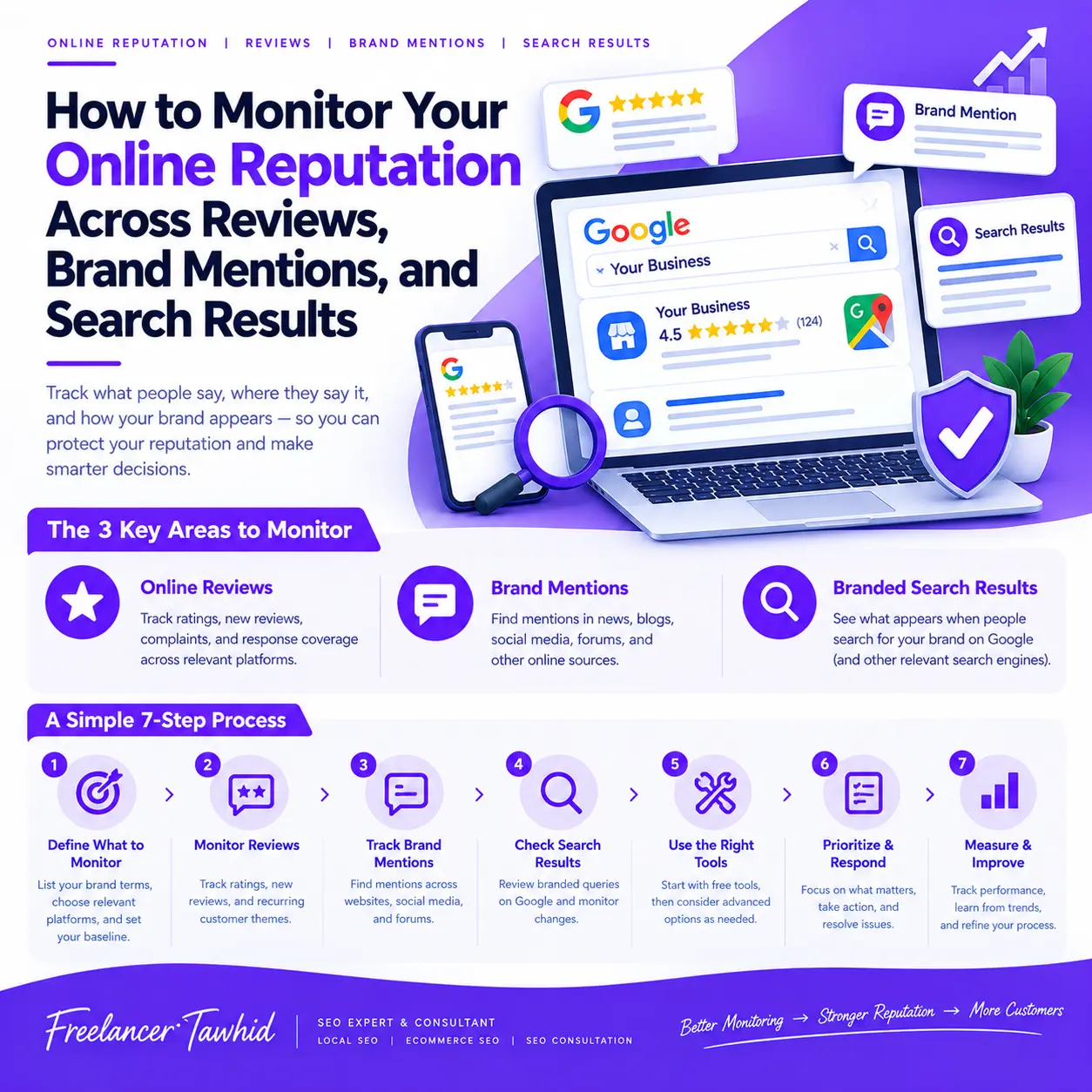
Monitoring your online reputation means regularly checking customer reviews, online brand mentions, and search results to understand how people perceive your business. An effective system combines relevant alerts, periodic searches, a record of important changes, and a clear process for responding. This helps you identify potential problems, understand customer feedback, and make informed decisions about your brand’s online presence.
Your online reputation is not shaped by a single review platform or website. Potential customers may encounter your business through customer reviews, independent articles, social media discussions, industry forums, search engine results, and other public sources.
A business can receive positive customer feedback while an outdated article appears prominently in search results. An ecommerce brand may discover recurring product complaints across marketplace reviews and public discussions. A service business may find that unanswered reviews are creating a poor first impression.
These situations require different responses, but they share one important requirement: reliable monitoring.
This guide explains how to monitor your online reputation across reviews, brand mentions, and search results, which tools can help, what to measure, and how to turn monitoring data into practical action.
What Is Online Reputation Monitoring?
Online reputation monitoring is the ongoing process of discovering, reviewing, and evaluating information about a business or brand across relevant online channels.
It involves tracking customer feedback, identifying public brand mentions, observing relevant search results, and documenting changes that may affect customer trust or business decisions.
Online reputation monitoring is part of a broader reputation management process. Monitoring helps you understand what is happening; reputation management involves deciding how to respond, addressing underlying problems, and improving how your business is represented online.
The three areas every reputation monitoring system should cover
An effective online reputation monitoring system focuses on three interconnected areas.
Monitoring area | What to monitor | Why it matters |
Online reviews | Customer ratings, new reviews, complaints, recurring themes, and business responses | Reveals customer experiences and opportunities to improve service. |
Brand mentions | News articles, blog posts, public discussions, social media references, and third-party reviews | Helps identify conversations and information that may influence public perception. |
Branded search results | Website pages, review sites, business profiles, news articles, and other results associated with your brand | Helps you understand what people may encounter when researching your business. |
These areas overlap, but they are not interchangeable.
A customer complaint may first appear in a review, then become part of a wider online discussion. A third-party article may subsequently appear when someone searches for your business name.
Monitoring each area independently can help you identify individual signals. Examining them together can provide a more complete picture of what is happening and what deserves attention.
Why monitoring all three areas matters
Checking reviews alone may reveal dissatisfaction with a product or service, but it will not necessarily show whether the same issue is being discussed elsewhere.
Monitoring brand mentions can help you discover public discussions outside your review platforms. Reviewing branded search results can then help you understand whether relevant third-party pages are visible when people research your business.
For example, imagine an online retailer receiving several complaints about delivery delays. The same issue begins appearing in a public discussion forum, and a third-party review page mentioning the problem becomes visible for a branded search.
This is a hypothetical example, but it illustrates the value of connecting monitoring signals. Rather than treating each mention as an isolated event, the business can investigate the underlying delivery problem and evaluate how it is being discussed across different sources.
The goal is not to eliminate every negative mention. It is to identify meaningful changes, understand their context, and respond appropriately.
Step 1: Define What to Monitor and Establish Your Baseline
Before choosing monitoring tools, determine what you need to track and document your current situation.
Without a baseline, it becomes difficult to distinguish normal activity from a meaningful change.
Create a list of brand names and tracking terms
Start by listing the terms people might use when searching for or discussing your business.
Include:
- Your official business or personal brand name.
- Common abbreviations, alternative spellings, and former brand names.
- Important product or service names.
- Your website domain and distinctive brand phrases.
- Relevant product lines or branded offerings.
- Public-facing founders or spokespeople, when their mentions are relevant to the business.
For example, a company called BrightPath Digital might monitor its exact brand name, a distinctive product name, and its domain.
Be careful with common words and ambiguous names. A short brand name may generate many irrelevant alerts, so test your queries and refine them to improve relevance.
Keep competitor-monitoring terms separate from alerts intended to identify references to your own brand.
Identify the platforms that matter to your audience
You do not need to monitor every website on the internet.
Instead, identify the platforms where customers review products, discuss experiences, compare alternatives, or discover businesses.
Depending on your business model, relevant sources may include:
- Google Business Profile reviews.
- Independent review websites and industry-specific directories.
- Ecommerce marketplaces and app stores.
- Public social media discussions.
- Industry blogs and online publications.
- Relevant forums and community discussions.
- Third-party comparison and product-review websites.
The right sources depend on how customers discover and evaluate your business.
A local service provider may prioritize Google reviews and industry directories. An ecommerce company may need to monitor marketplace feedback, product reviews, and discussions about delivery or product quality.
Businesses operating across several markets should also consider language differences and platform coverage in the markets they serve.
Establish your current reputation baseline
Before making changes, record what your monitoring system currently finds.
For reviews, document the average rating, rating distribution, recent review activity, unanswered reviews, and recurring customer concerns.
For brand mentions, record important sources, the context of each mention, its relevance, and whether it links to your website.
For branded search results, document the main results appearing for selected brand queries and note which pages or third-party sources seem particularly relevant.
You can also examine your website’s branded search performance in Google Search Console.
Use a simple monitoring register with fields such as:
Field | Information to record |
Date detected | When the review, mention, or search-result change was observed |
Monitoring area | Reviews, brand mentions, or search results |
Source | Platform, website, or search query |
Source URL | Link to the original item where available |
Issue or theme | What changed and why it matters |
Priority | Urgent, high, medium, or low |
Owner | Person responsible for follow-up |
Action and status | Required action, progress, and resolution |
A spreadsheet is sufficient for many small businesses. Larger organizations may prefer a shared dashboard or dedicated monitoring platform.
The important point is to preserve enough context to verify findings, assign responsibility, and review changes over time.
Step 2: Monitor Online Reviews Across Relevant Platforms
Online reviews are one of the most direct sources of customer feedback. Monitoring them consistently helps businesses identify concerns, recognize recurring problems, and understand how customers describe their experiences.
Which review platforms should you monitor?
Start with the platforms your customers actually use.
For eligible local businesses, Google Business Profile may be an important source because reviews can appear in Google Search and Maps. Other businesses may need to monitor independent review platforms, professional directories, ecommerce marketplaces, app stores, or relevant social channels.
Do not assume that every review platform deserves equal attention. Evaluate each source according to customer relevance, review activity, and the potential impact of the information it contains.
For businesses that depend on local search, Google Business Profile is also part of the broader local visibility picture. See my guide to Google Business Profile Optimization for more information about improving and maintaining a business profile.
Track more than your average review rating
An average rating provides a useful summary, but it does not explain everything happening in your reviews.
Monitor the following signals:
Review signal | What to examine | What it may reveal |
Average rating and distribution | Overall rating and the distribution of high and low ratings | General patterns in customer feedback |
New review frequency | Number and timing of new reviews | Changes in feedback activity |
Response coverage | Reviews receiving appropriate business responses | Gaps in the response process |
Response time | Time between publication and response | Whether important feedback is being addressed promptly |
Recurring complaint themes | Repeated concerns about quality, delivery, communication, or service | Potential operational problems |
Source and authenticity concerns | Platform, context, and specific policy concerns | Whether verification or a platform report may be warranted |
Interpret these signals together.
A declining rating may reflect several different issues. Recurring delivery complaints, for example, may indicate an operational problem rather than a reputation problem that can be solved through response management alone.
Similarly, an increase in review volume is not automatically positive or negative. The context, authenticity, and content of the reviews matter.
Set up review notifications and a consistent checking process
Use the notification and review-management features available on each relevant platform.
For every important review, record its source, date, main theme, response status, and any follow-up needed.
If you manage multiple locations or sell through several platforms, centralizing these records can help prevent reviews from being overlooked.
Consider this hypothetical review record:
- Source: Product review platform
- Issue: Repeated complaints about delayed delivery
- Priority: Medium, pending verification of the broader pattern
- Owner: Customer service or operations
- Action: Investigate the order and delivery process
- Follow-up: Review subsequent feedback to determine whether the issue continues
This approach connects customer feedback to practical action rather than treating reviews as numbers to monitor passively.
Respond to negative feedback appropriately
When a negative review appears, first determine whether it describes a legitimate customer experience, contains a factual error, or appears to violate the platform’s policies.
For legitimate criticism, respond calmly and professionally. Acknowledge the concern, avoid revealing confidential information, and offer an appropriate way to resolve the issue.
If several reviews describe the same problem, investigate whether the underlying product, process, or customer-service experience needs improvement.
For reviews that may violate Google policies, follow Google’s official process for reporting inappropriate reviews. Google explains that reviews may be removed when they violate its policies, but disagreement with a review or dissatisfaction with a low rating is not, by itself, a valid reason for removal.
Avoid fake reviews, purchased ratings, incentives for positive feedback, or incentives in exchange for changing or removing a negative review. Google’s fake engagement and review policies prohibit these practices.
The objective is to manage feedback responsibly, not to suppress every criticism.
Step 3: Monitor Brand Mentions Across the Web
Customer reviews are only one part of your online reputation. People may also discuss your business in news articles, blogs, forums, social media posts, videos, and independent comparison pages.
Brand mention monitoring helps you discover these references and determine whether they require attention.
Identify where your brand is being mentioned
Start with the sources most relevant to your customers, industry, and products.
These may include:
- News websites and industry publications.
- Independent blogs and product comparisons.
- Public social media posts and discussions.
- Forums and online communities.
- Podcasts, videos, and other searchable media.
- Third-party websites that recommend or criticize your business.
Coverage will vary by tool. Some sources restrict access to their data, while others may contain material that is not indexed by search engines or available through ordinary alerts.
For this reason, no single monitoring method should be assumed to discover every online mention.
Understand linked and unlinked brand mentions
A linked mention references your brand and includes a link to your website. An unlinked mention names your brand without linking to it.
Both can be valuable from a reputation perspective.
A relevant article that discusses your business may introduce it to potential customers even without a clickable link. A mention on a credible industry website may also be worth evaluating as a potential citation or link opportunity.
However, an unlinked mention should not automatically be treated as a direct SEO ranking benefit. Its value depends on the source, context, audience, and accuracy of the information.
If a relevant publisher has referenced your business without a link, you can consider a polite outreach request where it would genuinely help readers. There is no reason to pursue every mention, and a link is not guaranteed.
Evaluate context, credibility, and sentiment
Not every brand mention deserves the same response.
For each important reference, ask:
- Is the mention accurate and relevant?
- Is the source credible, and does it reach a meaningful audience?
- Is the discussion positive, negative, neutral, or mixed?
- Does it describe a specific incident or a recurring concern?
- Could it affect customer understanding or purchasing decisions?
- Does it require a response, further investigation, or no immediate action?
Sentiment-monitoring tools can help categorize large volumes of mentions, but automated classifications are not always reliable. Sarcasm, mixed opinions, language differences, and industry-specific terminology can lead to errors.
Check the original source before making important decisions based on an automated sentiment label.
Also distinguish a high volume of mentions from a meaningful reputation issue. A large number of routine references may be less important than one credible report containing a serious factual error.
Use Google Alerts to discover relevant new mentions
Google Alerts is a useful starting point for monitoring matching results discovered by Google Search.
To set up alerts:
- Enter your brand name or another relevant tracking term.
- Open the available options and configure notification frequency, source types, language, and regional preferences as appropriate.
- Create separate alerts for important brand names, products, or distinctive phrases.
- Review the notifications and identify irrelevant matches.
- Refine your terms and record important findings in your monitoring register.
Google explains the available options in its official guide to creating and managing alerts.
For ambiguous names, a more distinctive phrase or a relevant contextual term can help improve alert quality.
Important limitation: Google Alerts is not a complete reputation-monitoring system. It does not guarantee that every review, social conversation, private discussion, or new brand mention will be found. Use it alongside platform notifications, relevant manual checks, and additional tools when your coverage requirements justify them.
Step 4: Monitor Your Branded Search Results on Google
Monitoring branded search results helps you understand what people may encounter when researching your business through Google.
This is distinct from monitoring your website’s rankings for general commercial keywords. The focus is on relevant searches involving your brand and the pages or features associated with those searches.
Search for your brand as a prospective customer would
Periodically review important queries, such as:
- Your business or personal brand name.
- Your brand name combined with a major product or service.
- Your brand name combined with words such as “reviews.”
- Important branded product names.
- Other distinctive combinations that reflect how customers research your business.
Examine the relevant search results, including your website pages, third-party review pages, news articles, public discussions, and other visible information about your brand.
For eligible businesses that depend on local search, review the relevant Google Business Profile and Maps results as well.
You can explore Google Maps SEO for a deeper explanation of local search visibility and the factors businesses can work to improve.
When checking results, record the date, query, relevant search context, visible source URLs, and important changes.
Do not assume that a manually observed result represents a fixed position for every user. Search experiences can vary, and one observation does not establish universal visibility.
Use Google Search Console to monitor branded search performance
Google Search Console provides useful data about how your website performs in Google Search.
In the Performance report, review queries associated with your brand and examine:
- Impressions: How often your website’s search-result links were shown.
- Clicks: How often users clicked through from the relevant Google search results.
- Click-through rate (CTR): The proportion of impressions that resulted in clicks.
- Average position: The average position of your website’s result under the report’s measurement method.
You can filter query data, examine pages that receive branded traffic, and compare performance across date ranges.
Google’s official documentation explains the available metrics and their limitations in the Search Console Performance report guide.
Search Console is particularly useful for determining whether your website is receiving branded search exposure and how that performance changes over time.
However, it does not provide a complete report of all third-party pages appearing for a branded query. A competitor’s website, an independent review page, or a news article is not part of your own site’s performance data merely because it mentions your brand.
Use Search Console to measure your website’s performance and separate search-result checks to examine the broader picture.
Investigate significant changes in branded results
A change in branded search results is a signal to investigate, not an automatic reason to panic.
Examples worth examining include:
- A new third-party review page becoming particularly visible.
- An outdated page containing inaccurate business information.
- A significant news article or public discussion about the brand.
- An important branded landing page losing search exposure.
- A change in the mix of sources appearing for an important brand query.
Record the query, observation date, source, and potential business impact.
If the change concerns your website’s performance, investigate the relevant pages and Search Console data. If it concerns third-party information, examine the original source and determine whether a factual correction, legitimate outreach, or another response is appropriate.
When a broader website or local-search problem is evident, a Local SEO Audit may help identify related issues affecting the business’s search presence.
Consider AI-assisted search experiences as an additional monitoring layer
Some users may encounter information about a brand through AI-generated answers in Google Search or other search experiences.
For important brands, it may be useful to check a small, representative set of brand and product queries in the AI search interfaces relevant to their audience. Record notable factual inaccuracies, cited sources, or differences in how the business is described.
Treat these checks as supplementary observations, not a complete or standardized measurement of reputation.
Google’s current guidance continues to emphasize useful, original content and established SEO fundamentals rather than special AI optimization shortcuts. Google also introduced dedicated generative AI performance reporting in Search Console; its official announcement describes reporting on website visibility within supported generative AI experiences.
Use the available reporting where relevant, while recognizing that website visibility data is not the same as a complete assessment of every AI-generated response about your brand.
Step 5: Choose the Right Online Reputation Monitoring Tools
The best monitoring setup depends on your business size, source coverage requirements, monitoring frequency, and available resources.
You do not necessarily need a paid platform to begin monitoring your reputation effectively.
Start with free tools and existing platform features
A practical starting setup may include:
Tool or method | Primary purpose | Main limitation |
Google Alerts | Discover matching new web results | Does not cover every platform or mention |
Review-platform notifications | Identify new reviews on selected platforms | Notifications may be separated across platforms |
Google Search Console | Measure your website’s Google Search performance | Does not report the full set of third-party branded results |
Manual branded searches | Observe relevant results for selected brand queries | Results are snapshots, not universal rankings |
Spreadsheet or shared register | Record findings, assign owners, and track actions | Requires consistent maintenance |
For a smaller business, these methods may be enough to establish a useful monitoring routine.
The key is to use the tools consistently and document important findings rather than relying on occasional, unstructured searches.
When should you consider paid monitoring software?
Dedicated monitoring software may be appropriate when your business needs more comprehensive source coverage, consolidated dashboards, faster notifications, collaboration features, or large-scale reporting.
Depending on your requirements, you might evaluate media-monitoring platforms such as Brand24, social-listening tools, or review-management software designed for businesses managing several profiles or locations.
Do not choose a tool simply because it advertises extensive features. First, decide which problems your current process cannot solve.
Compare tools using practical selection criteria
Before subscribing, evaluate:
- Source coverage: Does the tool monitor the review sites, publications, social channels, and other sources relevant to your business?
- Alert timing: How quickly does it identify important new mentions?
- Filtering: Can you distinguish genuine brand references from irrelevant matches?
- Sentiment analysis: Does it provide useful classification, and can important results be reviewed manually?
- Collaboration: Can you assign issues, track responses, and prevent important items from being overlooked?
- Reporting: Can you compare trends and export useful information?
- Scalability: Does it support the number of brands, profiles, users, or locations you need?
- Cost: Does the subscription provide sufficient value for your actual monitoring requirements?
Verify current features, supported platforms, integrations, and pricing directly with vendors before deciding. Tool capabilities and subscription terms can change.
Step 6: Prioritize Reputation Issues and Respond Appropriately
Collecting information is only the first part of monitoring. You also need a reliable way to decide what deserves attention first.
A practical prioritization system helps prevent routine mentions from distracting your team from more consequential issues.
Use a simple reputation-issue priority framework
Classify issues according to their credibility, severity, visibility, urgency, and potential customer or business impact.
Priority | Example | Recommended initial action |
Urgent | Credible threats, serious privacy concerns, or a consequential issue spreading rapidly | Escalate immediately to the appropriate management, security, legal, or communications contact. Preserve relevant evidence. |
High | A highly visible factual error or repeated complaints indicating a significant underlying problem | Verify the information, investigate the cause, assign an owner, and decide whether a correction or response is necessary. |
Medium | A negative review or relevant complaint requiring clarification or service recovery | Investigate the concern, respond professionally, and record follow-up actions. |
Low | A routine positive mention, neutral reference, or low-impact observation | Record it if useful, acknowledge it where appropriate, and continue monitoring. |
These categories are a practical starting point, not an industry-standard scoring system. Adjust them to the nature and risk of your business.
Verify the original information before responding
When an alert identifies a potentially important issue:
- Open the original review, article, or discussion.
- Confirm the publication date, wording, source, and context.
- Check the accuracy of any important factual claims.
- Determine whether the issue is isolated or part of a recurring pattern.
- Assign responsibility and record the appropriate next step.
This process reduces the risk of making decisions based on incomplete alerts, misleading snippets, or inaccurate automated sentiment classifications.
Choose the right response
Different issues require different approaches.
A legitimate customer complaint may need a professional response and an internal service investigation. A demonstrably inaccurate third-party statement may justify contacting the publisher with supporting evidence. Content that appears to violate a platform’s rules may be eligible for a formal report.
Serious legal, privacy, or security concerns may require appropriate specialist advice.
Not every negative mention needs a public response, and not every disagreement can or should be resolved through removal requests.
Avoid arguing with reviewers, disclosing confidential information, posting retaliatory reviews, or attempting to manipulate public feedback.
The objective is to resolve meaningful problems and communicate accurately, not to make every online conversation positive.
Step 7: Measure Online Reputation Monitoring Performance
A monitoring system should help you identify changes and make better decisions. Reporting should therefore go beyond the number of alerts received or the number of reviews published.
Choose measurements that reflect your business goals and the information your tools can reliably provide.
Track useful reputation monitoring metrics
Category | Useful indicators | What they help you understand |
Reviews | Rating distribution, new-review frequency, response coverage, response time, recurring complaint themes | Customer feedback patterns and response effectiveness |
Brand mentions | Relevant mention volume, source quality, recurring themes, important new references | Where discussions occur and whether emerging issues need investigation |
Branded search | Observed result changes, source mix, branded-query impressions, clicks, CTR, and average position | What people may encounter and how the website performs for branded searches |
Response operations | Time to detect, time to assign, time to respond, unresolved issues, repeated complaints | How well the monitoring workflow operates |
Business impact | Relevant referral traffic, inquiries, and conversions where measurable | Whether reputation-related changes coincide with meaningful business outcomes |
Use each measure carefully.
For example, a drop in a branded-query click-through rate may warrant investigating changes in search results or user behavior, but it does not automatically prove that your reputation has deteriorated.
Likewise, an increase in negative mentions does not necessarily mean that customers are becoming more dissatisfied. A news event, greater audience reach, or a change in monitoring coverage may explain the increase.
Avoid attributing revenue, ranking, or acquisition changes to reputation-monitoring activity without supporting evidence.
Turn monitoring data into useful recommendations
Your reports should answer five practical questions:
- What changed during the reporting period?
- Which changes are most important?
- What evidence supports the interpretation?
- What action was taken, and what remains unresolved?
- What should be investigated or monitored next?
A concise report that identifies recurring delivery complaints and assigns an operational follow-up can be more useful than a dashboard containing hundreds of unreviewed mentions.
Use monitoring data to improve decisions, not merely to produce more data.
How Often Should You Monitor Your Online Reputation?
The right monitoring frequency depends on your business’s activity, reputation risks, customer feedback volume, and available resources.
The following schedule is a practical starting point rather than a universal standard.
Monitoring activity | Suggested starting cadence |
Urgent alerts | As they arrive, with immediate escalation for genuinely urgent issues |
New review checks | Daily for high-volume or high-risk businesses; otherwise according to review activity and a sustainable routine |
Brand-mention review | Weekly for routine monitoring, with greater frequency when necessary |
Branded search-result checks | Monthly, and after significant incidents or material changes |
Performance and trend reporting | Monthly, with periodic reviews of sources and monitoring effectiveness |
Businesses facing an active reputation crisis or handling substantial public discussion may need continuous alerting and more frequent human review.
A smaller business with limited activity may manage effectively with automated notifications and a consistent weekly routine.
The objective is to identify important issues promptly while reviewing longer-term trends over meaningful periods.
Common Online Reputation Monitoring Mistakes to Avoid
Even businesses that use monitoring tools can overlook important signals when their processes are poorly designed.
Relying on a single tool or platform
Google Alerts and individual review notifications are useful, but neither guarantees comprehensive coverage. Review the sources your customers actually use and add appropriate monitoring methods for any important gaps.
Tracking only the exact brand name
Alternative spellings, product names, former names, and distinctive phrases may reveal relevant mentions that an exact-name search misses. Review your tracking terms periodically and refine them to reduce irrelevant matches.
Measuring only average ratings or mention counts
Aggregate numbers can conceal recurring customer complaints, credible factual errors, or changes in the sources discussing your brand. Examine context, credibility, and potential customer impact alongside volume.
Treating automated sentiment analysis as verified fact
Automated tools can misinterpret language and context. Check important mentions directly before deciding what they mean or how to respond.
Treating one Google search as a complete reputation report
Search results vary, and a manual observation is only a snapshot. Record dated observations and use Search Console to measure your own website’s performance where appropriate.
Collecting alerts without taking action
An alert without an owner or next step can easily be forgotten. Establish response responsibilities, priority categories, and follow-up procedures so that important issues are investigated and resolved.
Trying to suppress every negative review
Legitimate criticism is not automatically removable, and attempts to manipulate reviews can undermine trust. Follow platform policies, respond constructively, and address the underlying causes of recurring complaints.
Frequently Asked Questions About Online Reputation Monitoring
1. How often should I monitor my online reputation?
Monitor urgent alerts as they arrive, check new reviews according to their volume and importance, and review brand mentions regularly. Weekly checks can be a practical starting point for routine monitoring, while monthly reviews help identify trends. High-volume businesses or brands facing active reputation issues may need more frequent human review.
2. Is Google Alerts enough to monitor online reputation?
Google Alerts is a useful starting point for discovering matching new web results, but it should not be treated as a complete reputation-monitoring system. Combine it with relevant review-platform notifications, periodic branded search checks, and Google Search Console. Businesses that need broader source coverage, collaboration, or analytics may benefit from dedicated monitoring tools.
3. Do unlinked brand mentions help SEO?
An unlinked mention can help people discover and evaluate a brand even when it does not link to the website. However, it should not automatically be treated as a direct ranking boost. Evaluate its relevance, credibility, and context first. Where appropriate, explore a legitimate citation opportunity without pressuring the publisher or pursuing artificial mentions.
4. Can I get a negative Google review removed?
A business can report a Google review that appears to violate Google’s policies, but a negative rating or disagreement with a customer’s experience is not sufficient grounds for removal. Review the applicable policy, submit a report when there is a valid reason, and use the available appeal process if eligible. Otherwise, address the feedback professionally.
5. How should a multi-location business monitor its online reputation?
A multi-location business should monitor both brand-wide discussions and feedback associated with each eligible location. Centralize alerts and reporting, but retain the location and platform context needed to investigate complaints accurately. Establish clear response responsibilities, escalate serious issues consistently, and compare location-level patterns only where the available data supports meaningful conclusions.
Conclusion: Build a Consistent Online Reputation Monitoring Process
Monitoring your online reputation effectively requires more than checking your latest reviews or setting up a few alerts. It requires a repeatable process for tracking customer feedback, discovering brand mentions, reviewing branded search results, prioritizing important changes, and measuring whether your actions are helping.
Start by identifying the sources that matter to your audience and documenting a baseline. Use relevant notifications and search tools, verify important findings against their original sources, and assign responsibility for follow-up.
Review the results regularly, learn from recurring customer concerns, and refine your monitoring system as your business grows.
You do not necessarily need an expensive monitoring platform. A well-maintained process using appropriate tools can provide a useful starting point, while more complex businesses may benefit from dedicated software and clearly defined response workflows.
Most importantly, monitoring should lead to better decisions. The goal is to understand your online reputation accurately, address legitimate problems, and help customers find reliable information about your business.
Need Help With Online Reputation Monitoring?
If you need help evaluating customer reviews, brand mentions, branded search visibility, or related SEO issues, explore Freelancer Tawhid’s Reputation Management services.
For a broader assessment of your website and search visibility, you can also contact Tawhid to discuss your goals and current challenges.
The right approach depends on your business, the sources your customers rely on, and the issues your monitoring process needs to address. A clear assessment can help you identify practical next steps.
About the author
Tawhid is an SEO Expert & Consultant whose work focuses on Local SEO, Ecommerce SEO, and SEO consultation for businesses targeting markets worldwide.