
How to Earn Local News Links Through Digital PR

Freelancer Tawhid
SEO Expert and Consultant
- October 14, 2026
- No Comments
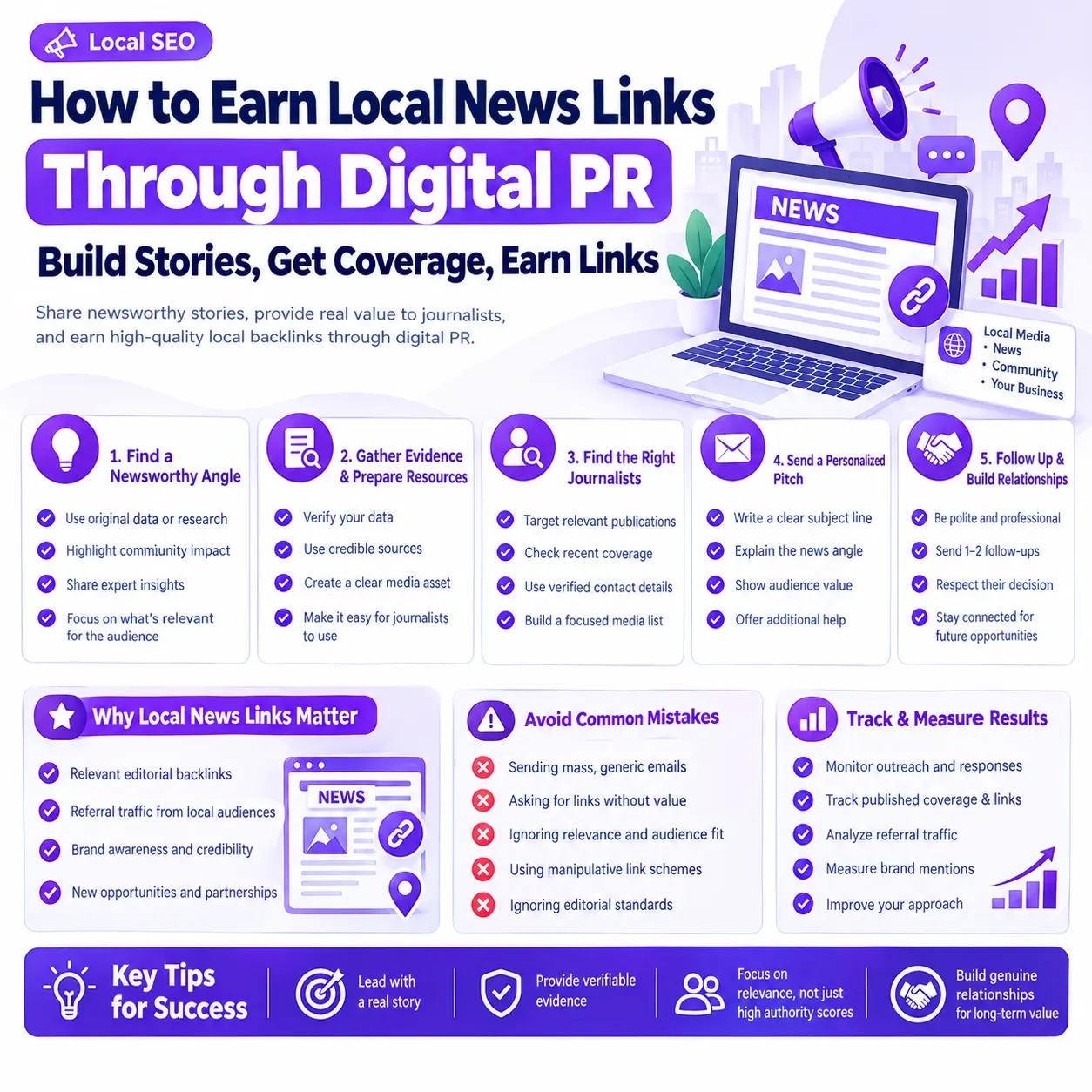
Local news links are earned by giving journalists a credible, relevant reason to cover your business, research, expertise, or community involvement. Start with a newsworthy story, support it with verifiable evidence, identify the journalists most likely to cover it, and send a concise, personalized pitch. Editorial coverage may generate backlinks, brand mentions, referral traffic, and wider visibility.
The challenge is that journalists receive numerous pitches, announcements, and promotional messages. A business asking for a backlink without offering a compelling story gives an editor little reason to respond.
Digital PR takes a different approach. Instead of starting with a link request, you start with something worth reporting.
This guide explains how to develop a newsworthy angle, prepare supporting evidence, find relevant journalists, pitch your story professionally, and evaluate the results. Whether you manage SEO in-house or work with an SEO consultant, you can use the process to plan a more purposeful local link-building campaign.
What Are Local News Links, and How Does Digital PR Earn Them?
Local news links are backlinks from news publishers whose coverage has a meaningful connection to a business, industry, community, audience, or story. They may appear in articles about research, business developments, expert commentary, community initiatives, or emerging issues.
Digital PR earns these links by creating and promoting information that journalists consider relevant to their readers.
For example, a company might publish an original report based on reliable public data. If a journalist uses the findings in a news article and links to the report as a source, the business has earned an editorial backlink.
The important distinction is that the link follows the editorial decision. The business provides the story and evidence; the journalist decides whether to publish the information and whether a link is appropriate.
Local news backlinks vs. other local link-building opportunities
Not every local backlink comes from a news website, and not every local link-building tactic works in the same way.
Opportunity | How it works | Primary purpose |
Local news backlinks | A publisher references your research, expertise, or business in an editorial article | Earned media coverage, referral traffic, and relevant links |
Local business citations | Business details appear in directories and relevant listings | Business discovery and consistent business information |
Community and association links | An organization references a relevant member, partner, or resource | Relationships, visibility, and relevant referrals |
Sponsorship links | A business supports an event or organization that acknowledges its contribution | Partnership visibility and community involvement |
Expert contributions | A qualified professional provides commentary or useful information for publication | Demonstrate expertise and reach relevant audiences |
Press release distribution | An announcement is distributed through news or PR channels | Communicate a development and potentially attract editorial interest |
These methods can complement one another, but they should not be treated as interchangeable. A directory listing does not replace editorial coverage, and a press release published automatically across multiple websites is not equivalent to independent journalism.
Why local news coverage can be valuable for SEO
A relevant news article can introduce your business to a new audience and create a useful reference to your website.
Potential benefits include:
- Relevant editorial backlinks: Journalists may cite an original report, dataset, resource, or expert source.
- Referral traffic: Readers can visit your website directly from the article.
- Brand awareness: Coverage can introduce your business to people who were previously unfamiliar with it.
- Credibility: Independent reporting can help audiences understand your expertise or contribution.
- Further opportunities: A useful story may attract additional reporting, interviews, or references.
These outcomes are possible, not guaranteed. A news mention may appear without a backlink, and a backlink does not automatically produce higher rankings.
Evaluate the relevance and context of the coverage rather than judging a placement solely by a third-party authority score or the publication’s size.
What makes a news link different from a link you can simply request?
An ordinary link request asks a website owner to reference your business. A digital PR pitch offers a reason for a journalist to consider a story.
Compare these approaches:
Weak approach: “Please add a backlink to our website because we provide useful services.”
Stronger approach: “We analyzed a relevant public dataset and identified a trend that may help your readers understand a current issue. The full methodology and findings are available in our report.”
The second approach gives the journalist something to evaluate. It provides a possible story angle, supporting evidence, and a resource that may be useful to readers.
That is the foundation of earning local news links through digital PR.
What Makes a Business or Story Newsworthy to Local Journalists?
A story is worth pitching when it offers something relevant to the publication’s audience, has a clear angle, can be supported with credible evidence, and gives the journalist a reason to cover it now.
A business may have extensive expertise and useful services without every announcement being newsworthy. The task is to find the part of that expertise or activity that has wider editorial value.
1. Find a newsworthy angle in original data or research
Original data can give a journalist a concrete finding to investigate, explain, compare, or reference.
Potential sources include:
- Government and public-sector datasets.
- Published industry research.
- Properly designed surveys.
- Historical data that can be compared consistently.
- Publicly available records.
- Original analysis of multiple reliable datasets.
For example, a hypothetical business association could analyze a public dataset to investigate changes in an industry. If the analysis reveals a meaningful trend, the association could publish the findings, explain its methodology, and offer the results to relevant journalists.
The value comes from the finding and its relevance, not merely from placing numbers in a chart.
Ahrefs describes a related approach in its Tabloid Technique guide to earning local links through digital PR. The method involves identifying a newsworthy topic, collecting relevant data, and sharing the findings with appropriate journalists.
Use that approach thoughtfully. A surprising comparison is not automatically meaningful, and an interesting headline does not justify misleading conclusions.
2. Use community stories, milestones, and meaningful announcements
Businesses can also earn coverage without conducting original research.
Potential story angles include:
- A significant business opening, expansion, or milestone.
- A community initiative with a documented outcome.
- A meaningful partnership between organizations.
- A new service addressing a demonstrated need.
- A substantial investment in a relevant industry or community.
- A charitable project with verifiable details.
- A genuine response to a developing public-interest issue.
The key is to explain why the development matters beyond the business itself.
A routine announcement about a new website may have little editorial value. A substantial initiative that addresses an important problem, involves credible partners, or produces a useful public resource may offer a stronger story.
Do not exaggerate the scale or impact of an initiative to make it appear newsworthy.
3. Offer expert commentary on a current issue
Journalists sometimes need a qualified specialist who can explain a developing issue, clarify technical information, or provide practical context.
A business owner or professional may be able to contribute by:
- Explaining how an industry change affects customers.
- Interpreting a relevant finding.
- Clarifying a technical subject in plain language.
- Identifying practical implications supported by evidence.
- Offering an informed perspective on a current development.
For example, an SEO consultant might explain the practical implications of an official search policy update when a journalist is covering changes in digital marketing.
The commentary should stay within the expert’s actual knowledge. Do not make unsupported predictions or present speculation as established fact.
Timeliness matters, too. A useful response delivered after a news story has lost relevance may be less valuable than a concise, accurate response provided while the journalist is working on it.
4. Create a useful resource that journalists can reference
A newsworthy finding becomes easier to use when the supporting information is well organized.
Depending on the story, a resource might include:
- An original research report.
- A downloadable dataset.
- A methodology page.
- A clear chart or infographic.
- An expert explanation.
- A collection of primary-source references.
- A tool or resource that helps readers understand the issue.
The resource should make it easy for a journalist to check the claim and understand where the information came from.
Avoid hiding essential findings behind unnecessary forms or requiring a journalist to request access to information that could be published openly.
A simple newsworthiness checklist
Before investing time in a campaign, ask:
- Is the subject relevant to a real audience?
- Is the central finding distinctive or useful?
- Can the claim be independently verified?
- Is there a clear reason to publish the story now?
- Does the story fit the publication’s coverage?
- Can a journalist explain the finding without relying on exaggerated claims?
If the answer to most of these questions is no, improve the story before starting outreach.
How to Develop a Local Digital PR Story From Scratch
A practical digital PR campaign does not begin with a spreadsheet of journalists. It begins with a subject worth investigating and enough evidence to support a credible story.
Step 1: Choose a subject that connects your expertise with audience interest
Start by identifying the topics your business understands well.
Then look for the overlap between that expertise, questions people care about, available evidence, and subjects relevant to news coverage.
Ask:
- What questions do customers repeatedly ask?
- What changes are happening in the industry?
- What reliable data could help explain those changes?
- What useful knowledge does the business have?
- What could a journalist’s audience learn from the findings?
Do not assume that a subject is newsworthy simply because it relates to your business.
A useful test is whether the story would still be interesting if the business name were removed from the headline. If not, the idea may be too promotional.
Step 2: Research the evidence and validate the findings
Once you have a potential angle, investigate whether the evidence supports it.
Use authoritative primary sources whenever possible, and document the source, publication date, collection date, and methodology.
For data-driven campaigns:
- Confirm that the data measures the subject you intend to discuss.
- Check whether the definitions remain consistent across the records being compared.
- Look for missing values, incomplete periods, and unusual outliers.
- Make sure the sample or dataset supports the conclusions.
- Distinguish correlation from causation.
- Explain important limitations.
- Verify any headline claim against the underlying evidence.
If you conduct a survey, explain how participants were recruited, how questions were worded, and what the sample can reasonably represent.
Do not manufacture findings, cherry-pick results to support a preferred headline, or imply that a small convenience sample represents an entire population.
Credibility is essential because journalists need information they can defend editorially.
Step 3: Turn the finding into a clear news angle
A useful way to develop the angle is:
Finding → why it matters → who it affects → supporting evidence → useful next step.
Consider this hypothetical example:
A business association reviews a public dataset and discovers a change in an industry trend. It checks the figures, compares relevant periods, explains the limitations, and publishes a report showing what changed and why the finding may matter.
The resulting pitch does not merely announce that a report exists. It tells the journalist what the report reveals, why the finding is relevant, and where the evidence can be checked.
This example illustrates a process, not a real campaign or a claim about expected backlinks.
Step 4: Prepare a journalist-ready media asset
Create a page or document that presents the essential information clearly.
Depending on the campaign, include:
- A concise summary of the main finding.
- The underlying data or links to the original sources.
- A transparent methodology.
- Charts that accurately represent the evidence.
- Relevant expert quotations.
- A spokesperson’s availability.
- Supporting images or documents, where appropriate.
Use descriptive headings, clear labels, and accessible formatting. Cite the original sources and explain any calculations that are not immediately obvious.
The journalist should be able to understand the central point quickly and investigate the evidence without unnecessary friction.
Step 5: Check the story before outreach
Before sending a pitch, review it from an editor’s perspective.
Is the finding accurate? Verify every important claim.
Is it relevant? Identify the audience that would benefit from the story.
Is it timely? Explain why the information matters now, if there is a genuine reason.
Is it original? Make clear what your research or analysis adds beyond existing coverage.
Is it accessible? Ensure the journalist can open the supporting material and identify its sources.
A well-prepared story does not guarantee publication, but it gives the journalist a more useful basis for evaluating the opportunity.
How to Find the Right Local News Websites and Journalists
The purpose of media research is to identify people who might genuinely want to cover your story, not to build the longest possible contact list.
Identify publications that cover the subject
Start with news websites, newspapers, digital-first publications, regional outlets, community news sources, and specialist publications that cover your topic.
Search for relevant articles and investigate who wrote them. Look for evidence that the outlet covers similar subjects, uses outside experts, or reports on the type of issue your campaign addresses.
Evaluate each publication based on:
- Relevance to the story.
- Audience and editorial focus.
- Recent coverage of similar topics.
- Credibility and editorial standards.
- Whether the proposed resource could help its readers.
A publication’s domain metrics alone are not enough to establish that it is a good prospect.
Find journalists through their recent reporting
Read the journalist’s recent articles rather than relying solely on their job title.
A reporter who regularly covers business developments may be relevant to an industry research story, while a specialist who focuses on technology may be better suited to a technical announcement.
Use publicly available bylines, author pages, newsroom contact pages, and professional profiles to verify the journalist’s current role and preferred contact method.
Avoid guessing private email addresses when a legitimate public contact route is available.
Build a prioritized media list
Record the information you need to make outreach relevant.
Field | What to record |
Publication | Name of the news outlet |
Journalist | Relevant reporter or editor |
Coverage area | Main topics they report on |
Relevant article | A recent example of their coverage |
Story fit | Why your pitch may interest them |
Contact method | Verified professional contact route |
Outreach status | Whether and when you contacted them |
Follow-up and outcome | Response, publication, or next action |
Prioritize a smaller group of well-matched journalists over indiscriminate bulk outreach.
A journalist who has recently covered the subject may be a more useful prospect than a high-profile reporter whose work has no meaningful connection to your story.
How to Pitch Local Journalists for News Backlinks
Once the story and media list are ready, write a pitch that makes the editorial opportunity easy to understand.
The objective is to earn consideration for the story, not to persuade a journalist to provide a backlink as a favor.
Write a specific, accurate subject line
The subject line should communicate the topic or finding without exaggeration.
For example:
- New research examines a change in [industry trend]
- Data analysis reveals a shift in [relevant topic]
- Expert available to explain [current development]
- New report explores [specific finding]
These are templates, not claims about actual research. Replace the placeholders only with accurate details from the campaign.
Avoid misleading urgency, exaggerated superlatives, and subject lines that promise a result the evidence cannot support.
Structure a concise, personalized pitch
A useful pitch generally contains six elements:
- Relevant context: Briefly explain why you are contacting this journalist.
- The news angle: State the central finding or development.
- Audience relevance: Explain why the story may interest their readers.
- Evidence: Link to the report, primary data, or supporting material.
- Additional help: Offer an interview, clarification, or relevant expert commentary if available.
- Clear next step: Make it easy for the journalist to request more information.
Keep the email focused. A journalist should not have to read several paragraphs of company history before discovering the story.
Example of a local digital PR email pitch
The following is a hypothetical template. Replace every placeholder with verified information before sending it.
Subject: Research on [specific industry trend or finding]
Hi [Journalist’s Name],
I read your recent coverage of [relevant topic] and thought this research might be useful for a story you are working on.
We analyzed [describe the dataset or research method] to examine [specific question]. The findings suggest [accurate, evidence-supported summary], with [important limitation, if relevant].
The full report includes the methodology, source data, and supporting analysis: [Report URL].
If this fits your coverage, I can provide additional context or arrange a conversation with [qualified spokesperson, if available].
Best regards,
[Your Name]
[Professional Role or Organization]
[Contact Details]
The strongest part of this template is its relevance and evidence, not its wording. Personalize it for the actual journalist and explain why the information matters to their audience.
Do not invent a previous relationship, claim exclusivity without authorization, or insist that the journalist include a link.
Follow up professionally without spamming
Journalists may be working against deadlines, handling multiple stories, or simply deciding that a pitch is not suitable.
If a follow-up is appropriate, send one concise message after a reasonable interval. Refer to the original pitch, restate the key point briefly, and provide any genuinely useful update.
Stop contacting the journalist if they decline or ask not to be contacted. Avoid repeated messages across email and social platforms.
There is no universal follow-up schedule or guaranteed response rate. Timing should reflect the story’s urgency, the journalist’s workflow, and any contact preferences they have communicated.
Which Digital PR Methods Can Earn Local News Links?
Different campaign types suit different businesses, stories, and resource levels. Choose the method that fits the evidence you can produce rather than forcing every idea into a large research campaign.
Method | Best suited to | Main consideration |
Original data research | A distinctive trend or finding | Data quality and methodology must be defensible |
Surveys and reports | Questions requiring new evidence | Sampling and limitations must be transparent |
Expert commentary | A current issue requiring explanation | Expertise and timely availability matter |
Community initiatives | Genuine public-interest developments | The story must offer value beyond self-promotion |
Business announcements | Significant developments | Routine updates may not interest journalists |
Reactive digital PR | A relevant developing story | Accuracy, speed, and editorial fit are essential |
Original research and data campaigns
Original research can be useful when the question is meaningful and the evidence can support a clear conclusion.
Before commissioning a study or investing heavily in data collection, examine whether the topic has a genuine audience, whether reliable data is available, and whether the result could offer something new.
A complex study is not automatically better than a straightforward analysis. A modest but well-supported finding can be more useful than an elaborate report built around a weak premise.
Expert commentary and reactive digital PR
Expert commentary may be a more practical option when a business has relevant knowledge but limited resources for research.
Prepare a clear explanation of your expertise, identify topics you can credibly discuss, and monitor relevant developments. Respond when you can offer meaningful context rather than sending generic commentary on every trending issue.
Reactive outreach must not compromise accuracy. If you cannot verify the facts or provide a responsible explanation within the available time, do not rush to publish a claim simply to join the conversation.
When a press release is useful—and when it is not
A press release can help communicate a genuine announcement, provide a consistent source of facts, and make supporting information available to journalists.
However, distributing a press release does not guarantee independent reporting, a backlink, or search visibility.
A useful release should:
- Present the news clearly.
- Include verifiable facts.
- Explain the significance of the announcement.
- Provide relevant supporting material.
- Identify a contact who can answer questions.
Avoid distributing near-identical releases across large numbers of websites solely to generate backlinks. Automated publication and independent editorial coverage are different outcomes.
What to Do When a News Outlet Mentions Your Business Without Linking
A journalist may publish an accurate and valuable story about your business without adding a hyperlink. This does not necessarily mean the campaign failed.
First, review the article and confirm that the mention is accurate. Then identify whether a link to your original research, relevant resource, or official business page would genuinely help readers.
Make a polite, editorially justified request
You can contact the journalist or editor with a short message thanking them for the coverage and explaining which resource could add value.
For example:
Subject: Thank you for covering [story topic]
Hi [Journalist’s Name],
Thank you for including [business or research] in your article about [topic].
I noticed the article references our research, which is available here: [Resource URL]. If you think it would help readers explore the original findings, you are welcome to reference that page.
Thanks again for the coverage.
Best regards,
[Your Name]
This message makes a suggestion without demanding a link. The publisher remains free to decide whether the link belongs in the article.
Record coverage even when no backlink is added
Track news mentions separately from earned backlinks.
A mention may still contribute to awareness, introduce the business to relevant readers, or provide an opportunity for future relationships. A backlink is one possible outcome of coverage, not the only outcome worth recording.
Common Local Digital PR Mistakes That Prevent Links
Pitching a promotional story with no audience value
A company announcement is not automatically a news story.
If the main point is that a business is excellent, innovative, or customer-focused, ask what evidence supports that claim and why a publication’s readers should care.
Replace generic promotional language with a clear finding, meaningful development, or useful explanation.
Contacting irrelevant journalists or sending generic bulk emails
Mass outreach often ignores what journalists actually cover.
Research each prospect, verify their role, and explain why the story fits their work. Do not send the same pitch to unrelated reporters or pretend to have read an article you have not reviewed.
Publishing weak or misleading research
Poor methodology can undermine a campaign even when the headline appears interesting.
Avoid cherry-picked figures, unsupported rankings, inaccurate comparisons, and conclusions that go beyond the evidence. Publish the sources and methodology so readers can understand how the findings were produced.
Paying for links or relying on manipulative link schemes
Legitimate PR can involve reasonable costs for research, creative work, media tools, and campaign management. Those expenses are different from purchasing editorial links intended to manipulate search rankings.
Google’s spam policies for web search identify link schemes as a policy violation. They include buying or selling links for ranking purposes and certain paid placements that pass ranking credit.
When a placement is sponsored or paid, follow the applicable link qualification requirements, such as using rel=”sponsored” where appropriate. Do not present paid advertising as independent editorial endorsement.
The objective is to earn genuine editorial references, not to manufacture the appearance of independent coverage.
Expecting every campaign to earn backlinks
A journalist may decline the story, publish it without a link, or use a different source. Even a well-researched campaign may receive no coverage.
Do not evaluate success solely by whether the campaign achieved a predetermined number of backlinks. Review story quality, audience relevance, journalist feedback, actual coverage, referral outcomes, and opportunities to improve the next campaign.
How to Measure a Local Digital PR Campaign
Measure the work from initial outreach through editorial coverage and subsequent business outcomes. A useful reporting process helps you understand what happened without assuming that every result was caused by the campaign.
Track outreach and editorial outcomes
Record:
- Relevant journalists identified.
- Pitches sent.
- Responses and requests for additional information.
- Articles published.
- Earned backlinks.
- Unlinked brand mentions.
- Links to the intended resource.
- Referral visits and meaningful engagement.
These measures describe different stages of the campaign. A high volume of emails sent does not demonstrate that the campaign was relevant or effective.
Evaluate backlink quality and context
For each earned link, review:
- Whether the linking page is live and accessible.
- Whether the publication and article are relevant.
- Whether the link appears naturally in the editorial content.
- Whether the destination page is appropriate and useful.
- Whether the link uses an applicable qualification attribute.
- Whether the article generates referral traffic or other observable engagement.
Third-party metrics can provide additional context, but no single proprietary score establishes a link’s value to Google.
Assess referral traffic and search performance
Use suitable analytics tools to examine visits referred by news articles and whether those visitors engage with the website.
Google Search Console can help you review search performance over time. However, it does not provide a complete record of every backlink, nor can it prove that a particular link caused a ranking change.
SEO performance is influenced by many factors, including competition, site quality, content changes, technical conditions, and broader search demand. Avoid attributing every improvement to one PR campaign without supporting evidence.
Decide what to improve in the next campaign
Use the results to identify the next practical step.
Observation | Possible next action |
Journalists show little interest | Reassess the story angle and audience relevance |
Pitches receive questions but no coverage | Improve evidence, clarify the finding, or provide missing context |
Coverage appears without links | Evaluate whether a relevant resource would help readers |
Links come from irrelevant articles | Refine publication and journalist selection |
Coverage attracts little referral traffic | Review the audience fit and the usefulness of the referenced resource |
A campaign produces useful editorial interest | Investigate related story angles without repeating the same material |
Treat these observations as diagnostic clues rather than definitive explanations. A journalist’s decision may depend on editorial priorities that are outside your control.
Can Small Businesses Earn Local News Links Without a Large PR Budget?
Yes. A small business can start with existing expertise, reliable public information, a meaningful announcement, or a genuine community initiative.
A large research budget is not a prerequisite for every digital PR campaign. What matters is whether the story is relevant, credible, and useful enough to justify editorial attention.
Start with the resources already available
Consider the information and expertise your business already has:
- Questions customers frequently ask.
- Industry changes you can explain.
- Public data relevant to your field.
- Documented business developments.
- Genuine community involvement.
- Resources that could help journalists explain a topic.
Start with the strongest idea you can substantiate. Do not spend money on a survey or data tool until you have established why the research is worth conducting.
Decide what to do in-house and what to outsource
In-house work may be suitable when the story is straightforward, the evidence is accessible, and the team has time to research journalists and manage outreach.
Professional support may be useful when the campaign requires original research, complex data validation, substantial media prospecting, coordinated outreach, or ongoing measurement.
When evaluating a service provider, ask how they select stories, validate claims, identify relevant publications, handle paid placements, and report campaign outcomes.
Be cautious of guarantees for a fixed number of editorial backlinks or specific ranking improvements. Journalists and publishers make independent editorial decisions.
If you need broader help assessing link opportunities and planning a sustainable strategy, see the Local Link Building service from Freelancer Tawhid.
Set realistic expectations for time and outcomes
The timeline depends on the complexity of the story, access to evidence, news cycles, editorial deadlines, and the responses received.
A simple expert-commentary campaign may require less preparation than an original research project. Neither guarantees publication.
Plan around the work you can control: evidence quality, relevance, pitch clarity, professional communication, and consistent measurement.
Conclusion: Earn Local News Links by Leading With a Worthwhile Story
The most sustainable way to earn local news links through digital PR is to give journalists something worth covering.
Start with a story that matters to an audience. Validate the evidence, prepare a useful resource, research journalists who cover the subject, and explain the opportunity in a concise, personalized pitch. Respect editorial independence, track both links and unlinked mentions, and use the results to improve future campaigns.
You do not need to turn every announcement into a major research project. You do need a clear reason for the story to exist beyond obtaining a backlink.
Digital PR works best when the link is a potential outcome of useful information and legitimate editorial coverage—not the only reason for the campaign.
If you want to assess your backlink opportunities, develop a more structured local link-building strategy, or determine how digital PR fits into your wider SEO priorities, explore Freelancer Tawhid’s Local Link Building service. You can also consider an SEO consultation if you need strategic guidance before committing to a campaign.
Frequently Asked Questions
1. How do you get backlinks from local news websites?
You can earn backlinks from local news websites by developing a relevant story, supporting it with verifiable data or expert insight, and pitching it to journalists who cover that subject. If a journalist publishes the story, they may link to your research, business website, or another useful resource. Coverage and links are never guaranteed.
2. What types of stories are most likely to attract local news coverage?
Stories with a clear audience benefit, credible evidence, and a timely or distinctive angle are worth prioritizing. Examples include original research, meaningful community initiatives, expert commentary on current issues, and significant business developments. The best angle depends on the publication’s audience and editorial priorities; no story format guarantees coverage.
3. How do you pitch a local journalist for a backlink?
Research the journalist’s recent coverage, identify why your story fits their audience, and send a concise, personalized email. Explain the finding, provide a credible source, and offer relevant supporting information or expert commentary. Focus on the editorial value rather than demanding a backlink, and respect the journalist’s decision if they decline.
4. Are press releases an effective way to build local news backlinks?
Press releases can help communicate genuine business developments, but distributing one does not guarantee independent news coverage or a valuable backlink. They work best when they communicate something genuinely newsworthy and provide verifiable information. Avoid relying on mass syndication or paid placements primarily intended to manipulate search rankings.
5. What should you do if a local news article mentions your business without linking to your website?
First, confirm that the mention is accurate and identify a relevant page that would genuinely help readers. You can then politely contact the journalist or editor, thank them for the coverage, and suggest the resource if a link would add value. If no link is added, record the mention separately from earned backlinks.