
How to Evaluate Local Backlinks and Avoid Link-Building Risks

Freelancer Tawhid
SEO Expert and Consultant
- October 14, 2026
- No Comments
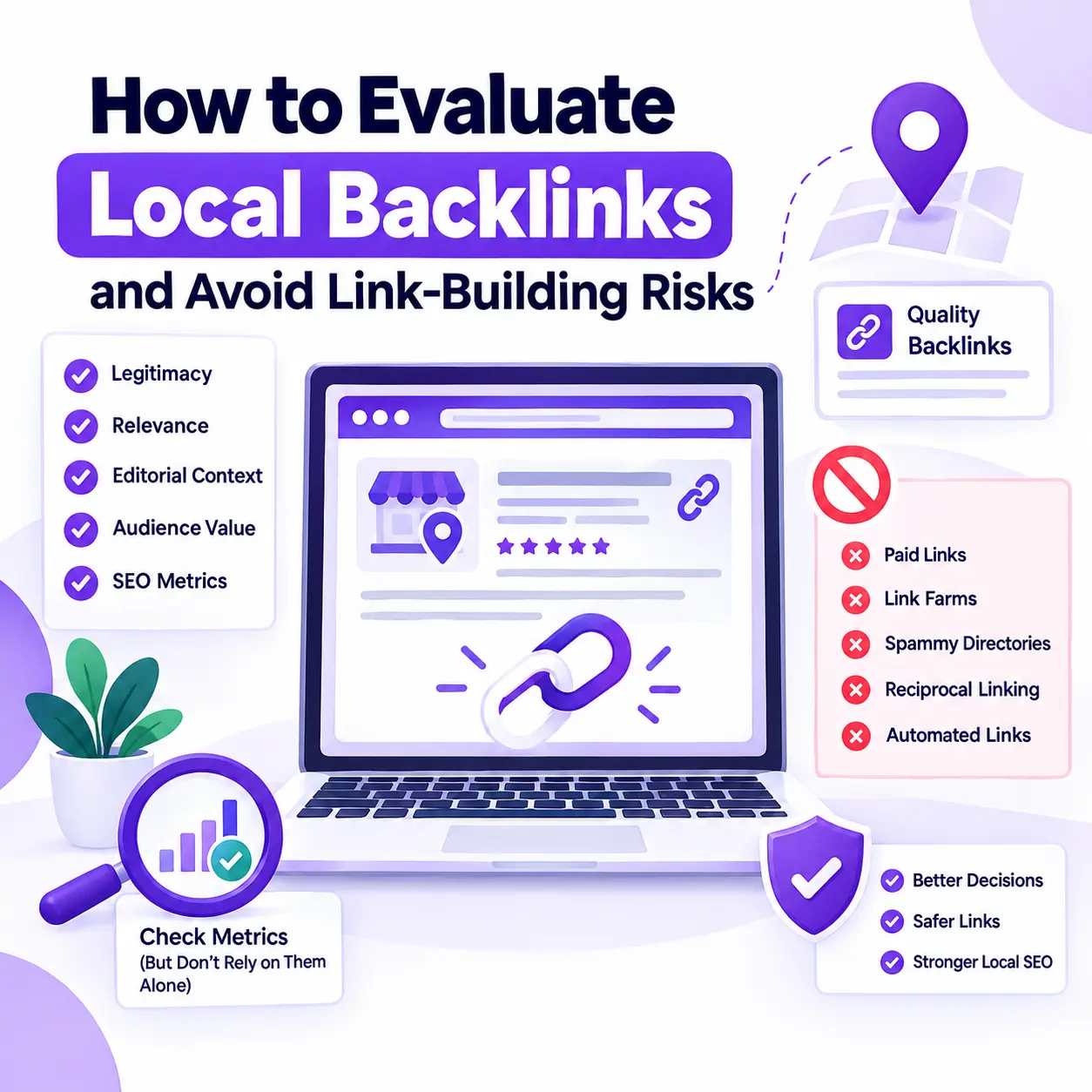
Local backlinks can help people discover a business, establish relevant connections across the web, and support a broader local SEO strategy. However, not every backlink is worth pursuing, and some link-building tactics can violate Google’s spam policies.
To evaluate local backlinks effectively, examine the referring website’s legitimacy, geographic or topical relevance, linking page, editorial context, and potential audience value. Use SEO metrics as supporting evidence rather than relying on authority scores alone. Reject manipulative link schemes, investigate suspicious links carefully, and focus on earning references that have a genuine reason to exist.
This guide explains how to assess backlink opportunities, recognize common risks, audit existing links, and make better link-building decisions.
What Makes a Local Backlink High Quality?
A high-quality local backlink is a link from a legitimate website or page that has a meaningful connection to a business’s location, industry, audience, or subject matter. The link should make sense in its context and provide a reasonable benefit to readers. Its quality cannot be determined by a single metric or by the website’s geographic proximity alone.
For example, a local business might receive a relevant backlink from an industry association, a community organization, a regional publication, or a supplier that genuinely works with the business.
These opportunities can be valuable for different reasons. Some may introduce the business to a relevant audience, while others may provide useful editorial references or strengthen legitimate professional relationships.
The key is to evaluate the complete context of the link rather than judging it by its source alone.
Local relevance versus topical relevance
Geographic relevance and topical relevance are related, but they are not identical.
Geographic relevance describes the connection between a website or page and the market or community a business serves.
Examples include:
- A community organization mentioning a business that supports its activities.
- A regional publication referencing a business in a relevant article.
- A local business association listing its legitimate members.
- A community resource recommending useful services to its audience.
Topical relevance describes the connection between the linking page and the business’s industry, expertise, products, or services.
Examples include:
- A professional association linking to a member’s useful resource.
- A supplier referencing a business partner.
- An industry publication citing an informative guide.
- A specialist website recommending a relevant tool or service.
Some backlinks offer both geographic and topical relevance. Others may be useful because they reach the right audience or provide an editorially justified reference, even if the website is not located in the same immediate area.
For instance, a plumbing company could reasonably receive a link from a plumbing industry association, a supplier, or a community resource. A link from an unrelated website that publishes articles about dozens of disconnected industries solely to sell backlinks would require much closer scrutiny.
The practical rule: A link should have a credible reason to connect the referring page with the destination website.
Why the referring page matters
A reputable domain does not automatically make every page on that domain a good backlink opportunity.
Inspect the actual page where the link appears.
Ask yourself:
- Does the page contain useful, relevant information?
- Is the link appropriate for the subject being discussed?
- Does the linked page provide additional value to readers?
- Is the link part of the main editorial content, a legitimate resource list, or a relevant directory?
- Does the page appear to exist primarily to accommodate paid links?
- Can visitors access the page and follow the link?
A link embedded in a useful article may help readers discover a relevant resource. A link placed in an unrelated article simply because someone paid for it has a different purpose and may introduce search-policy risks.
Placement alone does not prove quality, but it helps you understand why the link exists.
Quality versus quantity
A backlink count is not a reliable standalone measure of link-building success.
Consider these differences:
- Total backlinks: The number of individual links discovered by a tool.
- Referring domains: The number of distinct websites linking to the target.
- Relevant referring domains: The subset of referring websites with a meaningful relationship to the business, its subject, or its audience.
- Editorially earned links: References provided because another website finds the destination useful or relevant.
A website can accumulate many links without attracting meaningful attention from relevant websites. Multiple links from one domain also do not represent the same diversity of sources as links from multiple independent domains.
There is no universal number of backlinks every local business needs. The appropriate strategy depends on its industry, competitors, existing visibility, content, reputation, and the opportunities available.
Focus on the quality and purpose of individual links instead of chasing a predetermined link count.
How to Evaluate a Local Backlink Step by Step
A consistent evaluation process helps you compare opportunities, document your reasoning, and avoid decisions based on superficial metrics.
Use the following seven steps before investing time or money in a prospective backlink.
Step 1: Verify that the website is legitimate
Start by examining the referring website as a whole.
Look for evidence that it serves a genuine purpose, such as publishing useful information, supporting a community, representing an industry, operating a legitimate business, or providing a relevant resource.
Review the following:
- Website purpose: Can you understand why the website exists and whom it serves?
- Content quality: Does it publish useful, original material?
- Subject consistency: Do its main topics make sense together, or does it publish unrelated content seemingly designed to sell links?
- Editorial standards: Is there evidence of meaningful content selection and review?
- Audience credibility: Is there a plausible reason for real people to visit the website?
- Link-selling patterns: Does the site repeatedly publish unrelated commercial articles containing optimized backlinks?
Be cautious when a website publishes a large volume of unrelated guest posts, offers followed links for a fixed fee, or has little purpose beyond selling placements.
However, do not automatically reject a website because it has a small audience, limited content, or a low authority score. A small professional association or community organization may still be legitimate and relevant.
Look at the combined evidence.
Step 2: Inspect the actual referring page
Once the website passes an initial review, examine the individual page where the backlink would appear.
Check whether:
- The page has a clear purpose.
- The content is useful and relevant to its intended audience.
- Your website would be a reasonable resource for that audience.
- The link fits naturally within the content.
- The destination page provides the information or service the link implies.
- The page is accessible and the link works as intended.
For example, a detailed article about maintaining a commercial property might reasonably reference a useful guide from a relevant contractor. An unrelated entertainment article that suddenly inserts a commercial link to that contractor would need a much stronger justification.
Also check whether the page is an ordinary editorial resource, a sponsored article, a directory entry, or another type of placement. The nature of the placement affects how the link should be evaluated and qualified.
Step 3: Evaluate geographic and industry relevance
Ask whether the website and its audience have a genuine connection to the business.
Consider these questions:
- Does the website serve the community or market relevant to the business?
- Does the linking page discuss a related industry, problem, service, or resource?
- Would the intended audience find the link useful?
- Is the connection genuine, or does it exist only because a link seller claims the website is locally relevant?
A business does not need to obtain every backlink from a website in the same geographic area. Industry associations, specialist publications, suppliers, and other relevant organizations may provide useful references.
Likewise, a domain name containing a geographic term does not automatically make its links valuable.
Evaluate the actual relationship, not just the location mentioned in the domain or page.
Step 4: Review authority, traffic, and other SEO metrics
Backlink-analysis tools can help identify promising opportunities and investigate suspicious patterns. However, their metrics should support manual evaluation rather than replace it.
Useful indicators include:
Domain-level authority metrics
Tools such as Ahrefs and Semrush provide proprietary measures of backlink strength or website authority. These can help compare websites within a relevant set, but they are not Google’s own ranking scores.
Page-level metrics
The strength of the individual referring page may differ substantially from the overall domain’s metrics. Inspect both when the tool provides reliable data.
Estimated organic traffic
Organic traffic estimates can help you understand whether the referring website appears to attract search visitors. Investigate the relevance of that traffic and the specific page rather than assuming a high estimate guarantees a valuable link.
Referring domains and outbound links
Review the diversity of referring domains and whether the website links to an unusually broad collection of unrelated commercial destinations.
A large number of outbound links is not inherently suspicious. The context and purpose of those links matter.
Historical trends
When historical data is available, look for abrupt changes in content, traffic, or referring domains that might warrant further investigation.
Why a high authority score is not enough
A website may have a high third-party authority score but publish irrelevant paid placements. Another website may have a modest score yet serve a genuine professional or community audience.
Neither situation can be judged accurately using the score alone.
Ahrefs explicitly cautions against using Domain Rating as a standalone measure of website quality. Its documentation explains that the metric represents the strength of a website’s backlink profile within Ahrefs’ own system, not a direct measure of legitimacy or Google’s assessment.
Reference: Ahrefs’ explanation of Domain Rating.
Use metrics to identify questions worth investigating. Do not invent a universal authority threshold or reject every opportunity below an arbitrary score.
Step 5: Assess editorial placement and anchor text
The way a link appears can reveal whether it serves a legitimate editorial purpose.
Inspect the anchor text, surrounding sentences, link placement, and relationship between the linking page and the destination.
Natural anchor text describes the destination in language that makes sense to readers. Depending on the context, it might use a brand name, a resource title, a descriptive phrase, or a relevant term.
Warning signs include:
- Repeated exact-match commercial anchors arranged to influence rankings.
- Links inserted into unrelated articles.
- Excessive sitewide footer or template links.
- Paid articles that conceal their commercial purpose.
- Large-scale guest posting designed primarily to obtain ranking credit.
Do not assume that exact-match anchor text is automatically harmful or that branded anchors are always safe. Evaluate the acquisition method and the overall pattern.
Understand link attributes
Google provides link attributes that help website owners communicate the nature of a link:
- rel=”sponsored” identifies advertising, paid placements, and sponsorship-related links.
- rel=”nofollow” can indicate that a website does not want to imply an ordinary endorsement or association with the linked page.
- rel=”ugc” is intended for user-generated content, such as forum posts and comments.
Google recommends rel=”sponsored” for paid placements, while rel=”nofollow” remains an acceptable alternative for qualifying such links.
Official reference: Qualify outbound links to Google.
A paid placement should not be treated as an ordinary editorial endorsement simply because the publisher inserts a link into the article.
Step 6: Assess the potential audience and referral value
A backlink can offer business value beyond its possible SEO impact.
Ask whether the placement could realistically help relevant people discover the business, understand its expertise, or find a useful resource.
Consider:
- Whether the referring website attracts an audience relevant to the business.
- Whether visitors would have a reason to click the link.
- Whether the destination page satisfies the expectations created by the anchor text.
- Whether the placement supports a legitimate professional relationship.
- Whether the opportunity would still make sense without an assumed ranking benefit.
For example, a relevant industry organization may have a modest audience but still be useful because its members are closely connected to the business’s market.
Conversely, a website with impressive traffic estimates may be a poor choice if its audience has little interest in the linked resource.
Do not promise referral visits or conversions based on a backlink’s existence. Assess plausible value and monitor actual outcomes where measurement is available.
Step 7: Document the evidence and make a decision
Before approving a backlink opportunity, record the findings in a simple spreadsheet or evaluation document.
Include:
- Referring domain and page URL.
- Proposed destination URL.
- Geographic or topical relevance.
- Website legitimacy and content quality.
- Editorial placement and anchor text.
- Available authority and traffic metrics.
- Link attributes and commercial arrangements.
- Potential audience value.
- Identified risks and supporting evidence.
- Recommended next action.
Then classify the opportunity into one of four categories.
Decision | When to use it | Next step |
Pursue | The opportunity is legitimate, relevant, and editorially appropriate. | Continue with outreach or the appropriate relationship-building process. |
Investigate | The opportunity appears promising, but important facts remain uncertain. | Verify ownership, placement details, audience relevance, and commercial terms. |
Reject | The opportunity is irrelevant, deceptive, manipulative, or poor value. | Decline the placement and record the reason. |
Monitor or remediate | An existing link raises credible concerns about how it was acquired or used. | Investigate the evidence and choose a proportionate response. |
These categories are a practical decision framework, not an official Google scoring system.
Consider a hypothetical example: a relevant industry association offers a resource listing that serves its members. Its authority score is modest, but the association is legitimate and the link makes sense. The opportunity may be worth pursuing.
A different website advertises high-authority followed links across unrelated industries for a fixed payment. Despite its impressive metrics, the arrangement may create unnecessary risk and should not be accepted merely because the score is high.
The purpose of evaluation is to make informed decisions, not to find a justification for acquiring every available link.
Local Backlink Evaluation Checklist
Use this checklist when reviewing prospective backlinks or auditing existing ones.
Evaluation factor | Questions to ask | Warning signs |
Website legitimacy | Does the website have a credible purpose and useful content? | It exists primarily to sell placements. |
Relevance | Is there a genuine connection to the business, industry, or audience? | The link has no reasonable contextual relationship. |
Referring page | Does the page provide useful information? | Thin or unrelated content created mainly for links. |
Editorial integrity | Does the link make sense in context? | Forced placement or concealed paid promotion. |
Authority metrics | Are the metrics supported by other evidence? | A high score is the only reason to approve the link. |
Referral value | Could the link help relevant visitors discover a useful resource? | No credible audience or user benefit. |
Link implementation | Does the link work and accurately reflect its commercial nature? | Paid placement passes ranking credit without appropriate qualification. |
Overall risk | Is the decision based on documented evidence? | Bulk-link pressure, guaranteed rankings, or no transparency. |
The most important factors are legitimacy, relevance, editorial integrity, and compliance. Metrics can help you investigate an opportunity, but they cannot establish its quality by themselves.
Local Link-Building Red Flags to Avoid
Google defines link spam as creating links to or from a website primarily to manipulate search rankings. Its spam policies identify several practices that can violate its guidelines.
Understanding these practices helps you evaluate opportunities before committing resources.
1. Paid links that pass ranking credit
Paying for advertising or sponsorship is not inherently a problem. The risk arises when a paid placement is used to manipulate search rankings and is not appropriately qualified.
Examples include:
- Buying followed links specifically for ranking purposes.
- Paying publishers to insert optimized commercial anchors into articles.
- Exchanging products or services for links intended to pass ranking credit.
- Purchasing advertorials that conceal their commercial purpose and pass ranking credit.
Google recommends qualifying paid links with rel=”sponsored” or rel=”nofollow”.
Before approving a paid placement, clarify the commercial arrangement and how the link will be presented. A legitimate advertisement should not be confused with an independently earned editorial endorsement.
2. Link farms and private blog networks
Some websites exist primarily to sell backlinks or manufacture artificial connections between websites.
Potential warning signs include:
- Large volumes of unrelated commercial articles.
- Repetitive guest posts with similar linking patterns.
- Little useful content beyond paid placements.
- Multiple websites with overlapping, artificial publishing patterns.
- Strong pressure to purchase links in bulk.
These signals warrant investigation, but no single superficial characteristic proves that a website is part of a private blog network.
Assess the available evidence and the purpose of the proposed link arrangement.
3. Low-quality directories and mass submissions
Directories can be useful when they serve a genuine audience, industry, or community.
A legitimate professional association’s member directory is different from a low-quality directory created primarily to host links.
Avoid indiscriminate submissions to hundreds of unrelated directories simply to increase backlink counts.
Before submitting a listing, ask:
- Does the directory serve a real purpose?
- Is the listing relevant to the business?
- Does the directory provide useful information to visitors?
- Is there a clear reason for the listing to exist beyond the backlink?
This also helps distinguish backlink prospecting from legitimate business-listing management. For relevant listing work, see the Local Citation Building Service.
4. Excessive reciprocal linking
Reciprocal links occur when two websites link to each other.
Not every reciprocal link is manipulative. Genuine business partners, professional organizations, and related resources may naturally reference each other.
The concern is excessive or artificial link exchange arranged primarily to manipulate search rankings.
For example, a group of unrelated websites agreeing to exchange optimized links solely to increase ranking signals presents a different situation from two legitimate partners referencing one another because the information is useful.
Evaluate the purpose, relevance, and scale of the arrangement.
5. Automated link creation and comment spam
Avoid services that generate large numbers of backlinks through automated comments, forum profiles, artificial directories, or other low-value placements.
Common warning signs include:
- Promises of thousands of links within a short period.
- Automated submissions across unrelated websites.
- Keyword-rich links placed in irrelevant comments.
- Links embedded in distributed widgets or templates.
- No meaningful review of the referring websites.
A large number of automatically generated links does not demonstrate a strong link-building strategy. Google explicitly identifies automated link creation and several related practices as link spam.
6. Manipulative guest posting and low-value content
Guest contributions can be legitimate when they provide meaningful value to the publication’s audience.
Risk increases when articles are produced at scale primarily to obtain followed backlinks, especially when they use optimized anchors, appear on unrelated sites, or offer little original information.
Before accepting a guest-post opportunity, evaluate the publication’s subject matter, editorial standards, intended audience, and the actual value of the proposed article.
The question is not simply whether a website accepts guest posts. It is whether the contribution serves a legitimate editorial purpose.
7. Misleading promises from link-building providers
A provider’s sales claims should be evaluated just as carefully as its backlink opportunities.
Ask prospective providers:
- How are the links acquired?
- Can I review the proposed websites and placements?
- Are any placements paid, sponsored, or incentivized?
- How are paid links appropriately qualified?
- Will you provide the actual referring URLs?
- What criteria determine whether a prospect is accepted?
- Do you guarantee rankings or a fixed number of followed links?
- How will you report risks and explain the work performed?
Be cautious when a provider refuses to disclose its methods, sells large quantities of links without meaningful review, or guarantees ranking outcomes.
A credible service should be able to explain its process, document its work, and set realistic expectations.
If you are assessing a broader campaign, explore the Local Link Building Service to understand how a focused link-building strategy fits into your wider local SEO efforts.
Are Low-Quality Backlinks Harmful to SEO?
Not every low-quality backlink harms a website, and not every unfamiliar referring domain requires action.
The important distinction is between a link that offers little value and a link acquired through a manipulative scheme that violates Google’s policies.
Low-quality links versus policy violations
A weak backlink may come from a small website, an inactive page, or a source with limited audience relevance. It may simply provide little practical value.
A policy-violating link scheme is different because its acquisition or use is intended to manipulate search rankings.
For example:
- A small community website linking to a useful resource is not automatically harmful.
- A low-traffic industry blog may still provide a legitimate reference.
- A purchased followed link intended to manipulate rankings raises a different concern.
- A sudden increase in unfamiliar links is not, by itself, proof of a violation.
Third-party tools may label links as toxic based on their own scoring systems. Treat those labels as prompts for investigation, not definitive judgments about Google’s assessment.
When should you investigate suspicious backlinks?
Investigate when there is meaningful evidence of a problem, such as:
- A known history of purchasing links that violated Google’s spam policies.
- An agency campaign involving artificial or undisclosed link schemes.
- A substantial pattern of suspicious links connected to previous SEO work.
- A manual action relating to unnatural links in Google Search Console.
A sudden increase in backlinks may justify checking the data, but it does not establish that a competitor attack, penalty, or policy violation has occurred.
Examine the source, acquisition history, linking context, and any relevant Search Console notifications before deciding what to do.
What happens if Google identifies unnatural links?
Google’s spam systems may neutralize the effects of manipulative links. Policy violations can also result in a manual action, which may affect a site’s visibility in search results.
The specific outcome depends on the circumstances. You should not assume that every suspicious backlink causes a penalty or that removing a link will automatically improve rankings.
If you suspect a manual action, review the Manual Actions report in Google Search Console and follow the applicable guidance.
Official reference: Google Search Console — Manual Actions.
How to Audit Existing Local Backlinks and Address Risk
Evaluating new opportunities helps prevent avoidable mistakes. Auditing existing backlinks helps you understand your current link profile and investigate any credible concerns.
A backlink audit should be evidence-based, not a process of removing every link that looks unfamiliar.
Step 1: Export and organize backlink data
Start with the links available in Google Search Console. You can supplement this data with a backlink-analysis platform when you need additional referring-page details, historical information, or competitor comparisons.
Organize the information into a spreadsheet with columns for:
- Referring domain.
- Referring page URL.
- Target page URL.
- Anchor text.
- Link attributes, where available.
- Discovery date or acquisition history, if known.
- Suspected source or campaign.
- Evaluation notes.
- Recommended action.
Remember that different tools use different crawlers and databases. Their reports may not contain every backlink, and discrepancies between tools are normal.
Use the available data to identify patterns worth investigating.
Step 2: Investigate suspicious patterns manually
Review the actual referring pages and domains before deciding that a link is harmful.
Check whether the links appear to have been acquired naturally, through legitimate business relationships, or through a previous campaign.
Prioritize links supported by evidence of manipulative acquisition. Do not prioritize a cleanup simply because a tool assigned a low quality score.
A useful audit should distinguish between:
- Links that provide little value but raise no clear policy concern.
- Links that need further investigation.
- Links known to have been acquired through a problematic campaign.
- Links associated with an actual manual action.
This distinction prevents unnecessary work and helps keep remediation proportionate to the risk.
Step 3: Decide whether removal or qualification is appropriate
If a link was acquired through a policy-violating arrangement, consider whether the publisher can remove it or appropriately qualify it.
Depending on the circumstances, you may:
- Contact the website owner with a clear, professional request.
- Explain which link or placement needs attention.
- Request removal or suitable qualification when appropriate.
- Record the request and any response.
- Review the situation again if the link remains.
Not every suspicious-looking link needs to be removed. Base the decision on the evidence, acquisition history, and relevant Google guidance.
Step 4: Understand when to use Google’s Disavow Tool
The Google Disavow Tool is an advanced feature that should be used cautiously.
Google explains that most websites do not need to disavow backlinks. The tool is intended for limited situations involving a considerable number of spammy, artificial, or low-quality links and a manual action—or a meaningful likelihood of one—associated with those links.
Before disavowing links:
- Investigate the source and acquisition method.
- Attempt to remove problematic links where feasible.
- Review Google’s current disavow documentation.
- Ensure that the proposed disavow file contains the intended URLs or domains.
- Avoid including legitimate links simply because they have low authority scores.
Incorrect disavowal can harm search performance. It is not a routine step in every backlink audit, and it does not guarantee recovery from a ranking decline.
Official reference: Google’s Disavow Links Tool guidance.
Step 5: Monitor the outcome and keep records
Maintain a record of the audit findings, removal requests, link qualifications, and any disavow decisions.
Monitor relevant indicators over time, including:
- Manual-action status in Search Console.
- The availability and status of important landing pages.
- Organic search performance.
- New referring domains and changes to existing links.
- Referral traffic, where measurable.
Do not attribute every ranking fluctuation to backlinks. Search visibility can change for many reasons, including competition, content changes, technical problems, and changes in search systems.
If backlink concerns form part of a broader performance problem, a Local SEO audit can help put the evidence into the context of the website’s wider SEO health.
Tools for Evaluating Local Backlinks
Tools can help you discover backlinks, organize evidence, and investigate patterns. The most useful setup depends on the scope of your audit and the level of detail you need.
Google Search Console
Google Search Console provides first-party information about your website’s search performance and links recognized by Google.
Use it to:
- Review the available links report.
- Examine linking websites and linked pages where data is provided.
- Check the Manual Actions report.
- Monitor relevant search-performance changes.
The links report is not a complete inventory of every backlink on the internet. Treat it as one evidence source rather than a definitive list.
Official resource: Google Search Console.
Ahrefs and Semrush
Commercial backlink-analysis tools can help you investigate:
- Referring domains and individual backlinks.
- Linking-page context.
- Anchor-text patterns.
- Estimated organic traffic.
- Competitor backlink opportunities.
- Changes in backlink profiles over time, where supported.
Ahrefs and Semrush use their own data and metrics. Coverage, estimates, and scores can differ, so avoid treating a single tool’s output as conclusive evidence.
Choose a tool based on the information you need, the depth of analysis required, and your budget. A manual review may be sufficient for a small number of prospects, while a larger audit may justify more comprehensive reporting.
Manual website inspection
A browser remains essential for assessing information that automated metrics cannot reliably establish.
Inspect the website’s purpose, the page’s content, the link’s placement, the audience, and the commercial context.
A tool can identify a backlink. Human judgment is still needed to decide whether the link makes sense and whether the evidence warrants further investigation.
A practical tool-assisted workflow
Use this sequence to keep the process manageable:
- Discover candidate links through Search Console or a backlink-analysis platform.
- Review the referring domains and linking pages.
- Verify relevance, editorial integrity, and commercial arrangements.
- Record supporting evidence and potential risks.
- Decide whether to pursue, investigate, reject, or remediate.
- Monitor relevant changes without assuming that every movement in rankings is caused by backlinks.
The objective is not to use as many tools as possible. It is to make a sound decision with sufficient evidence.
How to Build a Safer Local Backlink Strategy
A good backlink evaluation process helps you reject poor opportunities. A sustainable strategy also needs legitimate ways to earn useful references.
The goal is not simply to accumulate more links. It is to develop relationships, resources, and contributions that give other websites a genuine reason to reference your business.
Prioritize opportunities with a legitimate reason to link
Depending on the business and industry, opportunities may include:
- Relevant professional and industry associations.
- Community organizations and useful community resources.
- Genuine suppliers, partners, and business relationships.
- Relevant publications and editorial resources.
- Appropriate business directories.
- Industry events, educational resources, and professional contributions.
These are opportunity types, not automatic guarantees of quality. Evaluate each website and placement individually.
Do not create artificial relationships or pay for followed links merely because a source appears relevant.
Create resources worth referencing
Useful content can give other websites a genuine reason to link to a business.
Examples include:
- Detailed practical guides.
- Original research based on verifiable data.
- Useful tools or calculators.
- Educational resources addressing common customer questions.
- Industry-specific explanations or reference materials.
- Original insights supported by evidence.
Publishing content does not guarantee backlinks. Its purpose is to provide genuine value that may make editorial references more likely.
Make sure the resource is accurate, accessible, and appropriate for the audience you want to reach.
Use competitor backlinks for discovery, not imitation
Competitor backlink analysis can reveal websites that reference businesses in a particular industry or market.
Use that information to discover possible opportunities, then evaluate each prospect independently.
Ask:
- Why did the website link to the competitor?
- Is the same resource or relationship relevant to my business?
- Is the referring page legitimate and useful?
- Would the link make sense without a ranking-related incentive?
- Is there an ethical, editorially appropriate way to contribute?
A competitor’s backlink is not automatically safe or worth replicating. It is a research lead, not an endorsement.
Set transparent campaign standards
Before starting a link-building campaign, establish clear expectations.
Document:
- The criteria for approving prospects.
- The methods permitted for acquiring links.
- How paid and sponsored placements will be disclosed and qualified.
- The information included in reports.
- Who approves placements and commercial arrangements.
- How risks and questionable opportunities will be handled.
- How success will be assessed beyond the raw number of links.
This makes the campaign easier to evaluate and helps prevent unclear practices from becoming embedded in the workflow.
For a broader strategy covering prospect research, outreach, and legitimate link acquisition, explore the Local Link Building Service.
Frequently Asked Questions About Evaluating Local Backlinks
What makes a local backlink high quality?
A high-quality local backlink comes from a legitimate website or page with a meaningful connection to the business’s location, industry, audience, or topic. The link should appear in a relevant context, provide a reasonable benefit to readers, and comply with applicable search spam policies. Authority metrics can support the assessment but should not determine it alone.
Are backlinks from low-authority local websites worth getting?
Yes, potentially. A low-authority website may still offer a valuable backlink if it is legitimate, relevant to the business, and useful to its audience. Third-party authority scores are estimates, not definitive measures of trust or ranking value. Evaluate the website’s purpose, the specific linking page, editorial context, and potential referral benefit before deciding.
Can spammy backlinks hurt local SEO rankings?
Low-quality backlinks do not automatically mean a website will be penalized. However, links acquired through manipulative schemes can violate Google’s spam policies and may contribute to ranking problems or a manual action. Investigate the acquisition method and surrounding evidence rather than assuming every suspicious-looking link is harmful.
Should I disavow every toxic backlink?
No. Third-party SEO tools may label links as toxic based on their own criteria, but that label does not establish that Google considers a link harmful. Disavowal is intended for limited circumstances involving substantial artificial or spammy links and a meaningful risk of a manual action. Review Google’s official guidance before using the tool.
How can I tell whether a link-building service uses risky tactics?
Ask the provider to explain how placements are obtained, share proposed referring websites, disclose paid or sponsored placements, and provide actual linking URLs in reports. Be cautious of guaranteed rankings, bulk link packages with little transparency, automated acquisition, and pressure to approve placements without reviewing their relevance or quality.
Conclusion: Evaluate the Reason for the Link, Not Just the Metrics
Evaluating local backlinks requires more than checking authority scores or counting referring domains. You need to understand why a website links to a business, whether the referring page is relevant, how the placement was obtained, and whether the arrangement complies with Google’s policies.
A practical evaluation process helps you:
- Identify legitimate and relevant backlink opportunities.
- Avoid link schemes and questionable placements.
- Use SEO metrics without treating them as definitive quality scores.
- Investigate existing backlinks based on evidence.
- Avoid unnecessary disavowal and other disproportionate responses.
- Build a sustainable strategy around useful resources and genuine relationships.
The most effective next step is to review your existing backlink profile or evaluate a small set of prospective websites using the checklist in this guide. Document your findings and investigate meaningful concerns before investing in a larger campaign.
Need Help Evaluating Your Local Backlink Strategy?
If you need help assessing backlink opportunities, identifying potential link-building risks, or planning a more focused approach to local link acquisition, explore Freelancer Tawhid’s Local Link Building Service.
For broader issues involving website structure, on-page SEO, technical health, and off-page performance, you can also explore the Local SEO Audit Service.
The objective is to make informed, evidence-based decisions that support your wider SEO strategy—not to pursue backlinks simply to increase a number in a report.