
How to Measure Local SEO Results: Rankings, Traffic, Calls, Leads, and ROI

Freelancer Tawhid
SEO Expert and Consultant
- October 18, 2026
- 2 comments
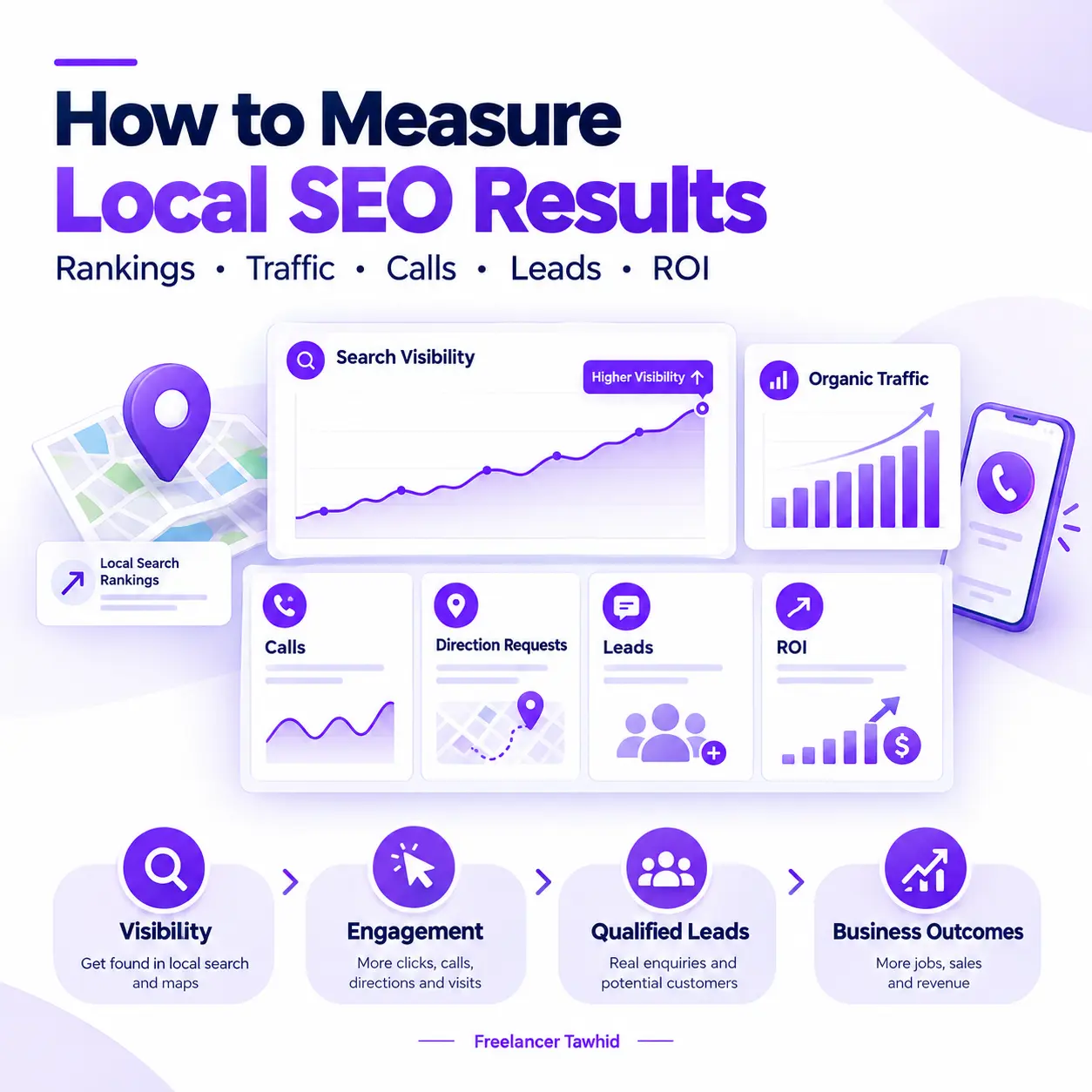
Local SEO results should be measured by more than keyword rankings. A reliable measurement process connects Google Search and Maps visibility with website traffic, customer interactions, qualified leads, and business outcomes. By combining Google Search Console, Google Business Profile performance data, website analytics, and lead records, businesses can understand what is working and where their Local SEO strategy needs improvement.
The goal is not simply to report better numbers. It is to determine whether the business is becoming easier to discover, attracting the right customers, and generating meaningful opportunities.
What Does Measuring Local SEO Results Mean?
Measuring Local SEO results means evaluating how effectively a business’s local search presence supports visibility, customer engagement, enquiries, and business objectives.
A useful measurement framework considers four stages:
- Visibility: Is the business appearing for relevant local searches?
- Engagement: Are people clicking, calling, requesting directions, or visiting important pages?
- Qualified opportunities: Are those actions generating relevant enquiries, bookings, or potential customers?
- Business outcomes: Are qualified opportunities contributing to completed jobs, sales, or revenue?
Each stage answers a different question. Higher visibility can create more opportunities for discovery, but it does not automatically mean more qualified leads or revenue.
For this reason, an effective Local SEO strategy should connect search performance with actual business goals rather than treating rankings as the final measure of success.
Which Local SEO Metrics Should You Track?
The right metrics depend on the business model, customer journey, available tracking, and reporting objectives. A storefront, a service-area business, and a multi-location company may need different measurement priorities.
Measurement area | Key metrics | What they help you understand |
Search visibility | Impressions, relevant queries, average position | Whether the website is appearing in relevant Google searches |
Website engagement | Organic clicks, landing-page sessions, engagement | Whether people visit and interact with the website |
Business Profile activity | Calls, website clicks, direction requests and other available interactions | How people use the profile on Google Search and Maps |
Lead generation | Qualified calls, form submissions, enquiries, bookings | Whether search visibility produces useful customer opportunities |
Business outcomes | Completed jobs, customers, sales and revenue | Whether those opportunities contribute to business performance |
Operational progress | Completed optimizations, technical fixes, content changes | What work was implemented during the reporting period |
Do not combine these metrics into one arbitrary SEO score. Each metric provides different information, and the value of a metric depends on how well it relates to the business’s objectives.
1. Measure Local Search Visibility
Visibility metrics help you understand whether your website or business profile is appearing when potential customers search for relevant services.
Google Search Console Impressions
An impression generally indicates that a link to your website appeared in Google Search under the applicable reporting rules.
Review impressions for relevant queries and important landing pages to identify changes in search exposure.
For example, increasing impressions for relevant service searches may indicate that Google is showing your website more often for those queries. However, impressions alone do not demonstrate that the traffic is qualified or that rankings have improved consistently.
Clicks and Click-Through Rate
Clicks show how often people select your website from Google Search results.
Click-through rate, or CTR, is calculated as:
CTR = Clicks ÷ Impressions × 100
Suppose a page receives 200 clicks from 4,000 impressions. Its CTR is 5%.
This example illustrates the calculation; it is not a performance benchmark.
CTR should be interpreted alongside the queries, search-result features, page position, and intended audience. A change in impressions may also change CTR without indicating a problem.
Average Position
Search Console reports average position for your website or individual pages.
This can help identify broad trends, but it should not be interpreted as a fixed ranking that every searcher sees. Results can differ across queries, devices, locations, and search contexts.
Google recommends examining clicks and impressions over time rather than relying on average position alone.
Use the Google Search Console Performance report to review these metrics and investigate the queries and pages associated with changes.
Branded and Non-Branded Search Queries
Separate searches for the business’s name from searches for its services or problems it solves.
Branded queries show how people discover the business by name. Non-branded queries help you evaluate visibility among people who may not already know the business.
For example, a search containing a company’s name has a different intent from a search for a particular service in a particular area.
Both types of searches can be valuable, but they answer different questions.
2. Measure Google Business Profile Performance
Google Business Profile provides performance data for eligible, verified profiles. The available metrics depend on the profile and supported features.
This data is important because someone can interact with a Business Profile without visiting the business’s website.
Important Business Profile Metrics
Profile views: These indicate how many people viewed the profile according to Google’s measurement rules.
Search terms: These provide information about searches associated with the profile. They can help you understand how people discover the business, although they are not a complete record of every search.
Call-button clicks: These measure clicks on the call button, not necessarily completed telephone conversations.
Website clicks: These measure interactions with the website link on the profile.
Direction requests: These indicate requests for directions, not confirmed physical visits.
Messages and bookings: Where available and applicable, these can help measure additional customer interactions.
Google explains the available metrics in its official Business Profile performance guide.
How to Review Business Profile Results
Start by selecting an appropriate reporting period in your Business Profile performance interface.
Then compare the available interaction metrics with the previous equivalent period. Check whether the changes relate to the business’s goals.
For example:
- A storefront may place greater importance on direction requests, calls, and completed purchases.
- A home-service business may prioritize relevant phone enquiries, estimate requests, and qualified leads.
- An appointment-based professional may prioritize completed bookings and suitable consultation requests.
Do not assume that every increase is beneficial. If a business receives more calls but many enquiries concern services it does not offer, its lead quality may have declined.
Similarly, fewer profile views do not necessarily mean that business performance has worsened if the business is generating more qualified enquiries from the people it wants to serve.
For help improving the profile itself, explore Google Maps SEO.
3. Measure Website Traffic From Local Search
Website analytics helps you understand what visitors do after arriving on your website.
Google Search Console and Google Analytics serve different purposes. Search Console reports activity associated with Google Search, while Analytics reports activity measured on the website.
Organic Traffic to Important Landing Pages
Review organic traffic to pages that support important business objectives, including service pages and genuinely useful location-specific pages.
Look beyond total traffic. Ask:
- Are visitors reaching the pages associated with important services?
- Are the pages attracting relevant searches?
- Are users interacting with important information?
- Do those visits contribute to enquiries or other meaningful actions?
A sitewide traffic increase can hide weaker performance on a commercially important page. Page-level analysis helps you identify the pages that need attention.
If the website attracts impressions but receives few clicks, investigate the queries, title and description, search intent, and search-result context before changing the page.
If traffic increases but enquiries remain unchanged, look beyond rankings. Review the page’s relevance, service information, credibility, user experience, and contact process.
Use Google Analytics to Understand Visitor Behaviour
Google Analytics can help you understand how visitors move through the website and whether they complete important actions.
For lead-generation websites, relevant actions may include:
- Successful contact-form submissions.
- Completed consultation or appointment requests.
- Quote requests.
- Completed purchases, where applicable.
- Other clearly defined actions that indicate genuine interest.
Google Analytics uses the term key events for actions that are particularly important to business success.
The recommended approach is to identify or configure an appropriate event, test that it records correctly, and mark important actions as key events when suitable.
See Google’s documentation on measuring key events in Google Analytics.
A click on a form button should not automatically be treated as a successful lead. Where possible, measure successful submissions or confirmed completions and check for duplicate events, failed submissions, and spam.
4. Track Calls, Forms, and Qualified Leads
An enquiry is not always a qualified lead.
A form submission may be spam, an existing customer’s request, a job application, or an enquiry about a service the business does not provide.
To understand the commercial value of Local SEO, separate raw interactions from relevant opportunities.
Define What Counts as a Qualified Lead
Create a consistent qualification process based on the business model.
For example, a service business might consider whether an enquiry:
- Concerns a service the business actually offers.
- Comes from an appropriate service area.
- Represents a genuine potential customer.
- Fits the business’s project requirements.
- Has a reasonable chance of becoming a booking or sale.
The exact criteria should be defined by the business, not assumed from an analytics event.
Track Phone Enquiries Carefully
A Business Profile call-button click is useful evidence of customer intent, but it is not proof that a call connected or became a customer.
Where appropriate, compare profile call clicks with available call records, answered calls, qualified enquiries, appointments, and completed sales.
If you use call-tracking technology, configure it carefully. Avoid introducing inconsistent business information or making unnecessary changes to the primary phone number used across important business listings.
Respect applicable consent and privacy requirements when recording or analysing customer interactions.
Connect Form Submissions to Business Outcomes
Use a suitable analytics event for successful form submissions and compare it with the enquiries actually received.
Where possible, use a CRM, booking system, or simple internal lead log to classify enquiries as qualified, unqualified, spam, booked, or completed.
These records help bridge the gap between website analytics and business results.
5. Measure Local Rankings Without Misinterpreting Them
Local rankings can be useful for understanding search visibility, but they need to be measured consistently and interpreted in context.
Google identifies relevance, distance, and prominence as the main factors behind local search results. Distance means the position a business can achieve may vary depending on where the searcher is located.
A single search performed from a business owner’s office therefore cannot represent local visibility across an entire service area.
Choose Meaningful Keywords
Track searches that relate to actual services, customer needs, and business priorities.
Avoid measuring dozens of irrelevant terms simply to produce a longer ranking report.
Your Local Keyword Research process should help identify suitable search themes and map them to relevant pages.
Keep the Measurement Method Consistent
When using a rank tracker, document the target query, location, device, and reporting frequency.
If your tool supports geographic grids, review visibility across the selected points rather than relying on a single reported position.
Compare equivalent observations across reporting periods. Changes in the tracked locations, keywords, or tool configuration can make comparisons misleading.
Combine Ranking Data With Other Metrics
A ranking increase is more meaningful when it aligns with relevant impressions, website clicks, customer actions, or qualified enquiries.
Conversely, a ranking decline does not necessarily mean business performance has declined if the affected keyword is commercially unimportant or other relevant searches are performing well.
Rankings should help diagnose opportunities and problems, not replace the measurement of actual business outcomes.
6. How to Measure Local SEO ROI
Local SEO return on investment, or ROI, estimates whether the business value attributable to the activity justifies its cost.
A meaningful ROI calculation needs reliable cost data and a reasonable method of connecting outcomes to Local SEO. Without this information, a precise percentage may create a false sense of certainty.
Local SEO ROI Formula
When reliable attributable gross-profit data is available, a useful formula is:
ROI = (Attributable Gross Profit − Local SEO Costs) ÷ Local SEO Costs × 100
For example, suppose a business spends $1,000 on Local SEO during an agreed measurement period and can reasonably attribute $3,000 in gross profit to that activity.
ROI = ($3,000 − $1,000) ÷ $1,000 × 100 = 200%.
This is an illustrative calculation, not a typical or guaranteed Local SEO result.
The example assumes that attributable gross profit has already been calculated appropriately and that the costs included in the analysis are clearly defined.
Revenue Is Not the Same as Profit
Suppose a business generates $5,000 in revenue from customers associated with organic search. That does not mean Local SEO produced $5,000 in profit.
The business may have costs associated with labour, materials, fulfilment, operating expenses, and marketing. A responsible calculation must use an appropriate financial measure and a clear cost definition.
Attribution Has Limitations
Customers may discover a business through Google, return directly, receive a recommendation, and eventually contact it after several interactions.
Analytics platforms cannot necessarily assign complete credit for every offline or cross-channel outcome.
Use available records, customer feedback, campaign information, and defined attribution rules to build a reasonable estimate. Make the assumptions explicit and avoid presenting uncertain attribution as exact proof of causation.
If reliable profit and attribution data is unavailable, report the observable metrics and qualified outcomes instead of inventing a precise ROI figure.
7. Build a Local SEO Reporting Template
A useful Local SEO report should help the business understand what happened, why it may have happened, and what to do next.
The following structure can be used for a monthly report.
Reporting section | What to include | Main question |
Executive summary | Main changes, issues and priorities | What matters most this month? |
Search visibility | Relevant impressions, clicks, queries and rankings | Is the business becoming easier to discover? |
Business Profile | Available views, calls, website clicks and directions | How are people interacting with the profile? |
Website performance | Traffic to priority pages and key events | What are visitors doing on the website? |
Lead quality | Qualified enquiries, bookings and completed jobs | Are interactions producing useful opportunities? |
Costs and business outcomes | Relevant costs, attributable revenue or profit when available | Is the investment supporting business objectives? |
Completed work | Verified changes and implementation dates | What was actually done? |
Next actions | Priorities, responsible person and review date | What should happen next? |
Compare Equivalent Reporting Periods
Use consistent reporting periods and metric definitions.
A full month should not be compared directly with an incomplete month without clearly accounting for the difference.
Where seasonality is important, compare similar periods in consecutive years when sufficient reliable history is available.
Document website changes, tracking changes, business closures, major campaigns, and other factors that may affect the numbers.
The purpose is to avoid attributing every change to Local SEO when other factors may also be involved.
8. How Often Should You Review Local SEO Performance?
A practical measurement schedule includes regular checks for technical or tracking issues, monthly reporting for performance trends, and broader periodic reviews for strategic decisions.
Weekly: Check for Significant Problems
Review urgent issues when appropriate, such as broken forms, missing tracking events, major website errors, or unexpected changes that require investigation.
A single day’s ranking movement is rarely sufficient evidence for changing the entire SEO strategy.
Monthly: Review Performance and Completed Work
Compare visibility, profile interactions, website behaviour, qualified enquiries, and completed implementation work.
Identify which changes need further investigation and choose a manageable set of next actions.
Quarterly: Evaluate Strategic Progress
Review longer-term trends, business priorities, lead quality, competition, and the impact of the work completed.
Use the findings to decide whether the current strategy remains appropriate or whether priorities should change.
The reporting frequency should reflect the business’s data volume and needs. Small businesses with limited traffic or few enquiries may require longer observation periods before drawing reliable conclusions.
9. What to Do When Local SEO Metrics Do Not Agree
Different metrics often move in different directions. This is not necessarily a problem, but it should prompt investigation.
Rankings Improve, but Leads Do Not Increase
Review the relevance of the keywords, traffic quality, landing pages, contact options, service information, and lead qualification process.
The ranking improvement may concern searches that produce little commercial value, or there may be a problem between the website visit and the enquiry.
Traffic Increases, but Calls and Forms Remain Flat
Check which pages and queries generate the additional visits. Determine whether visitors match the intended audience and whether the page answers their questions clearly.
Verify that forms, call links, and analytics events work correctly before concluding that conversion performance has declined.
Business Profile Views Increase, but Website Traffic Does Not
Some visitors may act directly from the profile rather than visiting the website. Compare available call, direction, booking, and website-click metrics before deciding whether the difference represents a problem.
Also confirm that the profile’s website link is correct and that relevant landing pages remain accessible.
Rankings Remain Stable, but Qualified Leads Increase
A stable ranking report does not rule out improvement. The business may receive better-qualified traffic, convert more visitors, or benefit from changes in customer demand.
Compare the relevant metrics and document other marketing or operational changes before attributing the improvement to a specific SEO task.
10. Common Mistakes in Local SEO Measurement
Measuring Only Keyword Positions
Rankings do not fully explain traffic quality, enquiries, or revenue. Use them alongside other relevant metrics.
Treating Every Call Click as a Customer
A call-button click is not necessarily a connected call, qualified enquiry, or sale. Use appropriate records where available.
Comparing Inconsistent Reporting Periods
Changes in date ranges, tracking settings, and reporting definitions can make apparent growth or decline misleading.
Ignoring Lead Quality
More enquiries are not necessarily better if they come from the wrong locations, concern irrelevant services, or fail to meet the business’s requirements.
Confusing Correlation With Causation
An improvement after an SEO change does not automatically prove that the change caused it. Consider timing, other marketing activities, seasonality, and measurement limitations.
Relying on a Single Tool
Search Console, Business Profile performance, Analytics, call records, and sales data answer different questions. Use the appropriate sources together rather than assuming that one dashboard tells the entire story.
Reporting Without a Next Action
A report should help the business make a decision. Identify the most important finding, explain its relevance, and specify what should happen next.
Frequently Asked Questions
How do you measure Local SEO results?
Measure Local SEO by combining search visibility, relevant website traffic, Google Business Profile interactions, qualified enquiries, and business outcomes. Search Console, Business Profile performance, website analytics, and lead records provide complementary information about different stages of the customer journey.
What are the most important Local SEO metrics?
The most useful metrics depend on the business. Common examples include relevant search impressions, clicks, landing-page traffic, Business Profile calls and website clicks, qualified enquiries, completed bookings, sales, and attributable profit where reliable data is available.
Does a higher Google ranking mean Local SEO is successful?
Not necessarily. A higher position can improve visibility, but it does not guarantee that the business will attract relevant visitors or generate more customers. Evaluate ranking changes alongside traffic, customer actions, lead quality, and business outcomes.
How can I measure Google Maps SEO performance?
Use available Business Profile performance data to review profile views, searches, calls, website clicks, directions, and other applicable interactions. Where useful, supplement this with consistent local rank tracking and lead records. Remember that ranking visibility and customer actions represent different parts of the process.
How do I track Local SEO leads?
Track successful contact-form submissions, relevant phone enquiries, bookings, and other meaningful actions. Use suitable analytics events and maintain a lead record that distinguishes qualified prospects from spam or irrelevant enquiries.
Can Google Analytics measure Local SEO ROI?
Google Analytics can measure configured website events and provide useful behavioural and attribution data. Calculating ROI generally requires additional business information, such as marketing costs, qualified leads, completed sales, and profit. Analytics data alone does not necessarily provide a complete financial picture.
How long does it take to see Local SEO results?
There is no universal timeline. The time required depends on the starting condition, competition, business model, implementation, search demand, and other factors. Establish a baseline, track changes consistently, and evaluate trends over appropriate periods rather than expecting a guaranteed result by a fixed date.
Should small businesses create a monthly Local SEO report?
A monthly report can help small businesses identify changes, check whether the work was implemented, understand where leads come from, and prioritize the next improvements. The report should focus on useful decisions rather than unnecessary charts or metrics.
Measure Local SEO With a Clear Business Objective
Local SEO performance should be evaluated by understanding how visibility leads to meaningful customer actions and, where measurable, business outcomes.
Rankings, impressions, profile interactions, traffic, enquiries, and revenue provide different pieces of the picture. The strongest reporting process uses appropriate data sources, consistent definitions, realistic attribution, and clearly documented next steps.
I’m Tawhid, an SEO Expert & Consultant at Freelancer Tawhid. I work with businesses worldwide on Local SEO strategy, implementation, and consultation based on their individual requirements.
If you need to understand your current local search performance, identify measurement gaps, or prioritize the next steps, explore my Local SEO services or Local SEO Audit service.
The objective is not to produce better-looking SEO reports. It is to understand what the data can demonstrate, make informed decisions, and connect the work to the business goals that matter.

2 Responses