
How to Improve the Search Results People See When They Google Your Business Name

Freelancer Tawhid
SEO Expert and Consultant
- October 16, 2026
- 0 comments
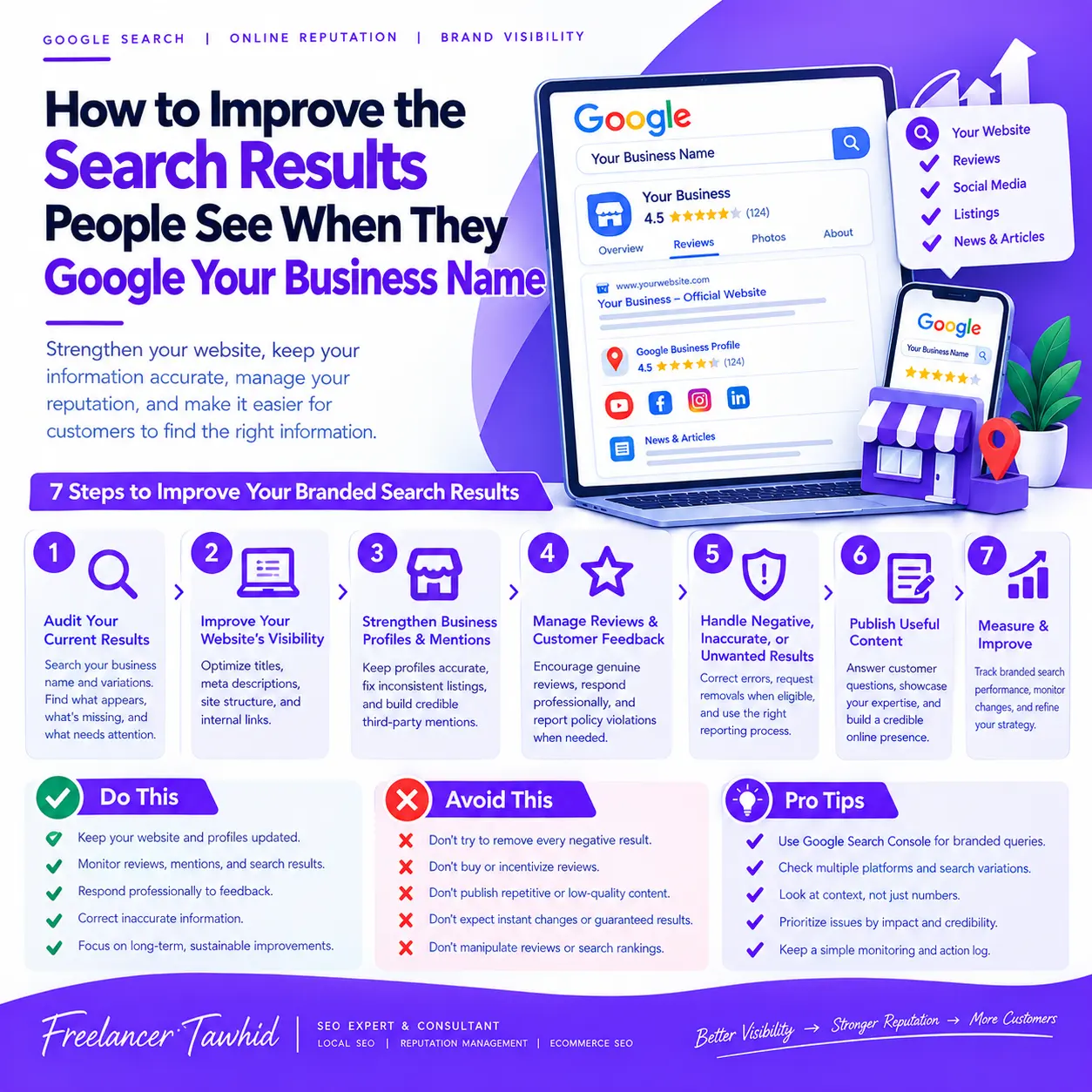
When someone searches for your business on Google, the results they see can influence their impression of your company before they visit your website or contact you. To improve your business name’s Google search results, strengthen your official website, maintain accurate business information, build a credible online presence, manage customer feedback, and address incorrect or outdated content through the appropriate channels. Although you can influence many parts of your online presence, Google ultimately decides which results appear and how they are displayed.
Whether your official website is difficult to find, outdated information appears prominently, or negative reviews affect how potential customers perceive your business, a structured approach can help you identify the issues and prioritize the right improvements.
In this guide, you’ll learn how to audit your branded Google search results, improve your website’s visibility, strengthen your online reputation, handle unwanted content appropriately, and measure progress over time.
What Appears When Someone Googles Your Business Name?
When people search for a business by name, Google may display its official website, individual website pages, social media profiles, online reviews, business listings, news articles, knowledge panels, and other relevant sources.
The exact combination varies depending on the search query, available information, device, and other contextual factors.
The complete collection of results associated with a brand-name search is often called a Brand SERP, short for Brand Search Engine Results Page.
For example, someone searching for a software company’s name might see its homepage, product pages, LinkedIn profile, review-platform listings, and articles published by third parties. Someone searching for an online retailer might see its store, product categories, customer feedback, and shopping-related information.
These results collectively shape how people discover and evaluate the business.
Why your branded search results matter
Your branded search results help people verify who you are, discover what you offer, and decide whether your business deserves their trust.
A well-organized search presence makes it easier for potential customers to find official information. Inconsistent details, misleading titles, outdated pages, or prominent unresolved complaints can create uncertainty.
A strong Brand SERP does not necessarily mean eliminating every negative result or controlling every listing. It means making accurate, useful, and credible information easier to find while addressing problems that can reasonably be corrected.
Which parts of Google search results can you control?
You have different levels of control over different search-result elements.
Search-result element | What you can do |
Official website | Improve page quality, technical SEO, navigation, content, and internal links. |
Page titles and descriptions | Provide accurate titles and useful page content, although Google may display different text. |
Website sitelinks | Improve site structure and navigation, but Google chooses whether to show sitelinks. |
Social media profiles | Maintain accurate information on profiles you manage. |
Business listings | Correct information on platforms where you have access or can request changes. |
Customer reviews | Encourage honest feedback, respond professionally, and report content that violates platform policies. |
Third-party articles | Request corrections where appropriate and build a stronger, credible online presence. |
Knowledge panels and other search features | Supply accurate information and use relevant supported tools, without assuming Google will display a particular feature. |
The distinction is important: you can improve the information available to Google and users, but you cannot choose the entire search-results page yourself.
1. Audit Your Current Business Name Search Results
Before making changes, examine what actually appears when someone searches for your business name. This helps you distinguish website SEO problems from information inconsistencies and reputation issues.
Search for your business name and relevant variations
Start by searching for your exact business or brand name.
Then investigate a few meaningful variations, such as:
- Your business name without punctuation or special characters.
- Common misspellings, abbreviations, or previous names.
- Your business name combined with terms such as “reviews,” “complaints,” or “customer service.”
- Important product or service names associated with your brand.
These searches help reveal whether problems affect only your primary brand query or extend to related searches.
Use a private browsing window or a signed-out browser session as one useful comparison point. However, remember that search results may still vary by location, language, device, and other factors. A single search is not a universal representation of what every potential customer sees.
Review the first page of results
For each important query, examine the visible results and record what you find.
Pay particular attention to:
- Whether the official website appears prominently.
- Which pages from your website appear beneath the main result.
- Whether titles and descriptions accurately represent those pages.
- Whether official social profiles are easy to identify.
- Whether business listings contain correct information.
- Whether relevant review sites or third-party articles appear.
- Whether outdated, misleading, or potentially policy-violating content is visible.
Look beyond rankings alone. A result can rank well and still create confusion if its title is misleading or the underlying page contains outdated information.
Classify each problem before taking action
Use the following framework to decide what to investigate first.
Problem | Possible cause | Appropriate first step |
Your official website is difficult to find | Indexing, relevance, site structure, or brand-identity issues | Inspect the affected pages and their technical SEO. |
Google displays an outdated title | The page or its signals may not clearly communicate its current purpose | Improve the title element and relevant on-page content. |
Incorrect business details appear | Outdated website information or third-party listings | Find the original source and request a correction. |
Negative reviews appear prominently | Customer dissatisfaction or potentially policy-violating content | Assess the feedback and select the appropriate response. |
An old article contains incorrect information | The publisher’s page has not been corrected or updated | Contact the publisher and investigate any applicable search-removal process. |
Important official pages are missing from the results | Weak navigation, limited relevance, or crawling and indexing problems | Review internal links, indexability, and page usefulness. |
Keep a simple record of the query, the result URL, the issue, the appropriate next step, and the date you reviewed it.
This creates a useful baseline for future comparisons and helps you avoid changing several unrelated things without understanding the underlying problem.
2. Improve Your Official Website’s Visibility in Branded Searches
Your website is one of the most important sources of information about your business. It should clearly identify your brand and help visitors understand what you do, which products or services you provide, and where they can find reliable information.
Make your homepage clearly represent your business
Your homepage should communicate your business identity without ambiguity.
Make sure it includes:
- Your correct and consistently used business name.
- A descriptive page title.
- A clear main heading.
- An accurate explanation of your business and its offerings.
- Links to important product, service, company, and contact pages.
- A recognizable logo or other appropriate brand identifiers.
Use your brand name naturally in prominent places where it helps users understand the page. Avoid repeating it excessively or adding unnecessary keywords to headings and paragraphs.
Your homepage should not be the only source of important business information. A well-developed About page, useful service pages, product pages, and clear contact information can provide additional context.
Optimize page titles and Google search snippets
A title link is the clickable title shown for a Google search result. A snippet is the descriptive text that may appear beneath it.
These elements influence how people understand a page before visiting it.
Google can generate title links using several sources, including the page’s title element, visible headings, prominent text, and other information. Snippets are usually generated from page content, although Google may use a meta description when it provides a better summary.
Consequently, editing a title tag or meta description does not guarantee that Google will display that exact wording.
Google explains these mechanisms in its official documentation on title links and search snippets.
To improve how your pages are represented:
- Write descriptive titles that accurately reflect each page’s purpose.
- Avoid generic, misleading, or unnecessarily repetitive titles.
- Make the main heading consistent with the page’s subject.
- Write informative meta descriptions that summarize the actual content.
- Update outdated information and remove conflicting signals.
- Recheck the results after Google has had an opportunity to process the changes.
For example, a title such as “About Us | Example Business” may be suitable for an About page, while a descriptive title explaining the purpose of a service page may be more useful than repeating the business name alone.
The goal is clarity, not forcing every page to use the same branded title.
Improve your website’s navigation and internal links
Google needs to discover and understand your important pages. Visitors also need an easy way to reach them.
Organize the site around a logical hierarchy, with important pages accessible through relevant navigation and contextual links.
For example, a company’s homepage might link to its main services, while individual service pages link to related offerings, useful guides, and supporting information.
Use descriptive anchor text that tells visitors what to expect from the destination. Avoid vague labels such as “click here” when a more meaningful description fits naturally.
A coherent site structure can also help Google identify useful pages for sitelinks. However, Google’s sitelinks documentation makes clear that sitelinks are selected automatically; website owners cannot manually choose or guarantee them.
If important pages are missing from branded searches, check whether they are accessible through internal links and whether they can be crawled and indexed.
Use structured data where it accurately describes your business
Structured data is a standardized way of describing information about a webpage so that search engines can interpret it more clearly.
Depending on the website and business type, relevant implementations may include WebSite, Organization, or an appropriate LocalBusiness subtype.
For example, Google’s site-name guidance explains how WebSite structured data can communicate a preferred site name. Google’s Organization structured-data documentation also explains how organization information can help Google understand and distinguish an organization.
Before implementing structured data:
- Choose types and properties that accurately describe the website or organization.
- Keep the markup consistent with visible information.
- Avoid inventing addresses, affiliations, reviews, or other details.
- Validate the implementation using the appropriate Google testing tools.
- Review current eligibility requirements rather than assuming every markup type produces a special search appearance.
Structured data can support Google’s understanding of your website, but it does not guarantee rankings, a knowledge panel, sitelinks, or a particular visual result.
Check crawling and indexing problems
If your homepage or important pages do not appear for your business name, investigate technical issues before publishing additional content.
Review whether the affected URLs are accessible, indexable, linked appropriately, and returning the correct responses. Check for accidental noindex directives, canonicalization problems, or robots.txt rules that interfere with crawling.
Google Search Console can help you inspect indexing status and examine how Google encounters your pages.
Requesting indexing after a meaningful update may help Google discover a page sooner, but it does not guarantee inclusion or a specific ranking.
3. Strengthen Your Business Profiles and External Online Presence
Your website is not the only source people may encounter when they Google your business name. Social profiles, business directories, review platforms, professional profiles, and third-party publications can also contribute to the picture.
The objective is to create a consistent, credible information footprint—not to register with every website that accepts a business listing.
Keep official profiles accurate and up to date
Review the social and professional platforms relevant to your business and its audience.
Check that your business name, website URL, description, logo, contact methods, and other visible details are accurate wherever the platform provides these fields.
Remove or update obsolete information when you control the profile. Where appropriate, make official profiles easy to identify from your website.
These profiles can offer people additional ways to verify your business, learn about your work, and reach you.
Correct inconsistent information across business listings
Outdated listings can create confusion when they show an old website, an incorrect business name, or conflicting contact details.
Review relevant directories and industry-specific platforms, especially those that already appear in your branded search results.
For each listing, verify the information against the authoritative source. Correct inaccurate details where you have access, or contact the publisher or platform when you do not.
Prioritize relevant and credible sources instead of spending time creating large numbers of low-quality listings.
For businesses that qualify, keeping a Google Business Profile accurate and complete is also important. Google’s official local ranking guidance explains the role of relevance, distance, and prominence in local results.
A Business Profile is particularly relevant to businesses with eligible in-person customer interactions. An online-only business should not create an ineligible profile simply to influence branded searches.
For more help with eligible profiles, see Google Business Profile Optimization.
Build credible third-party mentions
Useful references from relevant websites can help people discover your business and verify what it offers.
Depending on your industry, legitimate opportunities may include:
- Earning relevant editorial coverage.
- Publishing original research or genuinely useful resources.
- Participating in industry discussions and professional communities.
- Maintaining accurate profiles with relevant professional organizations.
- Building relationships that lead to meaningful references or citations.
- Correcting factual inaccuracies on third-party pages.
Prioritize relevance and credibility over sheer volume.
Avoid creating a large number of repetitive pages solely to occupy more search-result positions. Google advises against manipulative practices under its Search spam policies.
The better long-term approach is to make your official information useful and trustworthy while building a legitimate presence across the sources that matter to your audience.
4. Manage Online Reviews and Customer Feedback
Reviews can become a prominent part of branded searches, particularly when customers are evaluating a business before making a purchase or requesting a service.
A thoughtful reputation-management process should combine genuine customer feedback, appropriate responses, and improvements to the underlying customer experience.
Encourage honest reviews from real customers
Make it easy for customers who have genuinely interacted with your business to leave feedback.
You can provide convenient review links, explain where customers can share their experience, and establish a consistent process for requesting feedback.
The goal is to gather authentic opinions—not manufacture a positive image.
Do not buy fake reviews, impersonate customers, or manipulate the feedback process. Review requests should comply with the relevant platform’s policies and applicable laws.
Respond to negative reviews professionally
A negative review does not automatically mean your business has a reputation crisis. It may describe a legitimate customer concern that deserves a useful response.
A practical response process is:
- Read the review carefully and identify the underlying issue.
- Check the relevant facts before responding.
- Acknowledge legitimate concerns without becoming defensive.
- Offer an appropriate next step when further discussion is needed.
- Review recurring complaints to identify opportunities for improvement.
Avoid sharing confidential customer information or making accusations you cannot substantiate.
A professional response can provide context for readers who encounter the review later. It also gives the business an opportunity to demonstrate accountability.
Report reviews that violate platform policies
Not every negative review qualifies for removal.
Google allows businesses to report reviews that violate its policies, but disagreement with a review or dissatisfaction with its contents is not, by itself, a valid reason to remove it.
Examples of potential policy violations may include certain forms of spam, fake engagement, or prohibited content. Evaluate the actual review against the platform’s current rules before reporting it.
You can consult Google’s official guidance on reporting inappropriate reviews.
If a review is legitimate, focus on responding appropriately and addressing the underlying concern. If it appears to violate policy, use the official reporting and appeal process rather than attempting to manipulate the review system.
For businesses facing broader issues involving reviews, inaccurate listings, and branded search results, a structured reputation management strategy can help organize the work.
5. How to Handle Negative, Inaccurate, or Unwanted Google Search Results
Negative search results require careful diagnosis because different problems have different remedies.
A misleading directory entry, an outdated article, a legitimate customer complaint, and a page that violates a platform’s policies are not interchangeable problems.
Before attempting to remove anything, establish what is wrong, who controls the content, and which process applies.
Identify the type of problem
Start by separating the issue into one of four categories.
Incorrect information: A webpage or listing contains factual errors. Contact the source and request a correction, providing evidence where appropriate.
Outdated information: A page reflects a previous version of the business or an old situation. Ask the publisher to update it. If the source has already changed but Google continues displaying outdated information, check whether an appropriate refresh process is available.
Legitimate criticism: A customer or publisher expresses a negative but permissible opinion. Address any underlying business problems, respond professionally when appropriate, and work to improve future customer experiences.
Potentially policy-violating content: A page or review may violate the relevant platform’s rules. Review the applicable policy and use the official reporting or removal mechanism if the circumstances qualify.
Classifying the problem first prevents you from choosing an ineffective remedy.
Contact the source before seeking search-result removal
If an article, directory entry, or webpage contains inaccurate information, start with the publisher or website owner when possible.
Explain the specific error, identify the affected content, and provide evidence supporting the correction.
If the source updates the information but an outdated result remains visible, Google’s removal and refresh tools may be relevant, depending on the circumstances.
Google provides guidance on removing web results from Search. Eligibility depends on the reason for removal and the applicable process.
Keep the distinctions clear:
- Correcting a webpage changes the original source.
- Removing a Google result affects its appearance in Google Search under the applicable process.
- Removing a review from a review platform depends on that platform’s rules.
These actions are not equivalent, and success in one does not necessarily produce the others.
Understand the limits of reputation management
A business cannot automatically remove every negative article, critical review, or unfavorable mention.
Legitimate criticism may remain online even when the company disagrees with it. Likewise, a consultant cannot guarantee that Google will remove an eligible result, display a specific webpage, or move every critical result below the first page.
When content cannot reasonably be removed, concentrate on actions within your control: correcting misinformation, improving official pages, maintaining credible profiles, responding constructively to feedback, and building a stronger overall online presence.
This approach is more sustainable than relying on tactics designed solely to displace unwanted content.
6. Publish Useful Content That Strengthens Your Brand’s Online Presence
A useful website gives people and search engines clear, accurate information about your business. It also helps customers find answers to questions they may have before contacting you.
However, publishing more content does not automatically improve branded search results. The content needs a clear purpose and should help people understand the business or solve a real problem.
Answer questions customers genuinely ask
Consider which information is missing from your existing website.
Depending on the business, useful pages might explain:
- What the company offers and who it serves.
- How its products or services work.
- Frequently encountered customer problems.
- Support options, policies, or product specifications.
- The company’s approach, expertise, or professional background.
- Important updates that affect customers.
Create a page when the information warrants one. If a relevant page already exists, improve it rather than publishing a near-duplicate.
This helps build a coherent information resource instead of filling the website with pages that exist mainly to target variations of a business name.
Make your business identity and expertise easy to verify
Accurate company information, clear authorship, useful explanations, and transparent policies help readers assess a business.
Where relevant, provide appropriate professional biographies, genuine examples of work, documented processes, and evidence supporting important claims.
For a professional service provider, this may include a clear explanation of the services offered, relevant experience, and the process used to assess and solve problems.
For example, a company offering ecommerce software might publish practical documentation about its features, limitations, integrations, and support process. These resources serve customers while providing useful information about the business.
Keep all claims factual. Do not invent awards, qualifications, customer testimonials, or success stories to improve the brand’s appearance.
Google’s helpful, reliable, people-first content guidance is a useful reference when evaluating whether a proposed page offers genuine value.
Prioritize improvements over content volume
Before producing a new article or landing page, ask:
- Is important information currently missing?
- Can an existing page answer this question better?
- Is the current information inaccurate or outdated?
- Would a customer find the proposed content genuinely useful?
- Does the page have a distinct purpose?
If the problem is an inaccurate directory listing, publishing another blog post will not correct the original listing. If a page is blocked from indexing, writing additional content will not fix that technical issue.
Choose the solution that addresses the actual problem.
7. Measure Improvements in Your Branded Search Results
Once you have implemented changes, monitor the results to determine whether your website and broader online presence are improving.
Measurement helps you distinguish meaningful progress from isolated search observations.
Use Google Search Console to monitor branded queries
Google Search Console provides organic search performance data, including clicks, impressions, click-through rate (CTR), and average position.
Google introduced a branded-queries filter to help eligible websites distinguish branded from non-branded search performance. The feature was updated in March 2026 and is available to eligible properties; availability may depend on property type and having sufficient query data.
You can read Google’s official announcement and eligibility details.
When the filter is available for your property, use it to examine how people find your website through queries associated with your brand.
Understand what each metric means:
Metric | What it measures | How to interpret it |
Impressions | How often your results are shown in eligible Google Search reporting | Changes may indicate shifts in search visibility or demand. |
Clicks | Clicks from Google Search results to your website | Helps show whether people are visiting your pages from search. |
Click-through rate | The proportion of impressions that result in clicks | Can help identify opportunities to improve relevance and search-result presentation. |
Average position | An aggregated measure of where your results appeared | Interpret carefully because it does not describe one universal ranking for every user or query. |
Search Console’s branded classification is automated and may occasionally misclassify queries. Treat it as a useful analytical aid, not a perfect list of every branded search.
You should also inspect important queries and individual pages when an aggregate metric changes unexpectedly.
Track important results manually
Search Console does not show every detail a person may encounter on the full search-results page.
Maintain a simple audit log for important branded queries. Record which official pages appear, whether business information is correct, and whether notable third-party results have changed.
Compare observations over time rather than relying on one search or screenshot.
Where appropriate, repeat checks under consistent conditions and note relevant differences in device, location, or query wording. This makes the comparisons more useful without assuming that all searchers receive identical results.
Connect search performance with business outcomes
Higher rankings and more impressions do not automatically mean improved business performance.
Where suitable data is available, monitor relevant outcomes such as:
- Visits to important branded landing pages.
- Contact-form submissions or consultation inquiries.
- Calls or other meaningful contact actions.
- Engagement with appropriate business profiles.
- Qualified leads and conversion trends.
Interpret these metrics alongside the work that was implemented and other factors that may have affected demand.
For instance, if branded impressions rise after a major marketing campaign, that increase may reflect greater awareness rather than a technical SEO improvement alone. Avoid attributing an outcome to one change without sufficient evidence.
A useful measurement process connects search visibility, the quality of the results people encounter, and the business outcomes that matter.
8. Common Mistakes When Improving Business Name Search Results
Several mistakes can waste time or create unnecessary risk when trying to improve a brand’s Google presence.
Trying to remove every negative result
Not every negative article or review violates a policy or qualifies for removal. Attempting to eliminate all criticism is rarely a realistic goal.
Focus on correcting factual errors, using appropriate reporting processes, resolving legitimate customer concerns, and improving the quality of the information your business publishes.
Treating Google Business Profile as the entire solution
A Business Profile can be important for eligible businesses, but it does not represent the entire Brand SERP.
Your website, social profiles, review platforms, third-party articles, and other pages may all appear for a branded query.
Audit the complete results page before deciding whether the main problem requires Local SEO, technical website improvements, reputation management, or a combination.
Publishing repetitive content to occupy more results
Creating large numbers of near-duplicate pages simply to target branded-query variations is not a substitute for useful content.
Publish pages that answer distinct questions, provide important business information, or help your audience make informed decisions. Review Google’s Search spam policies before implementing questionable tactics.
Expecting immediate changes or guaranteed outcomes
Google controls its crawling, indexing, ranking, and search-result presentation systems. Even well-executed changes may take time to be reflected in search results, and some changes may not produce the desired display.
No responsible SEO process should guarantee the removal of legitimate negative content, a knowledge panel, sitelinks, specific rankings, or inclusion in AI-generated search features.
9. When Should You Seek Professional Reputation Management or SEO Help?
Some branded search problems are straightforward to resolve. Others involve several sources, technical issues, or reputation concerns that require a more structured assessment.
Professional help may be worthwhile when:
- Your official website is difficult to find for your business name.
- Incorrect information persists across several important websites.
- Multiple third-party results create a confusing impression of your business.
- Negative content is prominent and its appropriate remedy is unclear.
- Your website has potential crawling, indexing, or site-structure problems.
- You need a process for monitoring branded results and prioritizing improvements.
The right approach depends on the specific issue. A technical indexing problem requires a different solution from a policy-violating review or an outdated article on a third-party website.
What should a branded search audit examine?
A structured assessment should examine the major sources and mechanisms influencing your search presence.
This may include your official website, important branded queries, page titles and snippets, technical SEO, internal links, social profiles, eligible business listings, reviews, third-party mentions, and available performance data.
The assessment should then prioritize issues according to their accuracy, prominence, potential impact, and feasibility of correction.
A useful outcome is a practical action plan that identifies what to fix, who controls the affected source, which steps require specialist support, and how progress will be reviewed.
For businesses whose problems extend beyond a single page or profile, this structured approach helps prevent isolated fixes from overlooking the broader issue.
Frequently Asked Questions
1. How long does it take for Google to update search results for my business name?
The timeframe depends on the change, the source, and when Google recrawls and reprocesses the affected information. Some title-link changes may appear after a recrawl, while broader visibility or reputation improvements may take longer. There is no universal timeline for every issue, and indexing requests do not guarantee a specific result.
2. Can I choose exactly what Google shows when someone searches for my business?
No. You can improve your website, maintain accurate profiles, publish useful information, and request appropriate corrections, but Google selects and generates many search-result elements automatically. This includes title links, sitelinks, and site names. Good SEO improves the information available to Google; it does not provide complete control over the results page.
3. Can I remove a negative article or review from Google?
Sometimes, depending on the content, source, and applicable policies. You can request factual corrections from publishers, report reviews that violate platform rules, or use eligible Google removal processes. Legitimate criticism is not automatically removable. Correcting the original source may be the appropriate first step when the information is inaccurate or outdated.
4. Does my business need a Google Business Profile to improve branded search results?
No. A Google Business Profile is relevant to eligible businesses with qualifying in-person customer interactions, but it is not required to improve branded organic search results. Businesses can also strengthen their official website, publish useful information, maintain credible external profiles, and correct inaccurate listings. Online-only businesses should not create an ineligible profile for SEO purposes.
5. Why does Google show a different title or description from the one on my website?
Google generates title links and snippets using information from the page and other relevant signals. It may display a different title from your HTML title element or select descriptive text from the page rather than your meta description. Make titles accurate, keep the page content consistent, and allow time for Google to process the changes.
Final Thoughts: Build a More Accurate and Trustworthy Brand SERP
Improving the search results people see when they Google your business name starts with understanding what appears, identifying the source of each problem, and selecting the appropriate response.
Strengthen your official website, maintain accurate business profiles, publish useful information, encourage genuine customer feedback, and address incorrect content through the right channels. Then monitor important branded searches and use available performance data to guide further improvements.
The goal is not to control every result or eliminate every criticism. It is to make accurate, useful, and credible information easier for people to discover while addressing issues that are within your control.
If your business has persistent branded-search problems, confusing third-party listings, or reputation concerns that are difficult to diagnose, Tawhid’s Reputation Management Services provide a relevant starting point for exploring a more structured approach. You can review the service and discuss the specific challenges affecting your business’s online presence.
A consistent, evidence-based strategy is a more reliable foundation for improving your branded search presence than chasing quick fixes or expecting Google to display a predetermined set of results.