
Can Local Citations Help Businesses Appear in AI Search? What the Evidence Supports

Freelancer Tawhid
SEO Expert and Consultant
- October 15, 2026
- 0 comments
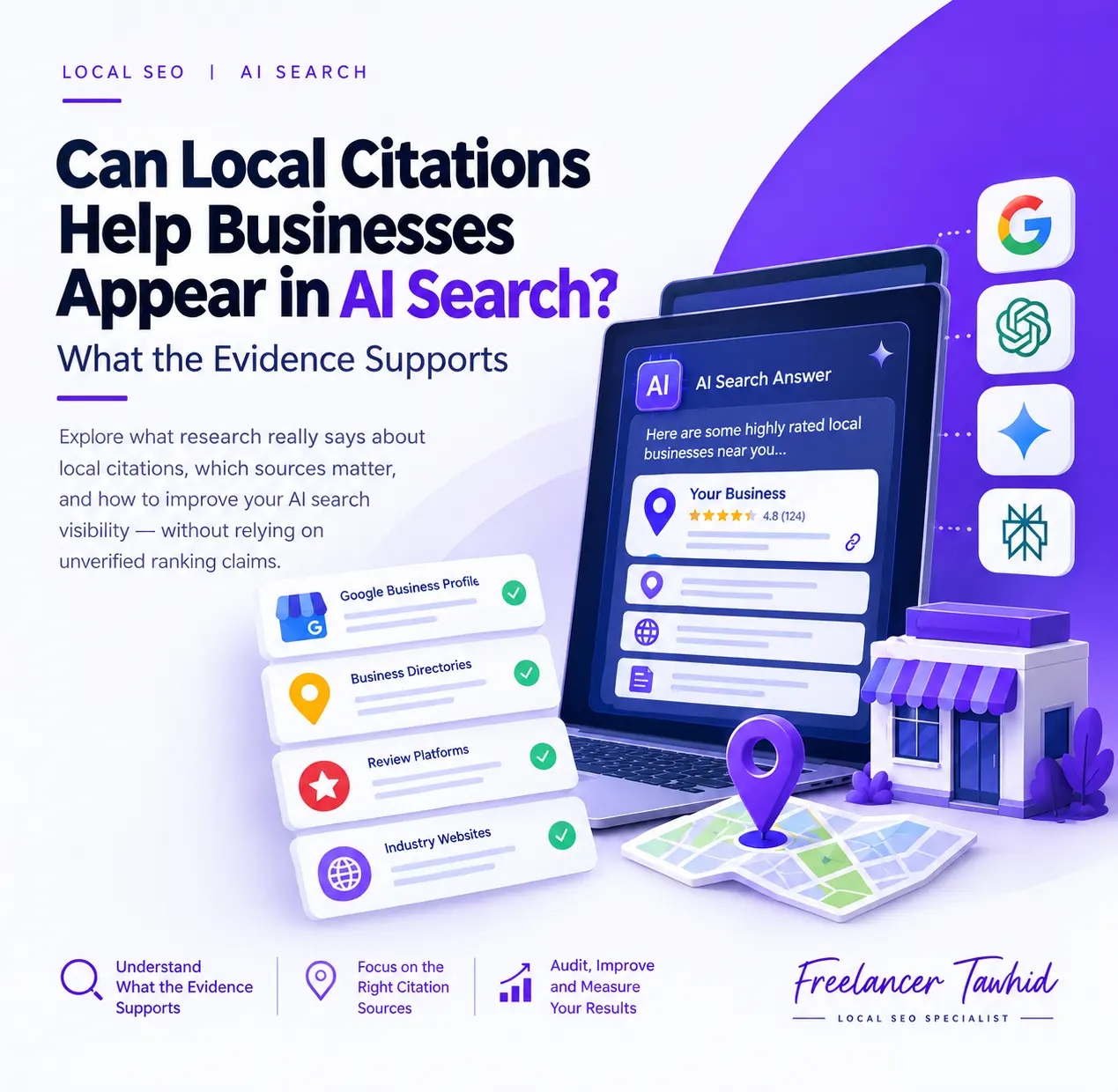
Local citations can help businesses become more discoverable in AI-powered local search when relevant listings or mentions are used as sources. Current research shows that AI-generated answers can draw from business websites, Google Business Profile, major directories, review platforms, and industry-specific websites. However, the evidence does not establish that adding more citations automatically causes a business to appear in AI recommendations.
For local businesses, the practical question is not simply how many directories contain their information. It is whether their business details are accurate, their online presence is relevant to their industry, and the sources customers and search systems consult provide a clear picture of what the business offers.
Understanding this distinction is essential as businesses adapt their Local SEO strategies to Google AI Overviews, Google AI Mode, ChatGPT, Gemini, and other AI-powered search experiences.
This article examines what the evidence supports, which local citations deserve attention, and how businesses can evaluate their AI search visibility without relying on unverified ranking claims.
What Are Local Citations, and How Do They Relate to AI Search?
A local citation is an online mention or listing of a business that contains identifying information such as its name, address, phone number, website, category, or services. Citations commonly appear in business directories, map services, review platforms, industry websites, and other relevant online resources.
They generally fall into two categories.
Structured citations appear in organized business listings where details are entered into specific fields. Business directories, map platforms, and review websites are common examples.
Unstructured citations appear naturally within articles, industry publications, professional organization websites, or other editorial content that mentions a business.
A citation may include a link to the business website, but a link is not essential for a mention to qualify as a citation.
This distinction becomes important when evaluating AI search because a business listing, an AI-generated business mention, and a source cited by an AI answer represent different things.
Local citations vs. AI citations vs. AI recommendations
Term | What it means | Example |
Local citation | An online listing or mention of a business | A directory displays a company’s name, phone number, and website |
AI-source citation | A source linked or referenced in an AI-generated answer | An AI answer links to an industry directory |
AI business mention | A business is named in an AI-generated response | An assistant identifies a particular service provider |
AI recommendation | A business is presented as a suitable option for a user’s needs | An assistant includes the business in a shortlist of providers |
These outcomes are related, but they are not interchangeable.
A business may appear in a directory consulted by an AI system without being named in the final answer. An AI assistant may also recommend a business while citing a third-party directory rather than the business’s own website.
Consequently, building citations should not be treated as a guaranteed method of obtaining AI recommendations or source links.
For a more detailed explanation of conventional citation management, including listing creation, NAP consistency, cleanup, and citation-gap analysis, see my Local Citation Building Service.
How are local citations different from backlinks?
A backlink is a hyperlink from one website to another. A local citation is a business mention or listing that helps identify the business and may include contact or service information.
Some citations contain backlinks, while others do not.
Both can have a legitimate place in a broader SEO strategy, but they serve different purposes. A backlink does not automatically establish that a business is accurately represented across business directories, and an unlinked citation does not automatically function as a conventional SEO backlink.
For AI search, the important question is whether the source provides relevant, accessible, and accurate information that helps identify or understand the business.
What Does the Evidence Say About Local Citations and AI Search?
The available evidence supports a measured conclusion: local citations and business listings can be part of the information ecosystem used in AI-powered local search, but there is not enough evidence to claim that citation volume independently causes better AI visibility.
Official platform documentation and third-party research provide useful insights, although they answer different questions.
What does Google officially say about AI search visibility?
Google’s official guide to optimizing for generative AI features in Search explains that the foundational SEO practices used for traditional Search remain relevant to AI Overviews and AI Mode.
Google emphasizes useful, distinctive content, technical accessibility, and pages that can be crawled and indexed. Its guidance also explains that its generative AI experiences use Search systems to retrieve relevant information and provide links to supporting sources.
For businesses, Google identifies Google Business Profile and other business-information features as relevant to appropriate local-business search experiences.
However, Google’s published guidance does not establish a universal local-citation count, a required number of directory listings, or a special citation-building formula for appearing in AI-generated answers.
Google also explicitly warns against pursuing inauthentic online mentions as a visibility shortcut. It does not require special schema markup or an llms.txt file for inclusion in its AI search features.
The distinction is important: Google’s guidance supports sound SEO and accurate business information, not the claim that accumulating citations guarantees AI recommendations.
What did BrightLocal’s 2026 research find?
In its August 2026 report, Top Sources and Directories for Local AI Search, BrightLocal analyzed sources appearing in local AI search results across Google AI Overviews, Google AI Mode, and ChatGPT.
The report describes a large dataset involving nearly 1.9 million AI citations across 116,670 domains, covering business locations in the United States, the United Kingdom, and Australia.
Its findings indicate several important patterns:
- Google Business Profile appeared prominently among sources used in Google’s own AI search experiences.
- Yelp and other established directories were frequently represented in the studied answers.
- Industry-specific websites and directories appeared for particular business categories.
- Individual business websites were also an important part of the source ecosystem.
- Different AI platforms did not necessarily rely on the same sources.
This research makes a strong practical case for examining business listings and relevant third-party sources when developing an AI visibility strategy.
However, the results need appropriate context. BrightLocal is a commercial local SEO provider, and its study measures sources appearing in a defined set of AI search results. It does not prove that adding a listing to a particular directory will cause a business to be recommended.
The findings should therefore guide investigation and prioritization rather than become a universal directory checklist.
What does the September 2026 Findable research reveal?
A second useful source is Findable’s research into 61,848 AI citations, last updated on September 24, 2026.
The study examined 941 UK businesses across 17 trades and 223 towns. It analyzed answers from ChatGPT and Gemini, along with Google AI Overviews where available, and recorded which businesses were named and which sources were cited.
One of its central observations is that being listed on a source is not the same as being named in an AI-generated answer.
The study also reports substantial differences between trades in the sources appearing in AI answers. A directory that featured prominently in the researchers’ plumbing-business observations did not necessarily appear in their accountant-business observations.
This reinforces the need to evaluate sources in the context of the actual business category rather than follow an indiscriminate list of directories.
There are limitations. Findable provides AI visibility services, and its own research page acknowledges that its observational findings do not prove causation. The results describe the researchers’ dataset, not every business, query, market, or AI response.
Nevertheless, the distinction between source presence and business selection is useful when deciding what to measure during a citation audit.
What does the evidence prove—and what remains uncertain?
The combined evidence supports several practical conclusions.
Evidence-based conclusion | What should not be inferred |
AI-generated local-search answers can draw on directories, official profiles, and business websites. | Every directory listing will improve AI visibility. |
Source selection can vary by platform and business category. | One directory is universally the most important source for every business. |
Accurate business information is worth maintaining across relevant platforms. | NAP consistency alone guarantees AI recommendations. |
Some directories and third-party pages appear in observed AI answers. | Adding more citations necessarily causes a business to be recommended. |
Measuring AI mentions and source citations can reveal visibility patterns. | A change in AI visibility can automatically be attributed to citation work. |
The most defensible strategy is to maintain accurate business information, prioritize sources that genuinely matter to the business, and evaluate results over time.
How Can Local Citations Help Businesses Appear in AI Search?
Local citations may support discoverability in several ways. These explanations should be understood as plausible mechanisms consistent with the observed use of business-information sources, not as confirmed standalone AI ranking factors.
1. They can make business information available across relevant sources
A business represented on appropriate directories, review platforms, or industry websites has information available beyond its own website.
When an AI-powered search experience retrieves information from those sources, a listing may help it identify the business or understand details about its services.
However, availability is only one part of the process. The source must be relevant to the question, the information must identify the business accurately, and the platform must choose to use that information in its response.
A listing on an irrelevant directory does not automatically make the business more likely to appear in a useful recommendation.
2. Accurate business information can reduce confusion
Google explains in its documentation, How Google Sources and Uses Business Profile Information, that business information can come from publicly available web content, licensed third-party data, user contributions, information supplied by business owners, and other sources.
This shows that a business’s online information environment extends beyond its official profile.
Consider a hypothetical company whose website and official profile show its current phone number, while several older directories still display a discontinued number.
Those inconsistencies can confuse prospective customers and complicate the process of understanding which details are current.
Correcting the outdated records improves the quality of the business’s online information. It is a sensible maintenance task, even though it cannot guarantee an improvement in AI recommendations.
3. Relevant industry sources can add useful context
Not every business needs to appear on the same directories.
A restaurant may benefit from accurate information on relevant dining and reservation platforms. A trades business may need suitable industry directories, while a professional firm may have legitimate opportunities for representation through relevant professional organizations.
These sources can provide context about the type of business, the services it offers, and how customers can find it.
The key is relevance. Businesses should evaluate whether a source genuinely serves their industry or audience rather than assuming a directory is valuable simply because it accepts submissions.
4. Citations can complement a useful business website
A directory listing does not replace the business’s own website.
The website should clearly communicate the business’s identity, services, contact information, genuine differentiators, and relevant qualifications or experience.
Service pages should address customer questions directly, explain what the business offers, and provide enough factual detail for visitors to evaluate whether it meets their needs.
The information should agree with the business’s actual operations and official profiles.
Google’s generative AI search guidance emphasizes useful, distinctive content and technical accessibility. It also states that there is no special content format or markup required specifically for AI search inclusion.
For that reason, citation work should complement a sound website and Local SEO strategy, not substitute for them.
Which Local Citation Sources Should Businesses Prioritize?
There is no universal directory list that guarantees AI visibility. The best sources depend on the industry, business model, target market, and platforms relevant to the business’s audience.
A sensible starting point is to prioritize accuracy and relevance before expanding the total number of listings.
Official business profiles and major platforms
Begin by reviewing the official profiles and major business-information platforms relevant to your customers.
Depending on the business and market, these may include:
- Google Business Profile.
- Apple Maps.
- Bing Places.
- Established general business directories.
- Relevant review platforms.
Check that the business controls its official profiles where applicable, that the information is current, and that the listing accurately reflects its services and legitimate operating details.
For businesses that depend on Google Search and Maps, a complete and accurate Google Business Profile deserves particular attention. My Google Business Profile Optimization service covers profile information and its relationship with the broader Local SEO strategy.
However, importance should be evaluated by platform. A finding about Google AI Overviews should not automatically be applied to ChatGPT, Gemini, or Perplexity.
Industry-specific directories
Industry directories can be valuable when they genuinely serve the business’s category.
Use the following questions to evaluate an opportunity:
- Does the platform serve the relevant industry or customer audience?
- Is the directory established and maintained?
- Can the listing contain accurate, useful business information?
- Is the business eligible to be listed?
- Does the source appear in research or repeatable checks relevant to the business’s AI visibility?
For example, a directory that is frequently used in AI answers for one trade may not be relevant to another. The Findable research discussed earlier illustrates why source selection should be evaluated by business category rather than treated as universal.
Editorial mentions and professional organizations
Business information can also appear in relevant articles, professional organization websites, industry publications, and other editorial resources.
Legitimate opportunities might include participation in an industry association, accurate coverage of the business’s work, expert contributions, or useful editorial references.
These mentions should arise from real relevance and legitimate business activity.
Do not purchase irrelevant placements, manufacture artificial business mentions, or pursue mass publication solely to create a larger digital footprint. Google’s current AI-search and spam guidance warns against manipulative or inauthentic approaches.
A practical source-prioritization framework
Use this framework to decide what deserves attention first.
Priority | Source opportunity | Recommended action |
High | An official business profile contains incomplete or inaccurate information | Correct the information and review the profile’s completeness |
High | A major, relevant directory contains outdated or duplicate business details | Investigate correction, updating, or appropriate consolidation |
High | A credible industry source is relevant but the business is missing | Determine whether a legitimate listing or mention is possible |
Medium | A relevant directory appears in repeated AI visibility checks | Review its usefulness and prioritize it if the listing adds genuine value |
Low | An unrelated or low-quality directory offers a submission opportunity | Avoid adding it merely to increase the citation count |
This is a practical decision framework, not a validated AI ranking formula. It helps businesses allocate effort according to relevance, accuracy, and likely usefulness rather than raw volume.
How to Audit and Improve Local Citations for AI Search
A useful citation strategy begins with a baseline and an audit—not with bulk submissions.
The following workflow connects business-listing management to measurable visibility.
Step 1: Establish an AI search visibility baseline
Before making changes, record what happens when people ask relevant questions through the AI platforms that matter to your business.
Develop a small set of realistic customer questions, such as:
- Which businesses provide a particular service?
- Which providers specialize in a specific type of work?
- What should someone consider when choosing a provider?
- Which businesses offer a service in a relevant geographic area?
Geographic wording belongs in these tests when location is genuinely relevant to the customer’s query. It should reflect the actual market or service area being evaluated, not arbitrary location modifiers added to the business’s content.
Test the questions on relevant platforms and record the results.
For each test, note the date, platform, exact question, business mentions, recommendations, source links, and any inaccurate details.
A baseline gives you a reference point for future comparisons. It does not provide a permanent ranking position because AI responses can change across queries and runs.
Step 2: Identify the sources appearing in relevant answers
Inspect the linked sources accompanying AI answers where available.
Record whether a response:
- Names the business.
- Recommends the business for a particular need.
- Links to the business’s own website.
- Links to a third-party listing containing the business.
- Uses a source with outdated or inaccurate information.
- Mentions competitors using sources potentially relevant to the same audience.
Keep these outcomes separate.
An AI system may cite a directory without recommending every business listed on that directory. Similarly, a business mention is not necessarily a qualified recommendation.
Repeat the checks before making substantial decisions based on one response. A source appearing in a single answer may not be consistently relevant.
Step 3: Audit existing citations before creating new ones
Build an inventory of official profiles, major directories, review platforms, and specialist sources.
Check the accuracy of the following information:
- Business name.
- Address, where applicable.
- Service-area information, where applicable.
- Phone number and website URL.
- Business categories and service descriptions.
- Opening hours and other changeable details.
- Duplicate or outdated listings.
- Ownership and verification status where relevant.
Do not force identical information into every field on every platform. Each listing must comply with the platform’s rules and reflect the business’s actual operations.
Pay particular attention to old addresses, discontinued phone numbers, duplicate records, and inaccurate categories.
If these issues are part of a wider local-search problem, a Local SEO Audit can help identify which areas require attention before further work is undertaken.
Step 4: Create a reliable business-information reference
Document the correct business information before changing multiple listings.
The reference should contain the legitimate business name, current contact details, actual location or service-area information, official website, relevant categories, and current services.
For a business operating from multiple genuine locations, maintain the appropriate information for each location.
For service-area businesses, ensure that the published details reflect the actual operating model and applicable platform requirements.
A reliable reference helps prevent new submissions from introducing further inconsistencies.
Step 5: Prioritize meaningful citation gaps
Use the audit and baseline research to identify the listings worth improving or adding.
Prioritize:
- Relevant sources with missing business information.
- Existing listings with errors or outdated details.
- Legitimate industry directories that are important to the audience.
- Sources that appear repeatedly in relevant AI search observations.
- Opportunities to improve the accuracy and usefulness of the business’s online representation.
A listing that offers little relevance or customer value should not become a priority simply because it increases the citation total.
Step 6: Strengthen the business website and official profiles
Review the business’s own website alongside the citation inventory.
Make sure important services are explained clearly, contact information is accurate, and relevant pages are accessible to search engines.
Where appropriate, ensure that the website and official profiles communicate a consistent, factual description of the business.
Structured data can support established search features when implemented appropriately, but Google does not require special schema markup to appear in its generative AI search experiences. Avoid spending time on supposed AI shortcuts such as artificial content chunking or llms.txt files when the work does not address a real user or technical need.
Step 7: Repeat the tests and document the results
After making targeted changes, repeat the original AI visibility checks using comparable questions and platform settings.
Record whether the business is named, whether it is recommended, which sources are cited, and whether the information is accurate.
Document other changes made during the measurement period, including website improvements, profile updates, review activity, or changes to important content.
This matters because a change in AI visibility may have several explanations. Without controlling for other changes as far as reasonably possible, it would be misleading to attribute the outcome entirely to citation building.
How Can You Measure Whether Citation Work Is Helping AI Search Visibility?
Measuring AI search visibility requires more than counting new listings.
A useful measurement process distinguishes visibility indicators from business outcomes and recognizes the limitations of AI-response tracking.
Track business mentions and source citations separately
Keep separate records for:
- Answers that mention the business.
- Answers that explicitly recommend it.
- Answers that link to the business website.
- Answers that cite third-party listings containing the business.
- Responses containing inaccurate or conflicting business details.
These measures answer different questions.
For example, more source citations do not necessarily mean more business recommendations. A directory may be cited frequently without a particular business being selected.
Compare platforms and repeat relevant queries
AI search experiences may return different answers and sources. Track each relevant platform separately rather than combining every response into one undifferentiated visibility score.
Use the same question set for before-and-after comparisons, recording the date and context of each test.
A basic tracking worksheet can use the following fields:
Field | What to record |
Date | When the query was tested |
Platform | The AI search experience used |
Query | The exact question |
Business mentioned | Yes or no |
Business recommended | Yes or no |
Source cited | URL or source name, where available |
Accuracy issue | Any incorrect or outdated information |
Notes | Other relevant observations or changes |
Repeated checks are more informative than isolated examples, but they still do not reveal an AI system’s internal ranking formula or prove causation.
Connect AI visibility to conventional SEO and business outcomes
AI search monitoring should sit alongside other relevant performance measures.
Review organic search performance, local search and Google Maps visibility, qualified website referrals, and inquiries or conversions where tracking allows.
Google’s current generative AI search guidance also directs website owners to its Generative AI performance report in Search Console to understand performance in relevant Google AI search experiences.
Use the reports available for your own property and pay attention to their scope. Do not assume that one reporting tool captures every AI platform or every brand mention.
Ultimately, business outcomes matter more than activity alone. A growing list of citations is not proof of improved visibility, just as an increase in AI mentions is not automatically proof of more qualified leads.
Common Local Citation and AI Search Mistakes to Avoid
Assuming more citations automatically improve AI visibility
A large citation count can look impressive, but quantity alone does not establish quality, relevance, or impact.
Prioritize correct business information and relevant sources rather than building listings simply to reach an arbitrary number.
Treating every AI platform as if it uses the same sources
Research into Google AI Overviews, AI Mode, ChatGPT, or Gemini should be interpreted in the context of the platform studied.
Patterns observed on one platform may offer ideas for another, but they should not automatically be treated as equivalent evidence.
Confusing source presence with a recommendation
Being listed on a directory is not the same as being named in an AI response.
Track both source citations and business mentions, and avoid assuming that inclusion on a prominent platform guarantees selection.
Creating inauthentic mentions or low-quality listings
Avoid artificial business mentions, irrelevant directory submissions, and campaigns designed solely to manipulate search visibility.
Google’s Search spam policies address manipulative practices, including scaled content abuse. Its generative AI guidance also cautions against pursuing inauthentic mentions.
Ignoring the website while building citations
Accurate listings cannot compensate for every problem on a business website.
If service information is unclear, important pages are inaccessible, or business details are inaccurate, improve those fundamentals alongside citation management.
Local citations should support a wider strategy rather than become a substitute for sound website SEO, accurate business information, and useful customer-focused content.
Frequently Asked Questions About Local Citations and AI Search
Do local citations help ChatGPT recommend a business?
Local citations may help ChatGPT discover business information when relevant listings or mentions are available to its retrieval systems. However, being listed does not guarantee a recommendation. Observational research shows that AI systems consult business directories and other sources, but it does not establish that adding citations causes a business to be recommended.
Which directories matter most for AI search?
There is no universal directory list that guarantees AI visibility. Research has identified Google Business Profile, Yelp, major directories, and industry-specific websites among sources used in local AI search. The best priorities depend on the platform, business category, target market, and sources appearing in relevant customer-query tests.
Are local citations a direct ranking factor in Google AI Overviews?
Google does not publish a specific local-citation count or citation-building formula for inclusion in AI Overviews. Its guidance emphasizes foundational SEO, useful content, technical accessibility, and relevant business information. Citations may contribute to the broader information environment, but the evidence does not establish that citation volume independently determines AI Overview visibility.
How many local citations does a business need to appear in AI search?
There is no verified universal number of citations needed for AI visibility. Prioritize accurate official profiles, relevant directories, and sources that matter to your industry and audience. Auditing existing listings and testing AI visibility is more informative than pursuing an arbitrary citation target or assuming that more listings will automatically improve recommendations.
How can I tell whether local citations are helping my AI search visibility?
Record a baseline of AI responses for relevant customer questions, noting whether the business is mentioned, recommended, or linked through a source. Audit the listings involved, make targeted improvements, and repeat comparable tests. Track relevant referrals and business outcomes where possible, while recognizing that other SEO changes may also affect results.
Conclusion: Treat Local Citations as Evidence-Based Local SEO, Not an AI Shortcut
Local citations can play a useful role in maintaining an accurate and relevant online presence. Research shows that business directories, official profiles, and other websites appear in AI-generated local-search answers. However, current evidence does not establish that increasing citation volume independently causes a business to be recommended.
A more reliable approach is to establish a visibility baseline, audit existing listings, correct outdated information, prioritize relevant sources, and strengthen the business’s own website and official profiles.
Then measure what changes. Look separately at business mentions, recommendations, source citations, and meaningful business outcomes. This helps you make informed decisions instead of treating citation submissions as proof of success.
If you need help reviewing existing listings, identifying citation gaps, or prioritizing relevant sources, explore my Local Citation Building Service.
For businesses whose challenges extend beyond citations, a Local SEO Audit can help identify the wider issues affecting local search visibility.
The goal is not to build the largest possible citation profile. It is to establish an accurate, relevant, and trustworthy business presence that supports customers and a sustainable Local SEO strategy.