
How to Manage Local Citations Across Multiple Business Locations

Freelancer Tawhid
SEO Expert and Consultant
- October 15, 2026
- 0 comments
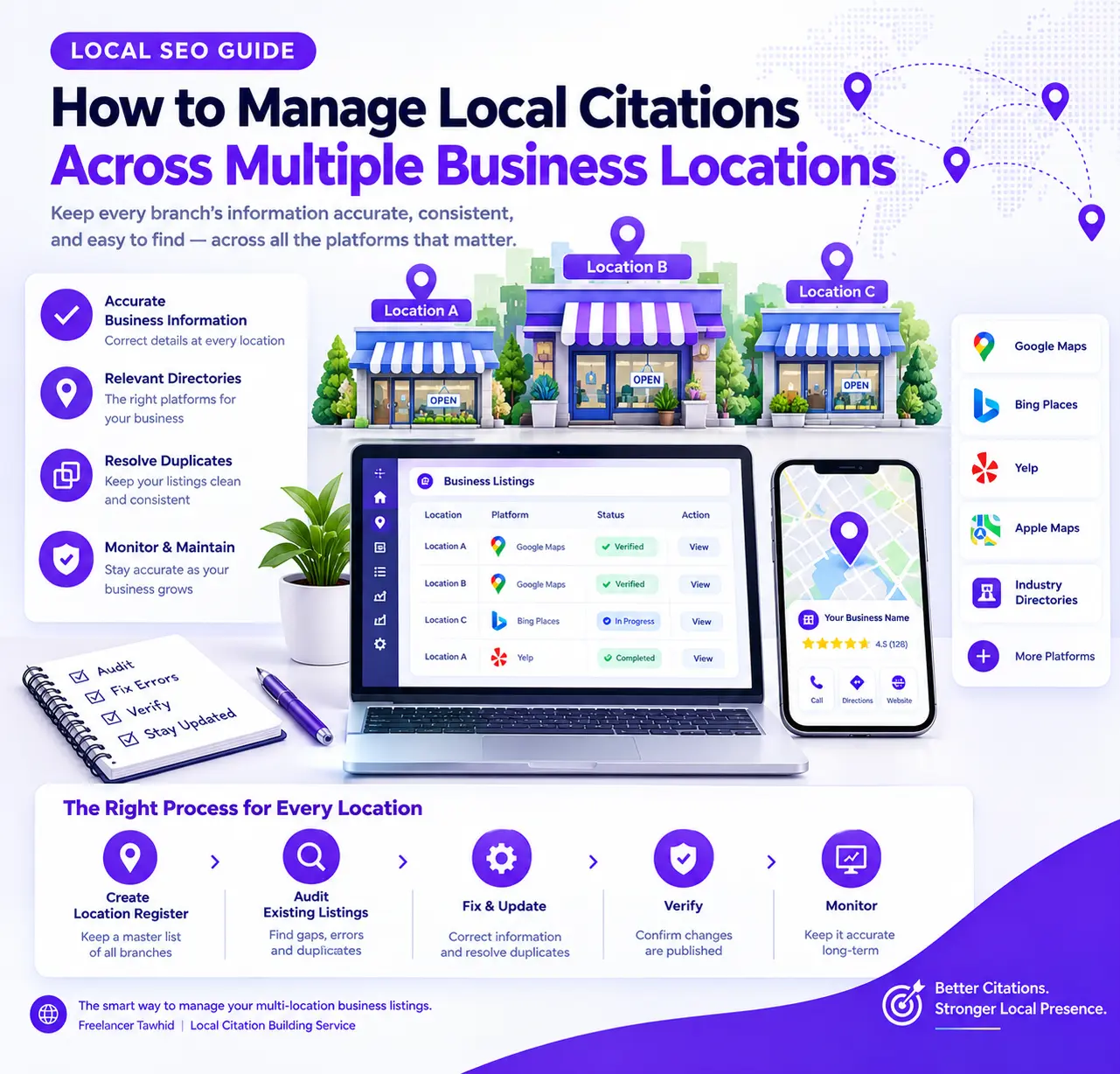
Managing local citations across multiple business locations requires a consistent system for keeping every branch’s business information accurate across relevant directories, map platforms, and other online sources. The process involves maintaining a central location register, auditing existing listings, correcting errors and duplicates, verifying changes, and monitoring information whenever a business location changes.
As a business expands, maintaining accurate online information becomes more complicated. One branch might have an outdated phone number, another might appear twice on a directory, and a third might still show an old address following a relocation. When different teams or platforms manage this information independently, these issues can become difficult to identify and resolve.
The solution is not to submit every branch to as many directories as possible. It is to establish a dependable process for managing the right information on the right platforms, with clear responsibility for every location.
In this guide, you’ll learn how to organize location data, audit local citations, resolve duplicate listings, choose appropriate citation sources, select management tools, and establish a sustainable maintenance workflow.
What Is Local Citation Management for Multiple Business Locations?
Local citation management is the process of finding, maintaining, correcting, and monitoring a business’s identifying information across relevant online sources. For a multi-location business, this process must account for each individual branch while preserving consistency in the company’s legitimate brand identity.
A local citation may appear in a business directory, a map service, an industry-specific website, or another online source that identifies the business. Some citations include a link to the business’s website; others simply mention its details.
The challenge is to ensure that customers can identify the correct branch and find accurate information wherever they encounter the business online.
Which Business Information Should You Manage?
Each location should have an approved record containing the information needed to maintain its online listings.
Information field | What to manage |
Business name | The genuine public-facing name used by the business |
Address | The accurate physical address, including relevant unit or suite details |
Phone number | The appropriate contact number for the location |
Website URL | The most relevant page for the specific branch |
Business category | The categories that accurately describe the location’s primary activities |
Opening hours | Regular hours and applicable holiday or exceptional hours |
Listing details | Platform URL, profile identifier, verification status, and access information where appropriate |
Management details | Assigned owner, last review date, pending issues, and change history |
Not every directory supports every field, and not every business needs every field on every platform. The goal is to maintain a reliable internal record and apply the relevant information accurately wherever appropriate.
Understanding NAP Consistency Across Locations
NAP stands for Name, Address, and Phone number. NAP consistency means ensuring that a business’s identifying details are accurate and appropriately aligned across online sources.
For a multi-location company, consistency does not mean giving every branch the same address and phone number. It means using the correct information for each individual location while following legitimate brand-wide standards.
For example, a company with three branches may use the same brand name across all three while maintaining a different address, local telephone number, opening schedule, and location page for each branch.
Google advises businesses to represent themselves consistently with their real-world identity and to provide accurate location information. Its guidelines also contain specific requirements for multi-location brands and duplicate profiles. Google Business Profile guidelines
The practical lesson is simple: standardize how location information is managed, but never standardize it by replacing legitimate branch-specific information with incorrect shared data.
Citations, Business Listings, and Backlinks: What’s the Difference?
These terms overlap, but they are not interchangeable.
- Local citations are online references to a business’s identifying information.
- Business listings are structured profiles or directory records describing a business or location.
- Backlinks are hyperlinks from other websites to a page on your website.
A business listing can include a backlink and therefore serve both as a citation and as a link source. However, some citations do not contain a hyperlink, and not every backlink is a local citation.
For citation management, the priority is accurate business representation and a useful customer experience—not acquiring the largest possible number of listing URLs or backlinks.
Why Is Citation Management More Difficult for Multi-Location Businesses?
The complexity comes from managing separate records that share a brand but represent different physical operations.
Common challenges include outdated directory information, duplicate records, inconsistent naming conventions, incorrect phone numbers, ownership or access problems, and delays in updating listings after business changes.
These issues can become harder to manage when head office, branch managers, marketing teams, external agencies, and automated listing tools make changes independently.
A centralized source of truth, a documented change process, and regular verification help reduce this complexity.
How to Audit Local Citations Across Multiple Business Locations
A citation audit helps you identify which locations have accurate listings, which contain errors, where duplicates may exist, and which relevant platforms are missing a listing.
Before creating new citations, establish what already exists. Otherwise, you may spend time submitting information to new directories while overlooking more important problems with existing records.
Step 1: Create a Complete List of Business Locations
Begin with a master list of all active business locations. Each location should have a unique internal identifier, even when several branches share the same brand name.
Record the approved business information for every location, then list the directories, map services, and other platforms where that location should be represented.
This initial register becomes the reference point for the entire audit.
Step 2: Discover Existing Business Listings
Search for each location using combinations of its business name, address, phone number, website URL, and previous contact information where relevant.
Check the platforms most useful to your audience first, including:
- Google Business Profile, where the business is eligible.
- Apple Maps and Bing Places.
- Relevant directories such as Yelp, where available and appropriate.
- Industry-specific directories and professional associations.
- Relevant regional or national business directories.
- Other existing listings discovered through branded searches or citation-audit tools.
The selection should reflect the actual business, industry, and markets served. A directory that is important for one business may have little value for another.
For every discovered listing, record its URL or platform identifier, the location it represents, and the status of its key information.
Step 3: Classify Citation Problems
Use consistent statuses so that the entire team can understand the audit results.
Status | Meaning | Recommended action |
Accurate | Important information matches the approved location record | Record verification |
Incomplete | Useful information is missing | Update the relevant fields |
Incorrect | One or more important details are wrong | Correct and verify |
Potential duplicate | Multiple records may represent the same location | Investigate before taking action |
Outdated | Information relates to a former address, phone number, or business identity | Determine the appropriate update or closure procedure |
Missing | No relevant listing was found | Evaluate whether creating one is worthwhile |
Unverified or uncontrolled | Ownership or editing access is uncertain | Establish access and determine available options |
Do not automatically classify every difference in punctuation, abbreviation, or formatting as an SEO problem. Focus on meaningful discrepancies that misrepresent the business, confuse customers, or prevent reliable management.
Step 4: Prioritize the Most Important Issues
Not every problem deserves the same level of urgency.
A listing with the wrong address may send customers to a former location. An incorrect phone number could prevent customers from contacting the branch. A missing listing on a low-relevance directory may have comparatively little impact.
Prioritize findings using four questions:
- How serious is the error? Could it mislead customers or misrepresent the business?
- How important is the source? Do customers use the platform, and is it relevant to the business?
- How widespread is the problem? Does it affect one branch or multiple locations?
- How urgent is the correction? Is a relocation, opening, closure, or contact-detail change involved?
A useful audit is not simply a list of errors. It is a prioritized action plan that identifies what needs fixing, who is responsible, and how the result will be checked.
For a broader assessment of citation issues alongside website and other local-search factors, see the Local SEO Audit service.
How to Fix Incorrect and Duplicate Business Listings
Once the audit is complete, the next step is to resolve issues without creating new problems.
The objective is to ensure that customers encounter accurate, appropriate records—not to make every directory display identical text regardless of context or platform requirements.
Correct Existing Listings Before Creating New Ones
When a suitable listing already exists, assess whether it can be corrected rather than creating another record.
Use the approved location register to confirm the correct business name, address, phone number, website, category, and other applicable fields. Update the existing listing through the platform’s supported process, then verify whether the changes were accepted and published.
For listings that the business cannot edit directly, investigate ownership, reporting, or correction options provided by the relevant platform.
How to Identify and Resolve Duplicate Listings
Two listings that look similar are not necessarily duplicates. Confirm that both records represent the same business at the same location before taking action.
Follow this process:
- Compare the business names, addresses, contact numbers, website URLs, and available listing identifiers.
- Determine whether the records represent the same underlying location or two legitimate entities.
- Identify the record that should remain, based on accuracy, ownership, history, and platform rules.
- Use the platform’s appropriate correction, duplicate-reporting, or consolidation process.
- Recheck the remaining record and document the outcome.
Google’s Business Profile guidelines generally prohibit more than one profile for the same business location, subject to legitimate exceptions such as qualifying departments and individual practitioners.
Do not delete listings indiscriminately. A separate department, practitioner, or independently operated business may require different treatment under the platform’s rules.
Manage Citations After a Business Relocation
A relocation often leaves outdated information behind on directories that the business rarely checks.
When a branch moves, update the central location register first. Then identify the platforms containing the former address, follow each platform’s relocation procedure, and verify that the new address appears correctly.
Also review the branch’s website destination, opening hours, contact details, and any third-party records that continue to direct customers to the old location.
Do not automatically create a new listing for the new address without checking the platform’s procedures. Depending on the circumstances, updating an existing profile may be the appropriate approach.
What Should You Do When a Location Closes?
For a permanently closed location, follow the relevant platform’s closure procedure and determine which other directories require updates.
Review the business website, too. Its location page may need to explain the closure, direct customers to an appropriate alternative, or be handled differently depending on whether the business has an active successor location.
Avoid leaving listings that falsely suggest a closed branch remains open. Equally, do not mark a business as permanently closed simply because it temporarily stops operating.
Manage Rebrands, Phone Number Changes, and New Locations
Different changes need different workflows.
Business change | Citation management action |
Rebrand | Confirm the legitimate new identity and update records according to each platform’s policies |
Phone number change | Correct affected records and verify that each branch displays the appropriate number |
New location | Add the branch to the master register and identify appropriate listing opportunities |
Change in opening hours | Update regular and exceptional hours on relevant platforms |
Change in ownership | Review listing access, account control, and the platform’s applicable transfer procedures |
Permanent closure | Follow platform closure procedures and review outdated directory records |
The important distinction is between maintaining consistency and blindly replacing information. A change affecting one branch should not automatically overwrite data for every other location.
Choose the Right Citation Sources for Every Location
An effective citation strategy prioritizes relevant sources over sheer quantity.
Not every directory will be suitable for every business, and not every platform supports the same location structure or information fields.
Start With Major Maps and Relevant Directories
Identify the platforms your customers are most likely to use and where your business can legitimately maintain a listing.
Google Business Profile is especially relevant for eligible businesses that want to manage their presence on Google Search and Maps. Other platforms may be valuable depending on the audience, country, sector, and nature of the business.
After reviewing the major relevant sources, evaluate industry directories, professional associations, and other credible websites that genuinely serve your audience.
How to Evaluate a Citation Opportunity
Before creating a listing, ask:
- Is this platform relevant to the business and its customers?
- Does it accept the type of business or location involved?
- Can it represent the location accurately?
- Is the platform credible and useful?
- Does the listing already exist?
- Will maintaining it provide sufficient value relative to the effort involved?
Competitor research can reveal overlooked sources, but a competitor’s listing is not automatically an opportunity worth pursuing.
Likewise, there is no universal number of citations that every location must achieve. A smaller number of accurate, relevant listings may be more useful operationally than a large collection of poorly maintained records.
Send Each Listing to the Correct Location Page
Where the website has a dedicated page for each branch, map the listing to the appropriate page whenever the platform supports that destination.
For example, a visitor looking for a particular branch should arrive at a page with the correct address, contact information, hours, and relevant location details—not a page describing an unrelated branch.
This also helps your team maintain a clear relationship between the location register, individual listings, and the business website.
Detailed location-page optimization belongs to your wider Local SEO strategy, but correct URL mapping is an important part of dependable citation management.
Should You Use a Spreadsheet or Citation Management Software?
The right management method depends on the number of locations, the volume of changes, the number of platforms involved, and the resources available to maintain the records.
When a Spreadsheet Is Enough
A centralized spreadsheet can be effective for a small or relatively stable business when listing coverage is manageable and the team can reliably handle updates manually.
It should include the approved location data, listing URLs, audit status, responsible person, last verification date, pending corrections, and change history.
However, spreadsheets do not automatically discover listings, distribute updates, or confirm that external platforms have accepted changes. They also become more difficult to control when many people edit them independently.
When Citation Management Software Makes Sense
Dedicated software may become valuable when the business has numerous locations, many listing sources, frequent changes, or several people coordinating work.
Evaluate tools based on their actual capabilities:
Selection criterion | What to check |
Location coverage | Can the tool manage all relevant branches and markets? |
Platform support | Does it support the directories the business needs? |
Audit capability | Can it identify missing, incorrect, or potentially duplicate listings? |
Bulk updates | Can appropriate changes be applied efficiently across several locations? |
Verification | Can you confirm whether the changes were accepted or published? |
Reporting | Can the team track issues by location, platform, and status? |
Access controls | Can responsibilities and approval permissions be managed? |
Cost | Do subscription, setup, and ongoing management costs justify the benefits? |
Data portability | Can the business export important information and maintain records if it changes provider? |
Verify product capabilities and current pricing directly with vendors before making a purchasing decision.
Why a Hybrid Workflow Often Works Well
For many multi-location businesses, a practical model combines three elements:
A master location register acts as the approved source of truth.
Management software supports discovery, bulk operations, and reporting where its features are appropriate.
Human verification handles ambiguous duplicates, changes to business identity, eligibility questions, and critical corrections.
Software can reduce repetitive work, but it cannot remove the need to understand what each business location actually represents or whether a proposed change is appropriate.
Build a Repeatable Multi-Location Citation Management Process
Citation management should be an ongoing operational process, not a one-time cleanup project.
A repeatable workflow makes it easier to maintain accuracy as branches open, close, relocate, or change their business information.
Use a Documented Workflow
Follow this sequence for every location:
- Centralize: Maintain the approved record for each branch.
- Audit: Identify existing listings and missing information.
- Classify: Separate accurate records from errors, duplicates, and outdated information.
- Prioritize: Rank problems according to severity, source importance, and urgency.
- Correct: Update existing listings or create appropriate missing listings.
- Verify: Confirm that important changes appear correctly.
- Monitor: Record outstanding issues and schedule future reviews.
The same process can be applied across several locations, but the corrective actions must remain specific to each branch.
Use Change-Triggered Reviews
Some changes should immediately initiate a citation review rather than wait for the next scheduled audit.
These include a new opening, relocation, rebrand, contact-detail change, permanent closure, ownership change, or discovery of an incorrect or duplicate listing.
Assign someone to approve the change, update the central record, carry out the required platform updates, and confirm completion.
This is particularly important when head office, franchise operators, branch managers, and marketing agencies share responsibility for business information.
How Often Should You Audit Local Citations?
There is no universally appropriate audit frequency for every business.
Begin with a comprehensive baseline audit. After that, use a combination of change-triggered checks and scheduled reviews based on the number of locations, operational risks, platform coverage, and the history of errors.
A quarterly review may be a reasonable starting point for a stable operation, while a business with frequent openings, closures, or contact changes may require more frequent monitoring.
Treat the schedule as an operational decision, not a ranking formula or an official Google requirement.
Assign Clear Responsibilities
A management system works only when someone is accountable for using it.
Decide who approves business information, who updates listings, who handles access problems, and who verifies completed corrections.
Record the previous value, approved replacement, effective date, affected platforms, implementation status, and verification date for meaningful changes.
This audit trail helps prevent confusion when multiple people or tools make updates.
How to Measure Citation Accuracy and Performance
Citation management should be measured through accuracy, issue resolution, and useful business outcomes rather than the number of directories submitted to.
Track the Quality of the Process
Useful operational metrics include:
- Percentage of planned locations audited.
- Percentage of priority listings verified.
- Number of confirmed duplicates and unresolved cases.
- Number of important business-information errors.
- Percentage of corrections verified after implementation.
- Time required to resolve important issues.
- Outstanding issues by location, platform, and priority.
You can also calculate an internal priority-field accuracy rate:
Priority-fieldaccuracy=AccuratepriorityfieldsPriorityfieldsreviewed100
For example, if 90 of 100 reviewed priority fields are accurate, the measured accuracy rate is 90%.
This is an illustrative management metric, not an official Google metric or a ranking formula. Define the fields being measured consistently so that results can be compared over time.
Measure Business Outcomes Separately
Accurate citations do not guarantee better rankings or more leads.
Google describes local search ranking primarily in terms of relevance, distance, and prominence. It also advises businesses to maintain complete and accurate information in their Business Profiles. Read Google’s local-ranking guidance.
To understand whether your wider local-search efforts are working, monitor relevant indicators such as:
- Search visibility and relevant impressions.
- Website visits from listing platforms.
- Available Business Profile interactions, including calls and website visits.
- Qualified enquiries and conversions.
- Local organic and Maps visibility for relevant searches.
Compare these outcomes over time and consider other changes made to the website, listings, marketing, and business operations. Do not attribute every improvement or decline to citations alone.
If the main challenge extends beyond business listings into Google Maps visibility, explore the Google Maps SEO service as part of the wider optimization process.
Common Local Citation Management Mistakes to Avoid
Even a well-organized business can create problems by using an inconsistent or overly automated workflow.
Avoid these common mistakes:
Creating listings before auditing existing ones. This can introduce duplicates or add unnecessary work when a correct listing already exists.
Using identical contact details for every branch. Shared branding does not mean that every location has the same address, telephone number, hours, or destination page.
Treating every formatting variation as an error. Investigate whether the discrepancy changes the meaning or accuracy of the information before taking action.
Deleting suspected duplicates without verification. Establish whether the records represent the same location and follow the relevant platform procedure.
Ignoring relocations and closures. Old listings can continue to mislead customers if nobody is responsible for updating them.
Relying completely on automated tools. Audit software can help identify issues, but important changes and ambiguous findings still need appropriate verification.
Prioritizing citation quantity over quality. Adding listings indiscriminately is not a substitute for maintaining accurate, relevant information.
Leaving responsibility undefined. Without an assigned owner, changes may be approved by one person but never implemented or checked.
Expecting citations alone to fix local rankings. Citation accuracy is one part of a broader strategy that may include Business Profile management, website optimization, reviews, relevant links, and other legitimate local-search factors.
The best approach is to create accurate records, maintain the right listings, resolve meaningful discrepancies, and consistently verify the results.
Example: Managing Citations for a Business With Three Locations
Consider a hypothetical business operating three branches. Its central location register identifies each branch and records the current information approved by the business.
An audit produces the following findings:
Location | Audit finding | Recommended action |
Branch A | Important listings match the approved location record | Record verification and schedule future reviews |
Branch B | Two directory records may represent the same branch, and their phone numbers differ | Investigate the records, resolve any confirmed duplicate through the relevant platform, and verify the correct contact number |
Branch C | Several listings still show its previous address | Follow the appropriate relocation procedures and verify the updated information |
Instead of treating these findings as one general citation-building task, the business can assign each issue to a responsible person, prioritize the highest-impact errors, and record completion separately.
The central register then becomes a management tool for both immediate corrections and future changes.
This example is illustrative, not a report of an actual client project. Its purpose is to demonstrate how a structured process can make work more manageable across several locations.
Frequently Asked Questions About Managing Local Citations
Does every business location need its own local citations?
Each genuine business location should be represented accurately wherever separate location-level listings are appropriate and supported by the platform. However, you do not need to submit every branch to every directory. Choose sources according to their relevance and policies. Google Business Profile has its own eligibility and per-location rules, which should be checked separately.
Should every branch use the same business name, phone number, and website?
Not necessarily. Comparable branches should follow the business’s genuine naming and category conventions, but their addresses, hours, phone numbers, and website destinations may differ. Google recommends providing a phone number connected to the individual location when possible or a website that represents that location. Always follow the business’s real-world identity and platform rules. Google’s guidelines provide further details.
What should I do when a directory shows two listings for the same location?
First, verify that both records represent the same business location and are not legitimate separate departments, practitioners, or entities. Identify the correct record, compare its information with the approved location data, and follow the platform’s correction, consolidation, or duplicate-reporting process. Record the outcome and verify the change instead of automatically deleting either listing.
How often should multi-location citations be audited?
Start with a full audit to establish the current situation. Afterward, review listings when important business information changes and conduct periodic checks based on location count, platform coverage, operational risk, and the frequency of errors. A quarterly review may suit a stable operation, but it is a practical starting point, not a universal platform requirement.
Do more local citations automatically improve rankings?
No. The number of citations alone does not guarantee better rankings. Relevant, accurate business information can help customers find the correct business, while local search visibility depends on wider factors. Google’s published guidance identifies relevance, distance, and prominence as the main local-ranking considerations. Focus on accurate, appropriate listings rather than maximizing citation volume. Read Google’s explanation of local rankings.
Conclusion: Make Citation Management an Ongoing Process
Managing local citations across multiple business locations becomes easier when every branch has an approved data record, existing listings are audited systematically, and corrections are tracked through to verification.
Start by establishing a central location register. Use it to identify important citation problems, prioritize corrections, resolve duplicates carefully, and maintain appropriate listings across relevant platforms. Introduce change-triggered reviews so that relocations, new openings, closures, and contact-detail changes do not leave outdated information behind.
The objective is not to create the largest possible citation footprint. It is to maintain accurate, relevant, and dependable business information wherever customers may discover each location.
If you need help identifying inconsistent business listings, resolving citation issues, or organizing citation management across several branches, explore Freelancer Tawhid’s Local Citation Building Service.
For businesses that need a wider strategy covering citations, Google Business Profile, Maps visibility, and other local-search factors, the Local SEO service is the broader starting point.
Accurate location data, a clear workflow, and consistent verification provide a more dependable foundation for multi-location Local SEO than citation building without a maintenance plan.
Publication note: The article follows Google’s published guidance on accurate business representation, local ranking factors, and helpful, people-first content. For ongoing accuracy, recheck platform-specific rules whenever publishing updates about Google Business Profile eligibility, duplicate listings, relocations, or management tools.