
Local Citations vs Backlinks: What's the Difference, and How Should Local Businesses Prioritize Them?

Freelancer Tawhid
SEO Expert and Consultant
- October 15, 2026
- 0 comments
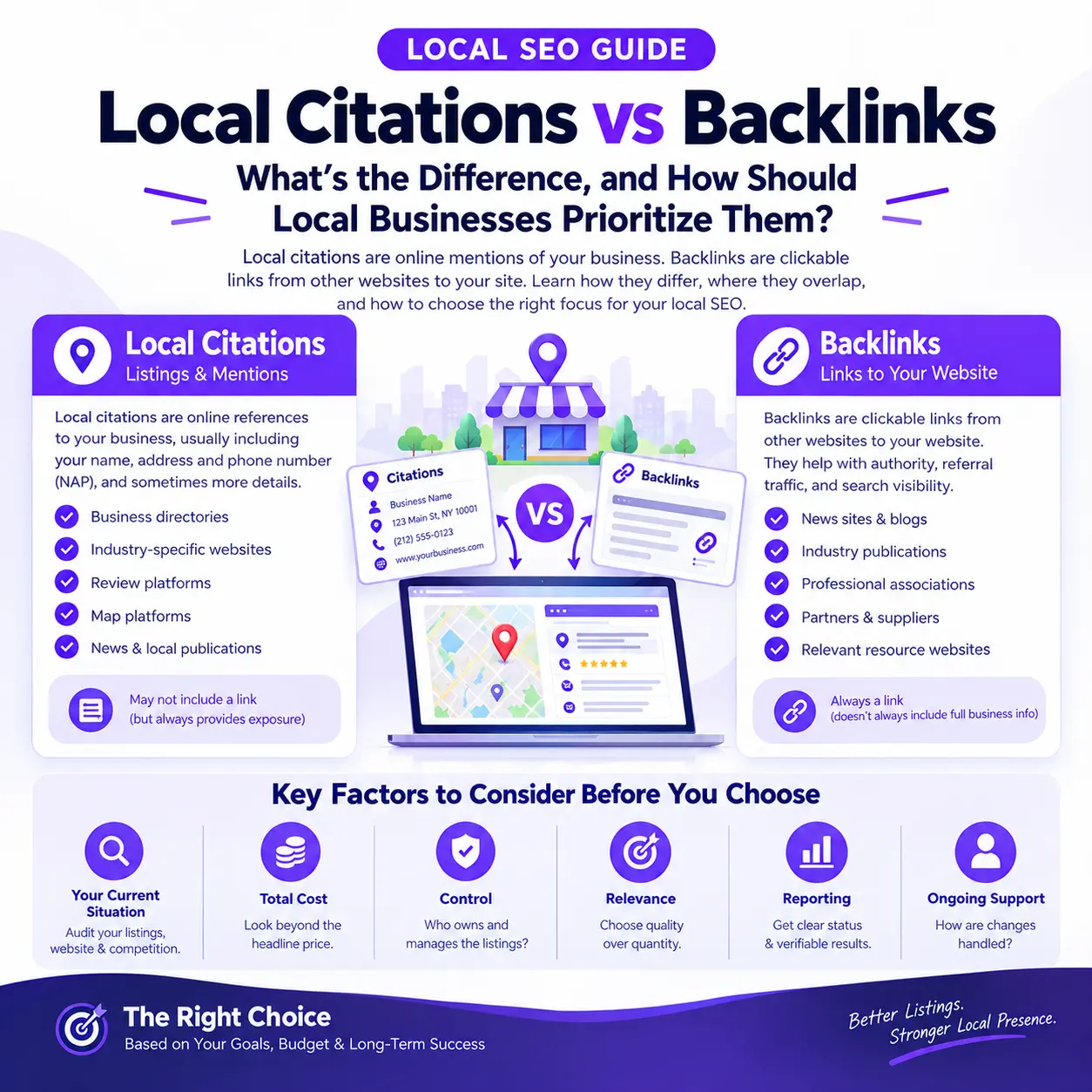
Local citations are online mentions or listings of a business’s identifying information, while backlinks are clickable links from other websites to its website. A single placement can serve both purposes, but the priorities differ. Correct inaccurate business information first, establish a reliable citation foundation, and then prioritize relevant backlinks according to your competition, website condition, and business goals.
For local businesses, deciding where to invest time and money in off-page SEO can be challenging. Some businesses spend months submitting directory listings, while others concentrate almost entirely on acquiring backlinks. Neither approach is automatically right for every situation.
The important question is not simply whether citations or backlinks matter more. It is which activity is most relevant to your business’s current needs.
In this guide, we’ll explain how local citations and backlinks differ, where they overlap, how they contribute to local search visibility, and how to determine which deserves attention first.
Local Citations vs Backlinks: What’s the Difference?
The main difference is that a local citation references a business and its identifying information, whereas a backlink is a hyperlink pointing to a website.
A citation does not require a clickable link. A backlink does. However, the same online placement can contain both.
What Is a Local Citation?
A local citation is an online reference to a business, commonly including its name, address, and phone number (NAP). Depending on the platform and context, it may also include the business’s website, category, opening hours, services, and other identifying details.
Common sources of local citations include:
- General business directories.
- Industry-specific directories and professional associations.
- Relevant review and discovery platforms.
- Business listing and map platforms.
- Editorial publications and other websites that mention the business.
Local citations generally fall into two categories.
Structured citations appear in organized listings where information is displayed in defined fields. A business directory listing with separate fields for the name, address, phone number, and website is a typical example.
Unstructured citations appear naturally within articles, news coverage, association pages, industry publications, or other online content. The business information may appear within a paragraph rather than a structured listing.
The purpose of citation management is not to place business information on as many websites as possible. It is to maintain accurate, useful information on sources that are relevant to the business and its customers.
For more detail about choosing appropriate sources and maintaining listing consistency, see my Local Citation Building service.
What Is a Backlink?
A backlink is a hyperlink from another website to your website. It is also commonly called an inbound link.
For example, suppose an industry publication writes an article about selecting a reliable contractor and links to a contractor’s service page. That hyperlink is a backlink.
Backlinks can come from several types of websites, including:
- Relevant industry publications and resource websites.
- Professional associations and legitimate business organizations.
- Suppliers, partners, and other genuine business relationships.
- News websites and editorial publications.
- Other websites that find the business’s content or expertise worth referencing.
Not all backlinks provide the same value. A relevant, legitimate editorial link may create useful referral opportunities and contribute to website authority, while an unrelated or manipulative link may offer little value or introduce risk.
The context, legitimacy, relevance, and destination of a link matter more than simply adding another link to a report.
Can One Placement Be Both a Citation and a Backlink?
Yes. A single placement can function as both a citation and a backlink when it references the business and includes a hyperlink to its website.
Consider three hypothetical examples:
Example | Local citation? | Backlink? |
A business directory displays a company’s name, address, and phone number but no website link. | Yes | No |
An industry article links to a company’s service page without displaying its address or phone number. | Not necessarily a conventional local citation | Yes |
A professional association lists a business’s contact details and links to its website. | Yes | Yes |
This distinction is important when evaluating off-page SEO work.
If an agency reports that it created 20 directory listings and acquired 20 backlinks, ask whether those are separate placements or whether the same listings are being counted twice.
More importantly, assess what each placement actually contributes. An accurate business listing may be useful even without a link, while an editorial backlink may be valuable without displaying the business’s full contact details.
The two activities overlap, but they should not be treated as interchangeable.
What Role Do Citations and Backlinks Play in Local SEO?
Citations and backlinks can support different aspects of a business’s online presence, but neither should be treated as an isolated solution to every local ranking problem.
Google’s published guidance explains that local results are primarily based on relevance, distance, and prominence. It also notes that information such as links from other websites and customer reviews can contribute to its understanding of a business’s prominence.
See Google’s official guidance on improving local rankings.
How Local Citations Can Help
Accurate citations can help customers find correct business information across relevant platforms. They can also support a more consistent online representation of the business.
Their practical benefits include:
- More reliable business information
Correct names, addresses, phone numbers, and website URLs make it easier for potential customers to identify and contact the right business.
- Better business discoverability
Customers may discover a business through industry directories, association websites, or other platforms without first visiting Google Search.
- Fewer information-related problems
Outdated phone numbers, old addresses, and duplicate listings can confuse customers. Identifying and correcting these problems helps maintain a cleaner business-information footprint.
- More useful coverage across relevant platforms
A business may benefit from being represented on platforms that its target customers actually use, especially when those platforms are relevant to its industry.
However, it is important to distinguish these practical benefits from direct ranking claims.
Google does not publish a universal citation-count target or a formula showing how much a particular directory listing will affect rankings. Accurate citations are worth maintaining, but creating more listings does not automatically produce better local search visibility.
How Backlinks Can Help
Backlinks connect a business’s website to the wider web.
Relevant, legitimate links can contribute to website authority, help search engines discover pages, and introduce potential customers who follow links from other websites.
For local businesses, particularly useful opportunities may include links from relevant professional organizations, suppliers, industry publications, and credible editorial coverage.
For example, a specialist service company might receive a link from a professional association’s member directory. Another company might earn an editorial link because it provided useful expert commentary for an industry publication.
Both links may be worthwhile, but their value should be evaluated in context rather than assumed from a third-party authority score alone.
A backlink campaign should also account for the pages receiving links. If the website’s important service pages are incomplete, irrelevant, or difficult to navigate, acquiring additional links may not address the underlying problem.
Citations, Backlinks, Google Maps, and Organic Search
Local Pack results, Google Maps visibility, and local organic website rankings are related but distinct outcomes.
An eligible business’s Google Business Profile can play an important role in local discovery. Its website also needs to provide useful information that matches relevant search intent.
For local results, Google identifies relevance, distance, and prominence as the primary ranking factors. Distance depends on the searcher’s location relative to the business, so a business may not appear in the same position for every searcher or location. Prominence can be influenced by information available across the web, including links and reviews.
This means neither citations nor backlinks should be evaluated in isolation.
If your primary concern is Maps visibility, review the wider factors covered in my Google Maps SEO service. If you need a broader strategy involving your website, business information, and off-page SEO, start with the overall Local SEO service.
Which Should Local Businesses Prioritize First?
There is no universal rule that every business must build citations before backlinks or backlinks before citations.
The more useful approach is to identify the current limitation and prioritize work that addresses it.
In practice, correcting materially inaccurate business information and establishing an appropriate citation foundation are sensible early priorities when those problems exist. Once that foundation is reasonably sound, relevant backlink acquisition may deserve more attention if the website has a meaningful competitive link gap.
Step 1: Audit Your Current Local SEO Position
Before spending more time or money on either activity, establish a baseline.
Review the following areas:
- Business information: Are the correct name, address where applicable, phone number, website, and relevant business details being displayed?
- Existing citations: Are important listings missing, inaccurate, outdated, or duplicated?
- Citation relevance: Does the business appear on the platforms and industry sources that genuinely matter to its customers?
- Backlink profile: Which relevant websites already link to the business, and what pages do those links reference?
- Website quality: Are the main service pages useful, relevant, accessible, and well structured?
- Search performance: What do available search, referral, and conversion data reveal about the business’s current situation?
- Competition: How do relevant competitors compare in terms of website relevance, established online presence, and legitimate backlinks?
The goal is to find an actual problem to solve.
A business that has never established accurate listings may need citation work first. A business with accurate information across its important platforms may have little reason to keep submitting to more directories if the stronger opportunity lies elsewhere.
Step 2: Match the Priority to Your Business’s Situation
Use this decision framework to choose the most sensible starting point.
Current situation | Recommended priority | Reason |
Important listings display the wrong phone number or an outdated address. | Correct material citation errors. | Customers need accurate information, and the business’s online representation needs attention. |
A new business has little presence on relevant directories and industry platforms. | Establish a reliable core citation footprint. | Important sources should contain accurate information about the business. |
A business has accurate core listings but few relevant backlinks compared with its competitive landscape. | Investigate legitimate backlink opportunities. | Additional directory submissions may not address the identified competitive gap. |
The website has weak service pages or technical problems. | Address the website and broader SEO issues. | Neither citations nor backlinks can substitute for a useful, accessible website. |
A business with multiple locations has inconsistent information across listings. | Improve location-level information management. | Each location needs accurate and distinguishable business information. |
Both citations and backlinks appear reasonably established, but visibility remains weak. | Conduct a broader Local SEO audit. | The underlying limitation may involve relevance, competition, the website, business information, or other factors. |
This framework is a diagnostic guide, not a guarantee of ranking improvements.
It is also important not to assume that competitors rank higher because they have more backlinks. They may have more relevant pages, stronger business information, better reviews, a better match for the search, or other advantages.
Step 3: Consider Budget, Effort, and Business Goals
Citation building and backlink acquisition require different types of work.
Citation projects may involve researching appropriate platforms, correcting old information, creating missing listings, and managing duplicates. The effort depends on the number of locations, the condition of the existing listings, and the sources that are genuinely relevant.
Backlink acquisition may require research, relationship development, useful content, outreach, and sometimes digital PR. The work can be less predictable because relevant publishers and organizations decide independently whether they want to reference a business.
Neither activity should be budgeted solely by the number of placements promised.
Before approving a project, ask:
- Which business problem is the work intended to solve?
- How were the proposed sources selected?
- What exactly will be created, corrected, or acquired?
- How will completed work be documented?
- Which outcomes can reasonably be measured?
- What other work might have a higher priority?
A sensible plan should reflect your website’s condition, competitive environment, available budget, and business objectives rather than a generic package of directory submissions or backlinks.
Step 4: Apply the Framework to Two Different Businesses
Example A: A recently relocated service business
Suppose a plumbing business has moved to a new address and changed its phone number. Several important directory listings still display the old details.
The immediate priority should be correcting the information that misdirects customers. Building additional backlinks while important business information remains inaccurate would leave a clear operational problem unresolved.
After the necessary corrections, the business can assess whether further citation opportunities or backlink work deserve investment.
Example B: An established business with accurate listings
Now suppose a service business has accurate information on its important platforms, no significant duplicate-listing problems, and a reasonably complete citation footprint.
A competitor review reveals that relevant organizations and publications link to competing businesses, while the business has few comparable references.
In this situation, research into legitimate backlink opportunities may be more valuable than creating another batch of generic directory listings.
These are illustrative examples, not client case studies. The point is that different starting conditions justify different priorities.
How to Build and Maintain Useful Local Citations
Once citation work has been identified as a priority, the next step is to focus on accuracy, relevance, and usefulness.
Establish a Reliable Source of Business Information
Document the correct business name, address where applicable, phone number, website, business category, and other essential information.
For businesses with multiple locations, maintain separate, accurate details for each eligible location. Do not use one location’s information to represent another.
Update the source information when the business moves, changes its phone number, changes its branding, or makes other significant operational changes.
Choose Relevant Citation Sources
There is no universal directory list that suits every business.
Depending on the business model and audience, appropriate sources may include:
- Major business directories and discovery platforms.
- Relevant industry or professional directories.
- Legitimate association and membership listings.
- Appropriate review platforms.
- Relevant regional or niche business resources.
Assess whether each platform is legitimate, relevant to the business, and potentially useful to customers.
A directory does not become valuable simply because it is popular with SEO practitioners or offers a listing for a fee. Avoid spending resources on sources that exist primarily to host large volumes of low-quality listings.
Correct Material Errors and Review Duplicates
Prioritize problems that could misrepresent the business or interfere with customer access.
Examples include:
- An incorrect phone number.
- An outdated address.
- A listing associated with the wrong business.
- A duplicate listing that creates confusion.
- An incorrect website URL.
- Incomplete information on an important platform.
Do not treat every difference in punctuation, abbreviation, or address formatting as an automatic ranking penalty. Focus on whether the information is materially incorrect, misleading, or inconsistent with the real business.
Where duplicate listings exist, follow the relevant platform’s procedures. Not every duplicate should be handled in exactly the same way.
If you need more comprehensive citation research, cleanup, or implementation, explore my Local Citation Building service.
Know When to Stop Adding Citations
There is no universal number of local citations a business needs.
Once the important listings are accurate and relevant, additional submissions should be evaluated against other available opportunities.
Ask whether another directory would improve customer discovery, fill a meaningful coverage gap, or help maintain correct business information. If the answer is unclear, further citation work may not be the best immediate investment.
Citation management remains useful when business details change, locations open or close, or significant listing problems arise. It does not mean continuously submitting the business to every available directory.
How to Earn Better Local Backlinks
When a backlink gap is a meaningful priority, focus on legitimate opportunities that make sense for the business rather than pursuing link volume.
Evaluate a Backlink Opportunity Before Pursuing It
Before investing effort in a link opportunity, ask:
Is the website legitimate? Review its purpose, content, audience, and editorial standards. Be cautious of sites that exist mainly to sell links.
Is it relevant? Consider the relationship between the referring website, the business’s industry, its audience, and the linked page. Relevant context can make a link more useful to people.
Does the link fit naturally? A link should make sense within the surrounding content rather than appear solely to manipulate rankings.
Is the destination appropriate? A relevant link to a useful service page or resource may be more beneficial to visitors than a link to an unrelated page.
Could it bring relevant referral traffic? Consider whether the website’s audience might genuinely benefit from visiting the business’s website.
Is the acquisition method legitimate? Avoid arrangements designed primarily to manufacture ranking signals.
Third-party metrics such as domain authority or domain rating can help compare websites within the relevant tool, but they are not Google’s own ranking scores. Do not use one metric as a substitute for evaluating relevance, legitimacy, context, and likely audience value.
Pursue Legitimate Opportunities
Potential backlink opportunities include:
- Professional associations: Relevant organizations may maintain member profiles or directories that link to members’ websites.
- Suppliers and partners: Genuine business relationships may create useful opportunities for company profiles, partner pages, or joint content.
- Editorial coverage: Journalists and publications may reference a business when it offers useful expertise, original research, or a legitimate newsworthy contribution.
- Industry resources: Useful guides, research, tools, and other resources can give relevant websites a reason to reference the business.
- Community involvement: Genuine participation in relevant organizations or events may create visibility and natural references.
These are possible opportunities, not guaranteed backlink sources. A business should choose methods that make sense for its industry, resources, and audience.
Avoid Risky Link-Building Shortcuts
Google’s spam policies for web search identify practices such as buying or selling links for ranking purposes, automated link creation, excessive link exchanges, and low-quality directory or bookmark links as examples of link spam.
Paid advertising and sponsorship are normal business activities, but arrangements intended to pass ranking credit through paid links should follow Google’s link-qualification requirements. Depending on the arrangement, appropriate attributes such as rel=”sponsored” or rel=”nofollow” may be necessary.
A paid directory listing can still provide genuine audience value. The issue is whether the placement is legitimate and useful, rather than being purchased primarily to manipulate rankings.
A smaller number of legitimate, relevant opportunities is a better strategic objective than acquiring links indiscriminately.
How to Measure Citation and Backlink Performance
A successful SEO process should distinguish between completing work and achieving an outcome.
Creating a citation, correcting a listing, or acquiring a backlink is a completed activity. It does not, by itself, prove that rankings or qualified leads improved.
Track Citation Quality and Backlink Acquisition Separately
For citation work, record:
- Important listings reviewed and corrected.
- Material errors and duplicates identified.
- Relevant missing listings addressed.
- Changes in business information.
- Referral activity from platforms where measurement is available.
For backlink work, record:
- Relevant new referring domains.
- The quality, context, and legitimacy of important links.
- The pages receiving those links.
- Lost links that matter to the website.
- Referral traffic and any meaningful engagement or conversions.
Avoid treating the raw number of listings or backlinks as the main performance indicator.
Connect SEO Work to Search Visibility and Business Outcomes
Use data from appropriate tools to understand what happens after implementation.
Google Search Console can help evaluate search impressions, clicks, queries, and pages appearing in Google Search.
Google Business Profile performance data, where available, can help track customer interactions with an eligible business’s profile.
Website analytics can help assess referral traffic, landing-page engagement, and configured conversions.
Lead and conversion tracking can help establish whether search activity contributes to enquiries, bookings, sales, or other business goals.
Where possible, record a baseline before making substantial changes. Compare subsequent performance while considering other website changes, market conditions, competition, and potential changes in search demand.
If rankings or traffic improve after citation or link-building work, do not automatically attribute the entire change to one activity. Search performance can be influenced by multiple factors, and simple before-and-after observations do not establish causation.
When Should You Reassess Your Priorities?
Revisit the strategy when:
- Business information changes significantly.
- Important listings become inaccurate or duplicated.
- The existing citation foundation is complete enough that further work has diminishing practical value.
- Relevant competitors reveal new, legitimate backlink opportunities.
- Search visibility changes without an obvious explanation.
- Website performance, qualified enquiries, or conversion patterns indicate another problem.
The objective is to keep directing effort toward meaningful opportunities rather than repeat activities because they are easy to count.
Common Local Citation and Backlink Mistakes to Avoid
Assuming More Citations Always Improve Rankings
A high citation count does not automatically indicate a strong local presence. Irrelevant, duplicated, inaccurate, or low-value listings may add unnecessary complexity without resolving the business’s actual needs.
Prioritize relevant sources and accurate information.
Treating Every NAP Difference as a Ranking Penalty
Not every formatting variation is a significant problem. Correct information that misrepresents the business or directs customers incorrectly, but do not invent penalties for harmless differences.
Counting Every Citation Link as a Valuable Backlink
A citation may contain a hyperlink, but the link’s presence does not guarantee that it is useful for SEO. Evaluate the business information and the hyperlink separately.
Likewise, a mention can be useful without including a backlink.
Acquiring Backlinks Based Only on Third-Party Scores
A high authority metric does not automatically make a link relevant or legitimate. Examine the website, context, destination, and method of acquisition.
Avoid link schemes that promise rankings through predetermined quantities of backlinks.
Expecting Citations or Backlinks to Fix Every Local SEO Problem
A business can have accurate citations and relevant backlinks while still struggling with local search visibility.
The issue might involve poorly targeted service pages, technical problems, a weak match for search intent, competition, an incomplete eligible Google Business Profile, or other factors.
Google’s local-ranking guidance identifies relevance, distance, and prominence as the main considerations. A sound strategy should therefore examine the wider local search environment instead of assuming that one off-page activity will solve everything.
If neither citations nor backlinks clearly explains your visibility problem, a broader Local SEO audit can help identify which areas deserve further investigation.
Frequently Asked Questions
Can one website listing count as both a local citation and a backlink?
Yes. A listing can function as both if it contains information identifying the business and includes a clickable link to its website. A citation does not require a link, while a backlink does. Assess the accuracy and usefulness of the business information separately from the relevance and legitimacy of the hyperlink.
How many local citations does a business need?
There is no universal citation count that every business needs. Start with accurate information on the major and industry-relevant platforms that make sense for your business. Then address material errors, missing important listings, and duplicates. Avoid assuming that submitting to more low-value directories will automatically improve local rankings.
Do minor differences in NAP formatting hurt local rankings?
Not every formatting difference indicates a meaningful problem. Focus on errors that misrepresent the business, such as an incorrect phone number, an outdated address, or a duplicate listing that creates confusion. Correct inaccurate information, but do not treat punctuation or harmless formatting variations as automatic ranking penalties.
How often should a business audit its local citations?
Review relevant listings when evaluating your Local SEO, and recheck them after a move, rebrand, phone-number change, or location opening or closure. Periodic reviews also help maintain accuracy. The appropriate frequency depends on how often business details change, how many locations you manage, and how effectively the listings are maintained.
Is it safe to pay for local directory listings or backlinks?
A paid directory listing may be reasonable if the directory provides legitimate exposure to a relevant audience. The risk arises when a placement is purchased primarily to manipulate rankings. Google identifies buying or selling links for ranking purposes as link spam. Evaluate the placement’s purpose, follow appropriate link-qualification requirements, and prioritize genuine audience value.
Conclusion: Prioritize the Work Your Business Actually Needs
Local citations and backlinks serve different purposes, even though a single placement can provide both.
Citations help maintain useful, accurate representations of business information across relevant platforms. Backlinks connect your website to other websites and can contribute to website authority, referral opportunities, and prominence.
For most businesses, the sensible starting point is to identify the current problem rather than assume that one activity is always more important.
Correct material business-information errors. Establish an appropriate citation foundation. When those needs are reasonably addressed, investigate whether relevant backlink opportunities offer a better use of resources. If neither activity explains the problem, broaden the investigation to the website and the wider local search strategy.
The most useful priority is the one supported by evidence about your business, competition, website, and objectives—not a fixed citation quota or an arbitrary number of backlinks.
Need Help Prioritizing Your Local SEO Strategy?
If you’re uncertain whether citation cleanup, Google Business Profile optimization, backlink acquisition, or another SEO improvement deserves attention first, the best next step is to assess your current situation.
I’m Tawhid, an SEO Expert & Consultant at Freelancer Tawhid. I began working with Local SEO in 2020 and developed my skills through research and practical implementation on real projects, later expanding into Ecommerce SEO.
My approach is to understand the business, identify the opportunities that matter, and prioritize work according to the website’s condition and objectives.
Explore my Local SEO services to learn how citations, website optimization, and other local search activities can fit into a broader strategy.
You can also contact Tawhid to discuss your website, current challenges, and potential next steps.