
Local Link Building Costs: What Affects Budget, Scope, and Timelines?

Freelancer Tawhid
SEO Expert and Consultant
- October 14, 2026
- No Comments
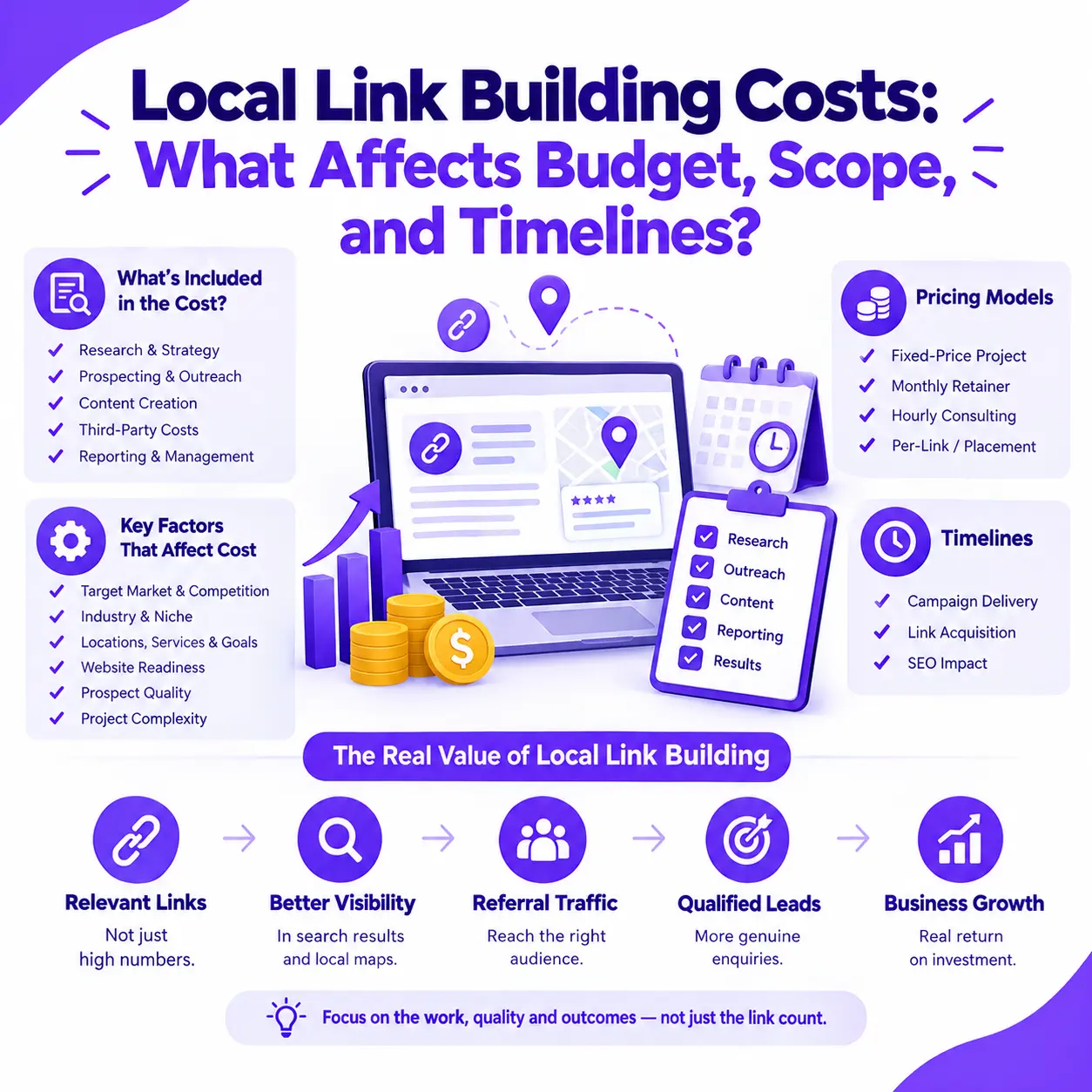
Local link building costs depend on the research, outreach, content and campaign management required to earn relevant backlinks. The budget also varies with competition, the availability of suitable websites, the business’s starting position and the agreed deliverables. To compare quotes fairly, look beyond the promised number of links and assess the work, quality standards and reporting included.
What Does a Local Link Building Budget Actually Pay For?
Local link building involves earning relevant links from websites, organizations and publications that can help people discover a business and understand its relevance. The cost of a campaign reflects the work required to identify suitable opportunities, develop relationships, create useful content where needed and monitor the results.
Two providers may offer services under the same name but include very different amounts of work. One quote might cover prospect research and outreach, while another includes content creation, campaign management and detailed reporting.
Understanding these components is the first step towards setting a realistic budget.
Initial research and campaign strategy
Before outreach begins, a provider needs to understand the business, its services, its website and its existing backlink profile. Competitor research can also help identify websites that reference similar businesses or publish relevant industry resources.
Depending on the project, this stage may include reviewing existing links, identifying potential gaps, assessing website readiness and prioritizing opportunities.
A business with useful content and an established network of relevant relationships may need less preliminary work than a business starting without either. The difference should be reflected in the agreed scope rather than assumed in advance.
Prospect discovery and quality assessment
Prospect discovery means finding websites that could reasonably reference, recommend or discuss the business.
Potential opportunities include relevant industry associations, suppliers, business partners, professional organizations, resource pages and publications. The appropriate sources depend on the business and its audience.
Research alone is not enough. Each prospect should be assessed for relevance, legitimacy, editorial context, audience suitability and potential referral value.
A list of 100 loosely related websites is not automatically more valuable than a carefully selected list of 20 relevant opportunities. These numbers are illustrative, not industry benchmarks. The point is that the quality of the research matters more than the size of a prospect list.
Outreach and relationship development
After identifying suitable prospects, the provider must find appropriate contacts and communicate a legitimate reason why the business or its resources may be relevant.
This work may involve personalized emails, follow-ups, conversations with partners, responding to editorial requirements and tracking the status of each opportunity.
Manual research and tailored communication require time. Automated bulk outreach may send more messages, but message volume alone does not demonstrate quality or meaningful relationship development.
A proposal should explain the outreach process and how progress will be reported, rather than using the number of emails sent as the primary measure of success.
Content and linkable-asset production
Some opportunities require a useful resource that gives another website a genuine reason to reference the business. Depending on the campaign, this could include original research, a practical guide, expert commentary, a resource page or a well-developed explanation of a relevant subject.
Content-related costs may include research, writing, editing, design and revisions.
Not every campaign requires new content. Sometimes an existing page already provides useful information. The provider should explain why additional content is needed and whether its production is included in the quote.
Creating content does not automatically earn backlinks. Its purpose should be to provide genuine value to the intended audience and make relevant references more worthwhile.
Third-party costs, approvals and reporting
A campaign may also involve agreed expenses for legitimate sponsorships, events, specialist content or other relevant activities. These costs should be identified separately from the provider’s service fee.
There is an important distinction between paying for advertising and buying links to manipulate search rankings. Google classifies buying or selling links for ranking purposes as link spam. Links associated with paid placements should be appropriately qualified, commonly with rel=”sponsored”; Google also accepts rel=”nofollow” for this purpose. See Google’s link qualification guidance and Search spam policies.
Reporting and project management also take time. A campaign might need prospect approvals, placement checks, progress reports and discussions about what to prioritize next. These requirements should be defined before the work begins.
What Factors Affect Local Link Building Costs?
There is no single price that applies to every local link-building campaign. The budget depends on the amount of work required, the availability of legitimate opportunities, the complexity of the project and the standards used to evaluate quality.
Target market and geographic competition
Some businesses have many relevant organizations, suppliers and publications they can approach. Others operate in markets where suitable opportunities are harder to find or where relationships take longer to develop.
The intended geographic market can also affect prospect research. A business targeting several genuinely distinct markets may need a wider set of relevant opportunities than a business focused on one established market.
Geographic relevance should be considered in relation to the campaign’s actual objectives. More locations do not automatically mean a better campaign, and a provider should be able to explain why additional research is necessary.
Industry and niche competitiveness
The availability of suitable link opportunities varies between industries. Some sectors have active professional associations, established trade publications and accessible supplier networks. Others may have fewer relevant publishers or require more specialized outreach.
The competitiveness of a market can influence how much work is needed to find appropriate opportunities and explain why the business deserves a reference.
However, an industry label alone cannot establish a reliable price. The actual prospect pool, editorial requirements and campaign objectives matter more than assumptions about which industry is always the most expensive.
Number of locations, services and campaign objectives
A campaign for one business location may have a different scope from one supporting several locations, multiple services or distinct market segments.
The number of locations can affect research and coordination, but there is no reason to multiply a campaign budget mechanically by the number of locations. Some opportunities may be relevant to the wider business, while others may only make sense for a particular market or service.
The provider should clarify which objectives the campaign supports and how each part contributes to the overall plan.
Existing backlink profile and website readiness
A website’s starting position affects what needs to happen before outreach becomes worthwhile.
An initial assessment may reveal relevant existing links, missing content, weak target pages or opportunities to build on current relationships. In other situations, the business may need better resources or clearer website information before outreach can be effective.
That does not mean every campaign requires extensive technical work or a large audit. The appropriate level of preparation depends on what the website actually needs.
When broader diagnosis is necessary, a Local SEO audit can help identify priorities before committing resources to link acquisition.
Prospect quality and editorial opportunity
The number of links acquired is only one part of a campaign’s evaluation.
Consider whether a potential source is relevant to the business, whether the link appears in meaningful context, whether the website serves a genuine audience and whether the reference could help people discover useful information.
Third-party SEO metrics may support research, but no single score establishes the quality or value of a backlink. A high numerical authority score does not make an irrelevant or questionable website a suitable prospect.
Quality assessment should explain why an opportunity is appropriate, not simply assign it a score.
Content, communication and project complexity
Custom content, specialist review, several stakeholders, multiple approval rounds and detailed reporting can increase the amount of work required.
For example, a campaign where the client supplies approved information and an existing resource may involve less content production than one that requires a new, researched asset. The difference should be visible in the quote.
Clear responsibilities also help prevent unexpected costs. Establish what the provider will create, what the client must supply, who approves prospects and how revisions will be handled.
Monitoring and reporting requirements
A one-time research project has different requirements from an ongoing campaign that includes outreach, follow-ups, placement verification and regular evaluation.
Reports should help the client understand what work was completed, which opportunities progressed, which placements were obtained and what should happen next.
A more elaborate report is not necessarily a better report. Its value depends on the relevance of the information and whether it helps the client make sound decisions.
How Are Local Link Building Services Priced?
Local link building providers use different pricing models depending on the type of work, level of ongoing involvement and deliverables. The best model depends on what your business needs, not simply which option appears cheapest.
Fixed-price projects
A fixed-price project works well when the deliverables can be defined clearly in advance. Examples include a backlink opportunity assessment, a competitor link-gap analysis or a qualified prospect research report.
Before agreeing to the price, confirm what the project includes, how completion will be assessed, how many revisions are allowed and what happens if the original scope needs to change.
A fixed fee offers clarity when the scope is well defined. It becomes less useful when the expectations are vague or important deliverables are left unspecified.
Monthly retainers
A monthly retainer may suit businesses that need continuing prospect research, outreach, relationship development, content support and reporting.
The important question is what the provider will do each month. A retainer should identify the recurring activities, expected deliverables, reporting schedule and any work billed separately.
Do not assume that paying monthly guarantees a certain number of backlinks or a particular ranking improvement. Editorial responses and search performance are not completely under a provider’s control.
Hourly consulting
Hourly consulting may be appropriate when your business needs strategic direction rather than someone to manage the entire campaign.
You might need help reviewing a proposal, assessing existing backlink opportunities, prioritizing activities or planning how an in-house team should approach link building.
Confirm the hourly scope, expected outputs and whether implementation is included. Consulting is most useful when the advice helps you make specific decisions or carry out a defined plan.
Per-link and placement-based pricing
Some providers charge a set amount for each acquired link or advertise packages based on link quantities.
This arrangement can make quotes appear easy to compare, but the number alone tells you little about the relevance, quality or compliance of the placements.
Ask where links will come from, how prospects are selected, whether content production is included, whether the placements are editorially appropriate and what happens if a placement becomes unavailable.
Be especially cautious when a provider guarantees followed backlinks at scale without explaining the acquisition method. Google identifies buying or selling links for ranking purposes as link spam, including paid guest posts or advertorials that pass ranking credit without appropriate qualification. Legitimate advertising is different when the relationship is disclosed and links are properly qualified. (Google Search spam policies)
Comparing local link building pricing models
Pricing model | May suit | What to confirm |
Fixed-price project | Defined research or campaign deliverables | Scope, exclusions, revisions and completion criteria |
Monthly retainer | Ongoing outreach and campaign management | Monthly activities, deliverables, reporting and cancellation terms |
Hourly consulting | Strategy, proposal review or in-house guidance | Hours, outputs and implementation responsibilities |
Per-link or placement-based fee | A clearly defined placement or advertising arrangement | Source quality, editorial context, disclosure and link attributes |
Compare providers using equivalent scopes. A research-only project should not be compared directly with a managed campaign that includes prospecting, outreach, content and ongoing reporting.
Are There Reliable Benchmarks for Local Link Building Costs?
Published pricing figures can provide context, but there is no single reliable rate that applies to every local link-building campaign worldwide.
One reason is that the term link cost can describe several different things: a publisher’s placement fee, a provider’s labour, the cost of producing content or the total cost of managing an entire campaign.
What published pricing research tells us
Ahrefs published an article updated on July 18, 2024, discussing backlink purchasing costs. It cited an Authority Hacker survey of 755 link builders that reported an average paid-link cost of $83. Ahrefs also described its own outreach tests involving 450 websites approached for paid link insertions and 180 websites approached about guest posts. The reported averages from those tests were $361.44 and $77.80, respectively. (Ahrefs: Should You Buy Backlinks?)
These figures illustrate how much placement prices can vary. They are not a current, representative price list for legitimate local link-building campaigns. The tests involved paid placements, not a standardized comparison of end-to-end local SEO services, and the article itself warns about the risks of buying backlinks to manipulate rankings.
They should therefore not be treated as recommended prices for your business or as universal industry averages.
Why placement prices are different from campaign budgets
Suppose a provider quotes a fee for a publication placement. That amount may exclude the research required to identify the website, communication with the publisher, content production, revisions and project management.
Another provider may quote a single fee that covers those activities, but only within a defined scope.
The headline prices are not directly comparable. The second provider may charge more because more work is included, or the proposal may simply be more expensive. The deliverables are what allow you to judge the difference.
There is also a policy distinction. A fee paid to purchase a link for ranking credit is not equivalent to paying for legitimate advertising. When an arrangement is a paid placement, the link should be qualified appropriately, usually with rel=”sponsored” or an accepted rel=”nofollow” attribute, as explained in Google’s link qualification documentation.
How to use pricing estimates responsibly
Before treating any published figure as a useful benchmark, check four things.
First, identify the date, currency and market represented by the data. Second, determine whether the figure refers to a link placement, a specific task or an entire campaign. Third, establish which activities and third-party costs are included. Finally, confirm whether the method described represents legitimate outreach and editorial opportunities or the purchase of links intended to manipulate rankings.
When comparable data is unavailable, a transparent breakdown of the work is more useful than an unsupported claim about the average cost of local link building.
How to Build a Realistic Local Link Building Budget
A practical budget begins with your business objective and the work needed to pursue it. Setting a target number of backlinks first can lead to a campaign that prioritizes quantity rather than useful opportunities.
1. Start with the goal and your current situation
Determine what you need the campaign to accomplish. Are you assessing existing backlink opportunities, building relationships with relevant organizations, developing content worth referencing or managing ongoing outreach?
Next, consider the current website, existing backlink profile, available content and any relationships that could provide legitimate opportunities.
This initial assessment helps establish which work is necessary. It also prevents paying for activities that may not be relevant to your actual situation.
2. Break the budget into clear components
A useful planning formula is:
Estimated campaign budget = strategy and research + prospecting and outreach + content production + approved third-party costs + quality assurance, reporting and project management.
Not every campaign needs every component. A prospect research project, for example, may not require new content or ongoing outreach. A more complex campaign may need substantial coordination and additional resources.
Use the formula to ask providers what each part of their fee covers. If an important component is excluded, decide whether your team can handle it or whether it needs a separate budget.
Contingency should reflect uncertainties in the scope, such as content revisions or changing requirements, rather than an arbitrary percentage presented as an industry standard.
3. Compare different campaign scopes
Consider these two hypothetical scenarios.
Scenario A: A single-location business with a prepared website
The business has clear service pages, useful resources and an identifiable group of relevant suppliers, professional associations or publishers. The campaign might focus on research, prioritizing suitable prospects and conducting targeted outreach.
Scenario B: A multi-location business with limited existing resources
The business needs to explore opportunities across several markets, has little content suitable for reference and requires coordination between multiple decision-makers. The campaign may require broader research, new content, more approvals and more detailed reporting.
Scenario B may require more resources, but its cost should not automatically be multiplied by the number of locations. Some opportunities may support the entire organization, while others may be relevant to only one part of the business.
These examples are illustrative, not real client projects or market-rate estimates. Their purpose is to show how differences in starting conditions and requirements affect scope.
4. Prioritize when the budget is limited
A limited budget does not mean choosing the cheapest available backlinks. It means identifying the most important work and allocating resources accordingly.
Start with prospects that are relevant to the business and have a credible reason to reference it. Use existing resources and genuine business relationships where they help. Avoid spending heavily on new content if existing pages can already serve the intended purpose.
If the website has foundational problems that prevent people from finding or using its services, address those issues as part of the wider SEO plan. A backlink campaign should not automatically take priority over every other SEO need.
The objective is to make a well-informed investment in useful work, rather than maximize activity for its own sake.
How Long Does Local Link Building Take?
The time needed for local link building depends on campaign complexity, the availability of suitable prospects, the amount of outreach required and the response of external websites.
It is important to distinguish three different timelines:
- Campaign delivery: how long it takes to complete research, outreach and agreed deliverables.
- Link acquisition: how long it takes to obtain and verify placements.
- SEO impact: how long it takes to observe any change in search visibility or business performance.
These are related, but they are not interchangeable.
The main stages of a local link-building campaign
Stage | Main activities | What influences timing |
Discovery and strategy | Review requirements, assess existing opportunities and agree on scope | Website condition, data availability and project complexity |
Prospect research | Identify and qualify relevant websites and organizations | Availability of suitable opportunities |
Outreach and follow-up | Contact relevant prospects and maintain communication | Response rates, contact availability and outreach quality |
Content and publication | Create or adapt content, obtain approvals and coordinate publication | Editorial decisions, revisions and client approvals |
Verification and reporting | Check placements, document work and review next steps | Placement availability and reporting requirements |
These stages may overlap. A campaign could begin outreach while some additional prospects are still being researched, for example.
Rather than accepting an unexplained delivery deadline, ask the provider for a schedule that identifies the stages, milestones, dependencies and reporting checkpoints.
What can delay or accelerate a campaign?
A well-defined project with accessible information and a clear approval process may be easier to manage than a complex project requiring several rounds of research and review.
Other factors include the availability of relevant websites, the quality of outreach, the need for original content, editorial standards and the speed at which the client supplies feedback.
Some of these factors are under the provider’s control. Others depend on independent publishers or the client.
A reliable proposal should distinguish between what the provider commits to deliver and what remains dependent on third parties. For example, a provider can agree to complete qualified prospect research, but cannot reasonably guarantee that every publisher approached will accept a placement.
When should you expect to see SEO improvements?
A successfully acquired backlink is a campaign deliverable. A ranking change, increase in organic traffic or improvement in enquiries is a separate outcome.
Search performance can be influenced by many factors, including website content, competition, technical conditions, relevance and the wider search environment. A link may not produce a measurable ranking change, and the effects of a campaign cannot always be isolated from other SEO activities.
For this reason, avoid guarantees that a certain number of links will produce specified rankings by a fixed date.
Instead, establish regular checkpoints for assessing completed work, the quality of opportunities, actual placements and relevant website performance. This makes it easier to distinguish progress in campaign delivery from evidence of business impact.
How to Evaluate a Local Link Building Proposal Before Hiring
A proposal should explain not only how much the campaign costs but also what the provider will do, how quality will be assessed and what you can expect to receive.
Check what the quotation includes
Before agreeing to a project, confirm whether the fee includes:
- Initial research and competitor analysis.
- Prospect identification and qualification.
- Outreach, follow-ups and communication.
- Content creation, editing and revisions.
- Third-party expenses and any required approvals.
- Link verification, reporting and project management.
- The project schedule, payment terms, exclusions and completion criteria.
Not every campaign requires all these services. The important thing is that the scope matches your requirements and that exclusions are clear.
Assess the quality of proposed opportunities
Ask how websites are selected and what makes a prospect suitable for your business.
A good evaluation considers relevance, legitimacy, editorial context, audience and the potential for people to discover useful information. Third-party authority metrics can help with research, but they should not replace a reasoned assessment.
Be cautious when a provider sells placements mainly through high domain scores or promises a specific number of links without explaining their sources.
Recognize misleading promises and risky practices
Be wary of offers that promise guaranteed Google rankings, fixed ranking deadlines or large volumes of backlinks from undisclosed websites.
Other warning signs include automated bulk-link creation, irrelevant sites, unnatural keyword-heavy anchors, hidden placement fees and unclear arrangements involving paid editorial links.
Google’s Search spam policies explain practices that may violate its guidelines, including link schemes intended to manipulate search rankings. These risks should be assessed by the actual method being used, not simply by the provider’s marketing language.
A low initial quote can become poor value if it excludes essential work or relies on unsuitable acquisition methods.
Evaluate reporting and accountability
A useful report should document the work completed and make the campaign’s status understandable.
Depending on the agreed scope, look for qualified opportunities, outreach progress, acquired links, verified destination URLs, relevance observations, spending against the budget and recommendations for the next phase.
Where data is available, referral activity and organic search trends may also be useful. However, reports should distinguish observed changes from proven causation. A ranking improvement after a link was acquired does not, by itself, establish that the link caused the improvement.
How to Keep Local Link Building Costs Effective Without Sacrificing Quality
Controlling costs is about reducing unnecessary work and prioritizing relevant opportunities, not obtaining the maximum number of backlinks at the lowest possible price.
Make use of existing business relationships
Suppliers, partners, professional associations and other genuine business relationships may reveal opportunities for relevant references. A supplier directory, an association membership page or a useful partner resource could provide a legitimate reason for a business to be mentioned.
The relationship should make sense for the audience. Do not create reciprocal-link arrangements solely to manipulate rankings or assume that every business connection should produce a backlink.
Improve the value of existing content
Review whether your existing pages offer useful information that another website might reasonably reference.
Sometimes a resource only needs clarification or improvement. In other cases, the content may need a more substantial update or an entirely new asset.
Choose content work based on the gap you identify. Producing articles simply to increase the number of pages on a website does not guarantee that other websites will link to them.
Integrate link building with the wider Local SEO strategy
Link building should support the business’s wider search objectives, not operate as an isolated checklist.
Your overall plan may also need to account for website structure, service-page relevance, business listings, customer reviews and other aspects of Local SEO. The appropriate priorities depend on the website’s current position and goals.
Freelancer Tawhid’s Local SEO services provide a starting point for understanding how link-building activities fit within a broader strategy. When directory accuracy and business listings are specifically relevant, see the Local Citation Building service.
Do not pay for a link-building campaign simply because it is the most visible activity on an SEO proposal. Choose work that addresses a genuine need.
Measure value beyond the number of links
Use metrics that correspond to the agreed objectives. These may include the number of relevant opportunities identified, qualified outreach completed, placements acquired, link quality, referral activity and changes in organic search performance.
For a business-focused campaign, appropriate enquiries and conversions may also matter. They should be tracked where possible and interpreted alongside other marketing activities.
A large number of acquired links is not proof of success. Equally, the absence of an immediate ranking change does not necessarily mean every campaign activity was wasted. Evaluate both the quality of the work and the results that can reasonably be observed.
Frequently Asked Questions About Local Link Building Costs
Why do local link building quotes differ so much?
Local link building quotes differ because providers may include different amounts of research, competitor analysis, prospecting, outreach, content creation and reporting. Competition and the availability of relevant websites also affect the workload. Compare the deliverables, exclusions, quality standards and acquisition methods of each proposal rather than comparing headline prices alone.
Does a local link building quote include content creation and third-party fees?
Not necessarily. Some providers include content production and campaign management in one fee, while others charge separately for writing, specialist assets, sponsorships or publication arrangements. Before agreeing to a proposal, confirm which costs are included, which require separate approval and how additional expenses will be reported.
Should I choose a per-link package or a monthly link building service?
Choose a pricing arrangement based on the work you need. A fixed project may suit a defined research task, while a monthly engagement may suit ongoing outreach and reporting. Per-link offers need particular scrutiny: assess the actual placements, editorial relevance and link qualification instead of relying on guaranteed link counts.
How long should I budget before evaluating a local link building campaign?
Agree on a schedule for research, outreach, content approval, placement verification and reporting before work begins. Publisher responses and editorial decisions can affect delivery. Evaluate the campaign’s agreed milestones separately from SEO outcomes, which depend on multiple factors and cannot be guaranteed by a specific date.
What should a local link building report include?
A useful report should document work completed, qualified opportunities, outreach progress, acquired links, verified URLs, relevance and quality observations, and spending against the agreed scope. Where data is available, include referral activity and organic search trends. Distinguish completed deliverables from potential SEO benefits rather than assuming every link caused a performance change.
Conclusion: Set Your Budget Around the Work, Not Just the Link Count
Local link building costs depend on what your business needs, how difficult relevant opportunities are to identify, and the resources required to research, contact, create and evaluate them.
The most reliable way to compare proposals is to examine the complete scope. Establish which tasks are included, assess how the provider selects opportunities, understand additional charges and agree on realistic delivery milestones. Be cautious of low-cost packages that emphasize large link counts without explaining their acquisition methods or quality standards.
A well-planned campaign should have a clear purpose, an understandable budget and transparent reporting. It should also form part of your wider SEO strategy rather than rely on the assumption that more backlinks automatically produce better rankings.
If you need help understanding the work your website requires, explore my Local Link Building Service. You can also contact Freelancer Tawhid to discuss your website, objectives, campaign scope and priorities.
The goal is not simply to spend more or acquire more links. It is to invest in relevant, well-managed work that makes sense for your business and can be evaluated responsibly.