
How to Find Local Backlink Opportunities With Competitor Research

Freelancer Tawhid
SEO Expert and Consultant
- October 14, 2026
- No Comments
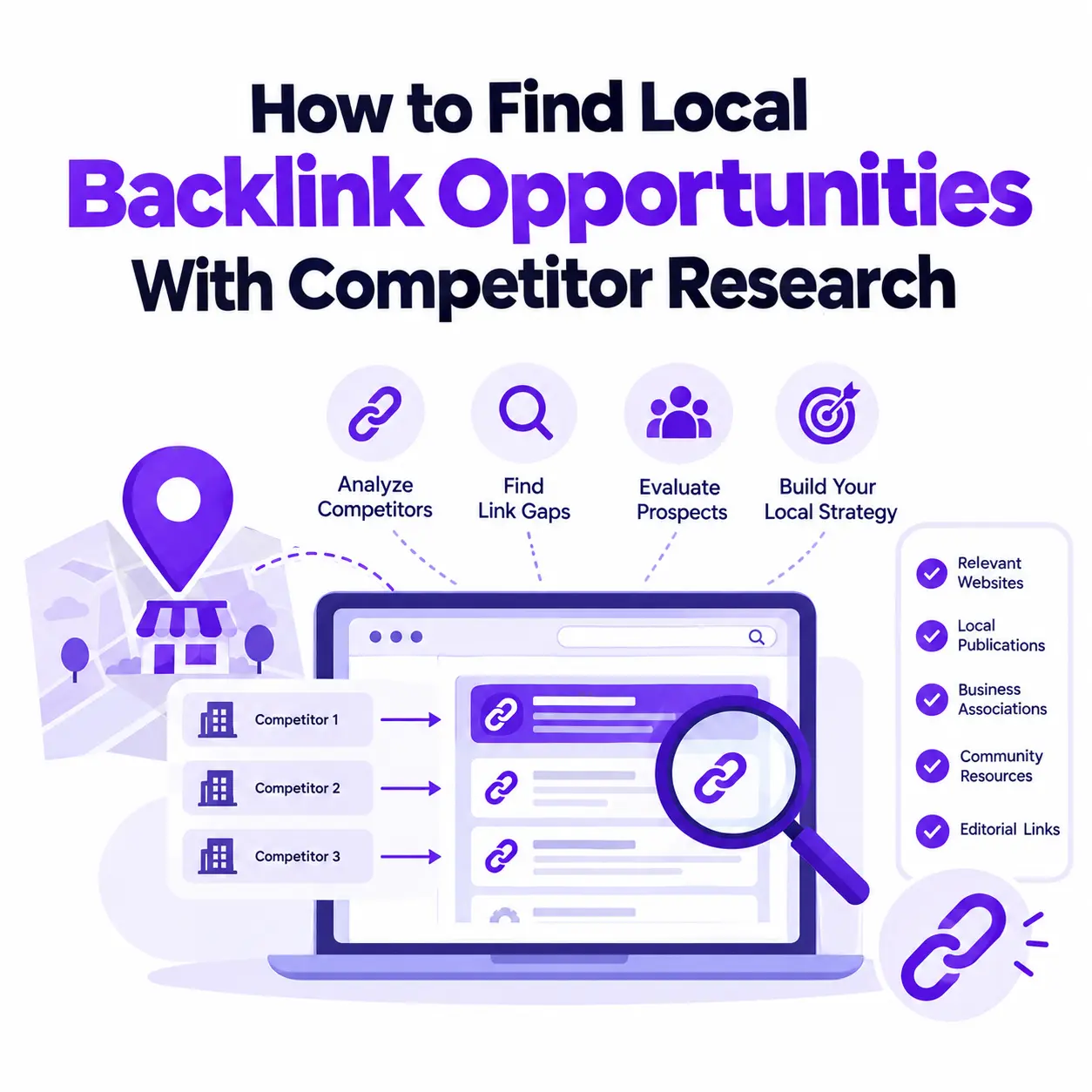
Finding local backlink opportunities starts with understanding which websites link to your competitors, why those websites link to them, and whether your business has a legitimate reason to earn similar links. By analyzing competitor backlinks, identifying link gaps, and evaluating relevant prospects, you can build a focused local link-building strategy instead of chasing links that offer little value.
Competitor research is useful because it reveals existing relationships, industry resources, editorial references, and other potential opportunities that might otherwise go unnoticed. However, not every competitor backlink is worth replicating. The goal is to identify relevant, realistic opportunities and pursue them in ways that provide genuine value to website owners and their audiences.
In this guide, you will learn how to find local backlink opportunities, analyze competing websites, evaluate potential link sources, and turn your findings into an actionable outreach plan.
What Is Local Competitor Backlink Analysis?
Local competitor backlink analysis is the process of examining links pointing to competing businesses and their websites to discover relevant opportunities for your own link-building efforts.
It helps you understand which organizations, publications, directories, resource pages, and other websites reference businesses operating in a similar market or industry.
Rather than guessing which websites might be willing to link to your business, you can use existing backlinks as research clues.
For example, imagine you operate a plumbing business and discover that several competitors receive links from trade associations, community resource pages, relevant suppliers, and local publications.
Those links can help you identify organizations worth researching. You would still need to determine whether your business qualifies, whether the link is relevant, and whether you can offer something valuable to the website.
What Can Competitor Backlink Research Reveal?
A well-organized analysis can reveal:
- Referring domains: Websites that link to one or more competitors.
- Backlink gaps: Relevant websites that link to competitors but not to your website.
- Link acquisition patterns: The types of relationships, content, and activities associated with competitor links.
- Local link opportunities: Relevant organizations, publications, business associations, and community resources.
- Content opportunities: Useful guides, original research, or resources that could attract references from other websites.
- Outreach possibilities: Websites where you have a genuine reason to introduce your business or recommend a resource.
The most important question is not simply, “Where do my competitors get backlinks?”
It is, “Why did those websites link to my competitors, and what would make linking to my business useful or appropriate?”
Local Competitors vs. Organic Search Competitors
Your direct business competitors and your organic search competitors are not always the same.
Direct competitors offer similar products or services to overlapping customers. Organic search competitors are websites that appear for the search queries you want to target.
For example, a local service business might compete commercially with several nearby companies, while its search results also include national directories, industry publishers, and specialist resource websites.
Both groups can provide useful backlink insights.
- Research direct competitors to discover relevant business relationships and market-specific opportunities.
- Research organic competitors to identify publishers, content resources, and websites that link to pages competing for similar search intent.
- Evaluate competitors from other markets selectively. Their backlinks may reveal useful industry opportunities, but those links are not automatically relevant to your own business.
Selecting the right competitors makes the entire research process more productive.
Step 1: Identify the Right Competitors for Backlink Research
Before opening a backlink analysis tool, build a list of websites worth investigating.
Starting with the wrong competitors can fill your spreadsheet with irrelevant domains and opportunities you cannot realistically pursue.
Find Direct Business Competitors
List businesses that provide comparable services and target similar customers in the market your business serves.
Consider:
- The services or products they offer.
- Their target customers.
- Their business model.
- Their market coverage.
- Their website structure and service pages.
You do not need to include every business in the market. Start with a manageable selection of competitors whose backlink profiles are likely to provide useful insights.
Find Organic Search Competitors
Search for important non-branded service queries and review the websites that repeatedly appear in relevant results.
You can also use an SEO platform’s organic competitor report, where available, to discover websites ranking for similar keywords.
Look beyond the homepage. A competitor may receive links to a specific guide, resource, or service page that competes for a search topic relevant to your business.
For a more detailed explanation of competitor research, see Ahrefs’ guide to competitor backlink analysis.
Choose Competitors With Useful Backlink Profiles
Prioritize websites that provide meaningful opportunities for comparison.
Look for competitors with:
- Services or content similar to yours.
- Relevant audience overlap.
- Backlinks from identifiable industry or community resources.
- Pages that attract references for a clear reason.
- Link acquisition methods that may be appropriate for your business.
A competitor with thousands of backlinks is not necessarily a better research target than a smaller business with a handful of relevant, legitimate referring domains.
The objective is to learn from the links that make sense for your business, not to imitate a competitor’s entire backlink profile.
Step 2: Analyze Competitor Backlinks Using SEO Tools
Once you have selected your competitors, examine their backlink profiles to identify potential link sources.
Review Competitor Referring Domains
Use a backlink analysis tool to investigate a competitor’s domain or a specific page.
Commonly used options include:
- Ahrefs Site Explorer.
- Semrush Backlink Analytics.
- Free backlink checkers with limited reports.
- Other SEO platforms that provide backlink and referring-domain data.
Available features, database coverage, and subscription requirements vary by tool.
When reviewing a backlink report, distinguish between the following:
Term | Meaning |
Backlink | An individual link pointing to a website or page |
Referring domain | A distinct domain containing one or more links to the target |
Referring page | The specific page containing the backlink |
Target URL | The page on the competitor’s website receiving the link |
Anchor text | The clickable text used for the link |
These distinctions matter because one website may link to a competitor multiple times. Several backlinks from the same domain do not represent several independent referring domains.
Start by reviewing the referring domains, then inspect the individual pages that contain the most promising links.
Pay attention to the source page, target URL, anchor text, surrounding content, and the apparent reason for the link.
You want to understand the relationship between the source and destination, not just collect URLs.
Use Backlink Gap Analysis to Find Missing Opportunities
Backlink gap analysis compares your website’s link profile with those of competing websites.
The aim is to identify domains that link to competitors but do not currently link to you.
For example, if three relevant competitors are featured on an industry association’s resource page, that page may be worth investigating if your business is eligible for inclusion.
You can perform this research using tools such as Ahrefs Link Intersect or comparable competitor backlink features.
A practical workflow is:
- Enter your website as the target.
- Add several relevant competitors.
- Choose domain-level comparison for broad prospect discovery or exact-URL comparison for page-specific research.
- Review websites linking to competitors but not to your target.
- Inspect the actual source pages behind the reported domains.
- Filter the results according to relevance and realistic acquisition potential.
- Export qualified prospects for manual review.
Ahrefs explains this process in its Link Intersect documentation.
Remember that a backlink gap is a research lead, not proof that the website will link to you. The source may have linked to a competitor because of a unique partnership, sponsorship, piece of research, or editorial decision that does not apply to your business.
Analyze Individual Competitor Pages
Domain-level analysis is useful for discovering broad patterns, but page-level research often provides better insight into why links exist.
Investigate competitor pages that have attracted relevant backlinks, including:
- Service and resource pages.
- Helpful industry guides.
- Original studies and research.
- Expert contributions.
- Community initiatives.
- Useful tools or reference materials.
Ask what makes the page worth linking to.
Perhaps it answers a question better than competing resources. Perhaps it provides original information, supports a community initiative, or is referenced by an organization with an established relationship with the business.
Understanding the reason for the link helps you choose an appropriate next step.
You might improve an existing resource, create something genuinely useful, establish a relevant partnership, or decide that the opportunity is not suitable.
Find Opportunities Without Paid SEO Tools
Paid backlink tools can save time, but they are not the only way to discover potential link sources.
You can supplement limited free reports with manual research.
Try searching for relevant combinations of:
- Industry associations and member resources.
- Business partners and supplier directories.
- Community organizations and useful resources.
- Relevant publications and expert contributions.
- Event organizers and legitimate sponsorship opportunities.
- Competitor names alongside terms such as “partners,” “resources,” “featured,” or “sponsors.”
Search operators can also help you explore specific websites. For example:
- site:example.com resources
- site:example.com partners
- site:example.com combined with a relevant industry phrase.
These searches are discovery aids, not complete backlink databases. Search engines do not necessarily expose every page or link, so manually verify any potential opportunity.
The practical difference between methods:
Research method | Best use | Limitation |
Backlink analysis tool | Reviewing referring domains and individual links | Coverage varies by provider |
Backlink gap analysis | Finding domains linking to competitors but not you | Gaps require manual qualification |
Manual search | Discovering organizations and specific resource pages | Takes more time |
Competitor page analysis | Understanding why particular content attracts links | Does not reveal every linking source |
For the best results, combine automated discovery with manual evaluation.
Step 3: Discover Relevant Local Backlink Opportunities
After collecting competitor backlink data, identify the types of websites that could reasonably link to your business.
The most useful opportunities depend on your industry, market, audience, existing relationships, and available resources.
Explore Business Associations and Community Organizations
Relevant organizations can provide useful opportunities when your business genuinely qualifies for membership, recognition, or inclusion.
Investigate:
- Business associations and chambers of commerce.
- Industry associations and professional organizations.
- Community organizations and nonprofits.
- Relevant event organizers.
- Genuine business partners and suppliers.
- Local publications and community resource websites.
Check whether these organizations publish member directories, partner pages, resource lists, event information, or other content that references participating businesses.
Do not assume that every listing is valuable. Review the organization’s purpose, audience, eligibility requirements, and website quality.
A relevant membership or partnership may provide business value independently of SEO. That is a stronger basis for participation than paying simply to obtain a backlink.
Find Industry-Specific Publications and Editorial Links
Competitor research can uncover specialist websites that publish useful content about your industry.
These may include trade publications, professional resources, relevant blogs, and websites that feature expert contributions.
Review the pages linking to competitors and look for patterns:
- Do they quote industry professionals?
- Do they reference original studies or useful data?
- Do they feature practical guides?
- Do they cover relevant business developments?
- Do they link to tools or resources that help their readers?
If you identify a relevant editorial opportunity, determine whether you have something genuinely useful to contribute.
That could be an expert explanation, original research, a practical resource, or a well-supported response to a topic the publisher covers.
An editorial link should be earned on merit. A publisher’s willingness to link to a competitor does not create an obligation to link to you.
Identify Useful Resource Pages and Directories
Resource pages and business directories can be worthwhile prospects when they serve a real audience.
For each candidate, ask:
- Is the page relevant to my industry, services, or customers?
- Does it contain useful information or legitimate recommendations?
- Are comparable businesses or resources included?
- Does my business meet the inclusion criteria?
- Is there a clear reason for the website to include us?
A carefully curated industry directory may be useful to customers. A generic website created primarily to sell links may not be.
If a directory charges a fee, evaluate the listing as a business decision. Consider potential customer exposure, credibility, and referral value rather than paying solely for SEO.
Look for Unlinked Mentions and Existing Relationships
Sometimes, the best opportunity comes from a relationship that already exists.
Competitor research may reveal websites that mention a business, feature its representatives, list its partners, or cover an event it participates in.
Investigate whether similar opportunities are appropriate for your business.
Potential examples include:
- A relevant publication that discusses your industry.
- A supplier that maintains a directory of business partners.
- An event organizer that lists participating organizations.
- A community resource page that accepts relevant submissions.
- A website mentioning your business without linking to it.
An unlinked mention can be worth a polite, contextual request when a link would genuinely help readers. However, not every mention needs to become a backlink.
The key is to identify a real reason for the link rather than treating every online reference as a link-building task.
Step 4: Evaluate Backlink Opportunities Before Pursuing Them
A large prospect list is not necessarily a useful one.
Before contacting a website, evaluate its relevance, quality, context, and likelihood of offering a legitimate opportunity.
Assess Topical and Geographic Relevance
Consider how the source website relates to your business and target audience.
A relevant local organization may be a strong prospect because it serves the same community. However, a website does not need to be based in the same city to be relevant.
For example, an industry publication serving businesses across several countries could be a useful source for a specialist business. Conversely, a geographically close website about an unrelated topic may offer little value.
Evaluate the actual context of the link rather than relying on location alone.
Review the Website and Source Page
Before adding a prospect to your outreach list, check:
- Whether the website serves a real audience.
- Whether its content is relevant and reasonably maintained.
- Whether the source page has a clear purpose.
- Whether the link fits naturally into the page’s content.
- Whether the website appears credible and legitimate.
- Whether the link is live and points to the expected destination.
- Whether the site shows signs of manipulative or mass-produced linking.
Third-party metrics can help organize research, but they are not definitive measures of link quality or ranking impact.
A high authority score does not automatically make a link relevant. Likewise, a smaller specialist website may be worth pursuing if it serves the right audience and provides a legitimate editorial opportunity.
Determine Whether the Opportunity Is Replicable
Not all competitor backlinks can or should be replicated.
Classify your prospects by the action required.
Directly actionable: Your business qualifies for a relevant directory, association, or resource listing.
Relationship-based: A genuine business relationship, partnership, or community involvement would be needed.
Content-dependent: You need a useful guide, original data, expert contribution, or other relevant resource before approaching the website.
Editorially earned: A publisher may consider your contribution, but the decision remains independent.
Unsuitable: The source is irrelevant, manipulative, or lacks a legitimate reason to link to your business.
This classification helps you allocate time and resources appropriately.
It also prevents a common mistake: assuming that every backlink in a competitor report is an opportunity you should pursue.
Prioritize Prospects With a Practical Evaluation Framework
You can use a simple internal scoring system to organize opportunities.
Assess each prospect against the following criteria:
Criterion | Question to ask |
Relevance | Does the website serve a related industry, audience, or market? |
Quality | Does the source appear legitimate and useful to its readers? |
Context | Is there a natural reason for the link to exist? |
Feasibility | Is there a realistic, legitimate way to earn the link? |
Value | Could the link or relationship provide meaningful audience or business value? |
Effort | What time, content, or resources would acquisition require? |
You can rate each criterion as high, medium, or low and use the combined assessment to establish priorities.
This is a planning framework, not a validated ranking formula. Its purpose is to make your decisions more consistent and explainable.
For example, a relevant industry association with clear membership requirements may deserve immediate investigation. A generic directory with little audience value may be excluded, even if its third-party metrics appear attractive.
Step 5: Turn Your Findings Into a Local Link-Building Plan
Once you have qualified your prospects, decide what action each opportunity requires.
Competitor research becomes useful when it produces a clear plan rather than a spreadsheet that is never revisited.
Match Each Opportunity to the Right Website Page
Choose a destination that fits the linking website’s audience and the purpose of the proposed link.
Depending on the opportunity, that might be:
- A relevant service page.
- A practical guide or resource.
- Original research or useful data.
- A business information page.
- Another page that directly supports the proposed reference.
Do not send every prospect to your homepage or force a commercial service page into an editorial context where it does not belong.
For example, a publisher looking for a practical resource may be more interested in a genuinely useful guide than in a sales-focused page.
The destination should make sense to the person who would use the link.
Identify What You Can Offer
Before reaching out, write down the specific reason the website might consider your resource or business.
Possible reasons include:
- Your resource answers a question relevant to its audience.
- Your information is more current or complete than an outdated reference.
- You can contribute credible expert insight.
- Your business qualifies for a relevant listing.
- You have a genuine partnership or organizational connection.
- Your original research adds useful information to an existing discussion.
If you cannot identify a legitimate reason for the link, the prospect may not be worth pursuing yet.
You may need to improve your content, establish a relationship, or simply move on to a better opportunity.
Write Relevant, Personalized Outreach
Effective outreach begins with understanding the website and the person receiving your message.
A concise email can follow this structure:
- Introduce yourself and establish the relevant connection.
- Mention the specific page or resource you reviewed.
- Explain why your business or resource is relevant.
- Describe how the proposed addition could help the website’s audience.
- Make a clear, respectful request.
- Follow up appropriately if necessary.
For example, if an industry resource page links to several useful guides but overlooks a relevant resource you have created, explain what your resource contributes and why it may be useful.
Avoid generic emails that ask for a backlink without demonstrating any understanding of the recipient’s website.
Do not misrepresent your relationship, fabricate credentials, or promise benefits you cannot substantiate. A relevant request may still be declined, and that is part of the process.
Track Your Prospects and Outreach
Maintain a spreadsheet or CRM so that research findings translate into specific actions.
Useful fields include:
- Prospect website.
- Source-page URL.
- Competitor receiving the link.
- Existing backlink and target URL.
- Opportunity type.
- Relevance and quality assessment.
- Reason the prospect may be suitable.
- Recommended target page.
- Contact details, where publicly and appropriately available.
- Outreach date and follow-up status.
- Outcome and acquired-link URL, if successful.
This record makes it easier to prioritize work, avoid repeated outreach, and identify which types of opportunities are most practical for your business.
It also gives you a record of why each prospect was selected, which is useful when you revisit the campaign later.
Step 6: Measure the Results of Competitor-Based Link Building
The success of a link-building campaign should not be judged by backlink counts alone.
Track both the quality of your research process and the outcomes of the work.
Monitor Prospecting and Outreach Progress
Useful operational metrics include:
- The number of qualified prospects identified.
- The types of opportunities discovered.
- The number of relevant websites contacted.
- Responses and meaningful conversations.
- Confirmed link placements.
- Time and resources required for each opportunity type.
These metrics help you understand whether the process is productive. They do not, by themselves, demonstrate ranking improvements.
Review Acquired Links and Referring Domains
When a link is acquired, verify that it works and that the source page is relevant to your business.
Track:
- The referring domain.
- The page containing the link.
- The destination URL.
- The context and purpose of the link.
- Whether the link remains live when checked later.
- Any relevant referral activity.
Remember that several links from one domain are different from links earned from several distinct referring domains.
Do not treat every additional backlink as an equivalent gain.
Evaluate Wider SEO and Business Outcomes
Where appropriate, monitor changes in organic visibility, relevant search traffic, referral visits, and qualified inquiries.
Google Search Console can help you review organic search performance, while an appropriately configured analytics platform can help assess referral traffic and conversions.
Interpret the results carefully. Rankings and traffic can change for many reasons, including competition, website updates, content changes, seasonality, and broader search-system changes.
A backlink campaign should be evaluated alongside the rest of your SEO activity rather than credited with every improvement that occurs during the same period.
Refresh Your Research as Opportunities Change
Competitors earn new links, publishers update their resources, organizations change their membership pages, and new content attracts attention.
Revisit your prospect list periodically based on your available resources and competitive environment.
Remove unsuitable opportunities, verify promising prospects, and look for new patterns in competitor backlink profiles.
Over time, this can help you develop a more informed approach to local link prospecting.
Common Mistakes to Avoid When Researching Local Backlinks
Competitor backlink research can be useful, but several mistakes can waste time or lead to poor decisions.
Copying Every Competitor Backlink
A competitor may have links from unique partnerships, old campaigns, irrelevant pages, or sources that are not appropriate for your business.
Do not assume that every link is valuable or replicable. Investigate the context and pursue only opportunities with a legitimate reason to exist.
Choosing Prospects by Authority Metrics Alone
Third-party authority scores are estimates produced by individual SEO tools. They are not Google rankings or definitive measurements of the value of a specific backlink.
Consider relevance, source-page quality, editorial context, audience value, and acquisition feasibility alongside any metrics you use.
Ignoring Why a Competitor Earned a Link
A backlink report tells you where a link was found, but not always why the publisher created it.
Understanding the reason for the link helps you decide whether to develop a useful resource, pursue a legitimate relationship, submit an eligible listing, or leave the opportunity alone.
Using Manipulative Link-Building Tactics
Google’s spam policies describe practices that violate its guidelines, including link schemes intended to manipulate search rankings.
Avoid buying links for ranking manipulation, excessive reciprocal link arrangements, automated link creation, and other manipulative practices.
Legitimate sponsorships and advertising are different from attempts to manipulate rankings. Where links are paid or sponsored, use appropriate link qualification, such as rel=”sponsored” where applicable.
The goal is to earn relevant links through legitimate editorial decisions, useful resources, and genuine relationships.
Expecting Immediate Results or Guaranteed Rankings
Competitor research is a way to discover opportunities, not a guarantee of ranking improvements.
The outcome depends on the relevance and quality of opportunities, the implementation of your strategy, competition, your website’s existing condition, and other factors.
Focus on building a sensible process, earning appropriate links, and evaluating the results over time.
Conclusion: Turn Competitor Backlinks Into Relevant Opportunities
Finding local backlink opportunities with competitor research is a structured process: identify the right competitors, analyze their backlinks, uncover relevant gaps, evaluate potential sources, and pursue opportunities that have a legitimate reason to link to your business.
The most important step is understanding why a competitor received a link. That insight helps you decide whether to build a useful resource, develop a genuine relationship, approach a relevant publisher, or exclude the opportunity.
You do not need to replicate every competitor backlink. You need a focused list of relevant prospects and a clear plan for approaching the opportunities that make sense.
If you want a more structured approach to competitor research, prospect qualification, and outreach, explore my Local Link Building service. I can help you evaluate link-building opportunities as part of a broader strategy tailored to your business, target market, and SEO priorities.
Frequently Asked Questions
1. How do I find local backlinks from my competitors?
Start by identifying businesses that compete for similar customers and relevant search queries. Analyze their referring domains with a backlink research tool, then inspect the pages linking to them. Shortlist websites that are relevant to your business and market, verify why they link to competitors, and pursue only opportunities with a legitimate acquisition path.
2. Can I find local backlink opportunities without paid SEO tools?
Yes. You can discover opportunities by searching for relevant business associations, community resources, industry publications, sponsorship pages, and partner directories. Inspect competitor websites and manually review pages that mention or link to them. Free backlink checkers may also help, although their coverage and export limits vary. Verify every prospect before contacting the website owner.
3. What makes a local backlink valuable?
A local backlink is worth investigating when it comes from a legitimate, relevant source and makes sense in the context of the business, audience, industry, or target market. Editorial context, website quality, potential referral value, and the reason for the link all matter. A website’s location or third-party authority score alone does not establish its value.
4. How many competitor backlinks should I try to replicate?
There is no universal number. Focus on the quality and relevance of individual opportunities rather than matching a competitor’s backlink count. Start with a manageable list of realistic prospects, prioritize those with a clear reason to link to your business, and expand your research as you learn which opportunity types are appropriate for your market.
5. Is it safe to copy competitor backlinks for Local SEO?
Competitor backlink research is a legitimate way to discover opportunities, but copying every link is neither necessary nor advisable. Evaluate the original link’s context and pursue comparable opportunities through genuine relationships, useful resources, eligible listings, or editorial contributions. Avoid link schemes intended to manipulate rankings, including buying links for ranking purposes or creating links through automated schemes.
For further reading about the broader process, visit my Local SEO service page.