
How to Do Local Keyword Research: A Step-by-Step Process

Freelancer Tawhid
SEO Expert and Consultant
- October 13, 2026
- No Comments
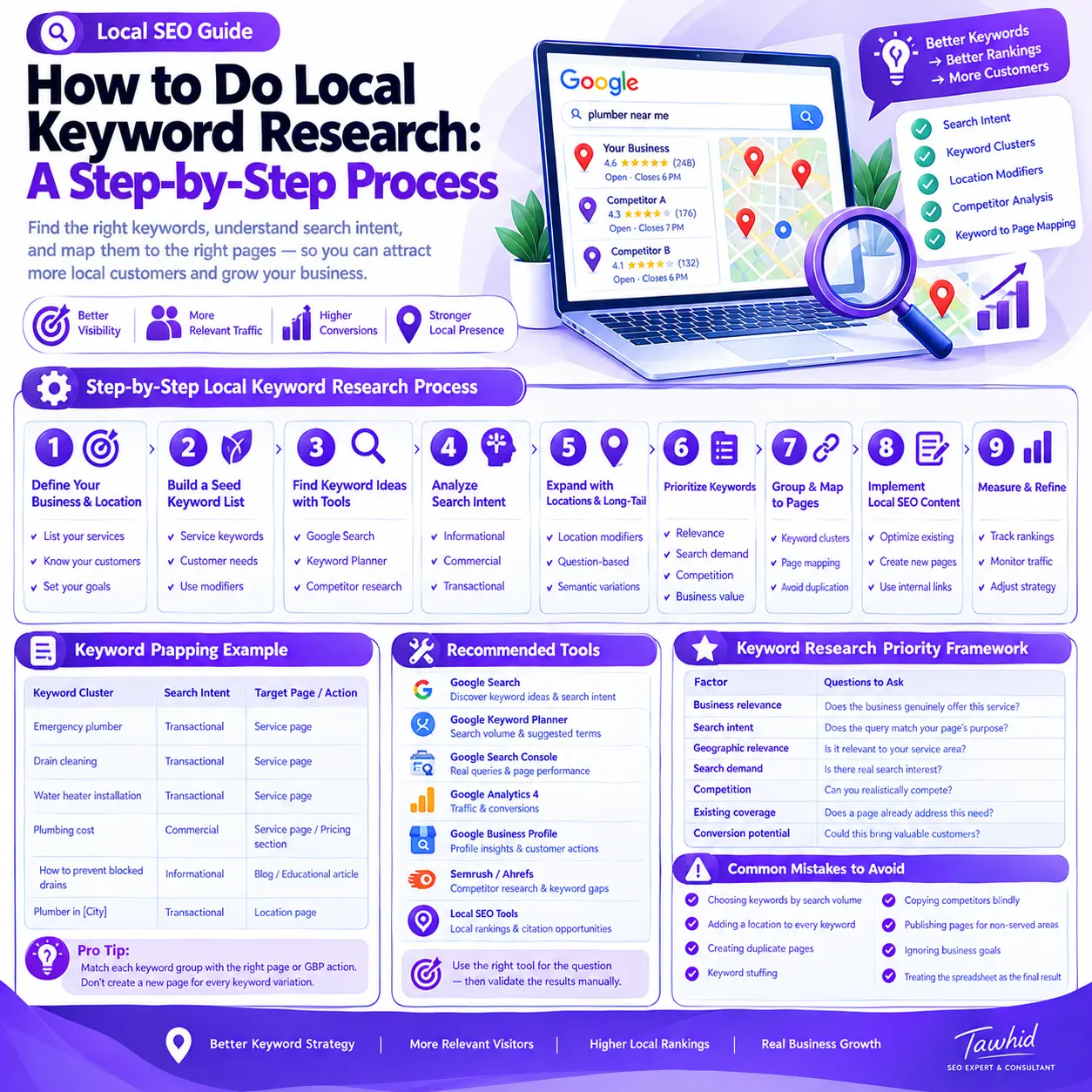
Local keyword research is the process of discovering and evaluating the search terms people use when looking for products or services in a specific geographic area. To do it effectively, identify your services and customers, collect relevant search queries, analyze search intent, evaluate opportunities, group related keywords, and map each group to the right website page or Google Business Profile action.
The goal is not simply to find keywords containing a city name. It is to understand what potential customers are searching for, why they are searching, and how your business can provide the most relevant answer.
For example, someone searching for a plumbing company may need an emergency repair, a drain cleaning service, or information about water heater installation. These searches represent different needs and may require different pages or content.
A well-planned local keyword research process helps you identify these opportunities, improve your existing website, and create a more focused Local SEO strategy.
In this guide, you will learn how to perform local keyword research step by step, which tools to use, how to prioritize keywords, and how to turn your findings into a practical keyword-to-page plan.
Step 1: Define Your Business, Services, and Target Locations
Before opening a keyword research tool, understand the business you are researching. Otherwise, you risk collecting hundreds of search terms that have little commercial value or do not reflect the services the business actually provides.
Identify your main services and sub-services
Start by creating a complete list of the products or services your business offers.
For example, a plumbing company might provide:
- Plumbing repairs
- Drain cleaning
- Emergency plumbing
- Water heater installation
- Leak detection
- Routine plumbing maintenance
Each service represents a potential source of relevant search queries.
A broad keyword such as “plumber” may help a business understand general demand, but it does not represent every customer need. Someone searching for an emergency plumber may have a different level of urgency and a different expectation from someone researching routine maintenance.
List the individual services that are commercially meaningful to the business. Avoid creating separate keyword targets for every minor variation before you understand how people search for them.
Understand your customers and their problems
Think about what potential customers need to accomplish before choosing a business.
They may want to resolve an urgent problem, compare service providers, estimate a cost, understand a process, or decide whether professional help is necessary.
Review genuine customer inquiries, sales conversations, service descriptions, reviews, and frequently received questions to identify the language people use.
For instance, customers might describe a problem as a “blocked drain,” while the business calls the service “drain cleaning.” Both terms may be useful, but their search intent should be evaluated before you decide how to target them.
Define the actual service area
Geographic relevance is an essential part of local keyword research.
First, determine whether the business operates from a customer-facing location, travels to customers, or serves multiple genuine locations. Then identify the areas it actually serves.
Depending on the business, relevant geographic terms might include cities, towns, neighborhoods, districts, or broader service areas.
Do not assume that every service should have a dedicated page for every location. Separate pages need a clear purpose and enough distinct value to help users.
Establish your business priorities
Before collecting keywords, record:
- Your most important services.
- The types of customers you want to attract.
- The locations you genuinely serve.
- The actions you want visitors to take.
- Your existing website pages and their purposes.
- Any available information about current search performance.
These details give your research direction and help you evaluate keywords according to business relevance rather than search volume alone.
Step 2: Build a Seed Keyword List
Seed keywords are the initial terms you use to discover more specific search opportunities. They usually describe a service, product, customer problem, or topic.
A good seed list reflects the business’s actual offerings and the language its customers use.
Start with service and product keywords
For the hypothetical plumbing company, an initial list might include:
- Plumber
- Plumbing services
- Drain cleaning
- Emergency plumbing
- Water heater installation
- Leak detection
These terms are starting points, not the final keyword strategy.
Expand your list with customer needs
Next, consider how people might search for each service.
For drain cleaning, related ideas could include:
- Blocked drain service
- Drain unblocking
- Recurring drain problems
- Drain cleaning cost
- How to prevent blocked drains
Some of these terms suggest an immediate need for a service. Others indicate that someone is researching a problem or comparing options.
Keep these differences in mind as your list grows.
Include relevant purchasing and problem-related modifiers
Depending on your industry, useful modifiers may include:
Modifier type | Example | Likely purpose |
Service | Drain cleaning service | Find a provider |
Urgency | Emergency plumber | Resolve an urgent problem |
Pricing | Water heater installation cost | Understand likely expenses |
Comparison | Repair vs. replacement | Evaluate alternatives |
Quality | Experienced plumbing contractor | Assess service providers |
Geographic | Plumber in [City] | Find a relevant provider in an area |
Informational | How to prevent blocked drains | Learn how to solve or prevent a problem |
These categories help you discover different customer needs without assuming that every variation deserves its own page.
Record the initial keywords in a spreadsheet
Create a simple worksheet with columns for seed keyword, candidate keyword, service category, possible search intent, geographic relevance, and research notes.
Do not worry about perfect prioritization at this stage. The objective is to create a useful starting list that you can validate and refine in the next steps.
Step 3: Find Local Keyword Ideas Using Research Tools
Once you have your seed keywords, expand them with search results, keyword tools, competitor research, and information from actual customers.
No single tool provides a complete picture of local search demand, so combine sources that serve different purposes.
Use Google Search to discover keyword variations
Search for your most important seed terms and observe the language used throughout the results.
Look for:
- Autocomplete suggestions, where available.
- Related searches, where displayed.
- People Also Ask questions, where displayed.
- Common topics covered by relevant competing pages.
- Different types of results appearing for the same query.
- Terms that reflect distinct services or customer problems.
Record actual observations. Do not assume that a suggestion has significant search volume simply because it appears in an interface.
Search results are especially useful for understanding intent and the type of content that may be appropriate for a query.
Research local competitors using Google Maps
Search Google Maps for important services and review relevant competing businesses.
Observe the services they describe, the categories they use, the types of businesses appearing in the results, and the questions or needs their websites address.
Competitor research can reveal potential keyword ideas you have missed. However, a competitor’s keywords are not automatically appropriate for your business.
Validate every promising term against your own services, geographic coverage, customer needs, and website capabilities.
Choose keyword research tools according to their strengths
Different tools answer different questions.
Tool | Best use | Important limitation |
Google Search | Discover search language and assess intent | Does not provide a complete keyword-demand dataset |
Google Keyword Planner | Generate keyword ideas and review search estimates | Designed for advertising research; estimates are not guarantees of organic traffic |
Google Search Console | Find queries already generating website impressions and clicks | Reports are limited to available data for your property |
Google Trends | Compare relative interest and investigate changes over time | Its normalized index is not an exact search-volume count |
Third-party SEO platforms | Explore keyword opportunities, competitor gaps, and estimated difficulty | Metrics depend on the provider’s data and methodology |
Google Business Profile Performance | Examine available profile interactions and discovery information | Available metrics depend on the report and profile |
Customer inquiries and sales records | Discover real customer language and needs | Reflect the business’s observed customers rather than the entire search market |
Google documents keyword discovery and search estimates in its Keyword Planner guide. For website performance, its Search Console documentation explains how to examine query, click, impression, click-through-rate, and position data. Google Trends provides relative-interest comparisons rather than absolute search-volume figures.
Use Google Search Console when the website already has data
If the website is verified in Search Console, open the Search results performance report and review the Queries and Pages dimensions.
Look for queries that already generate impressions, pages attracting relevant search traffic, and terms that seem closely related to important services.
For example, a service page may already receive impressions for a more specific service variation that has not been included in your initial keyword list.
That information can reveal opportunities to improve an existing page before creating another one.
Remember that Search Console does not expose every query or every search interaction. Treat its reports as useful first-party evidence, not a complete record of all demand.
Combine the findings
Bring together the ideas from Google Search, Maps, keyword tools, competitors, customer conversations, and existing website data.
Remove irrelevant suggestions and retain terms that plausibly match the business’s services, audience, and goals.
You now have a stronger candidate list that can be evaluated for search intent and business value.
Step 4: Analyze Search Intent Before Choosing Keywords
Search intent is the underlying purpose of a search. Two queries can contain similar words but represent different needs.
Understanding that difference helps you decide what kind of page should target each keyword group.
Identify the main types of search intent
Informational intent: The searcher wants to learn something.
Example: “How to prevent blocked drains.”
Commercial investigation: The searcher is evaluating a service, provider, or alternative.
Example: “Best drain cleaning service” or “water heater repair vs. replacement.”
Transactional intent: The searcher is ready to take action, such as requesting a service, making a booking, or purchasing a product.
Example: “Emergency plumber” or “book drain cleaning.”
Navigational intent: The searcher wants a particular business or website.
Example: A person searching for a specific plumbing company by name.
These categories can overlap. Use them as a framework rather than treating them as rigid classifications.
Inspect the search results for important keywords
For each major keyword group, examine the actual results and ask:
- Does Google display local pack or Maps results?
- Are the results mostly service pages, business directories, product pages, or educational articles?
- Do similar queries show substantially the same types of pages?
- What questions or needs do relevant competing pages address?
- Does the search suggest an immediate need or a desire to learn?
The goal is not to copy competing pages. It is to understand what searchers are likely expecting and then create a suitable, useful page.
Understand the relationship between keywords and local rankings
Local keyword research helps a business identify relevant search opportunities, but it does not determine local rankings on its own.
Google explains that local results are mainly influenced by relevance, distance, and prominence. Relevance concerns how well a business matches a search; distance concerns the searcher’s location relative to the business; and prominence relates to how well-known the business is.
Read Google’s official guidance on improving local rankings.
This is why adding a location name to a page is not a complete Local SEO strategy. Geographic relevance, accurate business information, useful website content, and broader local signals all matter.
Decide whether a keyword belongs on a website page or in GBP work
Some queries may reveal opportunities for a website service page or educational article. Others may inform accurate Google Business Profile categories, services, or business information.
Do not attempt to target every query by creating a new URL. The correct action depends on the search intent, business offering, and existing content structure.
Step 5: Expand Keywords with Location Modifiers and Long-Tail Queries
After validating your seed keywords, expand the list with relevant geographic variations, specific customer questions, and related terminology.
The objective is to discover meaningful opportunities—not to generate every possible combination of a service and a location.
Research relevant location modifiers
Depending on the business, useful variations can combine a service with a city, town, neighborhood, district, or actual service area.
For example:
- Plumber in [City]
- Drain cleaning in [Area]
- Emergency plumbing service in [Service Area]
Use placeholders in your initial worksheet, then replace them with locations the business genuinely serves.
For multi-location businesses, investigate whether the services, competition, customer needs, and search results differ meaningfully across locations.
If they do not, additional location-specific pages may provide little value.
Understand near-me searches
Searches containing “near me” often signal a desire to find a relevant business nearby.
Examples include:
- Plumber near me
- Emergency plumber near me
- Drain cleaning near me
These variations can reveal the local nature of a search, but they do not automatically require separate landing pages.
Focus on genuine service relevance, accurate business information, a suitable Google Business Profile, and useful website pages. Avoid repeatedly inserting “near me” into headings or creating pages that exist only to target minor wording variations.
Discover long-tail and question-based keywords
Long-tail queries are more specific search phrases that can reveal a particular need, concern, or stage in the decision-making process.
Examples include:
- How much does water heater installation cost?
- When should a blocked drain be professionally cleaned?
- What is included in a plumbing inspection?
- Should I repair or replace a water heater?
- How do I choose a reliable plumbing contractor?
These questions can reveal useful topics for service-page explanations, FAQs, or supporting educational articles.
Not every question requires a new page. If a question is closely related to an existing service page and can be answered adequately there, adding a useful explanation to that page may be the better choice.
Include semantic variations naturally
Searchers may use different expressions to describe the same service or related problems.
For example, drain cleaning research may uncover terms such as blocked drains, drain unblocking, recurring clogs, drainage inspection, and drain maintenance.
Investigate whether each variation represents the same customer need or a genuinely different requirement. Include relevant language in content where it improves clarity and completeness, not simply to increase keyword coverage.
Step 6: Prioritize Keywords by Relevance and Business Value
After expanding your list, evaluate which keywords deserve attention first.
Search volume matters, but a useful local keyword strategy also considers customer intent, service relevance, geographic coverage, competition, and the pages already available on the website.
Evaluate each keyword using practical criteria
Business relevance: Does the business genuinely offer the service or solution?
Search intent: Does the query match the purpose of the page you could provide?
Geographic relevance: Is the search relevant to an area the business actually serves?
Search demand: Is there credible evidence that people are searching for the topic?
Competitive opportunity: Can the business realistically create a useful, competitive result?
Existing coverage: Does a current page already address the need?
Conversion potential: Could satisfying the searcher’s need contribute to a valuable business outcome?
These questions provide a more complete evaluation than search volume alone.
Create a simple keyword prioritization matrix
You can score the factors qualitatively as high, medium, or low.
Keyword opportunity | Relevance | Intent | Existing coverage | Recommended action |
Core service query | High | Transactional | Weak | Review or improve the main service page |
Specific service query | High | Transactional | Missing | Investigate a dedicated service page |
Relevant cost question | High | Commercial investigation | Partial | Improve a suitable service or pricing section |
General informational question | Medium to high | Informational | Missing | Evaluate a supporting article |
Unrelated service term | Low | Any | Irrelevant | Exclude it |
This is a practical decision framework, not a Google ranking formula.
Do not automatically reject low-volume keywords
A query with modest estimated demand can still be valuable if it represents a relevant service, an important customer question, or a meaningful conversion opportunity.
Likewise, a broad keyword with substantial estimated volume may be a poor priority if it attracts the wrong audience or requires a type of content the business cannot reasonably provide.
Use the available data to support a decision rather than allowing a single metric to dictate the strategy.
Classify your final keyword opportunities
At this point, organize the list into four groups:
- Prioritize: Relevant opportunities that justify implementation.
- Support: Related terms to incorporate into an existing page.
- Investigate: Promising ideas that need more research.
- Exclude: Irrelevant, redundant, or unsupported terms.
This makes the next step—keyword clustering and page mapping—much easier.
Step 7: Group Keywords and Map Them to the Right Pages
Keyword clustering means grouping related search terms according to their meaning, intent, and the type of result that would satisfy the searcher.
Keyword mapping assigns those groups to suitable website pages or other appropriate optimization actions.
Together, they help prevent unnecessary page duplication and create a more coherent website structure.
Group keywords by shared intent
Consider the following hypothetical examples:
- “Emergency plumber” and “emergency plumbing service” may belong to the same group if they express the same need.
- “Drain cleaning service” and “how to prevent blocked drains” have different intents and may need different content.
- “Water heater installation” and “water heater installation cost” may be handled together or separately, depending on the search results and how the website can satisfy the two needs.
Do not group terms solely because they contain similar words. Evaluate what the searcher expects to find.
Assign each cluster to a suitable destination
A simplified keyword map might look like this:
Keyword cluster | Likely intent | Potential destination |
Emergency plumber, emergency plumbing service in [City] | Transactional | Relevant emergency service page |
Drain cleaning, blocked drain service in [City] | Transactional | Drain cleaning service page |
Water heater installation, water heater installer in [City] | Transactional | Water heater installation page |
Plumbing service cost, plumber quote | Commercial investigation | Relevant service page or useful pricing section |
How to prevent blocked drains | Informational | Existing article or a justified new educational article |
This table is illustrative. The correct mapping for an actual business should be determined by its service offering, website structure, and observed search intent.
Use existing pages before creating new ones
Before publishing a new page, check whether an existing URL already serves the same search intent.
If two pages target substantially the same need, consider improving or consolidating them. A new page is justified when it provides a genuinely distinct, useful destination—not merely a slightly different keyword target.
For a relevant service-area page, ask whether it offers useful information specific to that location. Avoid producing near-identical pages by replacing a city name in the same template. Google’s Search spam policies explain why doorway-style pages and other manipulative practices should be avoided.
Map relevant keywords to Google Business Profile work
Your keyword research may reveal opportunities to improve how a business describes its services or how accurately its Business Profile represents its real-world operation.
Use those findings to inform appropriate profile categories, services, and business details. Do not alter the actual business name to add keywords or misrepresent the services offered.
GBP optimization and website content serve connected but different purposes. The keyword map should reflect that distinction.
Record the final keyword-to-page assignments
A useful final worksheet should include:
- Primary keyword or query cluster.
- Supporting search terms.
- Search intent.
- Relevant geographic area, where applicable.
- Demand evidence and competitive observations.
- Current target URL or recommended destination.
- Priority and next action.
The resulting map is more than a research spreadsheet. It is an implementation plan showing what should be optimized, created, consolidated, or excluded.
Step 8: Implement the Research Through Useful Local SEO Content
Keyword research only creates value when its findings lead to useful improvements.
Start with the pages most likely to satisfy meaningful customer needs and make changes based on the research rather than applying the same optimization checklist to every URL.
Improve existing service pages first
Review whether each important service page explains the service clearly, addresses relevant customer questions, and reflects the language people use when searching.
Where appropriate, improve page titles, headings, service descriptions, supporting explanations, and contextual internal links.
The aim is to make the page more useful and relevant—not to place a target phrase in every heading.
If your keyword research reveals gaps in the current structure, a Local SEO audit can be a relevant next step for evaluating existing pages, targeting problems, and opportunities.
Create new pages only when they serve a distinct need
A separate service page may be appropriate when a business offers a meaningfully different service. A location page may be appropriate when the business genuinely operates in or serves a distinct area and can provide useful information for that audience.
An educational article may be more suitable when the query calls for instructions, explanations, or comparisons rather than a service offer.
Avoid creating pages simply because a keyword tool has produced another variation. Every page should have a clear purpose.
Use keywords naturally in important page elements
Relevant keywords may be appropriate in:
- Page titles and headings.
- Introductory paragraphs.
- Service descriptions.
- Useful supporting sections.
- Internal-link anchor text.
- Image alt text when it accurately describes the image.
Use related terms where they help explain the topic. There is no need to repeat a phrase a predetermined number of times or target a fixed keyword density.
Google’s guidance on helpful, reliable, people-first content emphasizes usefulness and satisfying the reader’s needs rather than creating content primarily to manipulate rankings.
Connect related pages with internal links
Use contextual links to connect relevant service pages, sub-service pages, and educational resources.
For example, a supporting article about a plumbing problem could link to the service page offering a solution. A main service page could link to a more specific service page when readers would benefit from further information.
Descriptive anchors help readers understand where a link leads. Google’s link best practices explain the importance of crawlable links and meaningful anchor text.
For businesses managing a broader local search strategy, Local SEO services can connect keyword research with related activities such as Google Business Profile optimization, Google Maps SEO, and website optimization.
Step 9: Measure Results and Refine Your Keyword Strategy
Local keyword research should not end when the keyword map is complete. As the business publishes content and improves its website, performance data can reveal which assumptions were useful and where further work may be needed.
Monitor search performance in Google Search Console
Review the available data for your important pages and related queries.
Pay attention to:
- Impressions: How often your site’s results appeared in Google Search.
- Clicks: How often people clicked through to the website.
- Click-through rate: The proportion of impressions that resulted in clicks.
- Average position: The reported average position of your result under Search Console’s measurement method.
- Queries and pages: Which searches and URLs are associated with the reported performance.
These metrics can help you understand whether the website is appearing for relevant searches and whether the intended page is attracting visitors.
Use Google’s Search Console performance reporting documentation to interpret the available reports.
If an unintended URL appears for a keyword group, investigate whether another page already serves that search intent or whether the website’s content architecture needs clarification.
Track meaningful business outcomes
Search visibility is only part of the picture.
Where reliable measurement is available, examine whether organic search contributes to calls, quote requests, bookings, sales, or other important business outcomes.
An increase in impressions does not automatically mean an increase in qualified leads. Likewise, a page with fewer visitors may still matter if it serves a specific, valuable customer need.
For local businesses, distinguish website search performance from Business Profile interactions and other reported local outcomes.
Consider geographic variation in local visibility
Local search results can vary with the searcher’s location, particularly when Maps and local-pack results are involved.
A single ranking check therefore provides only a limited view of local visibility.
Where necessary, use an appropriate local rank-tracking tool alongside website data, actual inquiries, and conversion information. Treat position measurements as indicators, not guarantees of the visibility every customer will experience.
Review your keyword map regularly
Revisit the strategy when the business changes its services, expands into a genuine new service area, identifies new customer needs, or discovers an important content gap.
For an ongoing campaign, a monthly monitoring routine and a broader quarterly review can be useful starting points. The best frequency depends on the business, the volume of available data, and how quickly its market changes.
The important thing is to let evidence guide further work rather than continuing to publish pages without reviewing their purpose or performance.
Common Local Keyword Research Mistakes to Avoid
Even a large keyword list can produce a weak strategy if the research and implementation decisions are poor.
1. Choosing keywords based only on search volume
High search volume does not necessarily mean high business value. Evaluate intent, service relevance, competitive conditions, and the suitability of the target page.
2. Adding a location name to every keyword
Geographic modifiers are useful when they reflect genuine local intent. Generating every possible service-and-location combination creates unnecessary work and may encourage redundant pages.
3. Creating separate pages for nearly identical queries
Related keyword variations can often be addressed by one useful page. Investigate intent and result overlap before creating another URL.
4. Stuffing keywords into website content or a Business Profile
Repeated keywords do not replace useful content or accurate business information. Write naturally, explain the service clearly, and keep profile details consistent with the actual business.
5. Copying competitors without validating their keywords
Competitors may offer different services, target different customers, or have a different website structure. Use their content as a research input, not as an automatic blueprint.
6. Publishing pages for locations the business does not genuinely serve
A location keyword is not a justification for a location page. Geographic targeting should reflect actual business coverage, and individual pages should provide meaningful value.
7. Treating the spreadsheet as the finished result
The real value of keyword research lies in what it helps the business decide: which pages to improve, which content to create, which opportunities to pursue, and how to measure the result.
Frequently Asked Questions About Local Keyword Research
Are “near me” keywords worth targeting?
Yes, near-me searches are worth considering when a business serves customers in a specific geographic area. However, creating a separate page or repeatedly inserting “near me” into content is not necessary. Focus on accurate business information, relevant service and location pages, a well-maintained Google Business Profile, and genuine local relevance.
How many keywords should you target on each local service page?
There is no fixed number of keywords that every local service page should target. Start with one coherent primary topic and include relevant variations that support the same customer need. If a group of queries requires a distinctly different solution or search intent, evaluate whether it deserves another useful page rather than forcing everything into one.
Which free tools can you use for local keyword research?
Start with Google Search suggestions, relevant Maps results, Google Trends, and a spreadsheet to organize your findings. Search Console can provide useful query data for a verified website, while Google Keyword Planner offers keyword ideas and search estimates through Google Ads. Feature access and account setup requirements may apply. Paid SEO platforms are optional rather than mandatory.
How should you do local keyword research for a service-area or multi-location business?
Begin with the services the business genuinely offers and the locations it actually serves. Research how customer needs, competitors, and relevant queries differ across those areas. Map each meaningful keyword group to an appropriate existing or new page, but create separate location pages only when they provide genuine value rather than near-identical content for every geographic variation.
How often should you update local keyword research?
Review local keyword research when services, locations, customer needs, or competitive conditions change. For ongoing campaigns, monitor relevant search and conversion data regularly and reassess priorities as new evidence becomes available. A monthly monitoring routine and a broader quarterly review can be useful starting points, but the appropriate cadence depends on the business and its data.
Conclusion: Turn Local Keyword Research into a Practical SEO Plan
Effective local keyword research starts with understanding a business and its customers. From there, you can discover relevant search terms, validate intent, evaluate business value, group related keywords, map them to appropriate pages, and use performance data to refine the strategy.
The objective is not to collect the largest possible list of keywords. It is to identify the search opportunities that matter, create useful content for those needs, and build a website structure that helps people find the right information or service.
For the best results, approach keyword research as part of a coordinated Local SEO strategy rather than an isolated task. The findings should inform page optimization, appropriate Google Business Profile improvements, content planning, internal linking, and ongoing measurement.
Need Help With Local Keyword Research?
If you have a long list of keywords but are unsure which to prioritize, how to group them, or which pages should target them, professional guidance can help you turn the research into a clearer implementation plan.
I’m Tawhid, an SEO Expert & Consultant at Freelancer Tawhid. I began working with Local SEO in 2020 and have developed my knowledge through research and practical implementation on real projects.
My Local Keyword Research Service is the most relevant starting point if you need help identifying keyword opportunities, evaluating search intent, analyzing competitors, and mapping keywords to suitable website pages.
For broader strategic guidance, you can also contact Tawhid to discuss your SEO goals.
The next step is to build a keyword strategy around your actual services, customers, and business objectives—not simply to publish more pages.
About the author: Tawhid is an SEO Expert & Consultant at Freelancer Tawhid, providing SEO services to businesses worldwide. His areas of work include Local SEO, Google Business Profile optimization, Google Maps SEO, and Ecommerce SEO.