
How to Audit Local SEO Competitors and Find Google Maps Ranking Opportunities

Freelancer Tawhid
SEO Expert and Consultant
- October 13, 2026
- No Comments
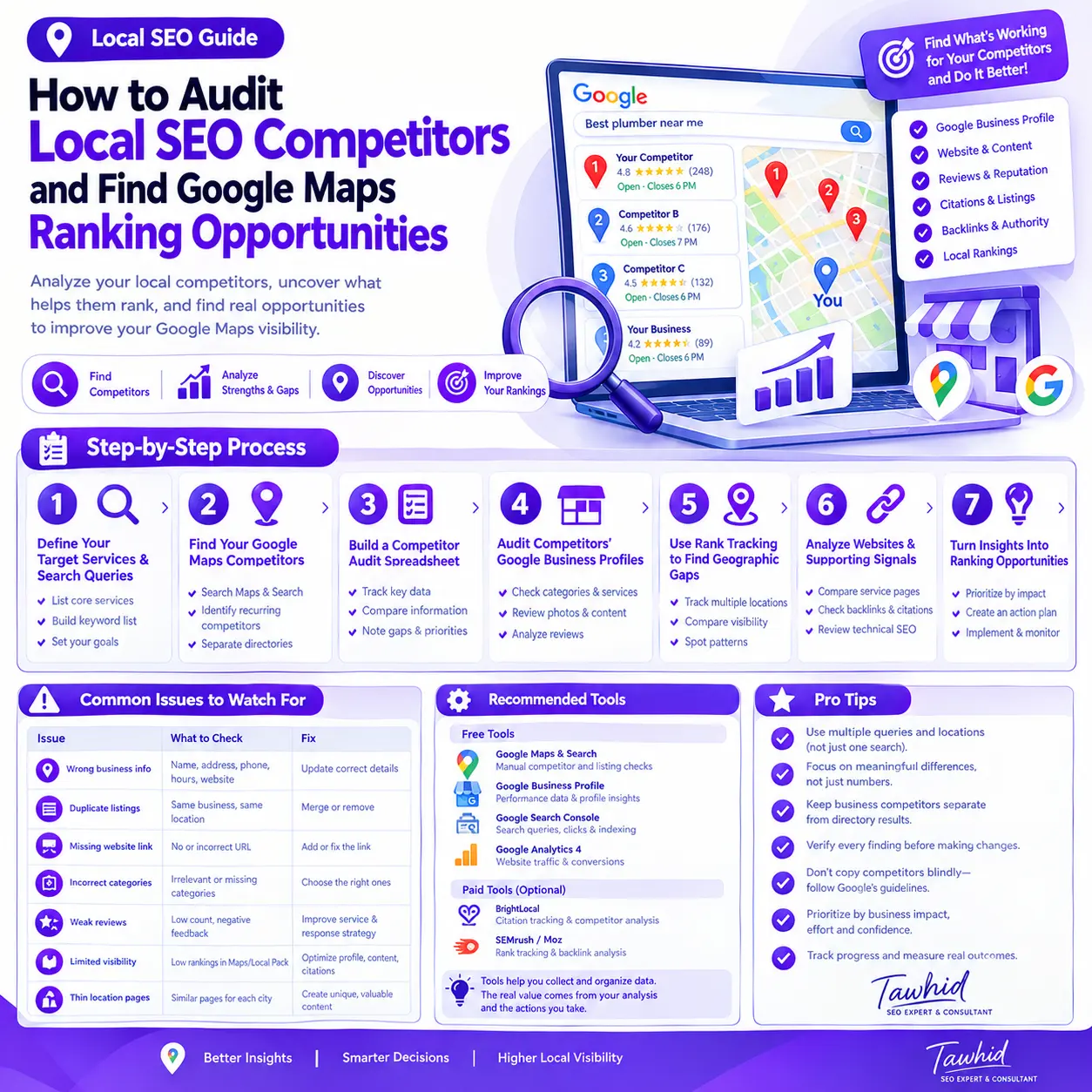
Local SEO competitor analysis helps you understand which businesses appear ahead of yours in Google Maps, why they may be more visible, and where your business has realistic opportunities to improve. By comparing Google Business Profiles, geographic rankings, reviews, websites, and local authority signals, you can identify meaningful gaps and build a prioritized optimization plan.
However, competitor analysis is not about copying businesses that rank above you. It is about gathering evidence, understanding your competitive environment, and deciding which improvements make sense for your business.
In this guide, you will learn how to audit local SEO competitors step by step, assess Google Maps ranking opportunities, interpret geographic visibility gaps, and turn your findings into practical actions.
What Is Local SEO Competitor Analysis?
Local SEO competitor analysis is the process of evaluating businesses competing for visibility in geographically relevant search results. It involves examining Google Maps listings, the Local Pack, business profiles, reviews, websites, relevant backlinks, citations, and other publicly observable information.
The purpose is to understand how competitors appear for important searches, identify differences that deserve investigation, and discover opportunities to improve your own local search presence.
A useful competitor audit should answer four questions:
- Which businesses consistently appear for searches relevant to my services?
- Where and for which queries am I less visible than those competitors?
- What meaningful differences exist between their local search presence and mine?
- Which improvements should I prioritize based on evidence, business value, and implementation effort?
Business competitors vs. Google Maps competitors
Your business competitors and your Google Maps competitors are not necessarily the same.
Business competitors are companies offering similar products or services to the same potential customers.
Google Maps competitors are businesses that appear alongside or above yours for the local searches that matter to your business.
Organic search competitors are websites competing for visibility in traditional Google Search results, including service pages, directories, and industry publications.
For example, a plumbing company might compete commercially with several large plumbing businesses. However, a smaller specialist provider could consistently appear above those businesses in Google Maps for an important service query.
That smaller provider may be a more useful SEO competitor to investigate because it provides direct evidence about the search results your business is trying to enter.
Start with the businesses appearing in relevant search results, then determine which ones deserve the most attention.
What counts as a Google Maps ranking opportunity?
A Google Maps ranking opportunity is a potential improvement supported by a meaningful observation or a verified issue.
Examples include:
- Your Google Business Profile uses a category that does not accurately represent your core business.
- A competitor has a relevant service page, while your website lacks a useful page for that service.
- Your business has strong visibility near its location but substantially weaker visibility at other relevant search points.
- Your review feedback reveals recurring customer concerns that your business could address.
- Your business information is incomplete or inconsistent across important platforms.
These observations help generate hypotheses, but they do not automatically prove why one business ranks above another.
For example, if a competitor has more reviews than your business, that is a measurable difference. It does not prove that the review count alone explains its ranking.
A good audit separates what you can observe, what you can reasonably infer, and what still needs investigation.
What Determines Google Maps Rankings?
Google states that local search rankings are primarily based on three factors: relevance, distance, and prominence. You can use these concepts to organize your competitor research.
Source: Google’s official guidance on improving local rankings.
Relevance
Relevance describes how well a business profile matches what someone is searching for.
During your audit, investigate whether your profile accurately represents your business, whether your selected categories match your actual services, and whether your website provides useful information about the services customers are looking for.
A difference between your profile and a competing profile can reveal an issue worth investigating. It does not mean you should automatically copy the competitor’s configuration.
Distance
Distance refers to how far a business is from the searcher or the location Google determines is relevant to the search.
This is why Google Maps rankings can differ across geographic areas, even when the search query remains unchanged.
A business may appear prominently near its location but have weaker visibility farther away. Competitor analysis helps you understand that distribution and decide where improvements are realistic.
Distance also creates limitations. A business cannot assume that better profile optimization will overcome every proximity disadvantage.
Prominence
Prominence refers to how well-known a business is. Google’s guidance identifies factors such as links from other websites, review quantity, and positive ratings as information relevant to prominence.
During a competitor audit, you can investigate reviews, relevant backlinks, citations, public mentions, and other evidence of reputation and authority.
Do not treat any single metric as a complete measure of prominence. The objective is to identify useful differences and investigate them in context.
Google also makes clear that businesses cannot request or pay for better local rankings. Competitor analysis can guide a legitimate improvement strategy, but it cannot guarantee a particular position.
Step 1: Define Your Target Services and Search Queries
Before analyzing competitors, establish which searches matter to your business.
A random selection of Google Maps results can produce an unfocused audit. Start with your most important services and the types of searches that indicate relevant customer demand.
Identify your core services
List the services your business actually provides and wants to attract customers for.
For a service-area business, this might include its main service, specialized services, and relevant variations of those offerings.
For a business with a physical storefront, the list might include its principal products, services, and categories of customer demand.
Separate high-priority services from secondary offerings. This will help you identify which competitive gaps deserve attention first.
Build a focused keyword list
Develop a manageable set of queries for your initial investigation.
Consider:
- Core service searches.
- Service-specific variations.
- Commercial-intent searches.
- Relevant category terms.
- Geographic modifiers where appropriate.
- Natural-language searches customers might use when looking for a provider.
For example, a hypothetical repair business could investigate searches such as “appliance repair,” “washing machine repair,” and “refrigerator repair.”
The objective is not to collect every possible keyword. It is to identify representative searches that reflect the business’s services and customer intent.
A useful starting point is three to five important queries. After identifying recurring competitors and understanding the initial results, expand the list where necessary.
If you need a more comprehensive keyword-discovery process, see my Local Keyword Research service.
Record your baseline
Before making changes, record the current state of your local search visibility.
Where applicable, document:
- Target search queries.
- Businesses currently appearing in the results.
- Observed Maps or Local Pack positions.
- Geographic points used for the checks.
- Relevant Google Business Profile information.
- Existing website pages and local search performance.
- The date and method of each observation.
This baseline helps you distinguish existing conditions from changes observed after implementation.
Step 2: Find Your Actual Google Maps Competitors
Once you have your queries, begin identifying the businesses that compete for those searches.
Search Google Maps and Google Search
Search for each target query in Google Maps and Google Search.
Record the relevant businesses appearing in Maps or the Local Pack. Keep traditional organic results in a separate list because directories, review websites, and service-provider websites do not compete in exactly the same way.
For each query, note the businesses that appear, the result type, and the order in which they are displayed in the environment you checked.
Manual searches can provide useful context, but results may vary with search location and other contextual factors. A single search should not be treated as a universal ranking report.
Identify competitors appearing across multiple queries
Look for businesses that repeatedly appear for important service searches.
A business that appears across several relevant queries may deserve closer investigation than one that appears only for an unrelated or low-priority term.
You can group competitors into three categories:
Competitor group | What to investigate |
Recurring competitors | Businesses appearing across multiple important queries |
Service-specific competitors | Businesses particularly visible for an individual service |
Geographic competitors | Businesses with stronger visibility in particular parts of your target market |
These groups help you determine where to focus your research.
You do not need to analyze every competing business in equal detail. Prioritize the businesses that compete for valuable searches and provide useful evidence about the opportunities available to you.
Separate business listings from directories
Not every competitor in Google Search is a direct business competitor.
Directories, review websites, and aggregators can appear prominently in organic results, but they may not have a Google Business Profile competing for the same Map Pack positions.
Track these websites separately.
They can still provide useful information about customer discovery, citation opportunities, industry content, or other ways businesses gain online visibility.
Step 3: Build a Local SEO Competitor Audit Spreadsheet
A spreadsheet turns separate searches and observations into a structured analysis.
Rather than relying on memory or a collection of screenshots, record comparable information for each query and competitor.
What should your spreadsheet include?
Use fields such as the following:
Audit field | What to record |
Target query | The service search being investigated |
Search location | The location or grid point used |
Result type | Google Maps, Local Pack, or organic |
Competitor | Business name and relevant profile or website |
Observed visibility | Position or tracking result |
Profile categories | Publicly observable primary and additional categories |
Reviews | Rating, count, recency, themes, and responses |
Website | Relevant service or location page |
Authority evidence | Relevant links, citations, and business mentions |
Potential gap | The difference worth investigating |
Evidence confidence | Confirmed fact, correlation, or hypothesis |
Recommended action | A practical next step |
Priority | Business relevance, potential impact, effort, and confidence |
You do not need every field for every competitor. Include the information relevant to the question you are trying to answer.
Distinguish evidence from interpretation
Suppose a competitor appears above your business for a service query and has a more relevant website landing page.
Record the two observations separately:
Observed: The competitor’s page directly addresses the service, while your website has only a general services page.
Interpretation: Your website may not provide the same level of relevance for that query.
Next step: Review the search intent and determine whether a dedicated, genuinely useful service page is appropriate.
This approach is more reliable than declaring that a particular difference is definitively responsible for a ranking position.
Make comparisons consistent
Compare businesses using the same queries, similar geographic sampling, and comparable reporting periods.
Do not compare one competitor’s best ranking at its nearest search point with your business’s weakest ranking at a distant point.
Consistency makes your findings easier to interpret and more useful when measuring future changes.
Step 4: Audit Competitors’ Google Business Profiles
Google Business Profile analysis helps you understand how competing businesses present their services and communicate their relevance to customers.
The objective is to identify legitimate improvements—not to copy every element of a competitor’s profile.
Compare primary and additional business categories
Review the categories publicly displayed on competitor profiles where available.
Ask whether your current primary category accurately represents your business’s main purpose and whether an appropriate category better describes the service you are investigating.
Google recommends choosing the fewest categories necessary to describe the business’s overall core activity and selecting categories that are as specific and representative as possible.
Do not add unrelated categories simply because a competitor uses them.
For more detailed guidance, read How to Choose the Right Google Business Profile Categories.
Review services and business information
Compare relevant information, including:
- Business name and category alignment.
- Accurate address or service-area information.
- Opening hours and special hours.
- Services and other relevant profile details.
- Available business attributes.
- Website destination and consistency with the actual business.
- The clarity and usefulness of customer-facing information.
Look for genuine omissions or inaccuracies in your own profile.
For example, a business may have expanded its services but failed to update the relevant information customers see. Correcting that omission can improve the customer experience and make the business’s offering clearer.
The business name must reflect the real-world business name. Adding service keywords or location terms that do not belong in the legitimate business name can violate Google’s guidelines.
Compare photos and other profile content
Review whether competing businesses provide useful, genuine photos and other available visual information.
Ask whether a potential customer can understand what the business does, what its premises or work look like, and what to expect before making contact.
Do not assume that uploading more photos or publishing more updates automatically produces higher Maps rankings. Prioritize accuracy, usefulness, and the actual customer experience.
Analyze competitor reviews
Reviews can reveal how customers perceive competing businesses.
Compare the following where relevant:
- Overall rating.
- Total review count.
- Recent review activity.
- Recurring positive and negative themes.
- Feedback about specific services.
- Owner responses to customer concerns.
Do not evaluate reviews using numbers alone.
For instance, a competitor with more reviews may also receive recurring complaints about communication or service quality. Those observations may reveal areas where your own business can differentiate itself through better customer experience.
If you identify review-management gaps, focus on delivering good service, inviting genuine customers to leave honest feedback, and responding appropriately.
Never use fake reviews, incentives that violate platform policy, or practices that misrepresent customer experiences.
Identify questionable competitor practices
Competitor research may reveal business names containing apparent keyword stuffing, inaccurate business information, or other questionable practices.
Record what you can verify, but do not assume that every suspicious-looking listing has violated Google’s policies.
More importantly, do not copy a potentially manipulative tactic simply because the listing appears to rank well.
Use Google’s Business Profile guidelines to evaluate the appropriate approach for your own business.
For help applying these principles, see my Google Business Profile Optimization service.
Step 5: Use Local Rank Tracking to Find Geographic Visibility Gaps
One of the most useful parts of a Google Maps competitor audit is understanding how visibility changes across different geographic points.
A business’s observed position at one location may not represent its visibility throughout the entire market.
Why one Google Maps ranking is not enough
Imagine a business that appears prominently near its physical location but becomes less visible as the search point moves farther away.
That pattern may be consistent with the influence of distance, but other differences in relevance, prominence, competition, and search conditions can also matter.
The important point is that visibility should be assessed across relevant locations instead of relying on one search.
How to audit rankings with a geographic grid
A local rank-tracking grid samples search visibility at multiple points across a defined area.
A basic process looks like this:
- Select the most important service queries.
- Define representative geographic points relevant to your actual target market.
- Record your business’s visibility and the competitors appearing at those points.
- Compare the distribution of results across the grid.
- Investigate where meaningful visibility gaps occur.
- Record what the pattern suggests and what evidence is still needed.
Grid-based tools can automate repetitive tracking and make competitor comparisons easier.
For example, BrightLocal’s Local Search Grid documentation explains the tool’s approach to tracking local rankings across geographic points.
A small business can also begin with consistent manual observations, provided the locations and methods are recorded carefully.
How to interpret grid patterns
Use the grid to generate diagnostic hypotheses.
Observed pattern | What to investigate next |
Strong visibility near the business but weaker visibility farther away | Proximity, genuine service coverage, and the competitive environment |
Strong visibility for one service but weak visibility for another | Search relevance, categories, service information, and relevant website pages |
Weak visibility across most sampled points | Profile eligibility and accuracy, search relevance, website alignment, prominence, and competition |
Strong Maps visibility but weak website traffic or enquiries | Website relevance, page quality, customer experience, and conversion measurement |
Visibility changes substantially between reporting periods | Measurement consistency, business changes, competitor changes, and possible changes in search conditions |
These patterns are starting points for investigation, not proof of a specific ranking cause.
A grid cannot remove legitimate geographic limitations. Nor should poor visibility in a distant area automatically lead to recommendations to create additional business locations.
Focus on the areas your business genuinely serves and the opportunities that make commercial sense.
Step 6: Analyze Competitors’ Websites and Supporting SEO Signals
Google Maps competitor analysis should include relevant website and authority signals because local search visibility does not exist independently of a business’s broader online presence.
However, keep Maps results separate from traditional organic rankings when collecting and interpreting evidence.
Compare competitors’ service and location pages
Open the relevant pages of businesses that consistently appear for your target queries.
Evaluate:
- Whether a dedicated, useful service page exists.
- How closely the page matches the search intent.
- Whether the service is explained clearly and accurately.
- Whether the content answers important customer questions.
- How titles and headings describe the page.
- Whether contextual internal links connect related services.
- Whether location information reflects the business’s actual operations.
- Whether the page offers a clear next step for interested customers.
For example, your website might have a general service page, while competitors have detailed pages addressing specific services. That difference may justify investigating whether your customers need more focused information.
It does not mean you should automatically create a separate page for every keyword variation.
Each page should serve a distinct, useful purpose. Avoid thin or substantially duplicated location pages created only to target additional geographic queries.
Explore my Local On-Page SEO service for more information about improving relevant website pages.
Compare backlinks, citations, and business mentions
Investigate the publicly observable authority signals associated with competing businesses and websites.
Relevant areas include:
- Industry-related websites.
- Reputable local organizations.
- Relevant business directories.
- Genuine partnerships and community mentions.
- Industry publications.
- Relevant editorial backlinks.
- Accuracy of important business citations.
Prioritize relevance and credibility rather than raw link counts.
A directory listing from an irrelevant website may be less useful than a genuine mention from a respected organization relevant to the business.
Likewise, finding a backlink on a competitor’s website profile does not mean that acquiring the same link will reproduce the competitor’s rankings.
Use this analysis to identify credible opportunities, such as partnerships, useful contributions to industry publications, or business listings that genuinely matter to customers.
Avoid buying links for ranking manipulation or creating artificial link exchanges.
Review technical SEO where necessary
Investigate relevant technical issues when there is evidence that they may affect the website’s ability to support local search visibility.
Examples include:
- Important service pages that cannot be indexed.
- Broken internal links.
- Incorrect canonical settings.
- Poor mobile usability.
- Pages that return errors.
- Unhelpful redirects.
- Important content that search engines cannot reliably access.
These checks are particularly relevant when a competitor has useful service content that your website lacks or when your own service pages have visibility problems.
Do not present every technical SEO improvement as a direct Google Maps ranking factor. The purpose is to identify and resolve genuine barriers in the website’s search and customer experience.
Assess the customer journey
Competitor analysis should also examine how effectively businesses convert visibility into customer action.
Can prospective customers understand the services, evaluate whether the business is appropriate, find accurate contact information, and take a logical next step?
A business that communicates clearly and delivers a better customer experience can differentiate itself even in a competitive search environment.
Step 7: Turn Your Findings Into Ranking Opportunities
After comparing profiles, geographic visibility, websites, reviews, and authority signals, consolidate the findings into a prioritized action plan.
Organize your diagnosis around Google’s three local-ranking considerations while maintaining a distinction between official guidance and your own hypotheses.
Diagnostic area | Questions to ask | Possible next step |
Relevance | Does my profile accurately represent the business and the services customers seek? | Review categories, services, information, and relevant website pages |
Distance | Where does my visibility weaken, and how does that relate to the business’s genuine location or service coverage? | Investigate realistic geographic opportunities and limitations |
Prominence | Are there meaningful differences in reputation, relevant links, reviews, or wider public visibility? | Identify legitimate reputation and authority-building opportunities |
Website support | Do my pages answer the same important customer needs addressed by competing pages? | Improve genuinely useful service content and internal linking |
Customer experience | Does my business communicate its offering clearly and respond to customer needs? | Improve relevant information and the customer journey |
Separate controllable issues from competitive limitations
Some findings may be straightforward to address.
For example, incorrect opening hours, outdated business information, a broken service page, or a category that does not represent the actual business can provide a clear reason to make a correction.
Other findings require more research. A competitor may have a stronger online reputation or more relevant editorial links, but those differences do not automatically identify the cause of a particular ranking position.
Finally, some limitations may be difficult to change, including distance from the searcher, intense competition, and established market conditions.
Recognizing these differences prevents an audit from becoming a list of unrealistic recommendations.
Use an impact, effort, and confidence framework
For each potential opportunity, evaluate three dimensions:
Potential impact: Could the improvement matter for valuable searches, qualified traffic, or customer enquiries?
Implementation effort: How much research, coordination, technical work, or content development will it require?
Evidence confidence: Is the issue directly verified, reasonably supported by multiple observations, or still only a hypothesis?
You can categorize each dimension as low, medium, or high.
For example:
Finding | Potential impact | Effort | Confidence | Suggested decision |
Incorrect business hours | High customer impact | Low | High if verified | Correct promptly |
An important service lacks a useful landing page | Medium to high | Medium | Medium until intent is assessed | Investigate and improve if justified |
Competitor has many more reviews | Potentially relevant | Ongoing | Low as a standalone causal explanation | Assess review themes and customer experience |
Visibility is weak at distant grid points | Market-dependent | Variable | High for the observed pattern, lower for its full explanation | Investigate proximity and realistic coverage |
These examples are illustrative. Actual priorities depend on the business, the queries, the evidence, and the potential value of each opportunity.
Build a phased implementation plan
Organize the work in a sequence that makes sense for the business.
Phase 1: Fix verified problems. Correct inaccurate business information, address eligibility or policy issues, and resolve important website errors.
Phase 2: Improve relevant assets. Where evidence supports the work, refine the profile, improve useful service pages, strengthen internal linking, and address customer-experience or reputation gaps.
Phase 3: Develop authority and evaluate opportunities. Investigate relevant citations, genuine backlinks, and other legitimate ways to strengthen the business’s presence.
Phase 4: Monitor and reassess. Compare later observations with the baseline and use the results to determine the next set of priorities.
The timeline and scope will depend on the business. There is no universal period within which a competitor audit or a set of optimization changes will produce a specific Google Maps position.
Step 8: Choose the Right Tools for Local SEO Competitor Analysis
You do not need a large collection of paid tools to begin auditing competitors. Choose tools according to the information you need to collect and the size of your project.
Free and manual methods
Google Maps and Google Search: Inspect visible competitors, profile information, result types, and relevant search queries.
Google Business Profile Performance: Review available information about how customers discover and interact with a verified profile.
Google Search Console: Analyze website search queries, impressions, clicks, and other organic search performance information.
Google Analytics 4: Evaluate website traffic and configured customer actions or conversions.
A spreadsheet: Combine the findings and prioritize the opportunities.
Keep these datasets distinct. Search Console data is not a substitute for geographic Maps rank tracking, and an increase in profile interactions does not by itself establish that a Maps ranking improved.
When should you use a paid rank-tracking tool?
A paid tool can be useful when you need to monitor multiple queries, locations, competitors, or reporting periods.
For example, BrightLocal’s Local Search Grid provides geographic rank-tracking functionality, while BrightLocal’s local competitor-analysis guide explains a broader competitor-research workflow.
Before choosing a tool, evaluate:
- Whether it supports geographic grid-based tracking.
- Whether competitors can be compared across queries and locations.
- Whether it maintains useful historical records.
- Whether relevant data can be exported.
- Whether it accommodates your business’s number of locations.
- Whether its features and cost fit your workflow.
Verify current pricing and functionality before purchasing.
Tools can collect and organize observations, but they cannot reveal Google’s complete ranking logic or prove that a particular optimization will work. The value comes from interpreting the findings correctly.
Step 9: Avoid These Common Local SEO Competitor-Audit Mistakes
Even a detailed audit can lead to poor decisions if the evidence is interpreted incorrectly.
Mistake 1: Relying on one Google Maps search
A single search provides only a limited view of local visibility.
Use multiple relevant queries and geographic observations to understand the competitive landscape more accurately.
Mistake 2: Copying everything competitors do
Competitors may have business categories, website structures, or profile practices that are irrelevant or inappropriate for your business.
Use their presence as a source of research, not as a universal template.
Mistake 3: Assuming one metric explains every ranking difference
More reviews, more backlinks, or more profile photos do not automatically explain why a competitor ranks above you.
Assess differences in context and gather supporting evidence before deciding what to change.
Mistake 4: Confusing organic rankings with Maps rankings
Keep organic website positions separate from Maps and Local Pack observations.
The two areas can overlap, but they should not be treated as identical ranking systems.
Mistake 5: Creating unnecessary pages for every keyword or location
A competitor’s large website does not mean your business needs the same number of pages.
Create pages when they offer distinct value, meet genuine customer needs, and accurately describe your services or locations.
Avoid doorway-style location pages and thin, duplicated content designed primarily to manipulate search results.
Mistake 6: Treating tools as a ranking shortcut
A report can identify an apparent gap, but it cannot implement the right solution by itself.
The process requires informed analysis, appropriate changes, and consistent evaluation.
Mistake 7: Tracking visibility without measuring business outcomes
Ranking positions matter, but they are not the final business objective.
Monitor relevant customer actions and conversions where measurement is available. A better local search presence is more useful when it helps the right customers find and evaluate the business.
Step 10: Measure Results and Repeat the Audit
Competitor analysis should not end when the spreadsheet is complete. Use the findings to establish priorities, implement improvements, and evaluate what happens afterward.
Track local visibility consistently
Use the same core queries, comparable geographic points, and consistent tracking methods when reviewing progress.
Compare the distribution of visibility rather than focusing exclusively on one position.
If your business becomes more visible for a particular service, investigate whether the improvement is consistent across the relevant search points and reporting periods.
Also record important changes to the business, profile, website, or competitors that may help explain the results.
Monitor customer-facing performance
Use appropriate data sources to measure relevant outcomes.
These may include:
- Google Maps and Local Pack visibility from your rank-tracking setup.
- Available Google Business Profile searches, calls, website clicks, direction requests, or other interactions.
- Google Search Console impressions and clicks for relevant website pages.
- Website enquiries, bookings, or other configured conversion events.
- Qualified leads and other business outcomes where reliable tracking is available.
Interpret each metric carefully. A button click is not necessarily a completed phone call, and a direction request does not prove that someone visited the business.
Where possible, distinguish visibility metrics from customer interactions and completed conversions.
Keep a record of actions and observations
Maintain a simple log containing:
- The issue identified.
- The supporting evidence.
- The change implemented.
- The date of implementation.
- The measurement method.
- The subsequent observation.
- Any remaining questions or limitations.
This record makes it easier to assess whether your strategy is progressing and whether the next audit should focus on different issues.
There is no mandatory audit frequency for every business. Reassess when the business changes services or locations, when its visibility changes substantially, after meaningful optimization work, or as part of a periodic local SEO review.
Frequently Asked Questions
1. How many competitors should I analyze for Local SEO?
A practical starting point is to identify the businesses that repeatedly appear for three to five of your most important local service queries, then expand the comparison where needed. The right number depends on competition, service diversity, and geographic coverage. Prioritize recurring, relevant competitors rather than analyzing every nearby business.
2. Why do Google Maps rankings differ from one location to another?
Google Maps results can differ because distance from the searcher is one of the main local-ranking considerations, alongside relevance and prominence. Results may therefore vary across locations, even for the same query. Use consistent geographic sampling or grid-based rank tracking instead of assuming one search reveals a business’s visibility everywhere.
3. Should I use the same Google Business Profile categories as my competitors?
Only select categories that accurately describe your own business. Competitor categories can provide useful research clues, but they do not establish which categories are appropriate for you. Google recommends choosing the fewest categories needed to describe the core business and selecting options that represent what the business actually is.
4. Should I focus on getting as many Google reviews as my competitors?
Review count and ratings are useful comparison points, but they should be evaluated alongside review recency, customer feedback, responsiveness, and business objectives. Build a compliant process for requesting genuine customer reviews and improving service quality. Do not use fake reviews or assume matching a competitor’s review count will produce the same ranking.
5. Can local SEO competitor-analysis tools improve Google Maps rankings by themselves?
No. Competitor-analysis and rank-tracking tools help you collect information, compare visibility, and identify potential gaps. They do not independently improve a business’s profile or guarantee ranking changes. Results depend on interpreting the findings correctly, implementing appropriate improvements, and evaluating outcomes against a consistent baseline.
Conclusion: Turn Competitor Insights Into Local SEO Opportunities
Auditing local SEO competitors is about understanding why certain businesses are visible for the searches that matter and identifying where your business can make meaningful improvements.
Start with relevant service queries. Identify recurring Google Maps competitors, compare their Business Profiles, examine geographic visibility, and investigate the website and authority signals supporting their presence.
Then separate verified issues from assumptions and prioritize actions according to potential impact, effort, and confidence.
Remember that stronger local search visibility does not come from copying competitors or changing profile fields randomly. A useful strategy combines accurate business information, relevant services, a helpful website, a strong customer experience, and ongoing measurement—while recognizing the influence of distance and competition.
Need Help Identifying Your Google Maps Ranking Opportunities?
If your business is struggling to appear for relevant local searches, a structured analysis can help you understand the potential causes and determine what deserves attention first.
As an SEO Expert & Consultant behind Freelancer Tawhid, my approach focuses on understanding the business, its services, search intent, geographic market, competitors, Google Business Profile, and website before recommending an optimization strategy.
Explore my Google Maps SEO service to learn how competitor analysis, profile optimization, local keyword research, and website alignment can fit into a broader local search strategy.
If you need a wider assessment covering competitors, your Google Business Profile, website SEO, citations, and other local search factors, you can also explore my Local SEO Audit service.
The goal is to identify realistic opportunities, understand what should be prioritized, and build a practical strategy around your business—without relying on ranking guarantees or unsupported shortcuts.