
Local Citation Audit: How to Find Inconsistent Business Information and Duplicate Listings

Freelancer Tawhid
SEO Expert and Consultant
- October 13, 2026
- No Comments
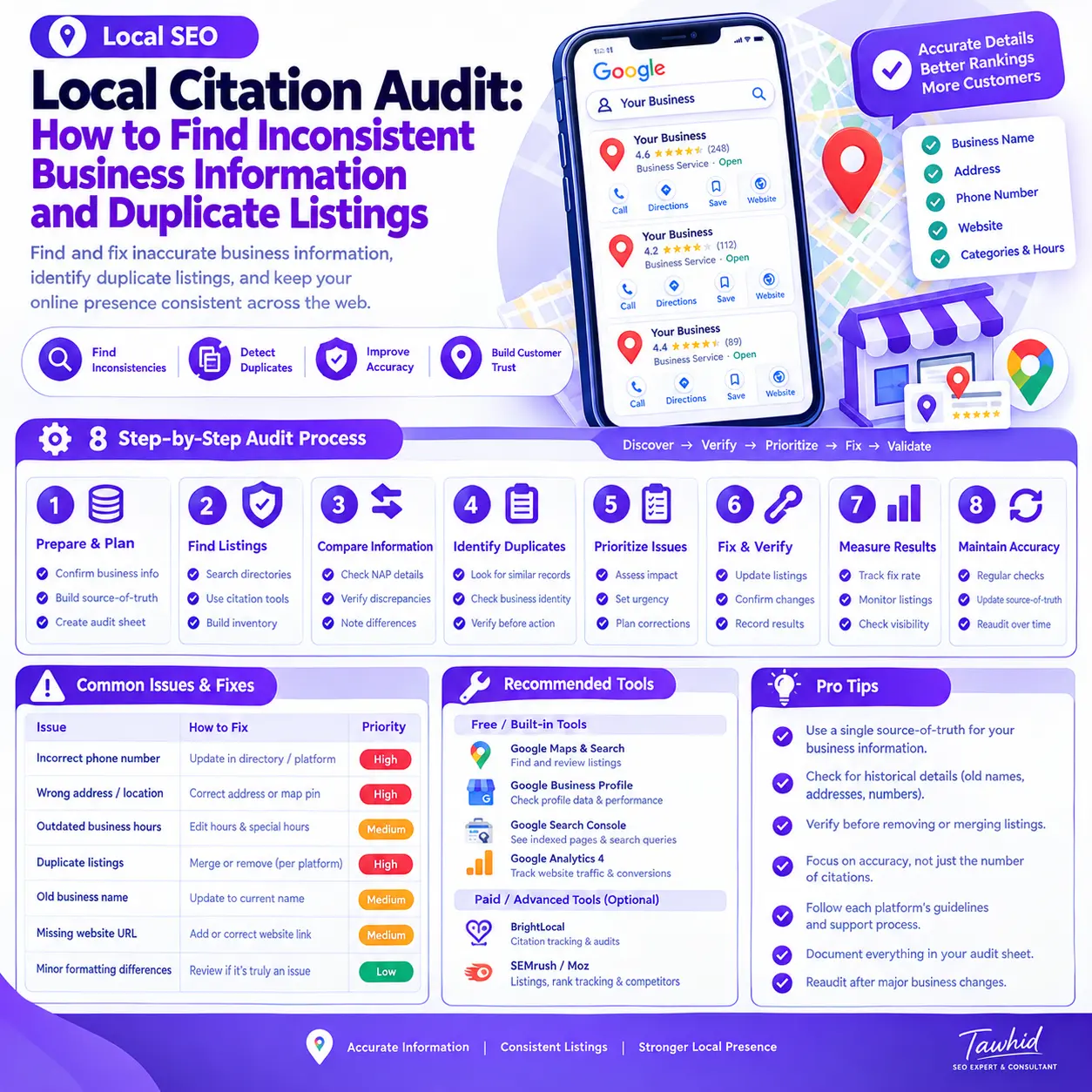
A local citation audit is a systematic review of online business listings to find inaccurate contact information, outdated details, and duplicate records. By comparing each listing with an approved source of truth, verifying suspected errors, and prioritizing corrections, businesses can improve the accuracy of their online information and reduce confusion for potential customers.
Business information can become inconsistent for many reasons. A company may change its phone number, move to a new address, rebrand, open additional locations, or have listings created by different marketing providers over several years.
As a result, directories and other websites may continue displaying old information long after the business has updated its own website.
A local citation audit helps uncover these discrepancies and determine which records need attention. It also helps distinguish genuine duplicate listings from legitimate separate businesses or locations that should remain active.
In this guide, you’ll learn how to audit local citations step by step, find NAP inconsistencies, investigate duplicate business listings, prioritize corrections, and verify whether your cleanup work has been completed successfully.
What Is a Local Citation Audit?
A local citation audit is the process of reviewing existing online references to a business to determine whether its identity, contact details, location information, and other important business data are accurate and appropriately represented.
The audit typically examines structured listings on business directories, map platforms, industry websites, and other relevant websites.
Its main objectives are to:
- Identify incorrect or outdated business information.
- Find potential duplicate listings.
- Verify the accuracy of business names, addresses, phone numbers, and website URLs.
- Determine which discrepancies require correction.
- Track corrections and confirm whether they have been published.
- Establish a reliable baseline for future citation management.
A citation audit is different from creating new citations. An audit evaluates existing information; citation cleanup resolves verified problems; citation building creates or improves appropriate business listings.
The three activities may support one another, but they serve different purposes.
What information should a local citation audit check?
The core data includes NAP information:
- Name: The business’s real-world name.
- Address: The correct physical location or other address information that the platform permits the business to display.
- Phone: The appropriate contact number for the business or individual location.
A thorough audit should also examine the website URL, business category, opening hours, listing status, and other relevant fields supported by each platform.
Not every directory displays the same information. Therefore, the audit should compare the fields that exist on each platform against the correct information for that business.
Local citations, business listings, and backlinks: What’s the difference?
A structured local citation is a business reference on a directory or listing platform. It typically contains identifying details such as the business name, address, and phone number.
An unstructured citation is a relevant business mention within content such as an article, association page, or other publication.
A backlink is a hyperlink from another website to your website.
These concepts can overlap, but they are not interchangeable. A business listing may include a website link, while a legitimate business mention may contain no link at all.
For this article, the primary focus is structured business listings because they are particularly useful for auditing inconsistent information and duplicate records.
Why Is a Local Citation Audit Important?
The immediate value of a citation audit is straightforward: it helps businesses understand where their online information is inaccurate, outdated, or potentially duplicated.
Consider a hypothetical business that changes its phone number. Its website displays the new number, but several directories still show the old one. Customers who discover those listings may call a disconnected number or reach the wrong person.
A separate problem can occur when multiple listings represent the same business on the same platform. Customers may encounter conflicting details or become unsure which record is legitimate.
A citation audit helps identify these issues so that they can be investigated and corrected.
Common reasons businesses need a citation audit
A review is particularly useful when:
- The business has changed its name, address, phone number, or website.
- The company has rebranded, merged with another business, or acquired an existing operation.
- A previous agency or freelancer created listings without maintaining them.
- Multiple locations have similar or conflicting business information.
- Old listings continue to appear in search results.
- Customers report incorrect contact details.
- A broader Local SEO review identifies potentially inaccurate business information.
An audit is also useful when taking over an existing Local SEO campaign because it provides a documented starting point.
Do inconsistent citations directly lower Google Maps rankings?
Not every citation discrepancy causes a ranking decline.
Google explains that local search results primarily depend on relevance, distance, and prominence. It also recommends maintaining complete and accurate Business Profile information. However, Google does not state that every NAP variation automatically reduces rankings.
See Google’s official guidance on improving local rankings.
The practical reason to audit citations is to improve information accuracy, reduce customer confusion, and identify listing-management problems. Better citation accuracy may support a broader Local SEO strategy, but an audit cannot guarantee higher rankings.
Before Starting: Establish the Correct Business Information
Before comparing citations, establish what the business information should be.
Without this reference, an auditor may identify differences without knowing which information is correct.
Create a source-of-truth record
Prepare a central record containing the approved information for the business.
Include:
Business field | Information to record |
Business name | The correct real-world name |
Primary address | The verified address and relevant suite or unit details |
Phone number | The appropriate primary contact number |
Website | The official website URL |
Business hours | Accurate customer-facing hours, where applicable |
Business category | The most appropriate category for the platform |
Location identifier | A unique identifier for each branch, where applicable |
Historical details | Previous names, phone numbers, addresses, and relevant dates |
Confirm the information with the business owner or authorized representative before using it as the comparison standard.
For organizations with multiple locations, create a separate record for each eligible location. Never assume that every branch should use the same address or phone number.
Record historical details and legitimate variations
Historical information can explain why discrepancies exist.
For example, a directory displaying a former business name may have been accurate before a rebrand. An address associated with a previous location may remain online after a move.
Record these changes, including their approximate effective dates, so that you can determine whether a listing is genuinely outdated.
Phone numbers also require context. A number used for call tracking or forwarding should not automatically be classified as incorrect. Verify its purpose, routing, control, and suitability for the relevant platform before recommending a change.
Understand platform-specific requirements
Do not force every listing to display identical information without considering platform rules.
Google’s Business Profile guidelines require businesses to be represented accurately in the real world.
For example, service-area businesses that operate from a private residence may need to hide their address on Google Business Profile. A citation audit should not recommend making that address publicly visible simply to create uniformity.
The correct standard is accurate business information that complies with the requirements of the platform and the business’s actual circumstances.
How to Conduct a Local Citation Audit Step by Step
A useful local citation audit follows a repeatable process: discover listings, compare their details, verify discrepancies, prioritize corrections, and document the outcome.
Step 1: Create a citation inventory
Start with a spreadsheet to organize all the listings you find.
Record these fields for each citation:
Field | What to record |
Platform | Name of the directory or website |
Listing URL | Direct link to the listing |
Business location | The branch or business represented |
Actual information | Details currently displayed |
Expected information | Details from the approved record |
Issue type | Inconsistency, duplicate candidate, outdated record, or no issue |
Verification status | Confirmed, suspected, or not an issue |
Priority | High, medium, low, or investigation needed |
Next action | Correct, report, monitor, or investigate |
Final status | Pending, submitted, verified, or unresolved |
Recording the direct URL is essential. A platform name alone is insufficient when a directory contains multiple listings for the same company.
The inventory also makes it easier to assign responsibility and track the results of your cleanup work.
Step 2: Find existing business citations
Start by searching for the business’s current and historical information.
Useful discovery methods include:
- Search the exact business name.
- Search the business phone number.
- Search the business address.
- Search previous business names and former phone numbers.
- Search combinations of the business name, address, and website.
- Review relevant general directories, industry-specific directories, map platforms, and professional associations.
- For multi-location businesses, search each branch using its distinct identifiers.
Do not restrict your audit to listings on the first page of search results. Relevant records may appear deeper in search results or on directories that are less familiar.
Citation-audit tools can accelerate this discovery process, particularly for businesses with many listings or locations. However, automated results should be treated as leads for verification rather than unquestionable evidence.
Step 3: Compare each listing against the approved information
Open each listing and compare its actual information with the corresponding source-of-truth record.
Check the name, address, phone number, website, location, and other fields that matter for the platform.
For example, suppose a business’s current contact number is +1-555-014-2200, but an established directory displays +1-555-014-1100.
The numbers are materially different. Verify the correct number and its role, then mark the listing for correction if the discrepancy is confirmed.
Now consider a listing that abbreviates “Road” as “Rd.” If both records identify the same correct address, the difference may be harmless formatting rather than an actual NAP error.
The key question is not whether every character matches. It is whether the information accurately represents the correct business.
Step 4: Identify possible duplicate business listings
Look for multiple records on the same platform that may represent the same business or eligible location.
Potential clues include:
- The same business name and address.
- Matching phone numbers and website URLs.
- Two records with similar identifying information but different contact details.
- A listing created after an existing record was already active.
- A former record that still appears alongside a newer record for the same business.
Add every suspected duplicate to the audit spreadsheet and record the URLs of all relevant records.
Do not delete, merge, or report a listing as a confirmed duplicate based only on a similarity in its name or address. The verification process is explained in detail in the next section.
Step 5: Verify the discrepancies before taking action
Revisit each flagged listing and establish whether it is genuinely inaccurate.
Ask:
- Does the listing represent the correct business?
- Is the information still current?
- Does the discrepancy affect the identity, contact details, or location of the business?
- Could the difference be legitimate because of a rebrand, separate branch, historical record, or platform requirement?
- Is there enough evidence to justify a correction?
If the correct information or business identity is uncertain, mark the item as requiring investigation.
This prevents an audit from generating unnecessary changes based on assumptions.
Step 6: Prioritize the problems
Not every discrepancy deserves the same urgency.
A wrong phone number on a useful directory may be more important than a harmless abbreviation on a minor listing. A confirmed duplicate that misleads customers may deserve attention before an unverified duplicate candidate.
Prioritize issues according to their practical impact, confidence, relevance, and the availability of a safe correction method.
Step 7: Correct, verify, and document each result
Once a problem is confirmed, use the directory’s supported editing, claiming, reporting, or support process.
Record the action taken, the date, the person responsible, and any confirmation received.
Then revisit the direct listing URL to check whether the intended correction is visible. A submitted change is not necessarily a completed correction.
Some platforms process edits quickly, while others require further verification or support review. Keep unresolved issues in the report rather than treating them as fixed.
How to Identify Duplicate Business Listings Without Removing Legitimate Records
Duplicate detection is one of the most sensitive parts of a local citation audit. Similar-looking records do not always represent the same business, and removing the wrong listing may create additional problems.
What counts as a duplicate business listing?
A duplicate generally refers to multiple records on the same platform that represent the same business or eligible location when they should be represented by a single appropriate record.
Possible examples include two listings for the same current business at the same address or a second listing accidentally created by a previous marketing provider.
These examples are investigation triggers, not automatic deletion rules.
How to distinguish duplicates from legitimate listings
Use the following decision framework.
Situation | What to verify | Recommended action |
Same business name, address, and phone on two listings | Whether both records represent the same business and location | Confirm duplication before requesting removal or a merge |
Old and new addresses | Whether the business moved or each record represents a different branch | Establish the location history and follow the platform’s rules |
Two businesses at the same address | Whether they are distinct, eligible businesses with appropriate identity evidence | Preserve legitimate separate records |
Two locations of the same brand | Whether each listing represents a distinct eligible location | Maintain the correct location-specific records |
Similar names but different contact details | Whether the businesses are related or genuinely separate | Investigate before classifying either record as a duplicate |
A previously verified listing and a newly created record | Which record is valid and who controls it | Resolve the existing record and ownership situation appropriately |
A shared address or similar name may justify investigation, but neither proves that two listings are duplicates.
How should you handle duplicate Google Business Profiles?
Google generally allows one Business Profile per business. Its official duplicate-profile guidance explains how to handle existing profiles, ownership issues, incorrectly merged businesses, and duplicate records.
Use this process:
- Confirm the business identity. Establish whether both profiles represent the same business or whether they are genuinely distinct and eligible businesses.
- Review ownership. Determine whether the business already has a verified profile and whether authorized access is available.
- Select the appropriate resolution process. Depending on the situation, this may involve requesting ownership, reporting a duplicate, requesting a merge, or correcting an existing profile.
- Follow Google’s current guidance. Do not create another profile to work around an ownership or verification issue.
- Recheck the outcome. Confirm the status of the intended public listing and record the result in your audit report.
When two profiles represent the same business and Google accepts a merge, reviews may be combined, but other content such as review replies may be lost. Review the current procedure carefully before making a request.
If a business has moved, Google advises updating the existing profile rather than creating a new one for the new address.
The correct action depends on the actual situation. Never automatically remove a profile simply because a tool labels it a duplicate.
What about duplicate listings on other directories?
Other platforms may use different processes for editing, merging, reporting, or removing duplicate records.
Check the individual directory’s rules and retain evidence of the listings involved.
If the listing is inaccessible, unclaimed, or controlled by another party, use the supported support or reporting process. Not every directory offers a merge option, and not every record can be removed on request.
Document any unresolved issues so they remain part of the ongoing cleanup plan.
How to Fix Inconsistent Business Information and Prioritize Corrections
Once the audit findings are verified, organize them into a manageable action plan.
Classify issues by severity and confidence
A practical framework separates the seriousness of an issue from the certainty that the listing is wrong.
Priority | Example | Action |
High | Confirmed incorrect customer contact details, materially wrong address, or a verified duplicate that could mislead customers | Investigate and resolve promptly using the appropriate platform process |
Medium | Outdated information on a relevant directory or an incorrect secondary field | Schedule the correction and verify it afterward |
Low | Harmless formatting differences or low-impact discrepancies | Correct only if necessary; avoid changes that do not improve accuracy |
Investigate | A suspected duplicate with uncertain ownership or business identity | Gather evidence before making changes |
This is a practical decision aid, not an official Google score or a ranking-impact formula.
Choose an efficient correction order
A sensible workflow is:
- Confirm the approved business information with the owner or authorized representative.
- Correct material errors on important owner-controlled listings.
- Resolve confirmed duplicates using the appropriate platform procedure.
- Correct relevant general and industry-specific directories.
- Investigate upstream data sources where other directories obtain their information.
- Verify the results and record any unresolved issues.
The order may differ according to the business model, the platforms involved, and the markets in which the business operates.
There is no universal correction sequence that applies to every directory.
What if a listing cannot be corrected?
Some directories may require ownership verification or support intervention. Others may have outdated records that are difficult to remove.
In these cases, document the listing URL, the problem, the action attempted, and any response received.
Follow the platform’s available escalation process when appropriate. If no resolution is available, keep the issue marked as unresolved and revisit it when circumstances change.
Do not report a record as fixed simply because a request was submitted.
Tools and a Spreadsheet Template for Local Citation Audits
You do not always need paid software to conduct a citation audit. The appropriate approach depends on the number of locations, the amount of existing data, the available time, and the platforms you need to check.
Manual citation auditing
Manual research can work well for businesses with a manageable number of listings.
It allows you to inspect individual records, understand the context of discrepancies, and verify potential duplicates directly.
The main limitation is time. Discovering and comparing many listings across multiple locations can become difficult to manage manually.
Citation-audit tools
Citation-audit tools can help discover listings, compare business information, flag discrepancies, and organize reports.
For example, BrightLocal’s Citation Tracker documentation explains how to interpret citation reports and their status information.
Choose a tool based on its coverage of relevant platforms, supported markets, listing-level detail, duplicate-detection capabilities, and reporting features.
Do not assume that every tool checks every directory or that its automated findings are always correct. Verify important discrepancies at their source before recommending changes.
What should your audit worksheet include?
At a minimum, your spreadsheet should track:
- The business and location being audited.
- The directory and direct listing URL.
- Actual versus expected business information.
- The specific discrepancy or suspected duplicate.
- Evidence and verification status.
- Priority and recommended action.
- Correction date and current status.
- The date of the final verification.
A useful final report should distinguish confirmed errors from possible issues, summarize completed corrections, identify outstanding requests, and recommend the next steps.
This creates a record that can be reused for maintenance and future Local SEO reviews.
Common Local Citation Audit Mistakes to Avoid
Treating every formatting difference as an SEO problem
Punctuation, abbreviations, or different formatting conventions do not automatically mean a listing is inaccurate.
Focus on differences that change the business identity, contact details, location, or other meaningful information.
Removing duplicate listings without verifying them
A similar name or shared address is not enough to prove duplication. Establish the identity of the businesses and follow the appropriate platform rules before requesting removal or a merge.
Assuming that more citations always produce better rankings
Adding large numbers of irrelevant listings is not a substitute for accurate business information.
Google’s published guidance identifies relevance, distance, and prominence as the main local-ranking factors; it does not guarantee improved rankings from increasing citation volume.
Prioritize useful, accurate listings rather than maximizing the number of directories.
Ignoring historical business information
Old names, phone numbers, and addresses can help explain why conflicting records exist. Record the relevant history before deciding whether a listing is wrong.
Treating an audit score as the final result
A tool’s score is only as useful as its underlying data and methodology.
A good audit must identify the actual issues, verify them, prioritize action, and confirm corrections. A numerical score alone cannot establish that a business’s listings are accurate.
How to Measure Citation Cleanup Results and Maintain Accuracy
The most useful audit metrics measure the accuracy of the findings and the completion of the corrective work.
Track the number of listings reviewed, confirmed discrepancies, duplicate candidates investigated, corrections completed, unresolved problems, and fixes verified on the source platforms.
Calculate your verified fix rate
You can measure the proportion of actionable issues confirmed as fixed using this formula:
Verified Fix Rate = (Actionable issues confirmed fixed ÷ Total actionable issues identified) × 100
For example, in a hypothetical audit with 40 actionable issues, suppose 30 are corrected and verified. The verified fix rate would be 75%.
This measures the completion of the cleanup work. It does not measure ranking improvement or prove that citation cleanup caused an SEO performance change.
Monitor citations after the initial audit
Citation accuracy can change after a business moves, changes phone numbers, rebrands, opens or closes locations, or updates its operating details.
Schedule follow-up checks based on the business’s circumstances and the rate at which its information changes.
Revisit unresolved items and inspect the relevant listings after significant business changes. Keep the source-of-truth record current so future audits use accurate reference information.
What if local rankings do not improve after cleanup?
A completed citation audit does not guarantee better rankings.
If visibility remains weak, review other relevant factors, such as Google Business Profile quality, website content, relevance to the search, reviews, competition, and the geographic context of the search.
Where appropriate, a broader Local SEO audit can help identify issues that fall outside citation accuracy.
Evaluate changes using appropriate evidence, and avoid attributing ranking fluctuations to citation cleanup alone without a sound basis for that conclusion.
Should You Audit Local Citations Yourself or Hire a Specialist?
A DIY audit may be appropriate if you operate a single business location, know the correct business information, have access to the important listings, and can devote time to verification and follow-up.
Professional assistance may be useful when:
- The business operates across multiple locations.
- Many outdated or conflicting records exist.
- Previous providers created listings that are difficult to manage.
- Suspected duplicates involve complicated ownership or identity issues.
- The audit needs to be coordinated with a wider Local SEO campaign.
- The business needs a documented correction process and follow-up verification.
The value of professional support is not simply finding more directories. It is having a structured process for determining which information is wrong, which records are legitimate, what should be corrected first, and how to verify the outcome.
If the audit also uncovers problems with Google Business Profile management, consider reviewing the relevant Google Business Profile Optimization service.
For broader website and local search issues, explore Local SEO services.
Frequently Asked Questions About Local Citation Audits
1. How often should a business run a local citation audit?
Run an initial audit when reviewing your Local SEO, and recheck citations after a move, rebrand, phone-number change, acquisition, or location opening or closure. Periodic reviews can also help maintain accuracy. The ideal frequency depends on how many locations you manage, how often information changes, and how actively your listings are maintained.
2. Do inconsistent citations directly lower Google Maps rankings?
Not automatically. Google identifies relevance, distance, and prominence as the primary local-ranking factors, but it does not state that every NAP variation causes a ranking decline. Incorrect listings can confuse customers and should be corrected when necessary. If rankings remain weak, investigate other relevant Local SEO factors as well.
3. Does NAP information need to match exactly on every website?
Business information should accurately represent the same real-world business, but punctuation and formatting differences do not automatically indicate a harmful inconsistency. Focus on material errors such as incorrect phone numbers, obsolete addresses, wrong business identities, or mismatched locations. Also follow the requirements and privacy rules of each platform.
4. What should I do if I find duplicate Google Business Profiles?
First, confirm that the profiles represent the same eligible business rather than separate eligible businesses or locations. Google generally permits one Business Profile per business. Review ownership and verification, then follow Google’s current duplicate-resolution guidance. Do not automatically delete a profile or create another one to work around an existing listing problem.
5. How long does local citation cleanup take to show results?
There is no universal timeline because directories use different editing, verification, and publishing processes. Some changes appear quickly, while others require support requests or updates from external data sources. Track each correction and verify the public listing afterward. Citation cleanup also does not guarantee a particular ranking change or performance improvement.
Conclusion: Build a More Accurate Local Citation Profile
A successful local citation audit goes beyond searching for inconsistent business names, addresses, and phone numbers. It establishes an approved source of truth, discovers relevant listings, identifies meaningful discrepancies, verifies suspected duplicates, prioritizes corrections, and documents the outcome.
The most important principle is to verify before changing anything. A formatting difference is not necessarily an error, a similar listing is not necessarily a duplicate, and a submitted correction is not necessarily a completed fix.
Use a structured audit worksheet, preserve the evidence for each finding, and revisit important listings after making changes. This creates a reliable foundation for maintaining business information and supporting the wider Local SEO strategy.
Need help with local citation auditing and cleanup?
If your business has inconsistent NAP information, outdated directory listings, or suspected duplicate records that are difficult to resolve, explore my Local Citation Building Service.
I can help you assess the issues, prioritize the work, and determine an appropriate citation cleanup approach for your business.
For a broader review of your local search performance, visit my Local SEO Audit Service or contact Freelancer Tawhid to discuss your SEO requirements.