
Google Maps Ranking Factors: What Businesses Can Actually Influence

Freelancer Tawhid
SEO Expert and Consultant
- October 12, 2026
- No Comments
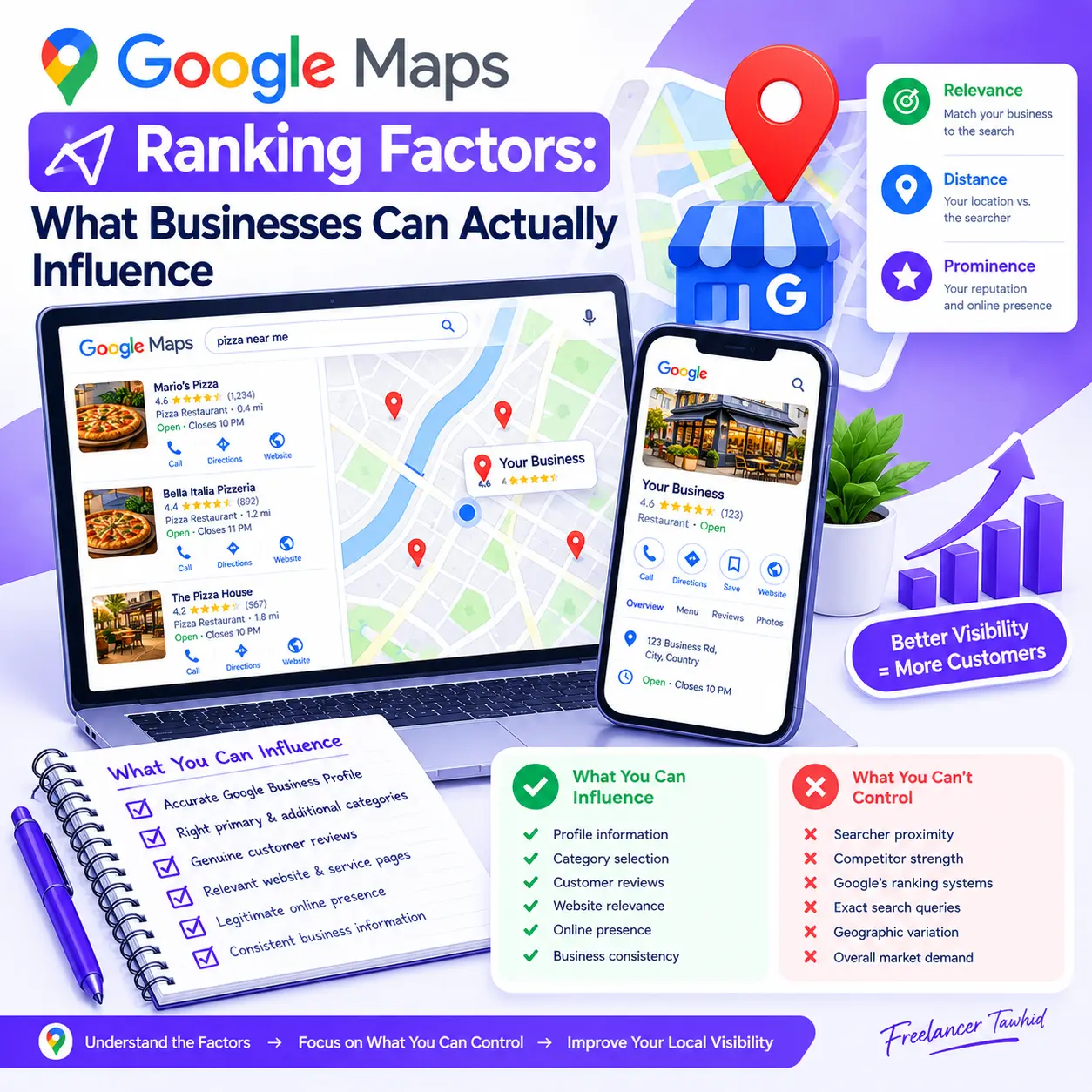
Google Maps rankings are mainly influenced by relevance, distance, and prominence. Businesses can improve their visibility by maintaining accurate Google Business Profile information, choosing appropriate categories, earning genuine customer reviews, and building a credible online presence. However, no business can fully control searcher proximity, competitors, or Google’s ranking systems.
Understanding this distinction is essential to making smarter Local SEO decisions. Instead of following every ranking tip you encounter, focus on improvements that address your business’s actual weaknesses and comply with Google’s guidelines.
In this guide, you’ll learn which Google Maps ranking factors matter, what you can realistically improve, which popular tactics deserve caution, and how to build a practical plan for improving local search visibility.
What Are the Main Google Maps Ranking Factors?
Google identifies three main considerations for local search rankings: relevance, distance, and prominence. Together, they help Google determine which businesses are suitable results for a particular search and location.
According to Google’s official guidance on improving local rankings, businesses can improve the accuracy and relevance of their Business Profiles, but there is no way to request or pay for better organic local rankings.
Let’s examine what each factor means.
1. Relevance: How Well Your Business Matches the Search
Relevance describes how well a business matches what someone is looking for.
For example, consider a person searching for a specialist repair service. A business that genuinely provides that service and has an appropriately configured Business Profile may be a better match than a business whose primary offering is unrelated.
You can improve relevance by making sure your business information accurately communicates:
- Your primary business activity and appropriate categories.
- The services and products you genuinely offer.
- Your business description and relevant profile details.
- The services described on your website.
- The relationship between your business, its services, and its legitimate locations.
Your Google Business Profile and website should tell a consistent, accurate story about your business.
However, relevance is not the same as keyword repetition. Adding a service keyword to every available field does not automatically make your profile more relevant, especially when the information is misleading or unnecessary.
What you can influence: The accuracy and clarity of your business information, category selection, and service descriptions.
What you cannot guarantee: That Google will consider your business the best result for every related query.
2. Distance: How Close Your Business Is to the Searcher
Distance refers to how far a business is from the person searching. When a searcher does not specify a location, Google may use its understanding of the searcher’s location to provide relevant results.
This explains why a business can appear prominently on Google Maps near its premises but have much weaker visibility farther away.
Imagine two businesses offering the same service. One is close to the person searching, while the other is several miles away. Even if the more distant business has a well-optimized profile, the nearer business may have a proximity advantage.
Businesses cannot simply optimize this geographic constraint away.
You can make sure your real location is represented accurately, correct an incorrectly placed map pin, and configure your service area appropriately if your business qualifies. These actions help Google and potential customers understand where you operate, but they do not guarantee rankings throughout a large geographic area.
Avoid creating fake addresses, renting unstaffed virtual offices to simulate physical locations, or establishing profiles for places where your business does not genuinely operate.
What you can influence: Accurate location information and legitimate service-area configuration.
What you cannot control directly: The searcher’s location or the physical distance between the searcher and your business.
3. Prominence: How Well-Known Your Business Is
Prominence describes how well-known a business is. Google explains that this consideration can involve information such as links from other websites and the number of reviews a business receives. More reviews and positive ratings can help local rankings.
Prominence is broader than the information in your Google Business Profile alone. Your business’s wider online presence can contribute to how established and recognizable it appears.
Relevant activities may include:
- Encouraging genuine customer feedback.
- Maintaining a credible reputation.
- Earning relevant links from legitimate websites.
- Building useful relationships with relevant organizations and publications.
- Keeping important business information accurate.
- Developing a website that clearly represents your business and services.
These activities are not interchangeable, and Google does not publish a complete formula showing how each signal is weighted.
For example, earning a genuinely relevant editorial link may contribute to your website’s authority, but there is no universal number of backlinks that guarantees a specific Google Maps position.
What you can influence: Your reputation, the quality of your online presence, and opportunities to earn legitimate recognition.
What you cannot guarantee: How Google’s systems will evaluate your business relative to every competitor.
Google Maps Ranking Factors at a Glance
Factor | What it means | What a business can do |
Relevance | How closely the business matches the search | Improve accurate categories, business information, and relevant service descriptions |
Distance | How close the business is to the searcher | Represent genuine locations correctly and understand geographic limitations |
Prominence | How well-known the business is | Build a genuine review profile, earn relevant links, and maintain a credible online presence |
These three considerations are the foundation for understanding local rankings. The sections below explain how to translate them into practical improvements without relying on unsupported ranking claims.
Which Google Maps Ranking Factors Can Businesses Actually Influence?
Although businesses cannot control every part of Google’s ranking systems, several areas deserve attention. The key is to prioritize legitimate improvements that match your business model and the problem you’re trying to solve.
1. Google Business Profile Accuracy and Completeness
Your Google Business Profile is an important starting point for local visibility.
Google says that complete and accurate business information makes a business more likely to appear in relevant local results. Verification also helps establish that you are authorized to represent the business.
Review your profile for the following details:
- Business name: Use the genuine name of your business.
- Primary category: Choose the category that best represents your main business activity.
- Additional categories: Include only those that accurately represent other relevant activities.
- Address or service area: Represent your real operating arrangements correctly.
- Phone number and website: Use accurate contact information and the appropriate website destination.
- Opening hours: Keep regular and special hours current.
- Business description: Explain what the business does using clear, accurate language.
- Services and products: Add relevant information where these features apply.
- Other profile details: Review applicable attributes and available information for accuracy.
Your business must also meet Google’s eligibility requirements. Not every business qualifies for a Business Profile, and an online-only business should not assume that it is eligible.
For the current requirements, see Google’s guidelines for representing your business.
Why profile accuracy matters
Suppose a business has changed its telephone number, but its profile still displays the old one. This creates a customer-service problem even if the profile appears otherwise complete.
Similarly, a business with inaccurate service information may attract searches it cannot satisfy.
Correcting these issues makes the profile more reliable for customers and helps it represent the actual business.
However, a completed profile is not a ranking guarantee. The goal is to remove avoidable information problems and improve the accuracy of your business representation.
For a more structured approach to this work, see my Google Business Profile optimization service.
2. Choosing the Right Primary and Additional Categories
Category selection deserves particular attention because it helps describe what your business does.
Your primary category should represent your main business activity as specifically as the available options allow. Additional categories should describe other genuine activities rather than every service keyword you would like to rank for.
Consider a hypothetical business whose primary activity is a specific repair service. Selecting the most appropriate repair category is more accurate than choosing a loosely related category simply because it appears popular.
When reviewing your categories:
- Identify the business’s principal activity.
- Check the available categories in Google Business Profile.
- Select the most specific accurate category for the principal activity.
- Add other categories only where they genuinely describe the business.
- Review the selection whenever the business model changes substantially.
Google’s Business Profile guidelines explain that businesses should use as few categories as necessary to describe their overall core business.
Avoid changing categories repeatedly in response to small ranking fluctuations. First determine whether your current categories accurately represent the business and match the searches that matter.
3. Genuine Customer Reviews and Reputation
Reviews are relevant to both prominence and customer decision-making.
Google explicitly states that review count and positive ratings can help local rankings. Reviews also give potential customers information about other people’s experiences with a business.
The objective should be to build an authentic review profile, not manufacture a particular rating.
Practical steps include:
- Ask customers to share honest feedback about their actual experiences.
- Make the review process straightforward.
- Respond professionally to reviews where an appropriate response is useful.
- Identify recurring complaints and address genuine service problems.
- Monitor your reputation across relevant review platforms.
- Avoid buying reviews or offering rewards in exchange for them.
Google prohibits fake engagement and incentivized reviews. Its policies also prohibit manipulating ratings through biased review requests or offering incentives for posting, revising, or removing reviews. See Google’s Maps user-generated content policies.
Should you ask customers to mention keywords in their reviews?
Focus on honest feedback rather than scripted wording.
A review should reflect the customer’s actual experience and be expressed in the customer’s own words. Do not make review requests dependent on mentioning a specific service, location, or positive sentiment.
A genuine reputation is more valuable than a manufactured collection of keyword-rich reviews.
It is also important to distinguish review quantity from review quality. More reviews do not guarantee higher rankings, and a business should not assume it needs to match a competitor’s exact review count before it can compete.
4. Website Relevance and Your Google Business Profile
Your website can support your broader local-search strategy by clearly communicating what your business offers and where it genuinely operates.
A useful starting point is to compare your website with your Google Business Profile.
Ask yourself:
- Does the website accurately describe the services listed on the profile?
- Does the relevant service page provide useful information about the service?
- Are the business’s contact details and location information accurate?
- Can visitors easily understand what the business offers?
- Is the website organized so customers and search engines can discover the relevant pages?
- Are the pages genuinely useful, rather than created primarily to repeat location keywords?
For a business with several services, dedicated service pages may help explain those offerings more clearly. For a business with multiple genuine locations, useful location-specific pages may also be appropriate.
However, these decisions should be based on the real business and its customers, not an assumption that creating more pages automatically improves Maps rankings.
Do title tags and headings directly improve Google Maps rankings?
Do not treat an individual title tag, heading, map embed, or website field as a guaranteed direct Google Maps ranking factor.
Website optimization can improve the relevance, usefulness, and organic search performance of your online presence. Google’s public local-ranking documentation does not disclose a complete list of website-level ranking signals or a formula assigning a specific Maps ranking value to each page element.
The practical recommendation is to make your website clear, relevant, accessible, and useful rather than rely on isolated technical adjustments.
If your website has weak service-page structure or unclear local relevance, my Local SEO service explains how website optimization fits into a broader strategy.
5. Relevant Backlinks and Wider Online Prominence
Backlinks are links from other websites to yours. Google specifically identifies links from other websites as one of the types of information associated with prominence in local search.
The relevant question is not how many links you can acquire as quickly as possible. It is whether your business can earn legitimate recognition from websites relevant to its work, industry, or community.
Potential opportunities include:
- Industry associations and professional organizations.
- Relevant business partnerships.
- Editorial coverage from legitimate publications.
- Useful contributions to industry discussions.
- Genuine community or business initiatives that merit online recognition.
- Resources that other relevant websites may reasonably want to reference.
Avoid buying manipulative links, generating large quantities of unrelated links, or participating in link schemes intended to manipulate search rankings.
A relevant, editorially earned link and an unrelated directory listing serve different purposes. Neither should be evaluated solely by its existence.
The same principle applies to local SEO: develop a credible online presence rather than pursuing a particular backlink number as though it were a universal ranking threshold.
6. Consistent Business Information Across Important Listings
Your business name, address, phone number, and website details should be accurate wherever those details are published.
Inconsistent information can confuse potential customers. It can also make it more difficult to determine which business information is current.
For example, an old telephone number in a directory or an outdated address on a business listing may need correcting.
A sensible business-information review should:
- Check the Google Business Profile against the real business details.
- Check the website’s contact information.
- Identify important directories and business listings containing outdated information.
- Correct significant errors at the source where possible.
- Keep a record of changes that may affect customer contact or location information.
This is the purpose of a practical citation review. It should not become a campaign to submit your business to every directory you can find.
An important distinction: Accurate business information is essential, but every citation and every exact name-address-phone match should not be described as an independently confirmed, powerful ranking signal. Prioritize correcting real problems and maintaining trustworthy information.
When listing discrepancies are an important part of the problem, my Local Citation Building service provides a relevant next step.
7. Photos, Services, Products, Hours, and Profile Updates
Photos, accurate service information, current opening hours, and useful updates can help customers understand your business and make informed decisions.
For example, relevant photographs may help customers recognize a genuine storefront or understand the services being offered. Current opening hours can help prevent unnecessary visits. Accurate service details can help visitors determine whether the business meets their needs.
However, these practical benefits should not be confused with proven direct ranking effects.
Google’s published local-ranking framework does not state that posting a certain number of photos, updating the profile every day, or publishing more frequently guarantees higher Maps rankings.
Similarly, geotagging photographs or embedding a Google Map on a website should not be treated as automatic ranking improvements.
Use these features to improve the accuracy and usefulness of your business information. Keep them current where relevant, but prioritize them according to the needs of your customers and the condition of your profile.
Which Google Maps Ranking Factors Are Outside Your Direct Control?
Understanding what you cannot control is just as important as knowing what to improve. It prevents wasted effort and helps you set realistic expectations.
Searcher Proximity
You cannot control how far a potential customer is from your legitimate business location.
You may improve other aspects of your local-search presence, but you cannot guarantee that your business will be equally visible throughout an entire city or large service area.
For service-area businesses, accurate service-area configuration is important, but it does not create a guarantee that the business will rank for searches performed anywhere within the designated area.
Competitor Strength
Your competitors may have advantages involving location, relevance, reviews, links, or established prominence.
Even if your profile is complete and accurate, another business may be a better match for a particular query or may have a geographic advantage.
Competitor analysis can reveal useful differences, but it cannot expose Google’s entire ranking calculation. Copying a competitor’s categories, content, or tactics without understanding the business context is not a reliable strategy.
Search Queries and Geographic Variation
Local results can vary according to both the query and the searcher’s location.
A business may rank well for one service query but less prominently for another. It may also appear in different positions depending on where the search takes place.
This is why a single ranking check is an incomplete way to evaluate local visibility.
A broader evaluation should compare relevant searches and locations under reasonably consistent measurement conditions.
Google’s Undisclosed Ranking Systems
Google does not publicly disclose the exact formula used to rank every local result.
That means no SEO professional can reliably assign a precise ranking weight to every profile field, review, website change, photo, or backlink based solely on public information.
It is useful to distinguish three categories:
- Officially documented: Factors and policies explicitly identified by Google.
- Evidence-informed recommendations: Practices supported by credible industry research and repeated professional observations, but not fully quantified by Google.
- Unverified or overstated claims: Tactics promoted as guaranteed ranking factors without sufficient reliable evidence.
Keeping these categories separate helps businesses evaluate advice critically instead of treating every SEO theory as established fact.
Google Maps Ranking Myths Businesses Should Treat Carefully
Some popular optimization recommendations may sound convincing but should not be treated as proven ranking levers.
Does Posting Frequently on Google Business Profile Guarantee Better Rankings?
No. Publishing useful updates may help customers understand current services, announcements, or business information. However, Google’s public local-ranking guidance does not say that a particular posting frequency guarantees higher rankings.
Publish when you have relevant information to communicate, and evaluate customer engagement separately from ranking performance.
Do Geotagged Photos or Map Embeds Automatically Improve Rankings?
There is no reliable basis for treating geotagging every photograph or embedding a map as an automatic way to increase Google Maps rankings.
Photos and embedded maps can be useful for visitors, depending on the context. Their usefulness to customers should not be converted into an unsupported claim about a direct ranking boost.
Focus on accurate business information, meaningful website content, and legitimate local-search improvements.
Do Keyword-Rich Reviews Automatically Improve Rankings?
Customer reviews should reflect real experiences, not be manufactured to contain target phrases.
Encourage honest feedback without scripting the review’s wording or exchanging benefits for a positive rating. Review management should focus on authentic customer experiences and professional responses.
Does Adding Keywords to Your Business Name Improve Rankings?
Your Business Profile name should reflect your real-world business name. Adding extra services or locations solely to manipulate search results can violate Google’s guidelines and may result in profile suspension.
Keep the business name accurate and use the appropriate profile fields to communicate categories, services, location information, and other relevant details.
Google explains these requirements in its Business Profile representation guidelines.
Can You Pay Google for Better Organic Maps Rankings?
No. Google explicitly states that businesses cannot request or pay for better organic local rankings.
Paid advertising is a separate product. It should not be confused with improving a business’s organic position on Google Maps.
Be cautious when an SEO provider promises guaranteed top-three placement or a fixed ranking position by a specific date. A credible provider should explain the problems being investigated, the work being proposed, the evidence available, and the limitations of the strategy.
How to Audit Google Maps Ranking Factors and Prioritize Improvements
Once you understand which factors can be influenced, the next step is to identify the specific problems limiting your business.
A structured review is more useful than randomly changing profile fields or implementing every optimization tip you encounter.
Step 1: Check Eligibility and Business Information
Start by confirming that the business is eligible for a Google Business Profile and that the profile is verified where required.
Review the business name, category, address or service-area setup, phone number, website, opening hours, services, and other relevant information.
Correct inaccuracies and resolve important profile issues before investing in more advanced optimization work.
Step 2: Define the Searches and Locations That Matter
Identify the services and non-branded search queries that are genuinely relevant to your business.
Then evaluate visibility in the geographic areas that matter to your actual operations.
Where appropriate, a local rank-tracking tool with location-based grids can help illustrate how visibility varies across a defined area.
Use a consistent approach to measurement. Record the queries, tracked locations, dates, and other relevant conditions so that later comparisons are meaningful.
Do not assume that one manually checked ranking represents every customer’s experience.
Step 3: Compare Your Categories and Website With the Services You Offer
Check whether the primary category accurately represents the business and whether additional categories genuinely describe other activities.
Next, review your website and relevant service pages.
Look for inaccurate information, unclear service descriptions, poorly structured pages, and mismatches between the actual business and how it presents itself online.
Avoid adding categories or pages simply to target more keywords. Improve existing information when that is the more accurate and useful solution.
Step 4: Evaluate Reviews, Links, and Business Information
Review the business’s genuine feedback, reputation-management process, relevant website links, and important business mentions.
Also check whether outdated details appear across important listings.
Prioritize problems you can demonstrate and correct instead of assuming the business needs a particular number of reviews, links, or directory listings to rank.
Step 5: Build a Prioritized Action Plan
Organize the findings by importance, feasibility, cost, and risk.
For example, correcting a major profile error may be a more appropriate first step than launching a large citation campaign. A serious category mismatch may deserve attention before investing in additional website content.
Record each change and when it was implemented.
Finally, measure relevant outcomes over time. Remember that a change in rankings after an edit does not prove that the edit alone caused the improvement, particularly when several changes were implemented together.
Google Maps Troubleshooting Table
Observed problem | What to investigate | Possible next step |
Your business does not appear for a relevant service query | Profile eligibility, category match, relevance, and competition | Correct inaccurate business information and category mismatches |
Your business performs well nearby but poorly farther away | Searcher proximity and geographic variation | Establish a realistic visibility baseline |
Competitors outrank your business despite complete profile information | Relevance, prominence, location, reviews, and website presence | Compare meaningful competitive differences |
Business information is incomplete or outdated | Profile data, contact details, hours, and website destination | Correct information at its source |
The business has visibility but receives few enquiries | Service relevance, customer information, landing pages, and conversion paths | Investigate the customer journey separately from rankings |
These are diagnostic starting points, not definitive explanations. A business can experience the same symptom for several different reasons.
If you need help identifying which issues deserve attention first, my Local SEO audit service provides a relevant starting point.
How to Measure Google Maps SEO Progress Properly
Effective measurement should go beyond checking whether your business appears in one position for one query.
You need to understand both local visibility and the business outcomes that visibility is intended to support.
Track Visibility Across Relevant Searches and Locations
Measure a meaningful set of service-related searches across the geographic areas that matter to the business.
Keep tracking conditions reasonably consistent, and note changes in your profile, website, competitors, or other circumstances that may affect the results.
Use location-grid tracking where appropriate, but recognize that these tools offer a structured view of selected locations rather than a complete representation of every searcher’s experience.
Monitor Profile Performance and Website Outcomes
Depending on your business and available data, useful measurements may include:
- Visibility for relevant local queries.
- Google Business Profile performance metrics.
- Website clicks and landing-page performance.
- Relevant organic search traffic.
- Calls, bookings, enquiries, and other qualified leads where measurable.
- Customer actions that can be connected reliably to the work performed.
Google Business Profile reporting and Google Search Console serve different purposes. Search Console can help assess your website’s performance in Google Search, while Business Profile performance reporting provides information about relevant profile interactions and search visibility metrics available for the profile.
Analytics and conversion tracking can help connect website activity to business outcomes when configured appropriately.
Separate Rankings From Actual Business Results
A business can improve its visibility without receiving a proportional increase in enquiries. Conversely, the quality of its leads may improve even if its average ranking position changes very little.
Customer demand, website usability, pricing, services, reputation, and competition can all affect the outcome.
Do not evaluate a campaign using ranking screenshots alone. Consider whether the work improves visibility for relevant searches and contributes to meaningful customer actions.
Set Realistic Expectations
There is no universal timeline for improving Google Maps rankings.
Results depend on the starting condition, location, competition, relevance, prominence, and the changes implemented. Some corrections may resolve obvious problems quickly, while broader improvements may take longer to assess.
Establish a baseline, document implementation, and evaluate performance over a suitable period. Be skeptical of fixed timelines and guaranteed ranking positions.
How Business Type and Location Affect Your Strategy
The same optimization checklist does not suit every business. Your approach should reflect how the business actually serves customers.
Storefront Businesses
Businesses that receive customers at a genuine physical location should keep the address and other location information accurate.
Correctly configured location information helps customers find the premises and avoids creating misleading signals about where the business operates.
Remember that proximity still matters. A storefront’s visibility will not necessarily be identical throughout its wider market.
Service-Area Businesses
Some eligible businesses travel to customers instead of receiving them at a storefront.
These businesses should configure their profiles according to Google’s service-area and address rules. If they operate from an address where customers are not served, they generally need to hide that address and specify their service area appropriately.
A service area should describe legitimate operations. It does not guarantee equal rankings throughout that area or justify creating profiles at artificial locations.
Review Google’s business address and service-area guidance before changing the configuration.
Businesses With Multiple Locations
Multi-location businesses need accurate information for each genuine, eligible location.
Depending on the business structure, a sensible approach may include separate eligible profiles, appropriate location-specific website pages, consistent business information, and separate visibility measurement.
Avoid manufacturing locations or creating near-duplicate pages simply to appear in additional geographic searches.
The strategy should represent real operations and help customers understand which location serves their needs.
Frequently Asked Questions About Google Maps Ranking Factors
1. Is distance a Google Maps ranking factor, and can I improve it?
Yes. Google identifies distance from the searcher as one of the main local-ranking considerations. Businesses generally cannot optimize away this geographic constraint. Keep your real location and eligible service-area information accurate, then focus on relevant searches where you can realistically compete. Creating fake or virtual locations to manipulate proximity is not an appropriate solution.
2. Do Google reviews affect Google Maps rankings?
Yes. Google states that review count and positive ratings can help local rankings as part of prominence. Genuine reviews also help potential customers evaluate a business. Encourage honest feedback, respond professionally where appropriate, and address genuine customer concerns. No particular review count or star rating guarantees a specific Google Maps position.
3. Do Google Business Profile posts and photos improve rankings?
Useful photos and profile updates can help customers understand a business, its services, and its current information. However, publishing more frequently or uploading a particular number of photos should not be treated as a guaranteed ranking improvement. Prioritize accuracy and customer usefulness, and evaluate engagement separately from changes in local visibility.
4. Can I add keywords to my business name to rank higher?
Your Business Profile name should accurately reflect your real-world business name. Adding services or locations to the name solely to manipulate rankings can violate Google’s guidelines and may result in suspension. Instead, use appropriate categories, accurate service information, a relevant website, and legitimate reputation-building practices to improve your local-search presence.
5. How long does it take to improve Google Maps rankings?
There is no universal timeline for improving Google Maps rankings. Outcomes depend on relevance, proximity, prominence, competition, the business’s starting condition, and the changes implemented. Establish a baseline, document your work, and monitor visibility and customer outcomes over time. Be cautious of providers promising a specific ranking position by a guaranteed date.
Final Thoughts: Focus on What Your Business Can Actually Influence
Improving Google Maps visibility starts with understanding the relationship between relevance, distance, and prominence.
You can improve the accuracy of your Google Business Profile, select appropriate categories, encourage genuine reviews, maintain a useful website, and build a credible online presence. These are meaningful areas to investigate, but none guarantees a particular ranking position.
You cannot control where every searcher is located, how competitors perform, or the full workings of Google’s ranking systems.
The most effective approach is to identify the real problems, prioritize legitimate improvements, and measure progress using both local visibility and business outcomes. Avoid chasing unverified ranking tricks when a more fundamental issue may be limiting your results.
Need Help Improving Your Google Maps Visibility?
If your business is struggling to appear for relevant searches, start by identifying what is holding it back. A structured assessment of your Google Business Profile, website relevance, competition, and local-search visibility can help establish which improvements deserve priority.
Explore my Google Maps SEO service to learn how I approach local visibility analysis and optimization for businesses worldwide.
You can also contact Freelancer Tawhid to discuss your SEO requirements and determine an appropriate next step.